Blog

  • He was paroled after 42 years. The conviction stayed with him for nine more.

    He was paroled after 42 years. The conviction stayed with him for nine more.

    In 1974, a young woman in Alabama was shown a row of photographs and pointed at one of them. The man in the picture was Ervin Harris, 19 years old, from the Birmingham area. According to the court record, she explained her choice by saying that the eyes in the other photographs were not big enough. Police told her they were going to go and get him. They did, that same day.

    That identification was the case. Not part of it. Essentially all of it. There was no fingerprint, no DNA testing anywhere in American courtrooms yet, and nothing physical that pointed at Harris. A jury in Bessemer convicted him in late 1975 and the sentence was 99 years. He served 42 of them.

    Then comes the part of this story that almost nobody writes about, and it is the part worth sitting with. Harris was released on parole in 2017. He did not walk out exonerated. He walked out a convicted man, with the conviction fully intact and every consequence of it still attached, and he lived that way for another nine years. He was 71 when a judge finally set the conviction aside, and 71 when the case against him was formally dropped a few weeks after that.

    Most wrongful conviction stories are shaped like a door opening. Someone is in a cell, the evidence collapses, and they come out into a car park with their family and a crowd of cameras. Harris did not get that shape. His prison sentence and his wrongful conviction ended nine years apart, and in the gap between them he was a free man in the narrow sense and a convicted one in every sense that touches a life.

    Start with what the trial actually was. The offence was in November 1974. The woman who was attacked was 21. Nothing about what happened to her belongs in this piece, and the one thing that should be said plainly is that nothing in the eventual ruling suggests she was anything other than a genuine victim telling the truth as she remembered it. She has since died. She is not the villain of this story and never was.

    What the record shows is that her memory and the man she picked did not match. The person she described to police differed from Harris in age, in height and in facial hair. She told police the man who attacked her spoke very clearly. Harris had, and still has, a severe stutter. His sister testified at the original trial that he could not talk for long without stuttering, and another witness said the same. The attacker drove her around in her own car before the assault. Harris could not drive, and a witness said she had never once seen him manage it. He also had a severe and contagious sexually transmitted infection at the time, which she did not contract.

    He gave police an alibi immediately: he was with family and friends, playing cards and shooting pool. A string of relatives and friends testified to it. Prosecutors were never able to shake any of them. The jury convicted him anyway on 6 November 1975, and that is not as strange as it sounds, because juries then and now tend to find a confident witness pointing across a courtroom more persuasive than a row of people saying somebody was at home.

    Semen and blood were found on the victim’s clothing. Nobody tested the blood type, which was possible in 1975 and would have narrowed the field considerably. Tests on Harris’s own clothing came back negative. The Alabama Court of Criminal Appeals upheld the conviction in 1976. He filed a petition in 1978 arguing his lawyer should have made more of the medical evidence, and the courts turned him down. After that, the legal system had said its piece, and he had 39 more years to serve.

    Judge David Carpenter, reviewing the case decades later, noted something about the circumstances that is in the record and should be stated once, without ornament: Harris was a Black man with two prior burglary convictions, accused of raping a young white woman in Alabama in 1974. The judge raised it as context for how a case this thin reached a conviction. It is not the engine of this story and it does not need to be dressed up. It is simply part of why nobody looked harder at the time.

    Now the nine years. In 2017, after more than 41 years inside, Harris was released on parole and required to register as a sex offender.

    That sentence passes quickly in every account of this case, and it should not. Alabama has one of the most demanding registration regimes in the country, and for an adult convicted of a sex offence it runs for life. The statute requires a registrant to appear in person to verify his information during his birth month and then every three months after that, in every county where he lives, for the rest of his life. Over nine years, that is somewhere around 36 separate appearances in front of law enforcement, each one a re-registration of a thing he said he had not done.

    The restrictions are not only administrative. Alabama law forbids a registrant from establishing or keeping a residence within 2,000 feet of certain properties, including schools and childcare facilities. In a built-up city, that rules out a great deal of the available housing, and it does not care whether the person has anywhere else to go. There are employment bars on top of that, including work at schools and childcare facilities and on mobile vending businesses. If a registrant wants to leave his county for three or more days, he has to give notice first. His name and address sit on a public database that anybody can search, including employers, landlords and neighbours.

    Put those pieces together and you get the real texture of those nine years. A man in his sixties, out of prison for the first time since the Ford administration, trying to find somewhere to live inside a map full of exclusion zones, trying to find work with a record that answers every question before he opens his mouth, and reporting to a counter four times a year to confirm that he is still who the state says he is. Parole is not an apology. It is a licence with conditions, and the conviction underneath it was still standing.

    There is a further wrinkle that is easy to miss. Registration in Alabama is not a sentence a judge hands down and a person completes. It attaches to the conviction itself and runs for life, which means that for nine years Harris was being supervised, restricted and published on the basis of a verdict that the same court system would eventually decide could not be trusted. Every quarterly appearance was an act of compliance with a finding that was wrong. And because the obligations are lifelong, nothing in the arrangement contained any prospect of improvement. There was no date in the future on which it was going to get easier. The only thing that could ever end it was the one thing that had already failed twice in the 1970s, which was a court agreeing to look again.

    It is also worth being clear about what the restrictions cost in ordinary terms rather than legal ones. Housing, work, where you can sleep, how far you can travel and who gets to know your business before they meet you are not peripheral things. They are most of a life.

    It needs saying honestly that Harris himself has not publicly described those years in any detail. The court filings, the registry record and the news coverage all move straight from his release to his hearing, and none of them stop to ask what the decade in between was like. That gap is itself worth noticing. The years a person spends in prison get counted carefully, because they are easy to count. The years afterwards, carrying a conviction that has not yet been undone, do not get counted at all, and there is no line in any statute that compensates for them.

    He did not stop trying. The Innocence Project took up his case in 2018, the year after he came out. There was not much to work with. He wanted DNA testing on clothing collected in 1974 by the Fairfield police, which would have settled the thing outright. The court ordered an exhaustive search for it. The evidence could not be found. Half a century of storage had swallowed the one item that could have given him a clean answer.

    So the case was rebuilt on the only thing left, which was the identification itself, and on what the last fifty years of research has established about how identifications go wrong.

    The structural problem with a single eyewitness is not that witnesses are careless. It is that there is nothing to check them against. In most criminal cases, a piece of evidence is only as good as the other evidence that agrees with it, and a jury weighing a dozen strands can notice when one of them does not fit. When the entire case is one person’s recollection, there is no second strand, and the only test available to the jury is whether the witness seems sure. That test does not work, which is the part the science has settled.

    This is where the story stops being about one man’s bad luck. In 2014 the National Research Council, part of the US National Academies, published a report called Identifying the Culprit, which remains the standard scientific assessment of eyewitness evidence. Its conclusions are not comforting for anyone who assumes memory works like a recording. Memories are forgotten, reconstructed, updated and distorted. A witness’s memory can be contaminated by all sorts of influences, including ordinary interaction with police, and the contamination does not feel like contamination from the inside. It feels like remembering.

    The report’s most uncomfortable finding concerns confidence. A witness’s confidence tends to grow between the identification and the trial, as she learns more about the case, goes through trial preparation and sits in the pressure of the witness box. By the time she points at the defendant in front of a jury, she may be completely certain, and her certainty tells the jury nothing reliable about whether she is right. That is why the report recommends recording a witness’s confidence verbatim at the very first identification, before anything can inflate it.

    The report also recommends that photo arrays and lineups be administered blind, meaning the officer running the procedure does not know which photograph is the suspect, so that nothing in his face or tone can steer the witness. It recommends that witnesses be told clearly that the perpetrator may or may not be among the pictures. It recommends that the whole procedure be video recorded as standard. None of that existed in 1974. What existed instead was a procedure in which a witness looked at photographs and the officers already knew which one they wanted, and then told her they were going to go and get him.

    At Harris’s hearing, an eyewitness identification expert named Nancy Franklin testified that the identifications in his case were highly unreliable, and that they were very likely the product of suggestive influences after the event rather than of memory. She made the point that the person the witness described and the person she identified were two different people. An investigator with the district attorney’s Conviction Integrity Unit, which was only set up in 2021, said Harris’s account of that night was the most consistent statement he had ever taken. Nothing in it had moved in fifty years.

    It matters to be exact about what happened next, because the distinctions are real and they are routinely blurred. On 19 June 2026, Judge Carpenter vacated the conviction and the 99-year sentence. The legal basis was that modern eyewitness research amounted to newly discovered evidence, and that if Harris had been able to put that science in front of his jury, the verdict would likely have been different. The judge also ordered him removed from the state sex offender registry. The district attorney’s office did not object to any of it. That is unusual and it is worth stating, flatly, without applause.

    What the judge did not do was declare Ervin Harris innocent. No court has. A vacated conviction means the verdict cannot stand, that the trial was not a reliable test of guilt, that the state’s case does not hold. It is not the same as a finding that the man did not do it, and the order does not contain one. Then, a few weeks later, on 12 July 2026, the prosecution asked for the case to be dismissed and the court granted it. That is as close to over as the system gets. Harris is no longer a convicted man and will not be tried again. The National Registry of Exonerations lists him among its exonerees, with mistaken witness identification as the cause.

    Which brings the story to arithmetic, because arithmetic is the only part of this that resolves cleanly. Alabama does have a compensation scheme for the wrongly imprisoned, set up in 2001 and run by a legislative committee with the state’s risk management division checking applications. The base figure is a minimum of 50,000 dollars for each year of incarceration. Harris served 42 years. At the statutory base, that is about 2.1 million dollars.

    He has not been paid any of it, and there is no public record of a claim. There are two obstacles in the way. The scheme is built around people who were imprisoned for felonies of which they were innocent, and the order in his favour does not make a finding of innocence, which is a problem an applicant has to solve rather than a box he can tick. And any amount the committee recommends beyond the base still has to be appropriated by the state legislature, which means a payment is a political act as well as a legal one.

    So the honest close is not a cheque and not a scene of vindication. The National Registry of Exonerations has recorded more than 3,800 exonerations in the United States since 1989, adding up to more than 36,000 years of lost life, and Harris’s 42 are now part of that total. But the number that stays with you is the smaller one. He finished the punishment before anyone undid the verdict. The state had already taken everything a 99-year sentence takes, and then nine more years on top of it from a man who was out of prison and still not free, and the correction arrived when he was 71, with nothing left for it to give back.
  • He could have walked out of a Myanmar prison by naming names. He chose to go back inside, and then spent 26 years building a list.

    He could have walked out of a Myanmar prison by naming names. He chose to go back inside, and then spent 26 years building a list.

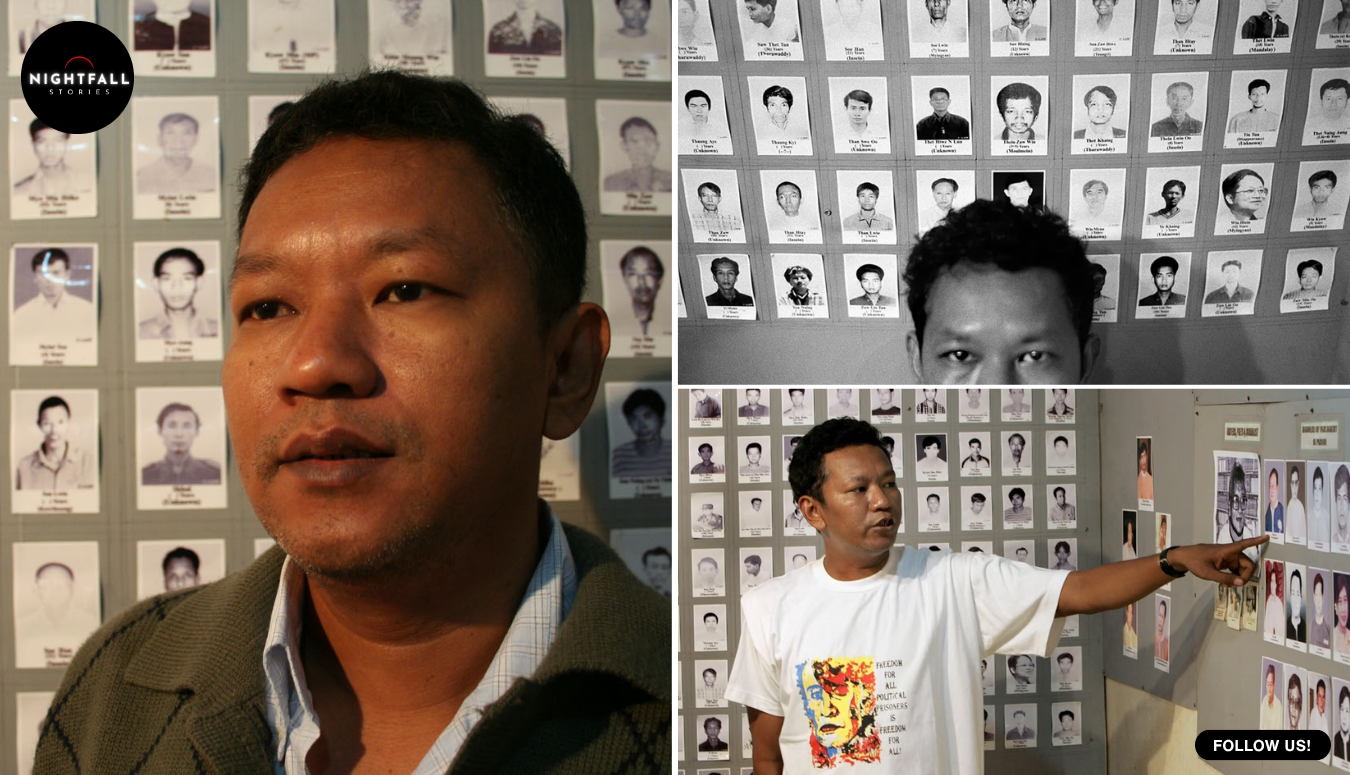
    The offer was simple, and it was the kind of offer that works. Bo Kyi had already served one stretch in a Myanmar prison for taking part in the pro-democracy uprising of 1988, when he was a student at Rangoon Arts and Sciences University. He was out. Military officials came to him with a proposition: work for us, tell us who the activists are, and your life gets easier. He said no. By one account of the exchange he answered their offer with conditions of his own, that they release all political prisoners and open a dialogue with Aung San Suu Kyi, which was not a counter-offer so much as a way of declining without pretending to be polite about it. He was arrested again.

    That is the whole story in one paragraph, and everything Bo Kyi has done in the thirty-odd years since follows from it. He had a door in front of him and the price of walking through it was other people’s freedom, and he shut it and went back to a cell. Nobody filmed it. There was no crowd. It is the kind of decision that leaves no record at all unless the person who made it survives long enough to be asked about it, and even then it sounds small when described, because the alternative version of his life, the one where he said yes, would have looked from the outside like an ordinary life.

    Earlier this autumn he was named a Ramon Magsaysay Award laureate, the recognition often described as Asia’s Nobel Prize. The award body’s citation talks about extraordinary moral courage, personal sacrifice, and an unwavering belief that democracy and human dignity are always worth defending. Which is accurate and also tells you nothing about what he has actually been doing for the last twenty-six years, because the honest answer to that is clerical. He has been keeping a list.

    Go back to the prison first, because there is one detail from those years that explains the rest of him better than any account of his treatment would. Bo Kyi taught himself English inside the cell. He did it by writing on the concrete floor with a piece of broken brick, which is what was available, and by taking lessons from a professor held in the next cell along. The professor would speak a sentence or two in English when the guard was out of earshot, and Bo Kyi would take it and work on it. He hid whatever study material he had accumulated every time a warden came past.

    Think about what that requires. Not courage exactly. Patience of an almost inhuman order, and a particular kind of faith: that there would one day be a reason to have English, in a cell where the evidence pointed the other way. A man scratching letters into a floor with a brick fragment, learning a language one whispered sentence at a time, is not resisting in any way that inconveniences his jailers. He is making a bet on a future he has no reason to expect. The language is why he can now sit in front of foreign journalists, diplomats and award committees and give them numbers in their own vocabulary. The brick did that.

    Accounts of the imprisonment itself differ in their detail, which is normal for Myanmar in that period and worth stating plainly rather than smoothing over. The award body’s own biography has him first arrested after the 1988 demonstrations, imprisoned twice, accumulating seven years in detention, released once in 1993 and again in 1998. An earlier profile by an international rights organisation dates an arrest to 1990 and gives a single sentence of seven years and three months. The totals are close enough that the shape is not in dispute. He went in as a student in his early twenties and came out, finally, in his late twenties, having spent most of the decade inside. He has never offered the physical particulars as his story, and they are not the point here either.

    What he did on getting out the second time was leave. He crossed to Mae Sot, the Thai town on the Myanmar border that has absorbed exiles, refugees, clinics and opposition organisations for decades, and in March 2000 he and other former political prisoners founded the Assistance Association for Political Prisoners. Its founding principle has been quoted ever since: as long as political prisoners exist inside Burma, Burma will not be free. The organisation still gives its base as Mae Sot and Rangoon.

    One thing about that founding is worth pausing on, because it is not incidental. AAPP was set up by former political prisoners, not by lawyers or academics or sympathetic outsiders. The people who built the register had all been on it. That is why the organisation knows what questions to ask a man who has just come out, and which answers are likely to be wrong, and how long to wait before asking anything at all. It is also why the work has a built-in expiry problem that nobody talks about, because the founding generation came out of the prisons of the 1990s and the people filling the cells now were not born when the brick was scratching the floor.

    Mae Sot matters too. It is a border town, and border towns are where this kind of organisation can exist at all: close enough that information still arrives, far enough that the people handling it are not immediately reachable. An outfit documenting Myanmar’s prisons cannot be inside Myanmar. The entire structure of the work is a consequence of that single geographic fact, and so is the exile of everyone doing it.

    Now, the list. This is the part that deserves the length, because it is the part that gets skipped.

    The work of AAPP is to know, by name, who is being held for political reasons inside Myanmar, and to keep knowing it as the number changes. That sentence hides an enormous amount of labour. A political prisoner is not an entry in a public register. Arrests are frequently unacknowledged. Families are not told where someone has been taken, or whether they have been charged, or with what. Sentences are handed down in closed hearings. People are moved between facilities without notice. Someone released may be rearrested within weeks, which means the list is never finished, only current.

    So the record has to be built from the outside in, which is slow and relies almost entirely on trust. Former prisoners are interviewed when they come out. Families come forward, or they do not. Lawyers, local networks and other organisations pass on what they have. Every name that arrives has to be checked, because an unverified report that goes into a public tally and turns out to be wrong damages the credibility of the whole record, and the credibility of the record is the only asset the organisation has. So AAPP does something unusual and quietly brave for an advocacy group: it publishes its uncertainty. Its running figures separate the detainees it has verified from the detainees it has not yet been able to verify. The second number is large. Keeping it visible rather than folding it into the headline total is a decision that makes the organisation look less impressive and the data much more useful.

    By AAPP’s own tallies, published and updated continuously, something over thirty-two thousand people have been arrested for political reasons since the military coup of February 2021. Close to fifteen thousand are recorded as verified in detention, with another seven or eight thousand reported but not yet verified, which is where the roughly twenty-two thousand figure that circulates in reporting comes from. Over nine thousand people have been released. AAPP also maintains a count of those killed by the military since the coup, which stands in the thousands. All of these are the organisation’s own estimates, compiled in the way described above, and they should be read as such rather than as official statistics, because no official statistics exist.

    The coup of 2021 changed the scale of the job rather than its nature. Before it, the counting was a matter of hundreds and then thousands; an international profile of Bo Kyi from the late 2000s put the number of political prisoners then held at around nineteen hundred. Then in a matter of months the arrests ran into five figures and the organisation had to move from periodic reporting to a daily briefing, because a monthly figure is useless when the number moves that fast. An outfit built by a handful of ex-prisoners in a border town absorbed that, and is still absorbing it.

    Bo Kyi has also given a plainer measure of the limits of the work. By his account there are around forty-nine prisons and detention centres in the country. AAPP is able to reach into about thirty-three of them, and through those it supports somewhere in the region of five thousand prisoners and family members. Sixteen facilities, then, that it cannot get near. He does not present the gap as a failure. He presents it as the size of the job.

    That reach is not only paperwork. The organisation’s work includes getting money and medical help to people inside and to the families left outside, monitoring conditions as far as it can, and running rehabilitation and assistance programmes for activists after release, which matters more than it sounds, because a person who has lost years and a career and sometimes a family comes out into a country that has no place for them. Since the coup AAPP has produced a daily briefing and a monthly data dashboard, which is the public face of the counting.

    The cost of keeping a list like this is not abstract. Everyone who feeds information into it takes a risk by doing so, and so the methods have to stay out of view, which means the organisation can never fully show its work, which means it is permanently open to the accusation that it is making the numbers up. It has to be scrupulous precisely because it cannot be transparent. The people who do this work also cannot go home. Bo Kyi has been in exile since the late 1990s and operates from Thailand, and there is no public indication that he has been able to return to Myanmar in all that time. The country he keeps the register of is one he knows now mostly through other people’s testimony.

    And the register is used. Governments, United Nations bodies, courts assembling evidence, bar associations, foreign ministries drafting sanctions, journalists and advocacy campaigns all need to be able to say how many and who, and when they do, the figure very often comes from this organisation. One of the stranger facts about international human rights machinery is how much of it rests on small outfits of exiles with a database. When a minister somewhere cites a number of political prisoners in Myanmar, a chain of custody runs backwards from that podium through a briefing paper, through a monthly dashboard, to an interview conducted with somebody who just got out, and before that to a family member who decided to risk telling someone.

    Which is what makes the Magsaysay a slightly odd fit, and also the right one. The award has gone to three people this year, including a Singaporean diplomat and a Bangladeshi social entrepreneur, both of whom have built things you can point at. Bo Kyi’s body of work is a spreadsheet that nobody wants to exist. The citation reaches for the language of moral courage, which is fair for the man who refused the informer’s job in the 1990s, but the twenty-six years since have called for something much less dramatic and much harder to sustain, which is the willingness to do the same careful, unrewarding, unfinishable task every month while the thing you are counting gets worse.

    Because it has got worse. That is the uncomfortable arithmetic sitting underneath the prize. The organisation was founded by men who had been political prisoners in the 1990s, at a point when the number inside was in the low thousands. A quarter of a century later, after a brief democratic opening and then the coup that closed it, the number is several times that. Bo Kyi has spent his adult life on this and the list is longer now than when he started.

    It would be easy to turn that into despair, and he does not. Nothing in the record suggests he treats Myanmar’s situation as hopeless or as fated, and the work itself is an argument against both readings, because you do not maintain a careful register of the imprisoned unless you believe somebody will one day need it. A list is a bet on accountability. It assumes a future in which names matter: release negotiations, legal proceedings, a transition, a family finally told where someone is. If the future never arrives, the list was still the right thing to have kept. If it does arrive, the list is the only reason anyone will know who to look for.

    The award ceremony falls later in the year, and a man who cannot go home will collect a prize in a country that is not his for keeping the count of a country that is. There is no neat ending available here, and inventing one would be a disservice.

    So here is the real one. In the 1990s Bo Kyi was offered a way out of a cell in exchange for names, and he refused to give them, and went back inside. Everything since has been the same decision pointed the other way. For twenty-six years he has been collecting names, as carefully and as verifiably as it can be done from outside a border, so that the people inside are not simply absent. He would not give up a single name to the people who were holding him. He has given tens of thousands of them to the rest of the world, which is the only form of protection available to someone in his position, and he will be adding to the list next month.

  • Forty life-sized buffalo walked through Lower Manhattan. The real herd they were built for began with ten animals.

    Forty life-sized buffalo walked through Lower Manhattan. The real herd they were built for began with ten animals.

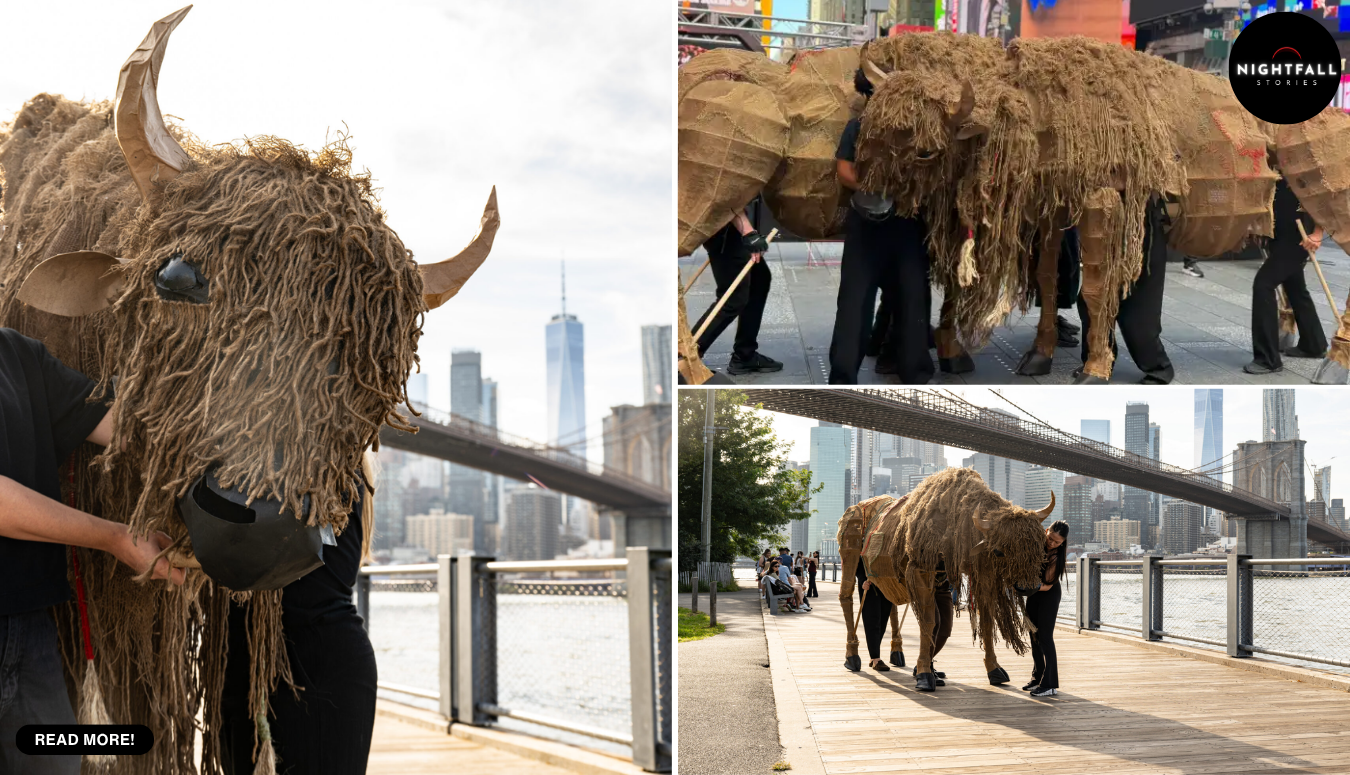
    The plaza outside the New York Stock Exchange is not a place where anything grazes. It is stone and barricades and men in suits moving fast, and on an evening last month it filled up instead with forty buffalo, each one six feet tall at the shoulder and nine feet long from nose to tail, each one carried by three people hidden inside its frame. The herd stopped. Two heavy metal guitarists played, one of them holding a low drone, the other going up into something thin and splintering, and the buffalo stood in the noise the way cattle stand in weather. Then the whole thing moved on up the street.

    None of the animals were real. All forty were puppets, built out of plywood and metal and burlap and other recycled or recyclable material, and the crowd watching them knew that within about four seconds. What most of the crowd did not know is that roughly two thousand miles west, on the Wind River Reservation in Wyoming, there is an actual buffalo herd that now numbers close to two hundred animals, and that ten years ago it numbered ten. The man who built it from those ten was walking in Lower Manhattan with the puppets.

    His name is Jason Baldes. He is the executive director of the Wind River Tribal Buffalo Initiative, vice president of the InterTribal Buffalo Council, and an enrolled member of the Eastern Shoshone Tribe. He has spent a decade moving live buffalo onto tribal land and keeping them alive there, which is slow, unphotogenic, permit-heavy work involving fencing, water, grazing plans and the patience to wait for calves. Forty puppets through the Financial District is the opposite of that in every way except the one that matters, which is that both are attempts to put the animal back in front of people who have stopped thinking about it.

    The easy way to write this story is as artists making a sympathetic piece about somebody else’s cause, with the real rancher brought along as a guest. That version is wrong, and the thing that makes it wrong is a single name on the production’s list of participants. Xavier Michael Young walked with the buffalo as a Lenape descendant of the Seminole Tribe of Florida and as one of the people who helped shape what the procession actually said. He is also the finance director of the Wind River Tribal Buffalo Initiative. Baldes’s own organisation was not a subject of the production. It was inside it, in the room where the decisions got made, with its books in the same hands.

    That link runs through a family as well as an institution. Young is the grandson of John Thomas, a Lenape elder of the Delaware Tribe of Indians, who worked on the production to make sure Indigenous language and protocol were built into the programme rather than decorated onto it. Manhattan is Lenape land. A procession of buffalo through Lenape land, conceived in partnership with Lenape and Lakota elders, with a Lenape elder checking the protocol and his grandson handling the money for the Wyoming herd the whole thing points at, is a tighter piece of construction than most public art manages. It is also the sort of detail that disappears from coverage, because the puppets are so much easier to photograph.

    Now the other good thread, which is geography. The buffalo that walked through New York were designed and built on a different continent, by the Ukwanda Puppets and Designs Art Collective in Cape Town, South Africa, with Craig Leo as puppetry director. South African puppet makers, working in a city about as far from the North American plains as you can get and still be on land, engineered forty American bison to be worn by three people each and to survive being walked repeatedly over city pavement. Then those frames had to get to New York and be learned by volunteers who had never operated a puppet before.

    Leo and the Ukwanda collective come out of a Cape Town tradition of large-scale figure puppetry that has been exported with unusual success, and the production around them has a direct precedent. The piece was created and directed by Amir Nizar Zuabi of The Walk Productions, the company behind Little Amal, the twelve-foot puppet of a Syrian refugee girl who walked across Europe and then through more than fifty events in New York a few years ago. Little Amal worked because one puppet, operated well, produces something close to the response a living thing produces. Zuabi’s bet here was that the same trick scales, and that forty of them moving together would read not as forty puppets but as a herd.

    Reports of how many people it took differ. One account of the Manhattan leg put it at more than a hundred artists; another put the number of volunteer puppeteers alone at over a hundred and fifty, trained specially and drawn from several countries. Either way the arithmetic is unforgiving. Three operators to a buffalo, forty buffalo, and a rotation so that nobody collapses two hours into a slow walk while carrying part of a nine-foot animal, plus musicians, plus marshals, plus the readers and singers who performed at the stops. The physical cost of the thing was real and it was paid by people most of the audience never saw, because the whole point of the design is that you do not see them.

    The route was built to run through the parts of the city that are about money and law. In Lower Manhattan the herd started at Bowling Green Park, the small patch of green at the bottom of Broadway, and finished at Foley Square outside the courts, pausing at Federal Hall and at the Exchange along the way. The following afternoon it went through Downtown Brooklyn, from Abolitionist Place to Brooklyn Bridge Park. At the stops there were readings from Frederick Douglass, Walt Whitman, Tecumseh, Mahmoud Darwish and the Lakota writer Tokala Two Elk, performed by actors including Wendell Pierce, Sam Waterston, Chaske Spencer, Daphne Rubin-Vega, Caridad De La Luz, Susan Sarandon and Rosario Dawson, with music from Rhiannon Giddens, Laurie Anderson, Davone Tines and a marching band, among many others. Alongside Baldes and Young, the Indigenous artists and participants named in coverage of the two days included Tokala Two Elk, Sonnie Allen, Evelyn Kionute, Eric and Aubree Wensman, the anthropologist David Quintero, and Joely Bigeagle Kequahtooway of the International Buffalo Relations Institute.

    That is a long list, and lists are the enemy of this kind of story, so here is the part of it that is load-bearing. A production with that many famous names attached could very easily have been about the famous names. It was not. The speaking that mattered happened when Baldes stopped in a park full of New Yorkers and gave them numbers.

    The numbers are the substance under the spectacle, and they are worth slowing down for. Ten buffalo arrived on the Wind River Reservation in the autumn of a decade ago. That is not a herd. Ten animals is a founding population, fragile in every direction: genetics, disease, a bad winter, a fence somebody leaves open, a single bad decision about where to put them. Getting from ten to close to two hundred means a decade in which nothing went catastrophically wrong, which in livestock terms is not luck, it is management. It means birth rates holding, it means grazing land secured and defended, it means enough forage and water through drought years, and it means repeated transfers of live animals from other herds, each one a negotiation involving federal agencies, veterinary clearance and trucks.

    It also now means money and buildings. The initiative has a nine million dollar expansion under way and a headquarters of around fourteen thousand square feet in design. That is the point at which a project stops being a project. A fourteen thousand square foot building is a statement that the buffalo are not a pilot scheme that might be wound up, and nine million dollars is the kind of figure that brings with it audits, staff, deadlines and a finance director, which is how Xavier Michael Young comes to have that title in the first place.

    Set the herd against the national picture and you see why anybody bothered with puppets. Baldes gave the crowd his own framing of the scale, which is that there are roughly ninety million cattle in the country, that something on the order of two and a half million of them are killed every month to feed people, and that there are fewer than five hundred thousand buffalo in the entire United States. Those figures come from him rather than from an agency count, and the buffalo number in particular blurs two very different things, because the large majority of American bison are commercial animals raised on private ranches for meat, while conservation and tribal herds like the one at Wind River are a small fraction of that total. Hedge it however you like and the shape holds. The animal that used to be the dominant large mammal of the continent is now a rounding error next to the animal that replaced it.

    And the replacement is still being defended. Baldes was walking through New York at a moment when bison grazing itself was in front of the courts. A federal attempt to revoke bison grazing permits held by the conservation nonprofit American Prairie ran into a judge who ruled that the Bureau of Land Management could not block the grazing, a decision that landed within days of the procession. Cattle industry opposition to putting bison back on open range is not a historical grievance, it is a live lobbying position with money behind it. Nobody involved in Return of the Buffalo, which is the production’s English title, paired with a Lakota one, pretended otherwise.

    A note on when all this happened, because the coverage cannot agree. Four outlets produced four different date pictures for the same event, including one that described the march as having happened on a Saturday in a piece published on a Monday. The production’s own company, St. Ann’s Warehouse, puts the two legs plainly: Lower Manhattan on the Friday evening, Downtown Brooklyn on the Saturday afternoon, in the middle of September. There was also an earlier teaser appearance in Times Square a few days before. So this was not one Saturday stampede. It was a multi-day, multi-borough run, which is itself a clue about how much work the thing took.

    What is genuinely odd about the whole exercise is how little it tried to be uplifting. Processions with a cause usually end in a rallying speech. This one ended in a square outside a courthouse with a herd of fake animals standing still, having walked past the Exchange, past Federal Hall, past the spot where a man read Frederick Douglass out loud to commuters. The historical argument was left on the pavement for people to pick up or not. The land under Manhattan was Lenape before it was anything else. The animal that is not there any more was killed off deliberately and within living memory of some people’s grandparents. Both of those facts were presented without anybody being told what to feel about them.

    There is an honest limit to what a march achieves, and it is worth saying out loud. Forty puppets do not add a single buffalo to a single acre. The permits still have to be filed, the fences still have to be mended, the nine million dollars still has to be spent correctly, and the herd at Wind River will grow or not grow for reasons that have nothing to do with what happened in Lower Manhattan. Attention is not the same as outcome, and anyone who has tried to keep a conservation herd alive knows which of the two is harder to get.

    But attention was the scarce resource here, and the production bought a lot of it cheaply, in a city where almost nobody will ever stand near a living buffalo. That is the asymmetry the piece was built on. A New Yorker can tell you what a bison looks like from a coin, a logo, a nature documentary. Hardly any of them have smelled one. Forty six-foot frames carried by volunteers through the Financial District was a way of borrowing the animal’s size for an afternoon, because size is the part no photograph delivers, and because a thing that stands taller than you and takes three people to move is harder to think of as a historical footnote.

    So the hundred-odd artists folded up their buffalo and went home, and the Cape Town frames went into storage, and the crowd went back to work. Most of those people will live their whole lives without seeing the real thing. In Wyoming the herd that all of it was pointing at is out on the grass right now, roughly two hundred animals strong, descended from ten, with a finance director who walked through Manhattan under a puppet and a building going up to run them from. Nobody will play a guitar for them. They will just keep calving, which is the only number in this story that compounds.

  • He was the doctor for 36 years. The faces he pasted beside the highway were his neighbours, and he did not always have permission for the wall.

    He was the doctor for 36 years. The faces he pasted beside the highway were his neighbours, and he did not always have permission for the wall.

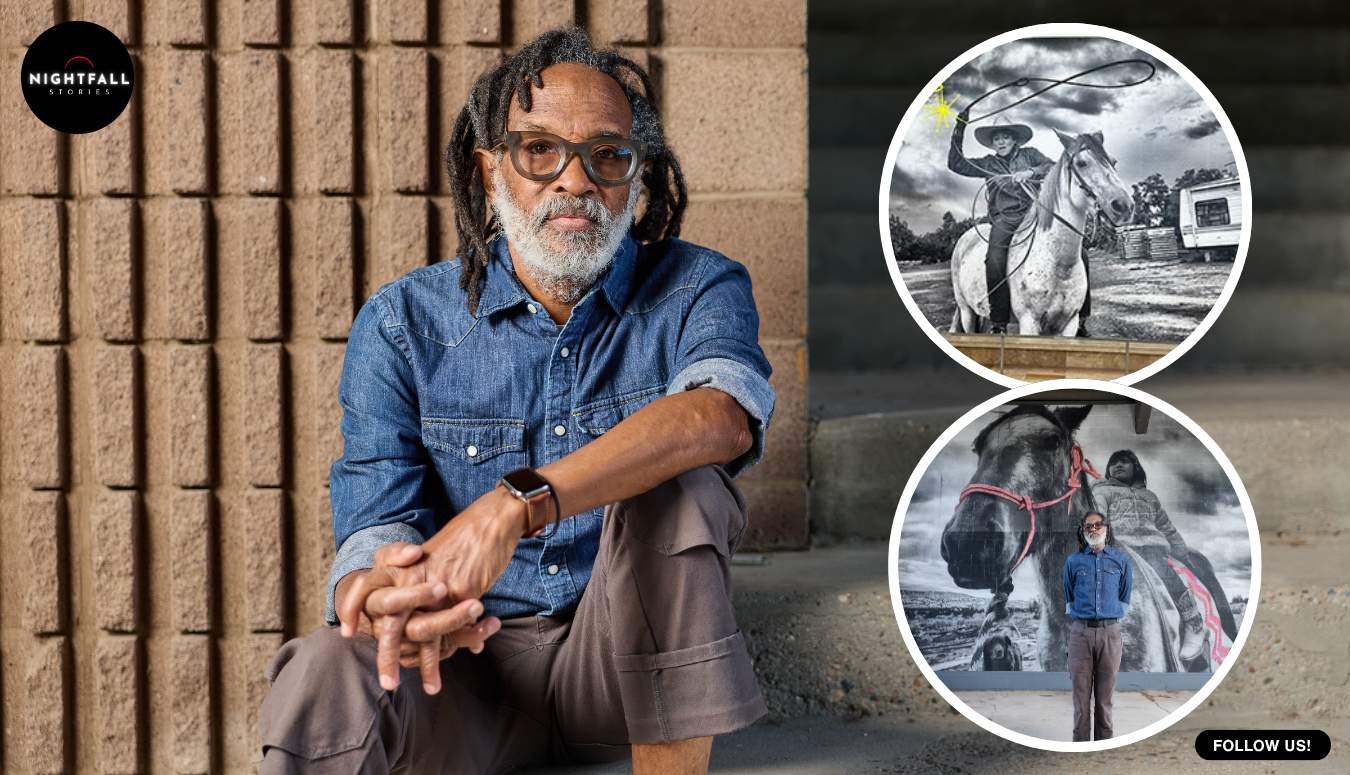
    In 1987 a young physician named Chip Thomas took a posting at the Inscription House Health Center, a small Indian Health Service clinic on the Navajo Nation in northern Arizona, and he was still working there 36 years later. The clinic sits in the stretch of country between Monument Valley and the Grand Canyon. He arrived with a four-year obligation to the National Health Service Corps, which is the programme that sends new doctors to places that cannot otherwise recruit them, and which most doctors complete and then leave. He finished his in 1991 and stayed another 32 years.

    Somewhere in the middle of that, he began pasting photographs onto the sides of water tanks.

    Not small photographs. Enormous black and white prints, pasted up at the scale of a building, on roadside structures along the highways of the western Navajo Nation: water tanks, the plywood sides of roadside stalls, sheds, abandoned buildings. A forearm tattooed with the words Native Pride, running 30 feet across a wall in Flagstaff. An image of a Navajo Code Talker on a roadside stand, which turned the stand into somewhere people stopped. Faces, mostly. The faces of people who live in the country the highway runs through, put up at a size that makes them impossible to drive past without seeing.

    He has done this since 2009, and in 2012 he gave the wider effort a name, the Painted Desert Project, and began bringing other artists in. He signs the work as jetsonorama. He retired from medicine in 2023. Last week, at 69, he was named a MacArthur Fellow.

    The fellowship is the reason you are reading about him, and it is close to the least interesting thing about him, so let us get it out of the way. Twenty people were named, the award carries 800,000 dollars paid over five years, and there are no conditions on how it is spent. The foundation’s citation describes him as a public artist turning neglected spaces into public works grounded in community history. That is accurate and it is also a sentence that could describe several hundred people. What it does not capture is the thing that makes this unusual, which is that for most of the years the work was being made, the man making it was also the doctor.

    Those two facts are not adjacent. They are the same fact.

    It is worth sitting with the 36 years for a moment, because the number is the part most likely to be skimmed past, and it is the part that is genuinely hard to do. The Indian Health Service is the federal agency responsible for health care for tribal nations in the United States, and it has struggled to keep doctors for as long as anyone has been measuring. A review by the Government Accountability Office published in 2018 found that across the agency’s eight geographic areas the overall vacancy rate for providers, a category covering physicians, nurses, nurse practitioners, physician assistants, dentists and pharmacists, stood at 25 percent, and ranged as high as 31 percent in some areas. One position in four, unfilled. The reasons the review identified were not mysterious: the facilities are rural, often very rural, there is frequently not enough housing for the staff you are trying to hire, and the agency cannot match what the same doctor would be paid in a city.

    The practical consequence of a vacancy rate like that is not an abstraction, and anyone who has lived somewhere underserved knows what it is. It is a different face every time. The doctor who knows your family history is replaced by one who has to read it off a screen, and then that one leaves too, and the people who most need continuity of care get the least of it. Against that, one physician in one small clinic for 36 years is not a nice biographical detail. It is the entire difference between being treated and being known.

    Consider how he got the photographs. He has described the mechanism himself, more than once, and it is not a photographer’s method. At the end of a clinic visit he would ask people whether he could come and see them at home, and then go, and help. Herd sheep. Haul wood. Whatever work was happening around the place that day. Over years, that turned into friendships that existed outside the examination room, and the photographs came out of the friendships rather than the other way around. His own account of it is that by spending time with people in their homes and family camps he came to know them as friends and not just as patients. Before he raised a camera he asked whether they were comfortable with him bringing it.

    This matters more than it might sound, because the obvious version of this story is a bad one. A doctor with a camera in a small community holds a quantity of power that would make most ethics committees go quiet. He is the person people come to when they are frightened. They cannot easily say no to him. If the photographs had been taken on that footing, nothing about the scale or the beauty of the finished work would redeem them, and the honest thing to do with the story would be to not tell it.

    What is on the record cuts the other way, and it cuts that way consistently across sources that do not depend on each other. His own account is that the relationships preceded the pictures and that consent was asked for explicitly. A master’s thesis on the murals, written at the University of New Mexico in 2020 by Mandolen Sanchez, describes the images as being placed on and around the reservation specifically so that they are shared with the people who originally allowed him to photograph them. And people who have been depicted have spoken about it on the record and in their own voice. Cyndy Begaye, whose father appeared in one of the pieces, has said that the first time she saw it she was moved to tears. A colleague from the clinic has described the murals as reflecting back everyday life by someone who understands it.

    That last point is the one Thomas himself puts at the centre of why the work moved outdoors at all. He had begun getting gallery shows around the country, and realised that the people in his photographs were the only people who never saw them whole. The pictures were travelling to cities to be looked at by strangers. So he stopped doing that as the primary thing and started putting the work where the people in it live, on the grounds, as he has put it, that what he wanted was to reflect back to the community the beauty it had shared with him. He has also described the whole enterprise as an extension of his medical practice, aimed at restoring balance, which is a doctor’s way of describing an art project and tells you which of the two careers he thought was the main one.

    Now the part that does not resolve cleanly, because it should not be smoothed over.

    The permission of the people in the photographs is documented. The permission for the walls was not always. Thomas has said so himself. He adopted the name jetsonorama in part because he did not always have the consent of the owner of the wall he was working on, and he has talked about the appeal of working that way in terms of it being democratic: if people do not like something, it is gone. Work has been removed. He has treated that as the deal.

    Those are two different questions and they deserve to stay separate. One is about people, and about whether a community’s faces were used without agreement, and the answer there is that they were not, by every account available including the accounts of the people depicted. The other is about property, and about plywood and corrugated iron and water tanks, and the answer there is that the arrangements were sometimes informal and he has never claimed otherwise. Treating the second as if it contaminated the first would be sloppy. Pretending the second did not happen would be worse.

    There has been friction of another kind too. A piece he made about protecting the Grand Canyon from uranium mining drew two people from the community who came and told him to his face that they objected, at a time of high unemployment, to an outsider campaigning against the kind of development that might bring work. That is a real argument and it is not a trivial one. Uranium mining on and around the Navajo Nation is one of the most charged subjects there is, with a long and bitter history of contamination and unpaid consequences, and also a history of being one of the few industries that ever paid local wages. Thomas kept making work about it. In 2024 he installed a photographic project explicitly about uranium mining and its effects, under the title panaceas, promises and problems. Reasonable people in the same community disagree about whether he should have.

    Which brings us to the fact the piece cannot be written without, and which he has never hidden. He is not Navajo. He grew up in Raleigh, North Carolina, born in 1957, took a degree at Wake Forest in 1979 and a medical degree at Meharry Medical College in 1983, and he is Black. He describes himself on his own website, writing about the period when the mural work began, as a black doctor in his fifties working on the Navajo Nation. He has a son who is half Navajo. He has lived there since 1987, which by now is the majority of his life.

    He is also entirely direct about what that does and does not buy him. Asked about it, his position has been that being a non-Navajo person, he will always be viewed as a non-Navajo person. There is no claim of adoption in that, no suggestion that long service converts into belonging. It is a statement about a permanent condition, offered without complaint.

    What he has built in response is procedural rather than rhetorical, which is the most interesting thing about the Painted Desert Project as a structure. When he brings outside artists in, and more than 20 have come, among them Roa, Hyuro, Pixel Pancho and Alexis Diaz, they do not arrive with a design. They meet with elders first, to learn what imagery would not be appropriate and what subjects are not theirs to handle, and only then make something out of what they have actually encountered. The project’s own framing of why it works this way names the thing it is trying to avoid by its proper name: the charge of cultural imperialism that gets levelled, often correctly, at large street art festivals that descend on a place, extract its visual interest and leave.

    Whether that is sufficient is a judgement, and it is the reader’s to make rather than this article’s. The case for it is that the photographs were consented to by people who have said publicly that they are glad of them, that the work was deliberately moved out of galleries and onto roads so those same people could see it, that the visiting artists are briefed by the community rather than by the curator, and that the man doing it had already spent decades being the person who showed up when someone was sick. The case against it is that none of that changes who holds the camera, who decides which face goes up 30 feet high, and whose name is on the fellowship.

    Both of those can be true. They probably are.

    The scholarly reading of the murals, in that New Mexico thesis, puts the work in a specific historical argument that is worth knowing about. Nineteenth and twentieth century photography of Native American people was used, extensively and deliberately, to present them as a vanishing race, a people in the act of disappearing, which was convenient for everyone doing the disappearing. Enormous photographs of living people, pasted at the edges of the roads they actually drive on, doing the work they actually do, argue the opposite. The thesis makes a further point that is almost too neat: in that exchange it is not the people who are ephemeral. It is the murals.

    Because they are. This is paper and wheat paste on metal and plywood in high desert country, and the climate there is not gentle. The sun takes the contrast out. Wind gets under an edge and lifts it. Rain pulls a corner loose and then the next storm takes a whole panel. The structures themselves are working structures, which means they get repainted, re-signed, demolished, or simply used, and a water tank does not exist to be a gallery wall. Every piece is temporary and he has always known it. The thesis puts it as the murals altering with the surrounding landscape, which is a polite way of saying they come apart.

    There is no conservation programme. There is no plaque. The pieces that are gone are gone, and the record of most of them is a photograph of a photograph.

    So he puts up more.

    That is the actual shape of 39 years in one place, and it is why the fellowship is the wrong ending. A man arrived to do one job for four years, among people who were not his, and did that job for 36. In the middle of it he found a second job nobody had asked him to do, which was to make the people he was treating visible to the strangers driving through their country at 65 miles an hour. He asked them first. He put the results where they could see them rather than where collectors could. He did not always ask the wall. He got argued with and kept going. The work does not last, and it was never going to, and the response to that has never been to find more durable materials.

    It has been to get the bucket out, mix more paste, and go back out to the road.

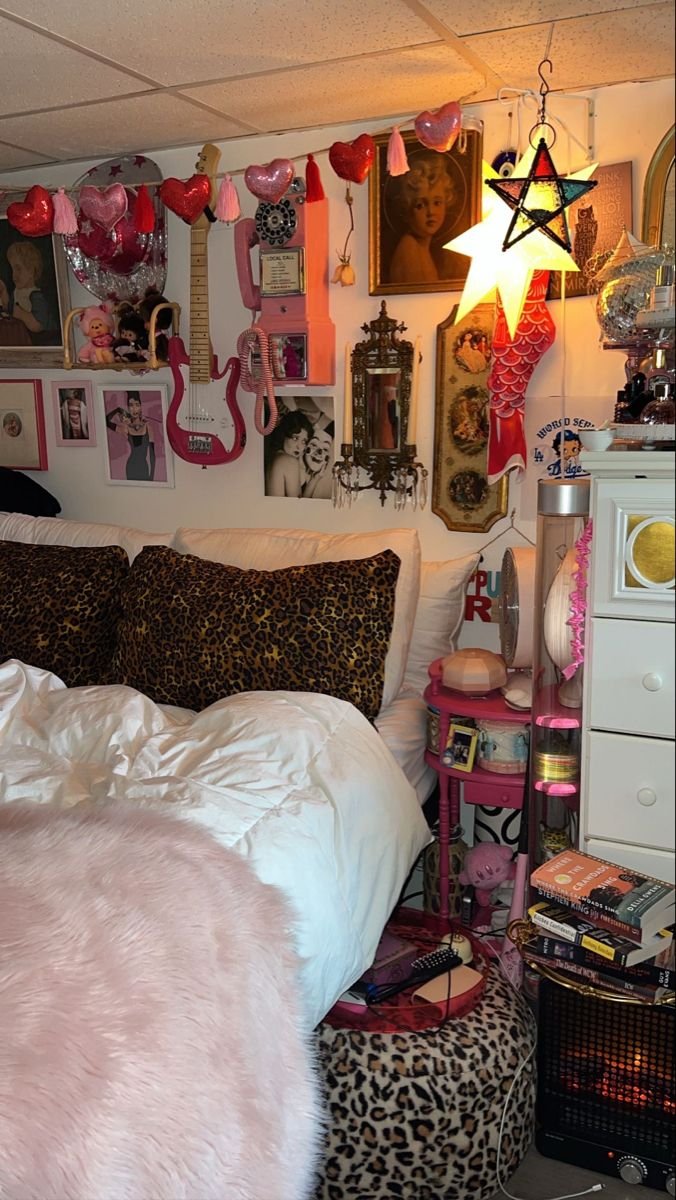
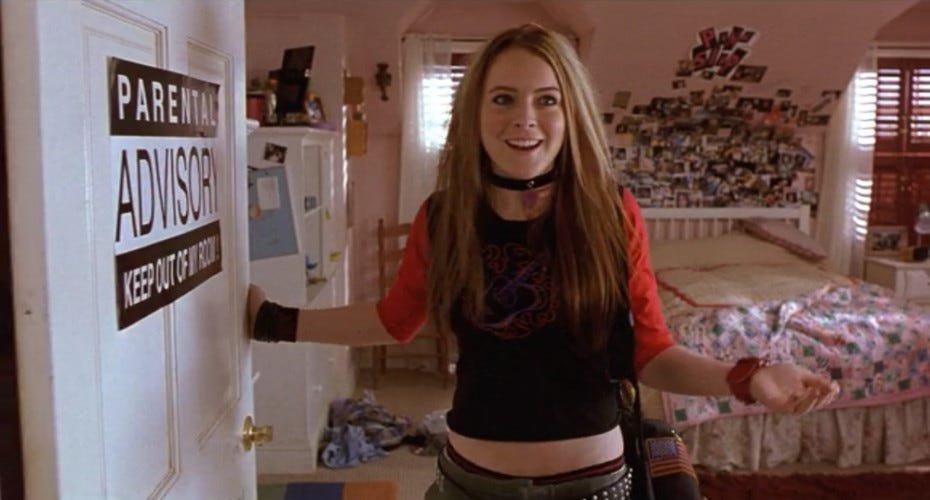
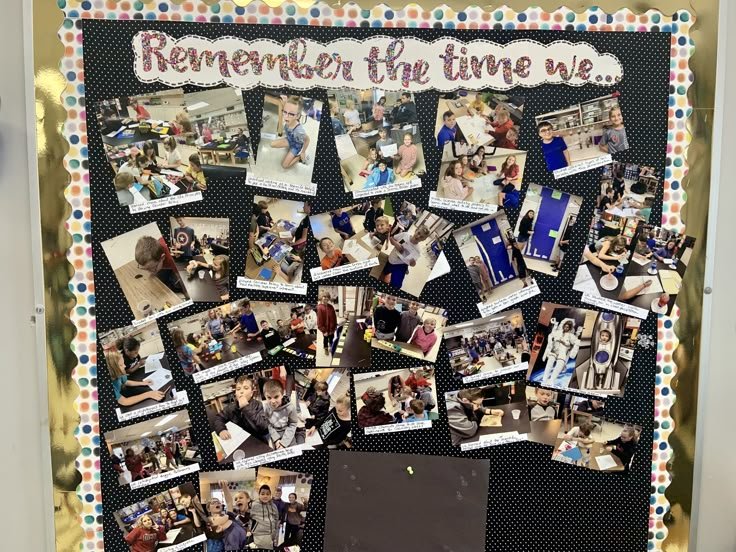
  • 12 things every 2000s teen had in their bedroom

    12 things every 2000s teen had in their bedroom

  • Ten years of traps came before the first kiwi arrived. What Paul Ward worries about now is not failure.

    Ten years of traps came before the first kiwi arrived. What Paul Ward worries about now is not failure.

    Before a single kiwi was released into the hills above New Zealand’s capital, there were traps. Around 4,600 of them by the count reported a few years into the work, strung in a grid across 24,000 hectares of sheep paddocks, pine blocks, mountain bike trails and gorse on the western edge of Wellington, running roughly from the coast at Pariwhero Red Rocks north to Porirua. About 2,000 of those traps already existed, put out over years by community trapping groups who were there long before anyone mentioned birds. The Capital Kiwi Project added the other 2,600 or so from 2018 onwards, and then did the part nobody writes about, which is walking the lines and checking them, in winter, up farm tracks, in the wind, again and again, for four years, before there was any kiwi in the landscape to show for it.

    That is the actual story here. The birds are the ending.

    Paul Ward founded the project and has led it since. The idea he started with was close to absurd on paper. Kiwi recovery in New Zealand mostly happens in places built for it: fenced sanctuaries, offshore islands, forest blocks with no roads and no dogs and no people. Ward wanted to put them into a working landscape on the doorstep of a capital city, across land owned by farmers and councils and trusts and individuals, crossed by public tracks and used every weekend by cyclists and walkers and their pets. Nobody puts kiwi there. Kiwi had not lived in those hills for something in the order of 150 years, long enough that no specific last sighting seems to be recorded anywhere, and long enough that the usual phrasing is simply more than a century.

    The reason it had to begin with traps rather than birds is a piece of arithmetic that governs everything about kiwi conservation. A kiwi chick hatches, is abandoned by its parents almost immediately, and has to feed itself and grow from a few hundred grams up to around a kilogram before it can survive a stoat. Below that weight it is prey. Above it, more or less, it is not. Stoats are small, fast, numerous and extremely good at finding a ground bird in a burrow. In unmanaged North Island forest, the proportion of chicks that reach stoat-proof weight is low enough that a population shrinks steadily even while adults are still calling at night. Release adult kiwi into a landscape full of stoats and you have not restored anything. You have delivered a food supply with a delay built in.

    So the first thing Ward had to do was not get a permit for birds. It was to persuade a lot of people to let him put steel traps on their land and keep coming back to them. That is the part of the decade that reads as nothing and was in practice the whole project. Much of the 24,000 hectares is private, mostly farmland, some of it held by families who have farmed it for generations and have heard plenty of enthusiastic plans from town. Some is public reserve with its own rules. The project’s framing of its own structure is a tripod standing on relationships with iwi and Maori, with the communities in the area, and with the landowners, and Ward has been blunt that if you take any one of those three legs away the whole thing tips over. That is not a slogan when the trap grid physically has to cross hundreds of boundaries.

    The trapping itself is unglamorous in a way that matters, because it never stops. A trap network is not an achievement, it is a standing cost. Stoats reinvade. They come in from the edges, from the pine, from the farmland beyond the grid. A line that is not checked is worse than no line, because it gives you a number you believe and a landscape that is quietly refilling. Peter Kirkman, the project’s head of operations, has had to run this as a logistics problem rather than a wildlife one: lines that get walked on a schedule, traps that get rebaited, data that gets entered, volunteers who keep turning up in bad weather for years on end without a kiwi to look at.

    Only once that was running did the paperwork for birds become possible, and the paperwork is more specific than most people assume. Moving a protected native species in New Zealand requires an authority issued under the Wildlife Act 1953, applied for through a formal translocation proposal. The Department of Conservation’s own guidance for community groups sets out what that proposal has to contain: the conservation justification, an assessment of both the source site and the release site, disease management, the design of the transfer itself, a monitoring programme and a plan for managing the animals after release. Consultation with iwi at both the source and the release site is not optional, and the department sends the proposal out to affected iwi and other parties for comment as part of processing it. The process is budgeted at a minimum of 70 days and a maximum of 90. Approvals come with conditions attached, covering collection, transport, release, welfare, what must be monitored, how it must be reported, and what happens if a bird dies, including necropsy. A transfer report is normally due within two months of the transfer being completed. Where monitoring is ongoing, a monitoring report has to be produced every year.

    That last detail is the one that gives the trapping its teeth. The permit does not just allow birds to be moved. It sets out what the project has to prove afterwards, in writing, annually, to the department. Capital Kiwi’s permit carried a target for the proportion of monitored chicks reaching stoat-proof weight, set at 30 percent. The underlying ecological threshold is lower still: roughly one chick in five surviving to that weight is the point at which a wild kiwi population can sustain itself rather than drain away. Before the first releases, the project’s own stated expectation was that it would beat one in five, based on what its monitoring of the trap network was telling it. Of the first twenty chicks fitted with transmitters, six survivors would have met the mark.

    The first releases happened in late 2022, in the Makara hills west of the city. Sixty-three birds went out in that first phase, with a departmental permit in hand for close to two hundred more. The birds came from places that had spare capacity because they had already done this work: Sanctuary Mountain Maungatautari in the Waikato, Otorohanga Kiwi House, and the Taranaki Kohanga Kiwi at Rotokare. Each transfer was arranged as a gift from one iwi to another rather than as a shipment. The request is made formally, as a tono. The handover happens at a powhiri, a formal welcome, which is the point at which responsibility for the birds passes to the receiving community. Ten birds moved from Rotokare in the Taranaki region in 2024, gifted by Ngati Tupaia and received by Taranaki Whanui ki Te Upoko o te Ika at a ceremony at Te Papa in Wellington, with Rotokare’s own conservation manager Fiona Gordon and staff from the Taranaki Kiwi Trust seeing them off. Birds from Maungatautari came from Ngati KorokI Kahukura. Ngati Toa and Taranaki Whanui are named by the project as having been essential throughout.

    Rawiri Walsh works on the project as its kaimanaaki kiwi, which in plain terms is the person responsible for the care and guardianship of the birds, and as its liaison with iwi. He is of Taranaki Whanui ki Te Upoko o Te Ika, Nga Rauru Kitahi, Ngati Raukawa ki te Tonga and Te Ati Haunui-a-Paparangi descent. The role is both practical and procedural: it is the person who handles the birds and the person who makes sure the tono and the powhiri and the relationships behind them are done properly rather than decoratively. It is worth being precise about what the iwi role actually was, because it is easy to flatten. Mana whenua were not a blessing added to a conservation plan. Consultation at source and release was a legal condition of the permit, the birds moved as gifts between specific iwi who had to agree to give and to receive them, and the transfer of responsibility at the powhiri is the mechanism by which the receiving community takes the birds on. At the Maungatautari end, Poto Davis, a kuia of Ngati Koroki Kahukura, was among those seeing birds leave. In Makara, Ted Smith, an elder of the local community, has put the obligation about as directly as it can be put: if a people named after an animal cannot look after that animal, that people has earned a less flattering name.

    Then the numbers came in, and they were not what anyone had budgeted for. Against a permit target of 30 percent of monitored chicks reaching stoat-proof weight, and a private hope somewhere in the mid to high forties, the project recorded more than 90 percent. Over three years following the 2023 season, only two monitored chicks were lost, one to a predator and one to natural causes. Chicks were hitting the kilogram mark in around four months, where the historical expectation is six to eight. That difference is not a quirk. A chick that spends four months in the vulnerable window instead of seven spends roughly half as long being findable, and a landscape where the stoat density is low enough to let them grow that fast is a landscape where the trapping has worked.

    By the time the project reached its permitted total it had moved around 250 birds. The final translocation was staged at Parliament, with a powhiri at the Beehive in late April of this year, which was a deliberate piece of theatre and a fair one: a bird that had been absent from the hills around the capital for a century and a half, handed over in the building where the country’s conservation law is made. Ward’s summary of that evening was that it was ten years of work arriving in a single moment.

    The more interesting number is the one nobody collected. The estimated population in those hills is now above 300, which is more than were ever released. The difference, somewhere between 60 and 70 birds on a conservative estimate, is chicks that hatched in the hills, were never caught, never fitted with a transmitter, and are not in any dataset. They are known about the way wild animals are known about: from tracking tunnels, trail cameras, acoustic recorders run through pattern-matching software, DNA taken from trapped stoats, and residents ringing in to say something screamed outside the house at two in the morning.

    In September the last transmitters came off. The monitored cohort stopped being monitored. Wellington’s kiwi became, in the project’s own phrase, properly free range.

    Which is where Ward’s worry sits now, and it is not the worry he started with. Ten years ago the question hanging over the project was whether it was being too ambitious. The question he names now is complacency. It is an unusual thing for a conservation project to say out loud at the moment of its success, and it is accurate, because nothing about the underlying situation has changed. The 24,000 hectares are still full of stoats trying to come back in. The trap lines still have to be walked by people who are no longer walking them towards a milestone. A good season is a good season and nothing more; the chicks counted this year do not insure the chicks of the next one, and a population that is growing because the trapping is working will shrink again, quietly and on the same arithmetic, if the trapping stops working.

    And there is a threat the traps were never going to solve. Stoats kill chicks. The thing that kills adult kiwi near a city is dogs. The project has stated it plainly: uncontrolled dogs are the single biggest danger to adult kiwi in any new release area, and even a small pet dog is capable of killing one. A kiwi has no keel, no flight muscle and no way of getting off the ground, and a dog does not have to be aggressive or hungry to kill one, only curious. Ferrets and other large mustelids are a danger to adults too. But the dog problem is the one that cannot be trapped away, because it is not a wildlife problem at all. It is a problem about several hundred thousand people, their weekends, their vehicles, their dogs, and whether they bother. Putting kiwi next to a city was always a bet that a city could be asked to change its habits, and that bet does not get settled in a decade.

    So the ending of this is not the bird at Parliament. It is the 60 or 70 young kiwi in the hills behind Makara that nobody has counted, nobody has handled and nobody is tracking, growing up in a landscape that works for them only as long as several hundred volunteers keep checking several thousand traps that catch, most weeks, nothing at all.

  • A dentist told the jury her teeth matched. Walking out of prison was only the first half.

    A dentist told the jury her teeth matched. Walking out of prison was only the first half.

    The order ran to twenty five pages, and the judge who wrote it did not hedge. Bite mark comparison, Chief Judge Dwayne Gillis found, was not competent evidence. Such evidence would seldom, if ever, prove anything. The dental profession’s own recognition that the method was inadequate, he wrote, was profound and undisputed. Proven unreliable scientific evidence, he added, should never serve as the basis of a conviction.

    That order came down in February 2020. Two months later Sheila Denton walked out of a Georgia prison. She was fifty three years old, and she had been in custody since 2004.

    And then, for six more years, she was still a woman facing a murder charge.

    That is the part of this story almost nobody tells, because almost nobody writes about what happens after the gate. A reversal is not an acquittal. When a judge grants an extraordinary motion for a new trial, the conviction is wiped out and the case does not end; it goes backwards, to the position it was in before the trial happened. The charge is live again. In theory the state can try you a second time. In practice it often does nothing at all, for years, and you live inside the gap.

    Denton lived inside it until September of this year, when the charge against her was finally dismissed. The arithmetic, counted from the day it was brought in 2004, is twenty two years.

    The case began with the death of a seventy three year old man named Eugene Garner, who was found dead at his home in Ware County, in southern Georgia, in the spring of 2004. He had been killed. That is as much detail as this story needs, and more than it would be decent to add.

    Denton became a suspect in the days that followed. The state’s case against her, as the Georgia Supreme Court later summarised it when it affirmed her conviction, was circumstantial and had several strands. She had previously sold Garner food items and knew he kept large sums of cash. She turned up at a house where crack cocaine was sold, with cuts on her arms, legs and hands and a bite mark on her. A witness said she had admitted killing a man who lived nearby. She bought three hundred dollars of crack shortly afterwards. She gave police a false name and ran when they came for her.

    It should be said plainly that this was not a case with no evidence in it. It is important to say so, because the easy version of a wrongful conviction story is one where the state had nothing and invented everything, and that version is rarer than people think. What the state had here was a pile of circumstance, much of it ambiguous, some of it genuinely bad for her, and none of it putting her in that house.

    What put her in that house was a dentist.

    Dr Thomas David, a forensic odontologist and a diplomate of the American Board of Forensic Odontology, examined marks on Garner’s body, compared them with impressions of Denton’s teeth, and told the jury she was the probable biter. That was the bridge. Everything else was a woman who knew the victim, needed money and behaved like someone in trouble. The dental testimony was the piece that said: this specific person, these specific teeth, that specific body.

    The jury convicted her of felony murder in March 2006, and acquitted her of malice murder, which is to say it was not satisfied she had intended to kill him. She also picked up a conviction for giving a false name to police. She was sentenced to life imprisonment with a consecutive twelve month term. In 2010 the state’s highest court heard her appeal, considered her arguments about the sufficiency of the evidence, and affirmed the conviction, finding no reversible error.

    At which point the law had finished with her, and the science started catching up.

    It is worth being precise about why bite mark comparison does not work, because the detail is more interesting than the slogan, and because a reader who understands the reasoning understands why this was never only Sheila Denton’s problem.

    The method rests on a chain of three assumptions, and each one has to hold or the whole thing collapses. First, that every person’s set of teeth is unique, in a way that can actually be measured. Second, that teeth transfer that uniqueness faithfully onto skin when they bite it. Third, that a trained examiner can read the resulting mark and work backwards to the mouth that made it.

    Take them in order. On the first, the National Institute of Standards and Technology, reviewing the published criticism of the field, pointed to the conclusion of researchers that the notion of dental uniqueness, which is central to the entire discipline, had been brought into considerable doubt, and that no sound evidence exists that forensic odontologists can accurately link a bite mark to one individual’s dentition to the exclusion of everyone else. Teeth may well vary enormously. Nobody has demonstrated that the variation is unique in any usable sense, which is a different claim.

    The second assumption is the one that ought to have been obvious from the beginning. Skin is a terrible recording medium. It stretches. It is not flat. It sits on top of muscle that moves. It responds to injury by swelling and then by healing, so the thing being measured is changing while it is being measured. NIST’s summary put the problem directly: there has been no demonstration that teeth can transfer a unique pattern to skin, or that skin can hold one, and the substrate itself distorts the pattern because of its elasticity, its unevenness and its healing response. Comparing a mark on human skin to a dental impression is like comparing a signature to a photograph of a signature written on a balloon that someone is inflating.

    The third assumption failed in the most damaging way, because it failed at a stage earlier than anyone had been testing. The 2016 report of the President’s Council of Advisors on Science and Technology concluded that the available scientific evidence suggests examiners cannot accurately identify the source of a bite mark, and cannot accurately determine whether a mark was made by human teeth at all. Read that twice. The question is not whether an expert can tell you whose bite it was. The question is whether an expert can reliably tell you that it was a bite.

    Seven years before that, the National Research Council’s landmark 2009 review of forensic science in the United States had already called bite mark comparison the most controversial area of forensic odontology, and found that it had shown no evidence of a scientific basis for identifying an individual to the exclusion of all others. In April 2016 the Texas Forensic Science Commission recommended that bite mark comparison not be admitted in Texas criminal cases unless and until a list of conditions including validated proficiency testing was met. Those conditions have not been met, and the Texas position has stood ever since. NIST’s own summary of the criticism, published in 2022, catalogued the rest: no agreement among examiners about what the standards of comparison even are, and a large potential for examiner bias.

    The damage this method did is countable. The Innocence Project’s register of bite mark cases documents thirty one exonerations and a further seven wrongful indictments, roughly four hundred and fifty six years of wrongful imprisonment between them, and four people sentenced to death on the strength of it. Sheila Denton is case twenty six.

    Dr David appears twice in that same register. He testified in the Pennsylvania case of John Kunco as well as in Denton’s, and in Kunco’s case he gave his opinion to a reasonable degree of dental certainty, which is the phrase the discipline used to mean something firmer than a guess.

    He also, and this deserves to be recorded rather than buried, changed his mind. After the 2009 National Research Council report, David disavowed bite mark evidence as unvalidated and unreliable. At an evidentiary hearing in Denton’s case in May 2018, he said that his testimony today would not be what it was at her trial, and that he would no longer compare marks to teeth, because he could not be certain what had caused the injury in the first place. The man whose testimony convicted her went into a courtroom twelve years later and said he had been wrong about the whole method.

    Five forensic dentists reviewed her case. One of them, Dr Rick Cardoza, put the problem about as plainly as it can be put: in his view the injury simply did not contain enough information to say whether it was a bite mark or not.

    Judge Gillis granted the motion in February 2020, finding that a trial held today would probably produce a different verdict. The Ware County district attorney’s office, then led by George Barnhill, had opposed the motion. Denton was released on the ninth of April 2020, having been behind bars since 2004, which is close to sixteen years.

    And here the story goes quiet, which is exactly what makes it worth writing.

    Consider what she actually was at that point, legally. She was not a convicted murderer. She was also not an innocent woman, in the specific sense the law cares about, because no court had said so and the charge was still on the books. She had no conviction to appeal and no acquittal to produce. She was a person under indictment for murder, at liberty, waiting for a prosecutor to decide something.

    That condition has practical teeth. A pending murder charge shows up on a background check, and it looks worse than a resolved one, because it is unresolved. It complicates work, housing, licences, insurance, travel, custody arrangements, anything where a form asks whether you have charges outstanding. It does not entitle you to anything either. Exoneration programmes, compensation schemes and the modest reentry help that sometimes follows a clearing are generally keyed to a final disposition, and she did not have one. She was out, and she was in limbo, and the two are not the same as being free.

    It also sits in your head. A retrial that is theoretically possible is a retrial you cannot stop thinking about, and the state is under no obligation to tell you it has lost interest. Nobody has to send a letter. The silence is the process.

    Six years of it.

    What appears to have changed, as far as the public record shows, is the office rather than the law. Barnhill, who fought her motion for a new trial, no longer runs the Waycross Judicial Circuit, which has since been led by an acting district attorney. The dismissal came under different management. That is a correlation and should be read as one; no order explaining the decision has been published, and no prosecutor has said publicly why it took from 2020 to 2026. The charge was dismissed on the ninth of September this year, according to the Southern Center for Human Rights and the Innocence Project, whose lawyers, Mark Loudon-Brown and Katherine Moss for the Southern Center and Chris Fabricant for the Innocence Project, had carried the case.

    Twenty one years, the Innocence Project called it. Fifteen, said the headline, counting differently. Both numbers are doing honest work on different clocks, and the cleanest way to say it is this: she was taken into custody in 2004, convicted in 2006, released in 2020 and cleared in 2026.

    There is one more piece of arithmetic, and it is the reason the dismissal matters practically and not just symbolically.

    For most of the time Sheila Denton was in prison, Georgia had no general scheme for compensating people whose convictions had been overturned. Last year that changed. The Wrongful Conviction and Incarceration Compensation Act now provides seventy five thousand dollars for each year of wrongful incarceration, with a further twenty five thousand dollars for each year spent on death row, with claims heard by administrative law courts. Five million dollars was appropriated to fund it, and payouts began this year. A handful of people have been approved so far, among them Kelvin Bradley, the first, and Mario Stinchcomb, approved for around one point four million dollars. Dozens of claims are reportedly still pending.

    Close to sixteen years, at seventy five thousand dollars a year, comes to something in the region of one point two million dollars.

    But the statute does not pay out because a judge threw out the evidence against you, and it does not pay out because a prosecutor finally dropped the case. Under the Act, as reported, a claimant has to prove their innocence, by a preponderance of the evidence, in front of an administrative law court. The burden is on her. The state that put her away on a method its own expert later disowned, and then left the charge hanging for six years without explaining why, does not have to prove anything. She does. There is no public record of a claim having been filed.

    And nothing in any of this amounts to a national rule. Texas has kept bite mark evidence out of its criminal courts for a decade. The 2009 and 2016 reviews are advisory. Judge Gillis’s finding that such evidence will seldom if ever be probative binds his own courtroom. Across the rest of the country the method has no general prohibition, which means it remains available to a prosecutor with an ambiguous mark and a willing expert, and it remains on the record in cases where nobody has gone back to look.

    Twenty two years from charge to dismissal. Close to sixteen of them behind bars, six of them in a condition the law does not really have a name for, and all of them traceable to a comparison that could not have been reliably made by anyone, with any amount of training, from any mark, on any skin.

  • A US city’s dams cut Canada off from its salmon. The man who won them back did the arithmetic.

    A US city’s dams cut Canada off from its salmon. The man who won them back did the arithmetic.

    Scott Schuyler has been the natural resources policy representative for the Upper Skagit Indian Tribe since 1987, which means he has spent nearly four decades arguing about three concrete walls that a city built across a river before he was born. Earlier this year he won. Seattle City Light, the municipal utility that owns the dams, signed a settlement committing up to 979 million dollars to move salmon past all three of them and to put water back into a stretch of riverbed it has kept almost dry for a century.

    Then he said the thing that tells you what kind of victory this is. He would like to see it done in his lifetime, he said, but you never know.

    He is not being modest. He is being accurate. Under the settlement, a fish passage facility at the lowest of the three dams has to be built within six years of the new licence being issued, and all three dams have to be passable within twenty four years of that same starting gun. The licence is not expected until around 2030. Run those numbers forward and the river is not fully connected until somewhere in the middle of the 2050s. Schuyler started this work in 1987. He is a father of four and a grandfather of six, and he has been fishing the Skagit for more than forty years. The settlement he negotiated has a timescale longer than a working life.

    Late last year, while all this was still paperwork, a small helicopter flew north up the Skagit and crossed an international border. On board were Richard Bussanich, a senior biologist with the Okanagan Nation Alliance, and a fellow biologist, Emily Matthews. They were looking at gravel. Specifically they were looking at whether the upper reaches of the Skagit, the part of the river that lies inside British Columbia, are still in good enough condition to receive salmon that have not been there in living memory.

    The answer was yes, emphatically. They found braided channels, natural logjams, side channels formed where fallen trees had rearranged the current, the kind of messy, woody, complicated water that coho like and that engineered rivers almost never have. Big Beaver Creek looked like spawning habitat. The tributaries looked like spawning habitat. Everything up there looked ready.

    Nothing can get to it.

    There is an irony buried in that survey result, and it is worth pausing on. The reason the Canadian upper Skagit is still in such good condition is partly that it was fought over and protected decades ago, by the campaign against raising Ross Dam and by the conservation body the 1984 treaty created to look after the watershed on both sides of the line. The habitat was preserved by people who could not get the fish back. Two generations later, somebody else got the fish back and found the habitat waiting.

    This is where the geography matters, and the geography is genuinely strange. The Skagit River does not begin in the United States. It rises in the Cascade mountains of British Columbia, in Canada, and runs south across the border into Washington state, where it swings west and eventually empties into Puget Sound. So the headwaters are Canadian and the mouth is American, and in between, sitting squarely on the American stretch, are three dams owned not by a national government or a private power company but by the electricity department of a single city.

    Gorge Dam is the furthest downstream. Then Diablo. Then Ross, the big one, a curved wall of concrete about 160 metres high whose reservoir, Ross Lake, is long enough that at high water it backs up over the international boundary into Canada. The first of these dams went up starting in 1917. Seattle wanted power, the Skagit had a steep gradient and reliable water, and the canyon was so remote that almost nobody was in a position to object.

    The practical effect is that a city roughly a hundred miles away, answerable to voters who have mostly never seen the upper river, has for a century determined whether salmon could reach a river in another country. There is no fishway at Gorge. There is no fishway at Diablo. There is no fishway at Ross. Salmon that had used the upper Skagit for as long as there had been a Skagit simply stopped arriving, and the Canadian reaches went quiet, and stayed quiet, and are quiet now.

    It would be comforting to say nobody understood what they were doing. That is not quite true either. Fish passage at high dams was a known problem in the 1920s and a famously difficult one, and the standard answer at the time was to build the dam and accept the loss. What makes the Skagit unusual is that the loss was exported. The power stayed in Seattle. The missing fish were mostly somebody else’s.

    The border has been a live issue on this river before. In the middle of the last century Seattle wanted to raise Ross Dam higher, a project known as High Ross, which would have flooded more than five thousand acres on the Canadian side of the line. British Columbia fought it for years. The fight ended in 1984 with a treaty between Canada and the United States, under which Seattle agreed not to raise the dam for eighty years and British Columbia agreed to sell the city power at rates roughly equivalent to what raising the dam would have produced. The treaty also created an unusual cross-border body, the Skagit Environmental Endowment Commission, with a mandate to conserve habitat, acquire timber and mineral rights for protection, build trails and look after the Ross Lake shoreline on both sides of the boundary.

    So there was a precedent, and the precedent is instructive. When Canada and Seattle last sat down over this river, the result was that the city agreed not to make things worse. Nobody got the fish back. That took another forty years and a different kind of leverage.

    The leverage, in the end, was a licence. Dams in the United States that generate power for sale operate under federal licences, and those licences expire. Seattle’s licence for the Skagit project expired in 2025, and the project has been running on short annual licences while the renewal was negotiated. A relicensing is the one moment in a fifty year cycle when everything is on the table at once: flows, habitat, recreation, fish. Tribes, agencies, counties and conservation groups all get standing. For the Upper Skagit, it was the first real chance in a generation to ask for something rather than object to something.

    Schuyler led the tribe’s negotiations. The settlement was reached in March of this year and the mayor of Seattle signed it formally in May. The signatories include the Upper Skagit Indian Tribe along with the Sauk-Suiattle, the Swinomish, the Yakama Nation and the Suquamish, plus federal and state agencies and local government.

    What the city agreed to is substantial and worth stating precisely, because the precision is the story. Seattle City Light will fund fish passage and habitat work with a contribution capped at 979 million dollars across the fifty year term of the new licence. It will design, plan and build passage at all three dams on the schedule described above. It will return water to the dewatered stretch below Gorge Dam. It will fund the studies needed to work out what technology can actually move a fish over a wall that high.

    The likely answer to that last question is not a ladder. At these heights a conventional fishway is close to unbuildable, and the method the parties expect to use is trap and haul, which is exactly as unglamorous as it sounds. You catch the fish, you put them in a truck, you drive them around the obstacle, and you let them out on the other side. It is already running next door. On the Baker River, a tributary of the Skagit, juvenile salmon are collected near a dam, netted, sedated, sorted by species, counted, loaded into tanks, trucked downstream past both dams and released into holding ponds where they settle before entering the river. It is a conveyor belt with biologists on it, and it works well enough that the Baker sockeye run has become a genuine success story, producing harvests for tribal and sport fishers and, last year, a record return.

    It is also only half the problem, and the half that gets less attention is the harder one. Moving adult salmon upstream is a matter of catching strong fish that very much want to go that way. Moving their offspring back down is a different engineering question entirely, because juveniles are small, fragile and inclined to follow the current, and on a dammed river the current goes through a turbine. That is why the Baker programme works the way it does, collecting juveniles on their way down rather than only lifting adults on their way up. A river is not reconnected until it works in both directions, and three dams means doing it three times.

    What is at stake if it works is more than a fish count. Salmon that spawn far inland and die there are a delivery system, carrying nutrients from the ocean up into mountain streams and leaving them in the gravel, in the bears, in the trees along the bank. An upper watershed that has had no salmon in it for a century is not just missing a species. It has been running on a reduced budget for a hundred years.

    That is the shape of the win. Now the part that negotiated settlements always contain and press releases rarely mention.

    Dam removal was never on the table. Taking Gorge Dam out, which would restore the bypass reach completely rather than partially, was not part of the negotiation at all. The 979 million dollars is a cap, not a floor, which means that if passage at a 160 metre dam turns out to cost more than anticipated, the ceiling has already been agreed. The twenty four year horizon is long enough that the engineering, the technology and the climate will all have changed before the last facility is finished, and the settlement leans on an adaptive management framework to handle that, which is a sensible provision and also a flexible one.

    The settlement is also not yet a licence. It is an agreement among parties about what the licence should say. Seattle must file an amended application, and the federal regulator then runs its own multi-year environmental review and public comment process before issuing anything. Nobody’s six year clock starts until that is done. The agreement is strong, but it is a promise about a document that does not exist yet.

    Not everybody signed. Local drainage and dike districts declined, saying they had not seen transparent plans. Skagit County pressed for conditions of its own, including a formal seat in negotiations, and at least one criticism raised during the county’s deliberations had nothing to do with fish at all: there is no dam failure warning system in the package. These are the ordinary frictions of a document with dozens of parties, and they are the reason a settlement is a compromise rather than a wish list.

    Which brings the story back to the one piece of it you can stand next to and look at.

    Below Gorge Dam, the Skagit does something a river should not do. The water is taken out of the channel and sent through a tunnel to a powerhouse at Newhalem, about three miles downstream, where it is run through turbines and returned. What is left in between is the bypass reach: a river bed with the river removed from it. Boulders, gravel, the banks where water used to be, and almost nothing moving. It has been like that for the better part of a hundred years. Under the settlement, minimum flows have to be maintained through that stretch, which means the water goes back.

    It has not gone back yet.

    Meanwhile the lower Skagit, below all three dams, still has fish in it, and Upper Skagit people still catch them. Tribal fishers including Justin Fernando and Janelle Schuyler work nets on the lower river for chinook, which is the continuity underneath all of this. The fishing never stopped. It just got smaller, confined to the reaches below the walls, a fraction of a river that used to run unbroken from the Canadian mountains to the sea.

    Schuyler’s framing of what the passage programme actually buys is worth paraphrasing rather than dressing up. It is a return to a biological function. Not a gesture, not a symbol, not an acknowledgement. A function. A river that performs the task a river in that place used to perform, which is carrying fish up into the mountains and carrying the next generation back down.

    So here is the arithmetic he was doing when he said he would like to see it in his lifetime.

    He took this job in 1987. The licence that makes his settlement enforceable is expected around 2030, forty three years later. The first fish passage facility, at the lowest dam, is due within six years of that. The last one, at Ross, is due within twenty four. Add it up and the river he has been arguing about since 1987 is scheduled to be whole again in the middle of the 2050s, roughly sixty seven years after he started.

    He will not be the one checking the trucks. Somebody among those six grandchildren might be.

    And three miles of riverbed below Gorge Dam are still dry, still waiting for water that a city has now promised in writing and has not yet turned on.

  • 12 movie soundtracks everyone still knows by heart

    12 movie soundtracks everyone still knows by heart

    Its title song still gets people out of their seats at weddings and parties.
  • She has given nearly 300 people their names back. For years, she was managing two a year

    She has given nearly 300 people their names back. For years, she was managing two a year

    Christian Gonzalez was 23 years old and from Monterrey, in Mexico, and he went missing in September 2012 while walking through ranch land in Brooks County, Texas. His family did not know where he was for six years. In 2018 a DNA match came back, and the following spring his sister Zaira was able to bury him properly. His grave has soccer balls on it, because that was his sport.

    Getting from the first of those sentences to the last took a laboratory near Austin, a foot bone, an Argentine human rights organisation, a federal database, a graduate student in a biohazard smock, and a professor who has spent more than a decade building a system that did not exist because nobody else was going to build it.

    Her name is Kate Spradley. She is a professor in the anthropology department at Texas State University in San Marcos, and the founding director of a project called Operation Identification. Late last month she was named a MacArthur Fellow, one of twenty, with a citation that reads: enabling identification and repatriation of the remains of migrants who have perished along the Texas-Mexico border. The fellowship is 800,000 dollars paid over five years, and the fellows can spend it on whatever they want.

    That is the news. The work is a lot more interesting than the news, and the work is where this story actually is.

    Here is the problem Spradley walked into. In most of the United States, when a person is found dead and nobody knows who they are, a medical examiner handles it. Along the Texas side of the border with Mexico, for most of the last stretch of road, there is no medical examiner. There have been as few as two covering the entire border, and at one point one of those two announced her retirement with no replacement lined up. What rural Texas counties have instead are justices of the peace, elected officials who are not required to be doctors or scientists, and who under the state’s code of criminal procedure are permitted to order an autopsy but are not obliged to.

    An autopsy is expensive. A report out of the University of Texas at Austin put the cost at more than 13,100 dollars per person in some cases, with counties paying around 2,000 dollars on average just to get a body off the scene and examined. Border counties do not have a line item in their budgets for this. One justice of the peace in the region, Mary Ann Luedecke, has described the position simply: counties are strapped, there is no more money, and there never was any money. For skeletal remains she has generally recorded the cause of death as exposure.

    So the deaths got recorded, and the people did not get identified, and the bodies went to local funeral homes and local cemeteries. In Brooks County, which is not on the border but sits inland on a route where people walk around a checkpoint, nearly 650 bodies were recovered over a ten year span. Many were buried in unmarked plots at Sacred Heart Cemetery in Falfurrias, sometimes more than one person to a grave. The county was not being cruel. It was being broke. That distinction matters, and it is also not much comfort to anyone on the other end of a missing person report.

    Spradley’s intervention was not an argument. It was a receiving address.

    Operation Identification, which she founded at Texas State’s Forensic Anthropology Center early in the last decade, offered counties something they did not have: somewhere to send an unidentified person at almost no cost. The counties pay transport. That is it. The lab takes custody, does the analysis, retrieves a DNA sample, and uploads what it finds to the two federal systems that matter, CODIS for the DNA and NamUs for the missing and unidentified person records. Then it waits, sometimes for years, for the other half of the match to appear.

    And where the people had already been buried, the lab went and got them. Spradley’s team negotiated with county officials and with private landowners and began exhuming the unmarked plots. In one January her team brought sixteen people out of Sacred Heart Cemetery in a single operation.

    What happens next in the lab is, in the plainest possible sense, filing. The work is measurement, record keeping and matching. Graduate students handle intake. Remains are cleaned, measured and documented. Age, sex and stature are estimated from the skeleton. Everything found with a person is catalogued separately and in detail, because objects are frequently what closes a case: a pair of blue Nike trainers, a blue shirt, jeans, a jacket, a crucifix, a stuffed animal, a baseball, a mobile phone, a letter. In one case a photograph of a man wearing blue Nikes was the thing that lined up. Families send photographs. The lab has the shoes.

    For the DNA sample, the lab usually submits the right fifth metatarsal, a small bone on the outside of the foot. The reason for that specific choice says a great deal about how this project thinks. It is a bone you can remove without making the skeleton look incomplete. Someone is going home to a family eventually, and that family is going to be at the graveside.

    Most of the hands doing that filing belong to students, which is worth pausing on, because it is the only reason the arithmetic has ever worked. Graduate students in blue biohazard smocks run the intake, clean and measure, write the records and prepare the submissions, and a good many of them are volunteering. One doctoral research assistant interviewed in the lab years ago said she had come to the work after her own father died, because she understood what it was to want an answer and she wanted to be the person who could hand one over. That is the labour model: a professor, a lab manager, a part time student, and a rotating supply of people in their twenties who decided this was what they wanted to spend their training on.

    The database work is the part that required Spradley to be a scientist rather than just an organiser. Forensic identification from a skeleton depends on reference data, which means measurements from populations the person is actually likely to have come from. For the people turning up in South Texas, that reference data was thin or did not exist, so she built Latin American specific reference data to make the estimates more accurate. She trained with the FBI on recovering fingerprints in difficult conditions. She co founded something called the Forensic Border Coalition, and helped set up what the MacArthur Foundation describes as the first cross border humanitarian DNA database, which is the piece of plumbing without which none of the rest of it works.

    Because the fundamental difficulty here is not biological. It is geographic. The unidentified person is in Texas. The family that could match them is in Mexico, or Guatemala, or Honduras, and has no particular reason to trust a United States government database and in many cases no way to access one. More than half of Operation Identification’s identifications have come through partnerships with non governmental organisations, in particular an Argentine forensic team that collects DNA from families in Central America and Mexico and has been doing that kind of work since the 1980s on cases of its own country’s disappeared.

    Spradley has said the frustrating thing is that the information often exists on both sides and still does not connect. The missing person reports exist. The unidentified person records exist. The DNA from the unidentified exists, and the DNA from the families exists. What has been missing, in her assessment, is the will at a national level to make the two halves meet.

    You can watch how much the plumbing mattered by looking at the output. From the project’s founding through most of its first decade, Operation Identification was making somewhere between two and five identifications a year. By 2019 it had taken custody of 287 individuals and had managed 31 positive identifications in total. Those are the real numbers, and they are brutal to read: six years of work, hundreds of people in the lab, and thirty one families with an answer.

    Then it changed. In one recent year the project made roughly eighty identifications. Not eighty over a decade. Eighty in twelve months. Nothing about the skeletons changed. What changed was that the cross border DNA pipeline started working and the NGO partnerships started delivering family samples at volume, so the matches that had been sitting in the system unmatched for years suddenly had something to match against.

    The staff doing all of this was, for a long period, one and a half people. One full time lab manager and one part time doctoral student, plus Spradley herself and a rotating supply of student volunteers. In one year that team of one and a half received 78 people into the lab. In the summer of 2022 the project got a million dollars of federal grant funding over three years, shared with the Center for Human Identification at the University of North Texas Health Science Center, which is the facility the state code requires DNA from unidentified remains to be sent to. The plan for that money was to hire.

    The figure that reached the headlines when the fellowship was announced is that Spradley’s project has identified and repatriated nearly 300 people. Both the MacArthur Foundation and Texas State University state it in those terms. It is worth being careful with, because in this field three different numbers get called the same thing: people received into the lab, people with a presumptive identification, and people whose identity is confirmed and who are actually returned to a family. The project’s own documented figures over the years show the pace moving from a handful a year to dozens a year, which makes a cumulative total approaching 300 confirmed returns entirely consistent, but the public breakdown as it stands today is not itemised anywhere that can be checked line by line.

    What is not in doubt is the direction of travel, or what a single return involves. The consulate of the person’s home country usually helps the family arrange and pay for the repatriation. If the family is inside the United States, they pay for it themselves. Death certificates have to be produced. Diplomatic relationships have to be functional enough for the paperwork to move. None of it is automatic and all of it takes time, which is why a 2012 disappearance can become a 2018 DNA match and a 2019 funeral.

    The other half of Spradley’s work, and the half that explains what she wants the fellowship money for, is upstream. The reason Operation Identification exists is that people were being buried without a DNA sample ever being taken, and it is cheaper and faster to take a sample before a burial than to exhume afterwards. The Texas code of criminal procedure urges that samples be collected before burial. Urges. A law passed a few years ago, House Bill 1419, went further and made it mandatory for justices of the peace or their designees to enter missing persons into NamUs, the publicly searchable federal system, so that identifications could happen faster. Spradley’s view of that is unsentimental: laws are suggestions until somebody enforces them, and nobody is enforcing this one.

    So she has been working on the people rather than the statute. Her material is being folded into the training that Texas justices of the peace actually receive, through the state’s Justice Court Training Center, where every new justice of the peace does eighty hours of training and serving ones do twenty hours a year. That is not a glamorous lever. It is probably the most effective one available. A justice of the peace who takes a DNA sample on day one saves a family six years and saves Spradley an exhumation. Her larger proposal is that there should be a single properly staffed facility handling these cases from discovery through identification to return, with trained people overseeing each one, rather than fifty county arrangements and a university lab absorbing the overflow.

    Which brings the money into focus. When the fellowship was announced, Spradley said the timing could not have been better, because the project’s main funding source, the federal Bureau of Justice Assistance grant, was finishing that same month. Eight hundred thousand dollars with no conditions attached does two things for her. It keeps Operation Identification running through the gap. And it buys her time to work on the medico legal system in rural counties that have no medical examiner, which is the thing that created the backlog in the first place.

    There is a version of this story that is about an award, and it is a short version. A professor nobody outside her field had heard of got a phone call and 800,000 dollars. The longer version is better, and it is the one her colleagues in the field would recognise: a reference dataset that did not exist, a database that crossed a border that databases do not cross, a foot bone chosen because it keeps a skeleton whole, sixteen graves opened in one January, eighty matches in a year after a decade of two or three, and a curriculum change for elected officials in small Texas counties that will quietly prevent more cases than any exhumation can fix.

    Zaira Gonzalez got a phone call about her brother six years after he disappeared. Several hundred other families have had a version of that call. The number that should go up fastest, if Spradley gets her way with the next five years, is not the number of people her lab identifies. It is the number of people who never need to come through her lab at all.