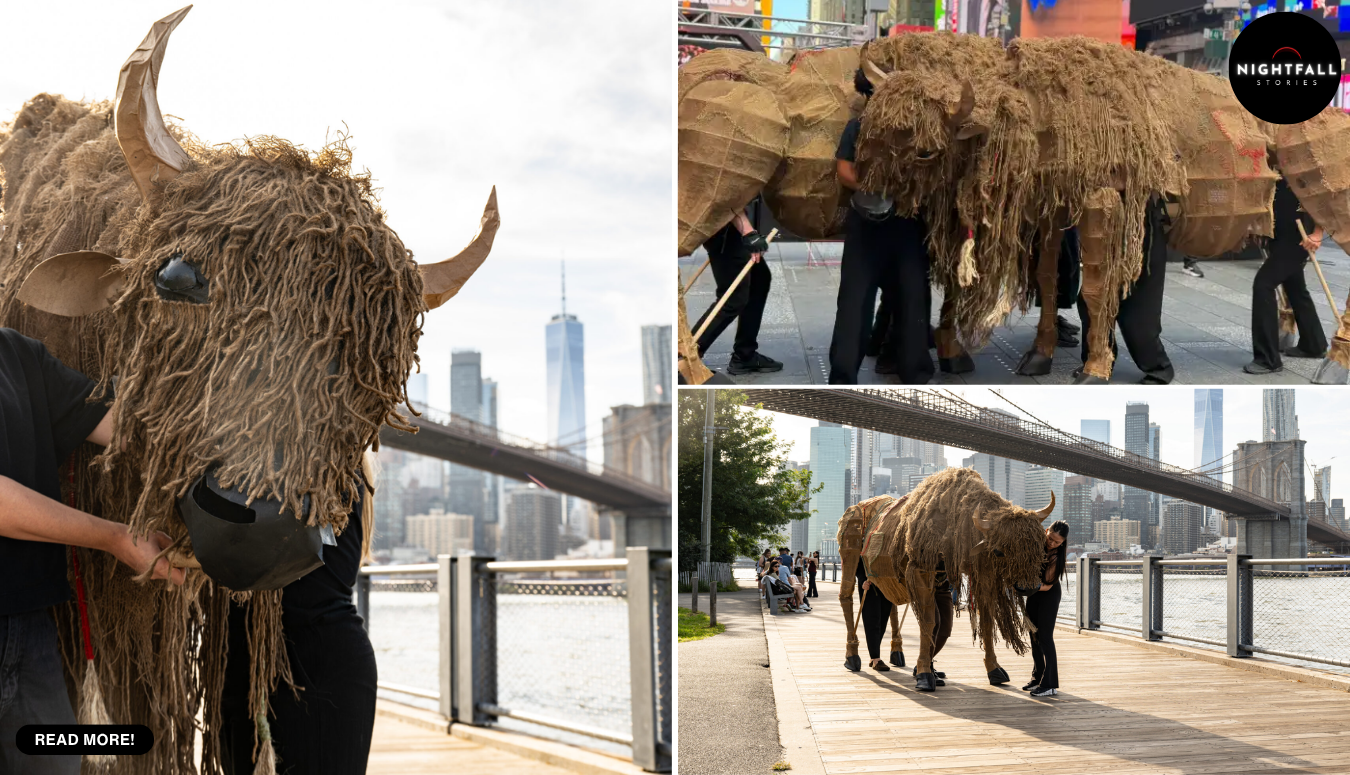
The plaza outside the New York Stock Exchange is not a place where anything grazes. It is stone and barricades and men in suits moving fast, and on an evening last month it filled up instead with forty buffalo, each one six feet tall at the shoulder and nine feet long from nose to tail, each one carried by three people hidden inside its frame. The herd stopped. Two heavy metal guitarists played, one of them holding a low drone, the other going up into something thin and splintering, and the buffalo stood in the noise the way cattle stand in weather. Then the whole thing moved on up the street.
None of the animals were real. All forty were puppets, built out of plywood and metal and burlap and other recycled or recyclable material, and the crowd watching them knew that within about four seconds. What most of the crowd did not know is that roughly two thousand miles west, on the Wind River Reservation in Wyoming, there is an actual buffalo herd that now numbers close to two hundred animals, and that ten years ago it numbered ten. The man who built it from those ten was walking in Lower Manhattan with the puppets.
His name is Jason Baldes. He is the executive director of the Wind River Tribal Buffalo Initiative, vice president of the InterTribal Buffalo Council, and an enrolled member of the Eastern Shoshone Tribe. He has spent a decade moving live buffalo onto tribal land and keeping them alive there, which is slow, unphotogenic, permit-heavy work involving fencing, water, grazing plans and the patience to wait for calves. Forty puppets through the Financial District is the opposite of that in every way except the one that matters, which is that both are attempts to put the animal back in front of people who have stopped thinking about it.
The easy way to write this story is as artists making a sympathetic piece about somebody else’s cause, with the real rancher brought along as a guest. That version is wrong, and the thing that makes it wrong is a single name on the production’s list of participants. Xavier Michael Young walked with the buffalo as a Lenape descendant of the Seminole Tribe of Florida and as one of the people who helped shape what the procession actually said. He is also the finance director of the Wind River Tribal Buffalo Initiative. Baldes’s own organisation was not a subject of the production. It was inside it, in the room where the decisions got made, with its books in the same hands.
That link runs through a family as well as an institution. Young is the grandson of John Thomas, a Lenape elder of the Delaware Tribe of Indians, who worked on the production to make sure Indigenous language and protocol were built into the programme rather than decorated onto it. Manhattan is Lenape land. A procession of buffalo through Lenape land, conceived in partnership with Lenape and Lakota elders, with a Lenape elder checking the protocol and his grandson handling the money for the Wyoming herd the whole thing points at, is a tighter piece of construction than most public art manages. It is also the sort of detail that disappears from coverage, because the puppets are so much easier to photograph.
Now the other good thread, which is geography. The buffalo that walked through New York were designed and built on a different continent, by the Ukwanda Puppets and Designs Art Collective in Cape Town, South Africa, with Craig Leo as puppetry director. South African puppet makers, working in a city about as far from the North American plains as you can get and still be on land, engineered forty American bison to be worn by three people each and to survive being walked repeatedly over city pavement. Then those frames had to get to New York and be learned by volunteers who had never operated a puppet before.
Leo and the Ukwanda collective come out of a Cape Town tradition of large-scale figure puppetry that has been exported with unusual success, and the production around them has a direct precedent. The piece was created and directed by Amir Nizar Zuabi of The Walk Productions, the company behind Little Amal, the twelve-foot puppet of a Syrian refugee girl who walked across Europe and then through more than fifty events in New York a few years ago. Little Amal worked because one puppet, operated well, produces something close to the response a living thing produces. Zuabi’s bet here was that the same trick scales, and that forty of them moving together would read not as forty puppets but as a herd.
Reports of how many people it took differ. One account of the Manhattan leg put it at more than a hundred artists; another put the number of volunteer puppeteers alone at over a hundred and fifty, trained specially and drawn from several countries. Either way the arithmetic is unforgiving. Three operators to a buffalo, forty buffalo, and a rotation so that nobody collapses two hours into a slow walk while carrying part of a nine-foot animal, plus musicians, plus marshals, plus the readers and singers who performed at the stops. The physical cost of the thing was real and it was paid by people most of the audience never saw, because the whole point of the design is that you do not see them.
The route was built to run through the parts of the city that are about money and law. In Lower Manhattan the herd started at Bowling Green Park, the small patch of green at the bottom of Broadway, and finished at Foley Square outside the courts, pausing at Federal Hall and at the Exchange along the way. The following afternoon it went through Downtown Brooklyn, from Abolitionist Place to Brooklyn Bridge Park. At the stops there were readings from Frederick Douglass, Walt Whitman, Tecumseh, Mahmoud Darwish and the Lakota writer Tokala Two Elk, performed by actors including Wendell Pierce, Sam Waterston, Chaske Spencer, Daphne Rubin-Vega, Caridad De La Luz, Susan Sarandon and Rosario Dawson, with music from Rhiannon Giddens, Laurie Anderson, Davone Tines and a marching band, among many others. Alongside Baldes and Young, the Indigenous artists and participants named in coverage of the two days included Tokala Two Elk, Sonnie Allen, Evelyn Kionute, Eric and Aubree Wensman, the anthropologist David Quintero, and Joely Bigeagle Kequahtooway of the International Buffalo Relations Institute.
That is a long list, and lists are the enemy of this kind of story, so here is the part of it that is load-bearing. A production with that many famous names attached could very easily have been about the famous names. It was not. The speaking that mattered happened when Baldes stopped in a park full of New Yorkers and gave them numbers.
The numbers are the substance under the spectacle, and they are worth slowing down for. Ten buffalo arrived on the Wind River Reservation in the autumn of a decade ago. That is not a herd. Ten animals is a founding population, fragile in every direction: genetics, disease, a bad winter, a fence somebody leaves open, a single bad decision about where to put them. Getting from ten to close to two hundred means a decade in which nothing went catastrophically wrong, which in livestock terms is not luck, it is management. It means birth rates holding, it means grazing land secured and defended, it means enough forage and water through drought years, and it means repeated transfers of live animals from other herds, each one a negotiation involving federal agencies, veterinary clearance and trucks.
It also now means money and buildings. The initiative has a nine million dollar expansion under way and a headquarters of around fourteen thousand square feet in design. That is the point at which a project stops being a project. A fourteen thousand square foot building is a statement that the buffalo are not a pilot scheme that might be wound up, and nine million dollars is the kind of figure that brings with it audits, staff, deadlines and a finance director, which is how Xavier Michael Young comes to have that title in the first place.
Set the herd against the national picture and you see why anybody bothered with puppets. Baldes gave the crowd his own framing of the scale, which is that there are roughly ninety million cattle in the country, that something on the order of two and a half million of them are killed every month to feed people, and that there are fewer than five hundred thousand buffalo in the entire United States. Those figures come from him rather than from an agency count, and the buffalo number in particular blurs two very different things, because the large majority of American bison are commercial animals raised on private ranches for meat, while conservation and tribal herds like the one at Wind River are a small fraction of that total. Hedge it however you like and the shape holds. The animal that used to be the dominant large mammal of the continent is now a rounding error next to the animal that replaced it.
And the replacement is still being defended. Baldes was walking through New York at a moment when bison grazing itself was in front of the courts. A federal attempt to revoke bison grazing permits held by the conservation nonprofit American Prairie ran into a judge who ruled that the Bureau of Land Management could not block the grazing, a decision that landed within days of the procession. Cattle industry opposition to putting bison back on open range is not a historical grievance, it is a live lobbying position with money behind it. Nobody involved in Return of the Buffalo, which is the production’s English title, paired with a Lakota one, pretended otherwise.
A note on when all this happened, because the coverage cannot agree. Four outlets produced four different date pictures for the same event, including one that described the march as having happened on a Saturday in a piece published on a Monday. The production’s own company, St. Ann’s Warehouse, puts the two legs plainly: Lower Manhattan on the Friday evening, Downtown Brooklyn on the Saturday afternoon, in the middle of September. There was also an earlier teaser appearance in Times Square a few days before. So this was not one Saturday stampede. It was a multi-day, multi-borough run, which is itself a clue about how much work the thing took.
What is genuinely odd about the whole exercise is how little it tried to be uplifting. Processions with a cause usually end in a rallying speech. This one ended in a square outside a courthouse with a herd of fake animals standing still, having walked past the Exchange, past Federal Hall, past the spot where a man read Frederick Douglass out loud to commuters. The historical argument was left on the pavement for people to pick up or not. The land under Manhattan was Lenape before it was anything else. The animal that is not there any more was killed off deliberately and within living memory of some people’s grandparents. Both of those facts were presented without anybody being told what to feel about them.
There is an honest limit to what a march achieves, and it is worth saying out loud. Forty puppets do not add a single buffalo to a single acre. The permits still have to be filed, the fences still have to be mended, the nine million dollars still has to be spent correctly, and the herd at Wind River will grow or not grow for reasons that have nothing to do with what happened in Lower Manhattan. Attention is not the same as outcome, and anyone who has tried to keep a conservation herd alive knows which of the two is harder to get.
But attention was the scarce resource here, and the production bought a lot of it cheaply, in a city where almost nobody will ever stand near a living buffalo. That is the asymmetry the piece was built on. A New Yorker can tell you what a bison looks like from a coin, a logo, a nature documentary. Hardly any of them have smelled one. Forty six-foot frames carried by volunteers through the Financial District was a way of borrowing the animal’s size for an afternoon, because size is the part no photograph delivers, and because a thing that stands taller than you and takes three people to move is harder to think of as a historical footnote.
So the hundred-odd artists folded up their buffalo and went home, and the Cape Town frames went into storage, and the crowd went back to work. Most of those people will live their whole lives without seeing the real thing. In Wyoming the herd that all of it was pointing at is out on the grass right now, roughly two hundred animals strong, descended from ten, with a finance director who walked through Manhattan under a puppet and a building going up to run them from. Nobody will play a guitar for them. They will just keep calving, which is the only number in this story that compounds.