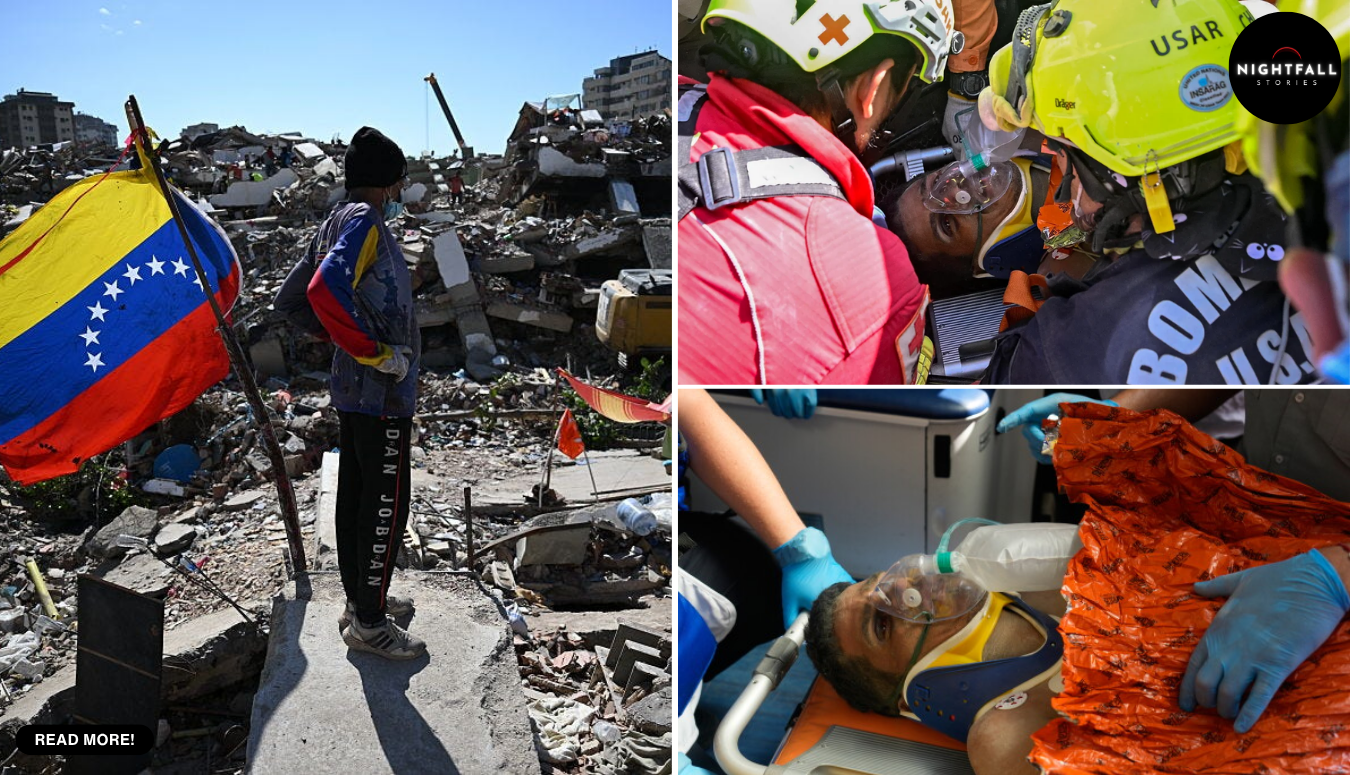
For the first two days he did not know whether anyone was looking. Hernan Gil, 43, was on shift as a security guard in the basement of a seven storey building in Catia La Mar, on Venezuela’s central coast, when the floor above him stopped being a floor. He remembers the second shock as unbelievably strong. He remembers stones hitting his head and his eye. Then nothing, for a while, and then dark.
When he came round he was not lying down and he was not standing. He was wedged partly kneeling, in a space with no light in it at all, and breathing was work. Aftershocks kept arriving. He could not tell morning from night, so he lost the count of days almost immediately, which is the detail that tends to get skipped when this kind of story is retold. He was not counting down to a rescue. He had no idea a rescue existed.
Then, on what he later worked out was the third day, he heard footsteps above him.
That is the moment the whole thing turns on, and it is worth being precise about what it actually was. Not a shout, not a dog, not a light. Footsteps, somewhere over his head, muffled through concrete. He started calling out. Someone called back. He has described what that did to him as a glimmer of hope, and the word he keeps returning to is hope rather than certainty, because a voice answering you through rubble is not the same thing as being out.
It took rescuers more than three further days to travel the short distance between that answering voice and Gil’s body. He came out on a stretcher on a morning in early July, eight days after the ground moved, having spent something in the order of 180 hours underneath a collapsed building. He was reportedly pinned beneath around 140 tons of concrete.
Before going further it is worth saying plainly where this account comes from, because the number of places it was published is misleading. The interview in which Gil described his eight days was given to the news agency AFP from his hospital bed a few days after he was pulled out. Almost everything you can read about what he thought and felt down there traces back to that one conversation. Several large outlets, including CBS, carried the AFP copy essentially unchanged. CNN and Al Jazeera produced their own write ups of the extraction itself, and a Costa Rican outlet interviewed rescuers directly. So there are perhaps three genuinely independent accounts of the rescue, and essentially one of the man’s own story. That does not make it untrue. It does mean nobody has gone back over it a second time, and a reader deserves to know that.
The earthquakes themselves were unusual enough that seismologists took an interest separate from the human toll. Two strike slip ruptures hit on the same evening near San Felipe, in Yaracuy state, on the San Sebastian fault system. A magnitude 7.2 came first. The magnitude 7.5 mainshock followed 39 seconds later, at a shallower depth of around ten kilometres. Some agencies published figures in a range up to about 7.8, and some treat the whole thing as one complex event rather than two, so the honest way to state it is as a doublet of roughly magnitude 7.2 and 7.5 with the agencies not in full agreement.
Thirty nine seconds matters more than it sounds. A building hit by a strong quake does not fail all at once. Columns crack, joints loosen, reinforcement stretches, walls lose their connection to the frame. In most earthquakes the structure then gets hours or days before the next serious shaking, which is enough time for people to get out and, sometimes, for engineers to look at it. Here the second and larger rupture arrived before anyone could stand up. Buildings that would have survived the 7.2 alone met the 7.5 already damaged, with their stiffness gone. Nearly 800 buildings were reported collapsed or badly damaged across the affected region, with 189 recorded as total collapses. Basements and ground floors took the worst of it, because that is where the weight of everything above lands when the frame lets go. Gil was in a basement.
Basements are a particular kind of trap, and also, occasionally, a particular kind of shelter. When a frame fails, the upper floors pancake downward and the lowest level takes the accumulated weight of everything that was above it. That is why casualty rates are worst at the bottom. But a basement also has thick retaining walls, structural columns at close spacing and, crucially, furniture and machinery that can jam under falling slabs and hold them at an angle. Where that happens you get a void, a space a few feet across that did not close. Survival at day eight is almost always a story about a void rather than a story about a person, and rescue teams are trained to read a collapsed structure for where the voids are likely to be before they touch anything.
The dig for him was slow for reasons that are worth understanding rather than glossing. Once his voice was located, in part with radar equipment pushed into voids, the teams’ first instinct was a tunnel. That plan was abandoned as too likely to bring the remaining structure down on both him and the rescuers, which is the routine arithmetic of collapsed building work and the reason these operations take days rather than hours. Every piece of concrete removed changes how the load travels through what is left. Move the wrong slab and you have killed the person you came for.
So they worked from above and around, in relays, cutting and lifting and shoring, then stopping to check what the removal had done to everything else. Rescuers from seven countries took turns on that site: Venezuela, Chile, the United States, Portugal, Costa Rica, El Salvador and Mexico. More than 100 specialists cycled through. Among the Americans were members of a Florida task force; a Chilean fire service urban search and rescue unit was on the final push. Across the wider disaster, at least twenty countries sent search and rescue personnel.
While they dug they kept him alive through the gap they had made. They passed a small camera down so they could see him, and they fed him fluids through a tube and, by several accounts, a syringe, because a syringe delivers a controlled amount to someone lying at an awkward angle who cannot sit up and who must not choke. You do not hand a solid meal to a man who has been crushed and dehydrated for five days. It is also worth noting the medical caution behind it: reintroducing food and fluid too fast to a body that has been compressed and starved carries its own risks, so small and controlled is the point rather than an improvisation.
The last obstacle was not concrete. It was a chair. Gil’s legs were tangled in it, and he has said that freeing them was the hardest part of the entire eight days, harder than the waiting. Rescuers who were there described the final moments as needing one more effort from him, at the end of nearly four days of their work and eight of his.
He came out with bruised legs, a bleeding nose and a right eye swollen and reddened where the stones had caught him. Hospital records reported afterwards included a dislocated left collarbone and a scalp haematoma, which is why photographs taken later show his left arm in a sling. He went to hospital by ambulance. A few days after that he was sitting up in a blue hospital gown talking to a reporter, and he said he felt reborn.
What he says he did down there is not dramatic. He prayed, a great deal. He thought about his wife, Gusbimar Gonzalez, and about his children, and about his father, who is dead. He talked about wanting to be at his son’s birthday and about taking the family to the beach. Gonzalez, for her part, called it the longest eight days of her life, and she meant it literally rather than poetically: she spent them at the site, not knowing.
That is the position most relatives of the missing were left in, and it is worth sitting with rather than passing over. For the best part of a week she was outside a pile of concrete knowing only that her husband had gone to work there and had not come home.
There is a temptation in stories like this to turn the burial itself into something meaningful, as though eight days in the dark were a lesson. It was not. It was eight days of thirst, pain, bad air and no information, endured by a man who happened to be in a survivable pocket of a building that killed other people who were not. The pocket is why he lived. The prayer helped him get through the pocket. Those are two different facts and collapsing them into one does a disservice to everyone who prayed just as hard in a space that had no air in it.
Gil was also not the only person pulled out alive in that window, which is worth saying because a single miraculous survival invites the idea that the rest of the effort was futile. An eleven year old was found alive by a Colombian team several days after the quakes. A small boy was recovered alive at La Guaira two days before Gil came out. Live rescues at day four, day six and day eight are the reason international teams stay on a site long past the point at which the public assumes everyone is dead.
Which brings the story to its hardest number, and the reason this disaster is still not finished counting. The death toll moved every day for weeks, and any figure printed about it is only true of the moment it was published. Al Jazeera reported the confirmed dead at 1,719 towards the end of June. By the time Gil was pulled out in early July, AFP reported the official count nearing 2,600, with the president of Venezuela’s National Assembly, Jorge Rodriguez, putting it at 2,295. Later reporting in July carried figures above 3,500. Separate tallies listed more than 5,000 injured and, in the same official accounting, more than 46,000 people registered as missing.
Those are three different categories and they must never be added together or averaged. Injured is a count of people treated. Dead is a count of bodies identified. Missing is a count of names reported to authorities by people who cannot find someone, and it includes the same person reported twice, people who left the area without telling anyone, people already recorded among the dead, and people still under 189 totally collapsed buildings. A missing figure twenty seven times larger than the confirmed dead does not mean 46,000 more bodies. It means a system that cannot yet tell the difference, and tens of thousands of families living in the gap.
Nor is the register a bureaucratic failure so much as an unavoidable one. In a disaster that damaged nearly 800 buildings across several states, with roads broken and phone networks patchy, the only way to compile a list of the unaccounted for is to let people report names. Nobody can verify those reports at the speed they arrive. A woman reports her brother; his employer reports him too; his neighbour reports the whole family. Three entries, one man, and if he is later identified among the dead there is no guarantee all three entries get closed. Authorities know this, which is why officials kept describing the missing number as a register rather than an estimate of the dead. That distinction was widely lost in the retelling, and it caused real harm, because families reading a figure of 46,000 were being told, in effect, that their odds were far worse than the arithmetic supported.
That gap is what Gil’s eight days actually illuminate. For 183 hours his wife was one of those families. He was a name on a list, in a category with no information attached to it, and then he stopped being one, because a rescue team walked over the right piece of ground at the right moment and he was conscious enough to hear their feet and shout. Most of the people on that list will not get the footsteps. The arithmetic guarantees it.
A last honest note, and it matters for how you read the ending. The most recent direct sighting of Hernan Gil in reachable reporting is that hospital interview in early July, left arm in a sling, calling himself reborn. There is no later follow up: no report of his discharge, no report of how his collarbone or his eye healed, and, importantly, no report of his death. What is documented is that he survived the building, survived the extraction, reached hospital, was in good enough shape to talk at length about it within days, and was talking about his son’s birthday rather than about the dark.
He went down as a man doing a night shift in a basement. He came up as the reason more than a hundred specialists from seven countries stayed on a pile of concrete for four days after most people had stopped expecting anyone to be alive inside it. And the thing that got him out was not equipment or luck in the usual sense. It was that on the third day, when he heard footsteps he had no reason to expect, he decided to shout.