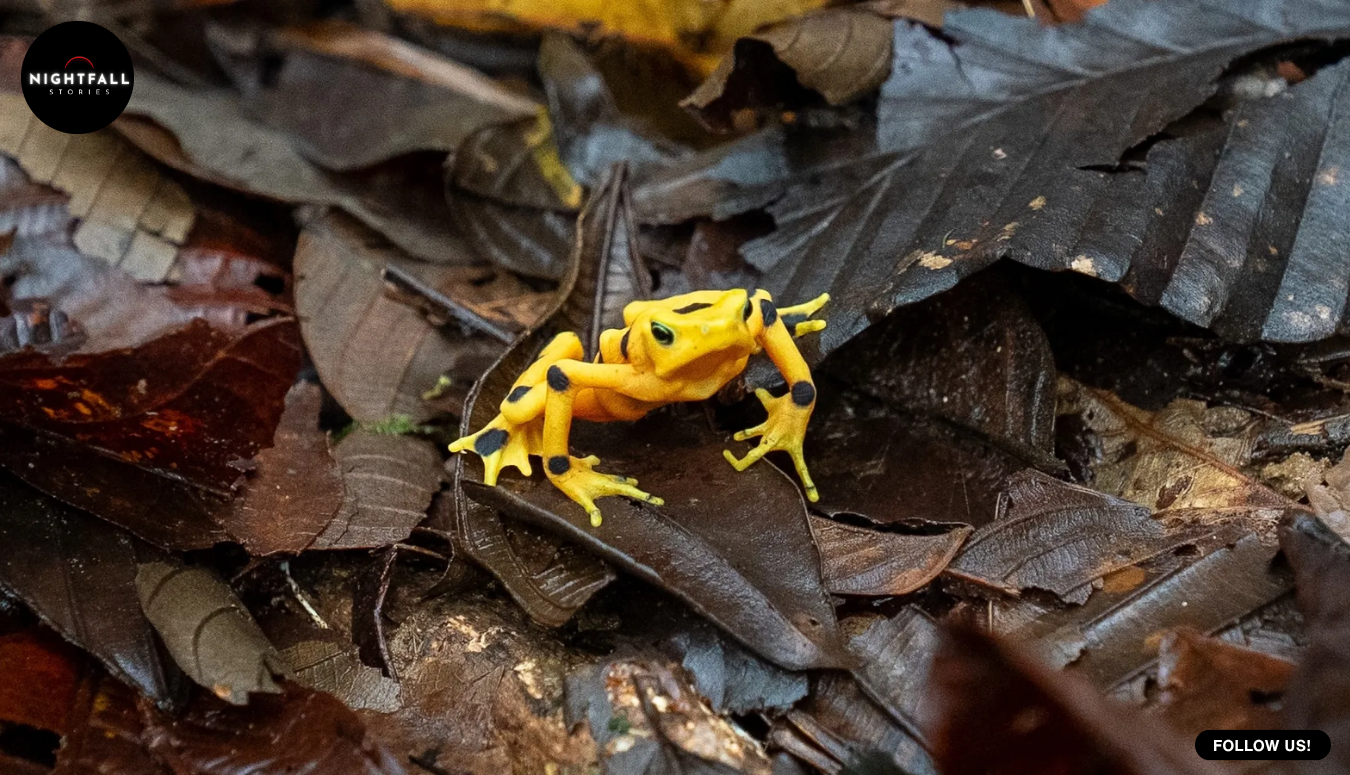
One hundred captive bred Panamanian golden frogs were carried up into the hills above El Valle de Anton and placed inside mesh pens on the forest floor, in the same kind of ground their ancestors had lived on before the species vanished from the wild in 2009. Twelve weeks later, roughly seven out of every ten were dead, killed by the same fungal disease that had emptied those hillsides in the first place.
Here is the part that makes this worth your time. The team that ran the trial did not bury the figure. Roberto Ibanez, who directs the Panama Amphibian Rescue and Conservation Project, and Brian Gratwicke, a conservation biologist with the Smithsonian’s National Zoo and Conservation Biology Institute, put it out in plain numbers, and then used it to argue against the thing their own programme had spent nearly twenty years preparing to do. The survivors were let out of the pens. And the strategy shifted away from putting more frogs back into the places the species used to live.
That is not a sad twist on a hopeful release story. It is also not a failure. It is a conservation programme discovering, at considerable emotional cost to the people holding the containers, that its preferred plan does not work yet, publishing the proof, and changing course on the strength of it. That sequence is rarer in conservation than you might expect, and it is the actual story here.
To understand why a hundred small yellow frogs matter this much, you have to understand what Atelopus zeteki is in Panama. It is not a species the general public has to be persuaded to care about. In 2010 a law was passed making the golden frog a national symbol. There is an annual day for it, with parades through the streets of El Valle de Anton, the town at the foot of the very hills where this trial took place. The frog turns up in handicrafts and local design. It is, in the most literal sense, a national emblem that stopped existing outside of glass tanks.
The thing that removed it was a fungus called Batrachochytrium dendrobatidis, usually shortened to Bd and the cause of a disease called chytridiomycosis. It moved through southern Central America from the late 1980s onward, travelling along the mountain chain, and reached the El Valle region in the mid 2000s. Accounts differ slightly on the exact year, with the Smithsonian’s own material putting the arrival around 2004 and the rescue project’s history page putting it at 2006, so the honest version is the middle of that decade.
What the fungus does, at the level that matters for a population rather than an individual, is attack the skin. For an amphibian, skin is not a wrapper. It is a working organ that handles water and salts and a great deal of the animal’s basic chemistry. Disrupt it badly enough and the animal cannot keep its internal balance. Scale that up across a stream valley and you do not get a gradual decline with survivors hanging on in pockets. You get a collapse that runs through a site in a single season.
The scale of what Bd has done globally is worth holding in mind, because it explains why a hundred frogs in pens on one hillside is treated as a serious experiment rather than a local curiosity. By one widely cited assessment published in 2019, the fungus had been implicated in the extinction of around ninety amphibian species worldwide and in the decline of at least four hundred and ninety one more. It is routinely described as the most destructive wildlife disease on record. Nobody has a cure for it in the wild. You cannot spray a mountain range, and a treatment that works in a tank does not transfer to a watershed.
Golden frogs were among the worst hit, because almost everything about them suited the fungus. They lived in cool, wet, fast running streams in the central mountains, which is close to the ideal temperature band for Bd. They were conspicuous, slow moving and gathered at streams to breed, which is exactly how a skin pathogen gets passed around. Researchers recorded severe chytridiomycosis declines at every one of the species’ known remaining sites. The last confirmed wild record was in 2009.
It is worth being precise about that, because sources use two different phrases. Some say the species is extinct in the wild. The narrower and more defensible statement, and the one the rescue project itself uses, is that the golden frog has not been recorded in the wild since 2009. Those are not the same claim, and in a story about a team being careful with its own numbers, it would be poor form to be careless with that one.
What saved the species from going out entirely was a decision made while the collapse was still happening. Animals were collected out of the wild and taken into captivity, a strategy the field bluntly calls an ark. It sounds dramatic. In practice it is close to two decades of unglamorous husbandry: water chemistry, feeder insects, temperature logs, quarantine, breeding records, and the slow genetic bookkeeping needed to keep a captive population from becoming a collection of cousins. The programme now holds more than a thousand adult golden frogs across more than fifty participating institutions in the United States and Canada, managed under a formal survival plan, alongside the Panamanian facilities run through the rescue project.
There is a second cost to an ark that rarely gets counted, which is what it does to the animals. A frog raised in a tank has never hunted a wild insect out of leaf litter, never dealt with a real temperature swing, never encountered the bacterial community that lives on a wild frog’s skin. Captive amphibians tend to lose the microbial and chemical defences their wild relatives carry, partly because the diet is different and partly because the environment is clean by design. Twenty years of successful breeding can therefore produce a healthy animal that is, in the specific sense that matters outdoors, naive.
An ark buys time. It does not solve anything. And the problem with this particular ark has always been obvious to everyone inside it: the fungus that emptied the hills is still in the hills. It did not pass through and leave. Bd persists in those watersheds, in other amphibian species that tolerate it better, in the water itself. You cannot simply open the doors on twenty years of careful breeding and hope the landscape has forgotten.
Which is why the trial was built the way it was. The frogs did not go straight out onto open ground. They went into mesocosms, which is a technical word for a very practical object: outdoor pens, built on real forest floor, with leaf litter layered in the bottom that came with its own insect life for the frogs to hunt. The mesh held the frogs in and kept predators out. Everything else about the enclosure was deliberately the real world, including the fungus.
That design is what makes the result usable. A soft release pen is a compromise between a tank, where you learn nothing about survival, and a free release, where you learn something but lose the animals and the data at the same time. In a mesocosm you can count. You know how many went in, you can check them, and at the end of the period you have a number rather than an impression.
Gratwicke has been open that the trial was built as a question rather than a rescue. The point was to see what actually happens when captive bred golden frogs are put back into a wild situation: how the disease behaves, how the frogs behave, and whether the animals begin to recover their skin defences. Golden frogs carry potent skin toxins in the wild, enough that a single frog has been described as holding sufficient toxin to kill more than a thousand mice, and there has long been a question about how much of that chemistry captive animals keep or regain once they are back on natural ground and natural food.
That question is not academic. Skin toxins are a defence against predators rather than against fungus, but the broader point behind it is the same: if an animal’s skin chemistry and skin microbiology shift back toward the wild state once it is living on wild ground and eating wild food, then time outdoors is itself part of the treatment, and a release becomes something you build in stages rather than a single event. The trial was set up to find out whether that was happening.
So one hundred frogs went into the pens. The monitoring period was twelve weeks. At the end of it, around seventy percent had died of chytridiomycosis.
It is worth sitting with what that figure means to the people who produced it, without making it prettier than it was. These were not anonymous units. They were animals bred inside a programme where individual frogs are tracked, by staff who have spent years keeping a species alive that no longer exists outside their care, in a town that holds a parade for it. The number was gathered by the same hands that raised the animals.
The contrast that gives the figure its edge came from the same broader programme. Three other amphibian species had been put through release work the previous year: crowned tree frogs, Pratt’s rocket frogs and lemur leaf frogs. They did noticeably better, with the lemur leaf frogs showing what the team described as excellent survivorship. So the seventy percent was not a verdict on soft release as a technique, or on the programme’s competence. It was specific. Other species could be put back on that landscape and live. This one, in this place, could not.
That specificity is what turned a bad result into a usable one, and it points directly at the reason the plan changed.
Bd has a temperature preference. It does best in cool, moist conditions and it struggles as things get warmer. Push the temperature up far enough and the fungus is suppressed. Golden frogs also have a temperature range they can tolerate, and it overlaps with the fungus, which is precisely why the historic sites were such killing grounds. But the two ranges are not identical. If there are places on the landscape that are warm enough to hold the fungus back while still sitting inside what the frog can handle, those places are refuges, and the whole reintroduction problem becomes a question of finding them rather than a question of waiting for the disease to fade.
Gratwicke’s position after the trial was that the data would set the strategy from there, and that earlier modelling had already suggested such climatic refuges might exist. The trial did not discover the idea. What it did was make the idea the main plan instead of a secondary one, by closing off the alternative with a number nobody could argue with.
There is something genuinely uncomfortable in the logic, and it deserves to be said straight rather than smoothed over. A warming climate is, for most amphibians, bad news on every axis: drying streams, shifting breeding seasons, heat stress. For this particular species against this particular pathogen, warmth is the one lever available. The team is not celebrating that. They are using it. A conservation strategy that depends on finding somewhere hot enough to make a disease uncomfortable is a strategy built in a corner, and the people building it know exactly which corner they are in.
The survivors were released fully, out of the pens and onto the hillside. Roughly thirty frogs out of a hundred, carrying whatever it is that let them get through twelve weeks of exposure that killed the rest. Whether that was genetics, skin chemistry, microbiology, luck or some combination is one of the open questions the programme is now chasing, because if the difference can be identified it can potentially be bred for.
The direction of travel from there is away from more releases into the old range and toward identifying and testing climatically favourable sites. Gratwicke framed the next round explicitly as release trials in more climatically favourable places, which is a sentence that quietly concedes the historic sites are off the table for now. For a programme whose entire founding purpose was to put golden frogs back where golden frogs used to be, that is a real concession, published voluntarily, on the strength of its own unflattering data.
It is also worth noting what this story is not. It is not a tidy redemption arc and the sources do not support one. Nobody involved has announced that golden frogs are back. The species still has no confirmed wild population. The ark is still running, still consuming money and staff time and tank space, still dependent on institutions in two countries continuing to care. And the fungus is still out there in the water, indifferent to all of it.
What changed is narrower and more valuable than a happy ending. A conservation programme ran a test that could only tell it something it did not want to hear, heard it, said it out loud with a figure attached, and moved. The seventy percent is not a footnote to a release story. It is the finding. It is the thing that bought the next decade of work its direction, and it cost seventy animals and twenty years of preparation to learn.
Somewhere above El Valle de Anton, around thirty small yellow frogs are living on a hillside their species had been absent from for well over a decade. They are not a recovered population and the people who put them there would be the first to say so. They are the survivors of an experiment designed to be honest, run by people who then published the part that hurt. In a field where plans tend to outlive the evidence against them, that is the result worth paying attention to.