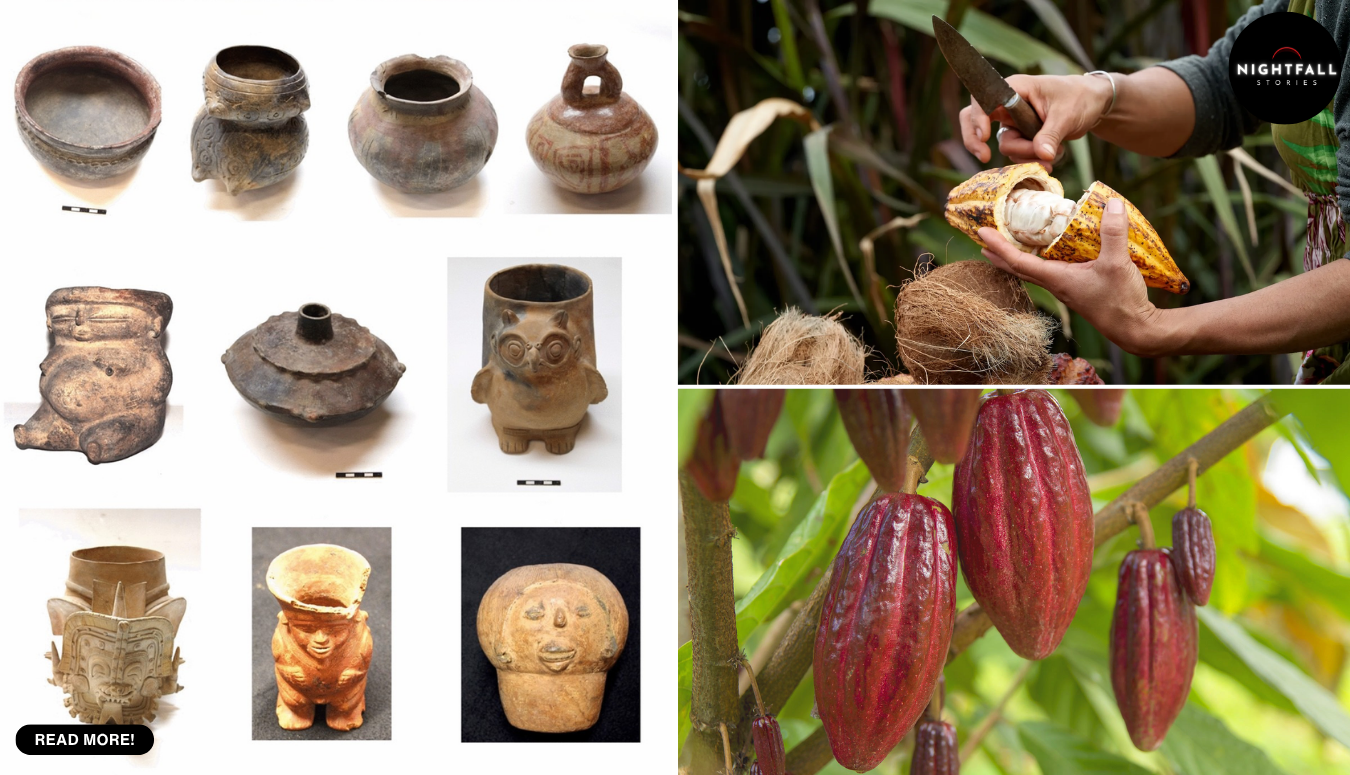
Nine years ago, a team led by the archaeologist Adam King ran thirty one broken pieces of pottery from the Etowah site in Georgia through a chemistry lab and found something that should not have been there. The sherds, soaked for centuries in whatever had been cooked or brewed in them, gave up traces of a family of compounds called methylxanthines. Four of them were being looked for: theobromine, theophylline, caffeine and paraxanthine. Almost half the samples held at least two. Three samples held all four.
That combination is the chemical signature of cacao. And cacao does not grow anywhere near Georgia. It does not grow anywhere in North America above Mexico. The nearest wild and cultivated populations were thousands of miles away, across terrain and water, in Mesoamerica and ultimately in the upper Amazon.
So the obvious conclusion sat there, and the team could not take it, because of a shrub.
Yaupon holly grows all over the southeastern coastal plain. It is a scrubby evergreen with red berries, and its leaves are caffeinated. Southeastern peoples brewed them for centuries into a strong, dark, ceremonial drink that Europeans later recorded under the name black drink. The trouble is that yaupon leaves contain more than caffeine. They carry the same methylxanthines, in combinations that overlap with cacao closely enough that an absorbed residue from one cannot be reliably told apart from an absorbed residue from the other.
That is the whole problem in one sentence, and it is a hard one. A residue test tells you what class of chemistry passed through a pot. It cannot tell you which plant the chemistry came out of when two candidate plants share it, and one of those candidates was growing within walking distance. King’s own 2017 paper said so. The honest conclusion was that it was not possible to distinguish residues created by cacao consumption from residues created by yaupon holly.
Earlier this year, a paper in PLOS ONE closed the gap, and it did it with genetics rather than chemistry. The answer came out of two sherds.
Before the method, the place, because Etowah is not a minor site and this is not a story about a curiosity in a drawer. Etowah sits on the river of the same name in northwestern Georgia, a walled town of mounds and a plaza built and occupied in stages across several centuries. At its height it was one of the largest and most important centres of the Mississippian world, the network of mound-building societies that stretched across the river valleys of the North American interior. Its great mound rises steeply above the floodplain. Its burials produced some of the most remarkable Mississippian art known, including copper plates and marble human figures. Adam King, at the University of South Carolina, has spent much of his working life on it and is the archaeologist most closely identified with the site.
The sherds in question, though, do not come from the famous period. They come from eleventh and twelfth century contexts, which is more than two hundred years before Etowah’s fourteenth century peak. That matters more than it first appears. This is not cacao arriving at a mature capital at the top of its power. It is cacao present early, while the town was still becoming the thing it became.
Now the method. Ancient DNA recovered from the wall of a cooking vessel is not DNA in the sense most people picture. It is wreckage. The paper’s own supplementary data show it: read length distributions that pile up at the short end, and clear evidence of heavy fragmentation. The molecules survive in pieces measured in tens of base pairs, scattered among the overwhelming genetic noise of every microbe, root, insect and human hand that has touched that sherd in nine hundred years and in the decades since it came out of the ground.
Finding cacao in that mess is a filtering problem, not a reading problem. The sequences are mapped against the Theobroma cacao genome, and anything that matches is then checked to see whether it matches cacao specifically rather than matching cacao because it would match almost any plant. Most of it fails that second test. What survives is a small handful of short sequences that are diagnostic of cacao and of nothing else available.
Contamination is the permanent anxiety in this kind of work, and it cuts both ways. A single speck of modern plant material, a laboratory that has handled cacao before, a reagent batch, a glove, and you can manufacture a positive out of nothing. The defences are mostly procedural and mostly boring: clean-room handling, dedicated equipment, blanks run alongside the samples so that anything appearing in an empty tube can be subtracted, and a hard look at whether the damage pattern in the recovered molecules actually looks ancient. That last check is the useful one, because genuinely old DNA has a characteristic shape. It is short, and it is chewed. Modern contaminant DNA arrives long and intact, and in a dataset where almost everything is forty or fifty base pairs long, a clean full-length read is a red flag rather than a prize.
The team, with the ancient DNA work done by Claire Lanaud and colleagues at CIRAD in Montpellier and at a palaeogenetics laboratory in Paris, did something in this paper that deserves more attention than the headline result. They set a numerical threshold before reporting, and they published it: at least five unique cacao-specific sequences in a sample before they would accept the plant was present.
Three sherds went in. Sample 3 returned twelve unique cacao-specific sequences. Sample 25 returned eighteen. Sample 2 returned four.
Four is not zero. Four is one short. And the paper reports it as a failure anyway and does not argue with its own rule.
That is the part of this that makes the rest believable. A team that wanted a result could have found a reason why four was good enough, or quietly dropped the third sample from the write-up, and almost nobody outside the field would ever have known. Publishing the near miss is what converts a claim into evidence. It also tells you something useful about preservation: three sherds from the same site, all three positive for all four alkaloids back in 2017, and only two of them still holding recoverable cacao DNA. Survival is patchy at this depth of time, and a negative result from a single sherd means very little on its own.
The threshold was not invented for tidiness. It exists because of a fight.
In 2009, researchers reported cacao residues in cylinder jars from Pueblo Bonito at Chaco Canyon, in what is now New Mexico, from a period running roughly from the mid eleventh to the mid fourteenth century. The implication was the same as here: a Mesoamerican plant consumed deep inside what is now the United States, which means something was moving a very long way. The finding was influential and it was also contested, hard, for years, and on exactly the ground that tripped up the Georgia chemistry. If other caffeinated plants in the region can produce overlapping residue signatures, then a methylxanthine profile is suggestive rather than decisive. The argument has never been fully settled to everyone’s satisfaction.
That history is the reason the Etowah paper reads the way it does. Having watched a residue claim get argued over for more than a decade, the authors did not simply assert a genetic match. They defined in advance what would count as one, applied it, and reported the sample that fell short. Cacao in North America north of Mexico is not a settled subject, and this paper is better understood as the first case where the identification itself is hard to argue with, rather than as a vindication of everything that came before it.
So what moved? This is where the paper is noticeably more careful than the excitement around it, and the care is worth repeating accurately.
The authors looked at how the recovered ancient sequences relate to the genetic groups of modern cacao and its wild relatives, using a standard measure of genetic distance. The two samples did not point the same way. Sample 3 came out closest to the Amelonado group, with the Marañón group next. Sample 25 came out closest to the Curaray group, with Marañón next. Those groups have their origins in South America, in and around the upper Amazon, which is where cacao’s deepest genetic diversity sits.
The paper then does the thing a careful paper does and undercuts its own most exciting number. These ancestry results are described as preliminary and needing confirmation, because they rest on very few usable single nucleotide positions. With a handful of short fragments, the nearest match on a distance table is a hint about where to look next, not a shipping manifest.
On the bigger question, the authors are explicit in a way that is easy to lose in retelling. They offer it as a possibility that the cacao reached Etowah from parts of Central America, which are closer to Georgia than Ecuador is, by way of networks that carried objects and people and ideas. And they state that for now, neither direct connections to Mexico nor direct connections to the American Southwest are supported by the archaeological evidence.
Read that twice, because it is the honest version. What the DNA establishes is that cacao was consumed at Etowah. What it does not establish is a route, a trading partner, a direction or a mechanism. Something that originated thousands of miles to the south ended up in a pot in northwestern Georgia in the eleventh or twelfth century. The hands it passed through on the way are not in the data. It could have travelled as beans through many short exchanges, each one between neighbours who had no idea of the whole chain. It could have moved as a rare, high-value substance along routes archaeologists have not yet identified. Nobody has the middle of the story.
None of which should make long-distance movement sound exotic for this part of the world, because the Mississippian record already contains plenty of it. Etowah’s own material includes copper worked into ceremonial plates and large quantities of marine shell, neither of which occurs locally, and both of which had to travel hundreds of miles before anyone at Etowah touched them. Mica, galena and particular stones for tools moved similarly. Long-distance exchange of valuable, portable, ceremonially loaded material is a documented feature of these societies rather than a surprise this paper invents. What is new is the distance and the direction. Copper from the Great Lakes region and shell from the coast are long hauls inside a continent. Cacao is an order of magnitude further, and it points south past every network archaeologists have mapped.
It is also worth being clear about what cacao meant, since the modern word chocolate imports the wrong associations. Cacao in this period, everywhere it appears, is a prepared drink and a prestige good. It is bitter, often frothed, often spiced, and it belongs to ceremony, hospitality and status rather than to anything like dessert. If cacao was being drunk at Etowah, the likeliest setting is the same kind of setting the mounds and the plaza were built for. The paper’s framing of feasting fits the architecture, and that is an inference about context rather than a chemical result, which is how it should be read.
Which puts the whole thing on a nine year arc that is more instructive than a simple before and after. In 2017 the chemistry found a signal and the team told the truth about its limits, which cost them the headline and left the question open. Terry Powis of Kennesaw State University, whose specialism is exactly this absorbed residue chemistry, had been doing the kind of work that made the signal findable in the first place. Nilesh Gaikwad, whose laboratory in California handled the alkaloid analysis, operates as a commercial outfit, Gaikwad Steroidomics, and that is listed openly as his affiliation on the new paper, which declares no competing interests. The gap between the two results was not laziness. It was a wait for a method capable of answering a question chemistry had been asked to answer and could not.
What the DNA added was not confidence. It was specificity. Alkaloids told the team that something caffeinated had been in those pots and narrowed the candidates to two. Genetics named the plant. That distinction is small to describe and enormous in practice, because it is the difference between a finding that can be argued away by pointing at a shrub and a finding that cannot.
And the caution at the end of it is real. Two sherds is two sherds. From one site, from one set of eleventh and twelfth century contexts, with a third sherd from the same batch that did not clear the bar. This is a foothold, not a map. It establishes that cacao reached Etowah; it does not establish how often, how widely across the Mississippian Southeast, or for how long. The next move is more sherds from more sites, and the method now exists to test them.
Etowah is a state historic site today, and the mounds are still there above the river, walkable, mown, quiet. The town they belonged to is ancestral to living nations, among them the Muscogee and the Cherokee, and the objects that make findings like this possible came out of ground that holds their ancestors. That is worth saying as part of the story rather than as a footnote to it.
What changed this year is modest and it is solid. For nine years the record said that people at Etowah had been drinking something caffeinated and that nobody could prove which plant. Now, from twelve sequences in one sherd and eighteen in another, the record says cacao, in the eleventh or twelfth century, at roughly the same time it was being drunk a continent’s width away at Chaco. Two broken pieces of a cooking pot, and a third that did not quite make it, which is the one that makes the other two worth believing.