A spacecraft the size of a large refrigerator, carrying three robotic arms and about 60 kilograms of xenon, got to within roughly 12 to 15 kilometres of its target. That is between about seven and a half and nine miles, which in orbital terms is close enough to see your destination and not nearly close enough to touch it. It needed to close that gap, reach out, grab a twenty two year old NASA observatory by a pair of handling flanges never designed to be gripped in space, and shove it back up into a higher orbit.
It never got there. A reaction control valve stopped responding, the spacecraft began to spin, and a power circuit switch failure finished the job. The rescue vehicle, called LINK, built by a company called Katalyst Space under a NASA contract worth around 30 million dollars, was deliberately brought down into the atmosphere and destroyed in late September. Its target, the Neil Gehrels Swift Observatory, is still up there, still working, and still falling.
Kieran Wilson, who was LINK’s principal investigator, listed the failures himself rather than waiting for anyone else to do it, and said flatly that they came very, very close. He also noted, with the kind of gallows accuracy engineers reach for, that he remained principal investigator for another twenty four hours or so until the thing reentered.
This story is easy to write badly in two opposite directions. One version is the debacle: 30 million dollars of public money burned up over the Pacific, nothing to show for it. The other is the noble try: brave people reaching for something hard and failing beautifully. Both are lazy, and both skip the part that is actually useful, which is what specifically broke, what that tells anybody who wants to service a satellite that was never built to be serviced, and what now happens to a working telescope that nobody can reach.
Start with why Swift was worth 30 million dollars of rescue attempt. It launched in November 2004 on a Delta II from Florida, into an orbit with a perigee of about 585 kilometres and an apogee of about 604. Its job was gamma ray bursts, which are the brightest explosions in the universe and, before Swift, were among the most frustrating objects in astronomy. A burst lasts seconds. By the time anyone could point a telescope at roughly the right patch of sky, the thing was gone and the position was vague.
Swift’s whole design was about collapsing that delay. It detects a burst, works out where it came from, and then slews itself around to put its X ray and ultraviolet and optical instruments on the fading afterglow, fast, while the afterglow still exists. That turned gamma ray bursts from flashes into objects with addresses. It is the reason astronomers can now tie individual bursts to individual galaxies, to supernovae, to the collisions of dense stellar remnants. Swift cost around 500 million dollars to build and launch. Twenty two years later it still works.
That matters beyond gamma ray bursts, because a telescope that can swing onto a target within minutes turns out to be useful for almost anything that changes fast. Swift has spent two decades being the instrument other astronomers call when something flares, erupts, explodes or simply does something unexpected, including following up the sudden events that other observatories and detectors flag. A fast, nimble, well calibrated X ray and ultraviolet observatory is a general purpose tool, and there is not a queue of replacements waiting.
What is killing it is not a broken component. It is air.
Low Earth orbit is not empty. There is a thin residual atmosphere up there, and it pushes back. How hard it pushes depends on the Sun. When solar activity rises, the upper atmosphere absorbs more energy, heats up and expands outward, so a satellite at a fixed altitude suddenly finds itself ploughing through thicker air than it was built for. Drag increases. The orbit decays faster. The models that planned Swift’s lifetime in the early 2000s assumed a certain amount of this, and the actual solar cycle around the 2024 maximum delivered more.
The numbers tell it plainly. Swift started at roughly 600 kilometres. By 2026 its orbit had come down to a perigee of about 373 kilometres and an apogee of about 378. Without a boost, the assessment ahead of the rescue mission gave it a ninety percent chance of reentering before the end of 2026.
Here is the part that makes the whole situation faintly absurd. Swift has no propulsion of its own to raise its orbit. It has no refuelling port, no docking fixture, no grapple fitting, nothing. This is not an oversight by the people who built it. In 2004, nobody designed science satellites to be serviced, because there was no way to service them. Hubble was the exception and Hubble got a space shuttle. For everything else the plan was simple: it works until it does not, then it falls down. An entire generation of still-functioning hardware is in orbit under that assumption.
That assumption is now a growing problem rather than a historical quirk. The same solar conditions dragging Swift down are dragging on everything else in low orbit, and a good deal of what is up there is ageing hardware that still works, still produces data, and has no way to raise itself. Shawn Domagal-Goldman, who directs NASA’s astrophysics division, made the affordability case directly: pushing an existing observatory back up is a fraction of the cost of replacing it. The catch is that nobody has yet demonstrated that it can be done to a spacecraft built before anyone thought to leave a handle on it.
So NASA tried something it had not tried before. In September 2025 it awarded Katalyst Space Technologies a contract, reported at around 30 million dollars, under a small business programme mechanism, to build and fly a spacecraft that could go up and physically push Swift higher. For scale, that figure is roughly six percent of what Swift itself cost. It is a fraction of what building a replacement would run. On those economics the attempt was worth making even at substantial risk of failure, and the people who approved it were explicit that they understood they were accepting a large risk.
LINK was built fast. It weighed about 425 kilograms, carried 60 kilograms of xenon propellant, three Hall effect thrusters for the slow efficient orbital work and a set of reaction control thrusters for attitude. Its business end was three parallel robotic arms, each with its own lidar sensor and grippers, in an arrangement described as a split Stewart platform. The plan was to use all three for control, though the design could in principle have captured with one.
The capture plan itself is the most interesting piece of engineering in the story. Since Swift has nothing built for grabbing, the team went looking for something on the spacecraft strong enough to take the load, and settled on the ground handling flanges on the satellite bus, which are the fittings technicians use to move the spacecraft around on Earth. LINK was supposed to approach, inspect visually and with lidar from a few tens of metres out, check that the flanges were not obstructed by degraded multi layer insulation or anything else twenty two years in orbit might have done to the surface, and only then make contact. The whole docking sequence was rehearsed on an air bearing table on the ground using a mock up of Swift.
LINK launched on 3 July 2026, at 08:36 UTC, from Kwajalein Atoll in the Pacific, on a Pegasus XL rocket dropped from the Stargazer carrier aircraft at around 39,000 feet. It took three weather scrubs and a technical delay to get off. It was the last planned flight of the Pegasus, a vehicle chosen because, as Katalyst’s chief executive Ghonhee Lee put it, it was the only rocket that could hit the orbit, the schedule and the budget at once. Katalyst got a discount on a rocket originally built for a customer who never flew it.
The launch worked. Separation was confirmed. Then things began to come apart in stages, and the sequence matters more than the headline.
About a week into the mission there was a failure of a reaction wheel switch on the power side. Reaction wheels are how a spacecraft points itself without spending propellant: spin a flywheel one way, the spacecraft turns the other. Lose them and you are down to thrusters, which burn a finite resource.
By 25 July, LINK had lost attitude control and was tumbling. Investigation found two of its three reaction wheels inoperable and the cold gas thruster system degraded, most likely the result of a temperature spike during an automatic bus reset. The spacecraft was spinning at about nine degrees per second. Over the following weeks the team wrestled that down to about 1.47 degrees per second by 5 August, which is genuinely impressive recovery work on a vehicle that had lost most of its pointing hardware.
Wilson’s account of the end of the capture attempt names an unresponsive reaction control system valve as the start of the chain that spun the spacecraft up, followed by another power circuit switch failure, and it was that combination that ended any possibility of rendezvous and capture. On 19 August, Katalyst gave up on the boost and reframed the mission around rendezvous and proximity operations instead: get close, look at Swift, gather the data, do not attempt contact. The root cause of the original spin was never definitively pinned down.
That is what took it to within 12 to 15 kilometres and no closer.
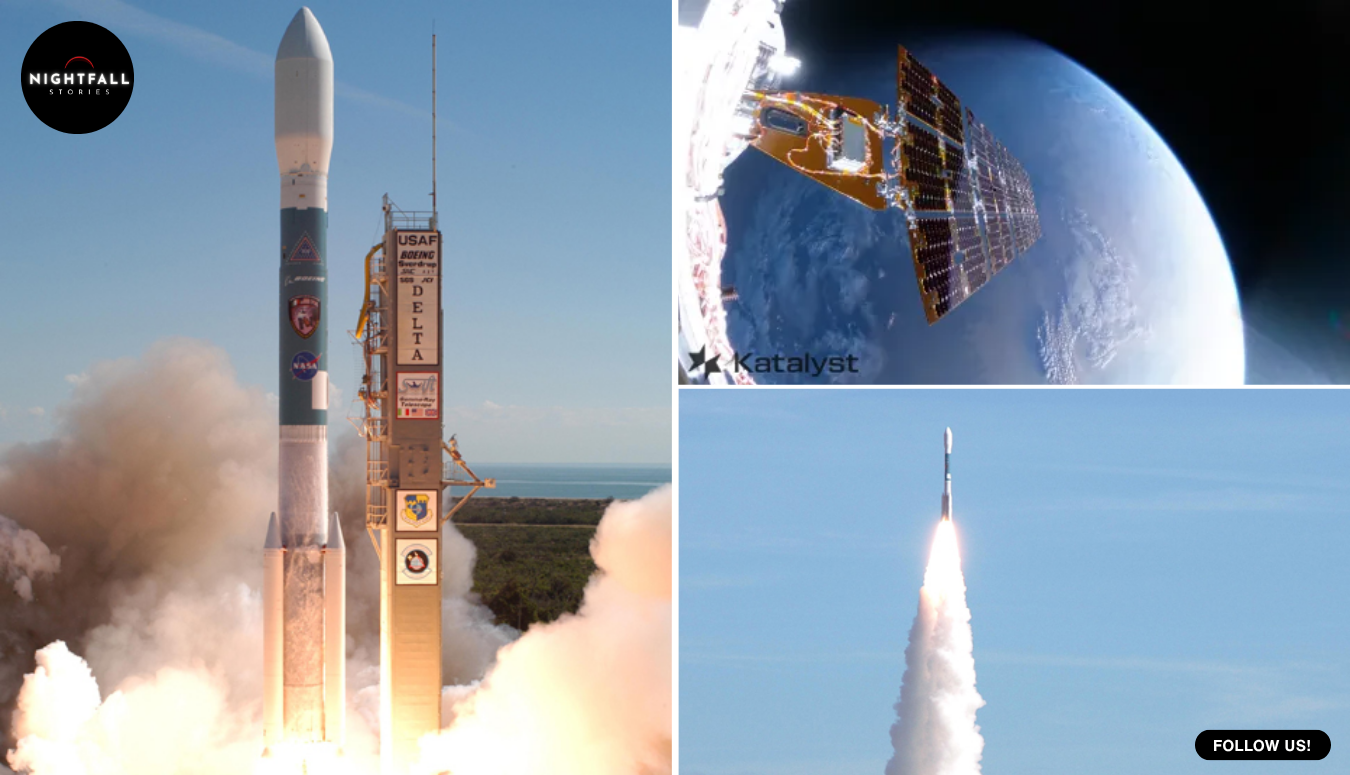
And this is where the useful part lives, because a failed capture that got that far is not the same as a vehicle that died on the pad. All three electric thrusters fired. The spacecraft changed its orbit as planned. All three robotic arms deployed correctly. LINK photographed its own solar panel in orbit in late August. The propulsion worked, the arms worked, the orbital mechanics worked. What failed was attitude control, twice, through a valve and through power switching.
If you are in the business of servicing satellites, that is a more specific and more valuable result than a general lesson about risk. It says the hard part of grabbing an uncooperative spacecraft may not be the grabbing. It says single point failures in valves and power switching can take out a mission whose headline technology performed. It says a vehicle built on a tight schedule with a modest budget can get within sight of a target it was never certain to reach, which is an argument for trying again rather than against it.
John Von Eepoel, deputy project manager at NASA Goddard on the boost mission, described an organisation that had decided to accept a large risk deliberately, top to bottom, and said the question internally was never whether to do it but how. That is an unusual thing for a space agency to say out loud, and the fact that it was said after the failure rather than before it is the part worth noting.
What happens to Swift now is the piece that has to be stated carefully, because it has not happened yet.
Swift is still observing. Two of its instruments, the X ray telescope and the ultraviolet and optical telescope, were switched back on in late August 2026 after having been configured for the boost attempt, and the observatory went back to work. Jamie Kennea, who led Swift’s science operations from Penn State University and has since moved to Schmidt Sciences, coordinated reorienting the spacecraft to present the smallest possible cross section to the oncoming air and slow its fall. Brad Cenko remains the mission’s principal investigator.
So the telescope is doing science on the way down. It is pointed to minimise drag and still returning data, and nothing about the LINK failure broke anything on board Swift.
The reentry itself is a forecast, not an event. The pre mission assessment put Swift’s chance of coming down before the end of 2026 at ninety percent, and the reporting after LINK’s loss expects it within months. That is a projection built on atmospheric density models and solar behaviour, both of which have already proved harder to predict than the original planners assumed. Nobody has announced a date. An uncontrolled reentry of a spacecraft this size is expected to break up in the atmosphere. When it actually happens, and precisely where, is not knowable now.
What is knowable is the shape of the thing. A telescope that changed how a whole class of cosmic explosion is studied is falling because the Sun was busier than the models said. A rescue was attempted for about six percent of the telescope’s original cost, using a rocket on its final flight and a spacecraft with arms designed to grip fittings meant for a loading dock. It got within nine miles. A valve and a switch stopped it, and the people responsible named both without being asked.
Swift will keep taking data until the air gets too thick to point in. That is a strange and slightly undignified way for a great instrument to finish, and it is also, on the evidence, exactly how the people operating it intend to spend what is left: working the whole way down.