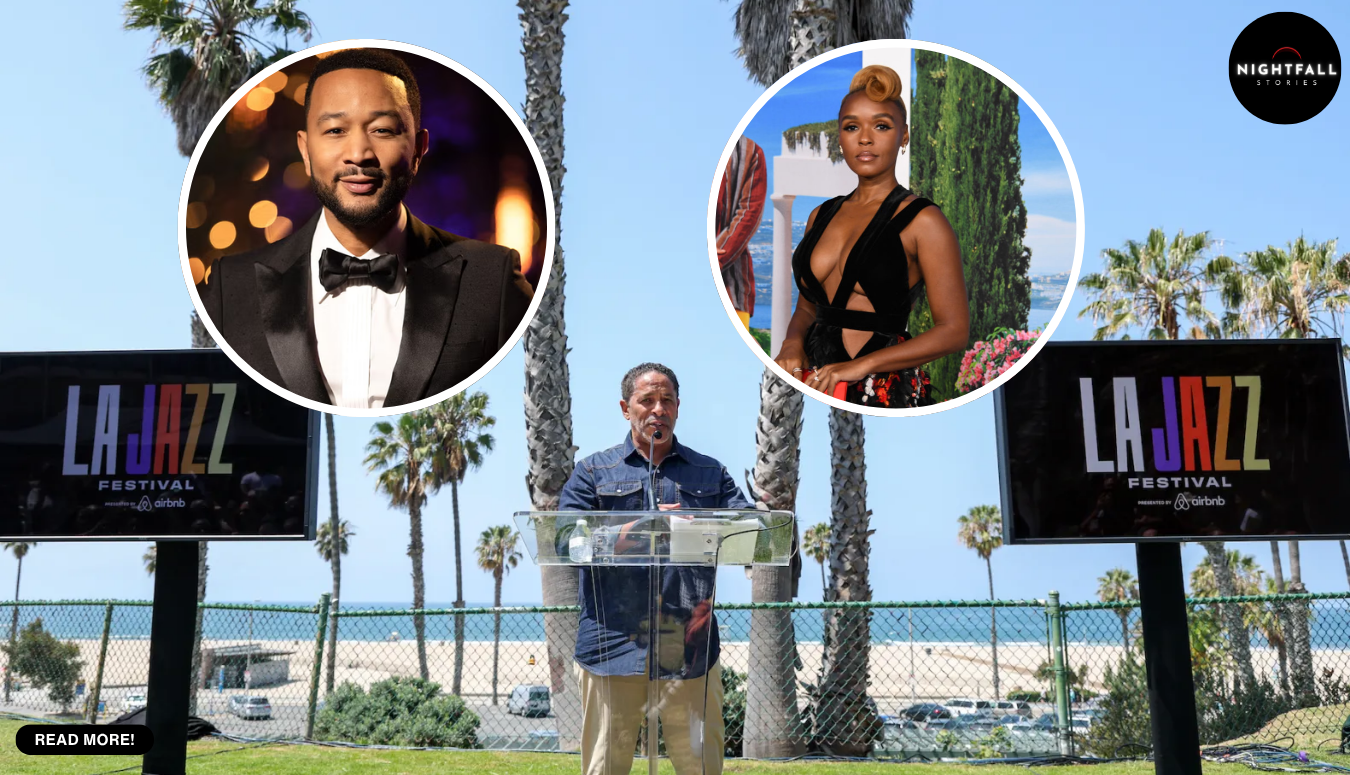
The Los Angeles Jazz Festival was supposed to run for most of a month. More than a hundred events across the city, twenty-five free concerts in parks, a two-day conference about the state of the music, a youth camp, a Caribbean street festival with four stages, and a closing weekend on the sand at Dockweiler Beach with John Legend and Janelle Monáe on the bill. Organisers talked about a quarter of a million people coming through. Tickets went on sale. Musicians cleared their calendars. Some of them flew in.
And then opening day arrived in early August, and there was nothing to open.
Not a rained-out show, not a headliner pulling out at the last minute, not a stage that went dark halfway through. The whole thing, the entire month, simply did not happen. Artists had been told days earlier by email that the opening night event, the park concerts and the late-night club series were all being postponed because of what the message called unforeseen permitting and production challenges. The beach finale went a few days after that. What was left was a website, a set of ticket confirmations that pointed at nothing, and a jazz scene that had been told for months that this was finally its year.
The man behind it is Martin Ludlow, a former Los Angeles city councilman who runs a firm called Bridge Street Inc. He had been talking about this festival for a long time. When it was announced earlier in the year, the mayor of Los Angeles stood up beside him and said she had been on a fifteen-year journey with him to get here, and that she was excited it was finally the year. Airbnb came in as the inaugural title sponsor. The framing was civic and generous: free admission for most of it, events in all fifteen council districts, deliberate bookings at venues owned by women and by people of colour, a celebration of a music that Los Angeles has a genuine claim to.
That is a lot of promise to put into a room, and it is why the collapse landed the way it did.
The reporting that pieced together what actually went wrong, published by the Los Angeles Times about two weeks after the cancellation, does not describe a single dramatic failure. It describes a slow one. The festival had a proposed budget of around sixteen million dollars, and according to that account the organisers were never able to finance all of it. There was a search for five million dollars of venture capital in exchange for a fifth of the company, and a hunt for a million-dollar title sponsorship. Airbnb’s contribution was reported at seven hundred and fifty thousand dollars. That is real money, and it is also a long way from sixteen million.
Running alongside the money problem was the paperwork problem, and the paperwork problem is the one with a paper trail.
According to the Los Angeles Times account, a lieutenant with the city’s police department wrote in late July that required documents were still outstanding despite repeated attempts to reach the organisers. A further letter at the end of that month reportedly warned that they were likely to miss the deadline. These are not accusations from a rival or a rumour from the scene. They are letters, written by the agency whose sign-off a festival of that size cannot proceed without, and they were written before anything was publicly cancelled.
Ludlow’s own explanation, given at the time, pointed at what he called a demanding multi-agency process and significant, unanticipated last-minute public safety and municipal costs. Both things can be true at once. Permitting a month-long event spread across an entire city really is a grinding administrative job with a lot of separate desks to satisfy, and the record also shows that the desks were asking for material and not getting it.
What that combination produced, in practice, was a festival that had committed to artists before it had secured the ground it would put them on.
Ludlow has said he spent more than a million dollars on performance fees for shows that never took place. That figure is his own account as reported, and it has not been independently audited. Around twenty artists, by the Times’ count, had not received the advances they were owed. Some of them had already spent money of their own getting ready.
The saxophonist Leah Concialdi’s Neighborhood Orchestra was one of them. Her group had paid out of pocket for photographers, for a video crew, for rehearsal time, all the invisible costs a band absorbs when it thinks a big date is coming. She reportedly found out the show was gone not through a phone call but because a ticket link stopped working. Her point afterwards was not a demand for money. It was closer to a warning to anybody else who wants to build something this size: you have to think about what happens to people once you have got them invested.
That is the part of this story that does not get a headline. A cancelled festival is an inconvenience for a ticketholder and a catastrophe for a working musician, because a working musician’s year is a jigsaw. Blocking out a month for one festival means turning down the touring dates, the session work and the residencies that would have filled it. When the month disappears, the alternatives are already gone.
The saxophonist Isaiah Collier had already flown to Los Angeles when his park show was called off. He described it afterwards as a wake-up call, and said much the same thing Concialdi did about the responsibility that comes with getting people invested. Neither of them sounded like people looking for a fight. They sounded like people doing the arithmetic on a month they were not going to get paid for.
And here is where the story turns, because something happened next that was not in anybody’s plan.
A New York musician and promoter called Gengis Don put together a replacement event at a Los Angeles gallery and gave it a name that told you exactly what it was for: Can’t Cancel Jazz. It was not a sixteen million dollar production. It was a room, a bill, and an audience, assembled fast by people who refused to let the month be a complete write-off. His summing up of the original festival was blunt and, in its way, fair-minded. He said the message had been right and the messenger had been wrong, and he worried aloud that a city with a genuinely rising jazz scene could be set back by a failure this public.
That distinction matters, and it is the reason this is not a simple story about a man who let people down.
Because the idea itself was not stupid. Los Angeles has an enormous, serious, historically deep jazz community, and it has never had a festival on the scale that community arguably deserves. Somebody was going to try. The question the collapse raised was not whether it should exist, but how you build one without breaking the people you build it on.
There is an instructive comparison sitting right there in the same city. The bassist Stanley Clarke, a genuine elder of the instrument, staged the Santa Monica International Jazz Festival earlier in the same year, with Kamasi Washington headlining, and it went off. His account of how was almost boringly practical. He took two years to plan it. He surrounded himself with people he described as smart and ethical. And, in a line that reads like a direct if unintended note to his neighbours, he said the trick was not shooting too big.
Two years, a realistic budget, and a smaller opening swing. That is not a glamorous recipe. It is, on the evidence, the one that works.
There were other warning lights that only became visible once somebody went looking. Tickets for the paid events had reportedly started under seventy dollars and run up into the thousands for luxury boxes, which is the pricing of an established brand rather than a first year. When the organisers began exploring a move of some shows away from the original sites and into established venues like the Greek Theatre and the Peacock Theater, several headliners reportedly stepped away, which is what artists do when the shape of a booking changes late. The festival’s chief operating officer until a couple of years earlier had her own tax conviction on the public record. And the relationship with the title sponsor was not new money arriving from nowhere: Ludlow’s firm had reportedly earned more than two million dollars from work with the same company previously.
None of that is proof of bad faith. Plenty of it is just how ambitious events get financed, with existing relationships doing the heavy lifting. But taken together it describes an operation that was running on optimism and personal credit rather than on locked-down funding, and an operation like that has no slack in it. The first serious delay becomes the last one.
There is a further complication in the Ludlow story that the reporting did not leave out, and it would be dishonest to leave it out here. He pleaded guilty in 2006 to conspiring to embezzle union funds, and served probation and a substantial community service order. That is a matter of public record from two decades ago, and he has worked publicly in the city ever since. It is not the reason the festival failed. The permits and the budget are the reason the festival failed. But it is part of why some people in the scene reacted to the collapse with more anger than they might have given a first-time promoter, and any honest account of the temperature afterwards has to acknowledge it.
What is genuinely unusual about this story is what Ludlow did once there was nothing left to save.
He could have gone quiet. That is the normal move. Festivals collapse fairly often, a shell company absorbs the damage, the founder stops answering email, and the artists write the money off. Instead he sat down with a newspaper that had just spent weeks reconstructing everything that went wrong and answered the questions. He described the experience as a brutal fishbowl. He said he had started calling billionaires and millionaires trying to find the money in time, and that he had run out of road. He described the permit failure in physical terms, as a blow to the solar plexus, which is about as close as anybody in this story gets to saying how it actually felt.
Then he made two commitments out loud. Refunds to ticketholders within thirty days. And a promise to call every single artist who would take the call, and settle what he owed them.
Whether he has managed all of that is genuinely unresolved. The reporting captured the promise, not the completion, and there has been no comprehensive public accounting since of who has been paid and who has not. Anyone telling you the artists have all been made whole is guessing, and so is anyone telling you none of them have. What can be said is that the promise was made specifically, in public, with a deadline attached, which is harder to walk away from than a vague apology.
He has also said, plainly, that he still thinks the idea is sound, and that he is living on the hope of working out how to rebuild it. That is either admirable or maddening depending on where you are standing. If you are a musician who is still owed an advance, a founder talking about the next attempt is not what you want to hear first. If you are someone who thinks a city that produced this much music ought to have a festival worthy of it, then somebody is eventually going to have to try again, and the person who has just learned the most expensive possible lesson about permits and budgets is not the worst candidate.
The wider context is not comforting. Weeks after the jazz festival went down, another Los Angeles music festival was reported to have collapsed too, an ocean-side event that had booked major acts and then cancelled. Festivals are brutally expensive to stage, the margins are thin, the up-front costs land long before any revenue does, and a single missing approval can take the whole structure down. What looks from outside like a party is, financially, a construction project with a fixed and immovable completion date.
What is left of the Los Angeles Jazz Festival, for now, is a set of lessons nobody wanted to pay for. That a mayor at a press conference is not a permit. That a title sponsor is not a budget. That announcing a lineup before the ground is secured shifts the risk onto the people with the least ability to carry it. And that the difference between a promoter who fails and a promoter who is finished is entirely in what happens in the weeks afterwards.
The scene got its music anyway, in a gallery, under a name that was half a joke and half a statement of intent. It was smaller than a beach full of forty thousand people. It also actually happened, which that August the bigger version never managed.