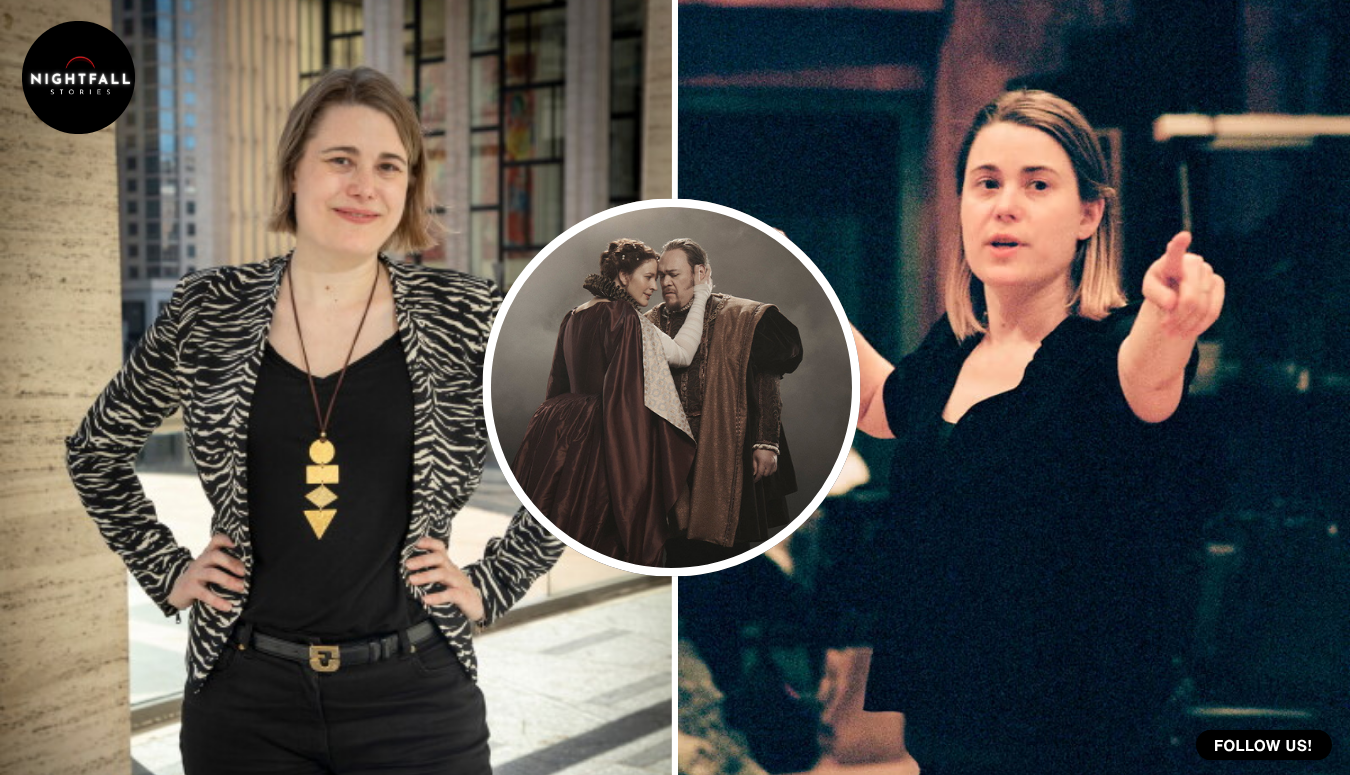
Opening night at the Metropolitan Opera is not a normal night. It is the single most scrutinised evening in American classical music, the one with the red carpet and the international press and a house of nearly four thousand people, and it is usually locked in two or three years ahead. Directors are chosen early precisely so that nobody ever has to rush.
This season’s opener, a new production of Verdi’s Macbeth, went to a director who got the call less than a year before curtain. When the Met’s general manager Peter Gelb reached her, his first practical question was essentially whether she could do it very, very fast, because the set designs had been due already.
Her name is Louisa Proske, she is forty-two, and until now most of her working life had been spent a very long way from a house that size.
It is worth being precise about how she came to be asked, because the easy version of this story is wrong. She was not a panic pick pulled out of a hat. The original director withdrew, which happens, and the Met needed somebody quickly. Gelb has said he was already aware of what Proske had done at Heartbeat Opera, and that she had been on his radar. So the speed was real and the urgency was real, but the name was not a stranger’s. It was a name he had been keeping an eye on, moved up the queue by circumstance.
The line about working very, very fast is not a put-down either, although it reads like one if you take it out of the room. It was a straight description of the calendar. A new production at that scale is a construction job: sets have to be designed, built, trucked and hung, costumes have to be cut, lighting has to be plotted, and every one of those has a deadline that was set before anybody knew who the director would be. Gelb was not testing her nerve. He was telling her that the first thing on her desk was already overdue, and asking whether she wanted it anyway.
She did.
What makes the choice interesting is where she was coming from. In 2014, Proske co-founded Heartbeat Opera, a small experimental company in New York built on the idea that the classics could be torn down and rebuilt with almost no money at all. Their first work was reportedly put together in a yoga studio with an upright piano and a single violin. That is not a charming origin detail, it is a working method. When you cannot afford an orchestra, you have to find out what a piece is actually made of, because you are going to have to rebuild it from the load-bearing parts.
Heartbeat became one of the more talked-about small companies in the city on exactly that principle. Proske left in 2021 and went back to Germany, where she spent four seasons directing at Oper Halle, a serious regional house with a serious workload. So by the time the Met rang, she had both halves of the training: the invention you learn when there is no budget, and the discipline you learn when you are turning out productions on a repertory schedule.
And then there is the coincidence that sounds invented and is not. The opera she was handed was Macbeth. Proske wrote her university thesis, at Cambridge, on Shakespeare’s Macbeth.
It helps to know what she was actually handed. Verdi’s Macbeth was his first attempt at Shakespeare, written when he was still in his early thirties and decades away from the late masterpieces, and he cared about it enough to come back and rebuild large parts of it for Paris nearly twenty years later. The result is a strange, uneven, unusually dark score that never quite behaves like the grand Italian opera around it. Verdi famously wanted a Lady Macbeth who sounded ugly when the drama demanded it rather than beautiful, which is a peculiar thing to ask of an opera singer and a clue about how far from convention he was reaching. It is not a comfortable piece, and it is not an obvious choice for a gala night when the house wants glamour.
That makes it a revealing thing to open a season with. Opening night at the Met is a fundraising occasion as much as an artistic one, and the safe programming instinct is something with big tunes and an easy welcome. Macbeth offers neither. It offers a marriage decaying under the weight of a murder, a chorus of exiles singing about a ruined country, and a lead baritone who spends the evening falling apart. Whoever chose it was not playing for the gentlest possible reception.
You could not write that into a script. Of all the titles in the repertory that could have come free at short notice, the one that did was the one she had already spent a year of her life taking apart on the page. When a director has less than a year to design, cast, rehearse and open a new production, the thing she has least of is thinking time. Proske had done a large chunk of hers two decades earlier.
Her reading of the piece is not the conventional one, and it is not a spectacle-first one either. She has described the opera as a terrifying story for a terrifying time, which is the kind of sentence a lot of directors say, but what she has built underneath it is more specific and more uncomfortable. She is interested in the marriage. Not in the witches, not in the prophecy, not in the crown, but in what happens between two people who decide together to do something monstrous and then have to live in the same house afterwards.
She has talked about the murder becoming their project, their secret and their crime, something you sense they had discussed in private, under the sheets, long before it happened. That turns Macbeth from a play about ambition into a play about intimacy, and it turns the two leads from a tyrant and his manipulator into a couple with a shared plan that curdles.
The witches, in her staging, are repositioned as something closer to greedy voyeurs, watching the pair come apart and enjoying it. That is a genuinely different choice. Most productions use the witches as the engine of the plot. Proske uses them as an audience, which means the people watching in the theatre are quietly implicated too.
The design carries the same idea. Jon Bausor’s set is a modern landscape scarred by war, dominated by a concrete wall, mostly drained to black and white, so that the few moments of colour, blood and the deep velvet of Lady Macbeth’s gown, do all the shouting. Montana Levi Blanco’s costumes pull the other way, toward the Renaissance, so that the people on stage never quite belong to the world they are standing in. The Met’s turntable does the scene changes, which on that stage means the whole world can rotate under the singers without a blackout.
The people singing it are not small names. Quinn Kelsey takes the title role. Lise Davidsen, the Norwegian soprano who has become one of the most in-demand voices anywhere, is Lady Macbeth. Freddie De Tommaso sings Macduff and Ryan Speedo Green is Banquo. Yannick Nezet-Seguin, the Met’s music director, conducts. A first-time director at that house, on that night, is not being handed a quiet room to experiment in. She is being handed the best-resourced opera performance in the country and a cast with their own very firm ideas about the music.
That is the part of this worth sitting with for a moment. The gap between Heartbeat Opera and the Metropolitan Opera is not a promotion, it is a change of physics. At Heartbeat, if an idea was not working at four in the afternoon, you could change it by six. At the Met, an idea has to be committed to months out because somebody has to build it, and once it is built it weighs several tonnes and is already on a truck. The invention that thrives on improvisation has to survive being decided early and then not touched.
Proske had less than a year to make that adjustment, and she made it while the designs were already late.
Opening night came earlier this week. The first published review did not read like a polite notice for a debut. It called the evening thrilling, praised Nezet-Seguin’s work with the orchestra, and singled out Kelsey’s Macbeth as the centre of the night, a portrait built out of weakness rather than menace, with the voice tracking every shift in the man’s collapse. De Tommaso, as Macduff, reportedly brought the house down.
The response to Davidsen was more layered, and it is the most interesting critical note of the evening. Her singing was described in something close to rapture, gorgeous, full of a beauty that is hard to put words around. But the reviewer felt the character’s appetite and her strangeness did not fully come through, and suggested that this might be a consequence of the direction rather than the singer.
That is a fair thing to raise, and it points straight back at Proske’s central choice. If you decide that Lady Macbeth is primarily a wife inside a conspiracy with her husband rather than a supernatural force driving him, you get depth and you get intimacy, and you may well give up some of the terror. Whether that trade is worth it is exactly the argument a new production is supposed to start. A staging that nobody wants to argue about is a staging nobody remembers.
The reviewer also noted the production’s use of doubling, characters mirrored and repeated so that the stage begins to look like the inside of Macbeth’s head, and drew a comparison with Roman Polanski’s film version of the play. Adam Silverman’s lighting and the angular choreography were picked out as doing real work on the tension. The main reservation beyond Davidsen’s characterisation was a pacing one, a feeling that a few of the long pauses could go.
For a debut on the biggest night of the season, delivered on roughly half the usual preparation time, that is a strong landing.
What happens next is where this stops being an opera-world story and becomes something bigger. The production runs for ten performances, and one of the matinees will be broadcast live into cinemas around the world in October. That broadcast is the Met’s widest-reaching format by a distance, and it means Proske’s Macbeth will be seen by an audience that will never stand outside Lincoln Center, in countries where there is no opera house at all, by people for whom this may be the first Verdi they ever watch.
A production conceived in a hurry by a director who spent most of her career making opera in rooms with no money is about to be the version of Macbeth that a global audience meets.
There is something quietly encouraging in that, and it is not the usual underdog story, because Proske is not an underdog. She is a working professional with a Cambridge education and four seasons at a German house behind her. The encouraging part is institutional. The most conservative building in the art form had a hole in its calendar at short notice, and instead of reaching for the safest available name, it reached for somebody whose reputation was built on taking the classics apart in small rooms, and then asked her to do it at full scale in under a year.
Houses do not usually behave that way. Emergencies normally make institutions more cautious, not less.
The other thing worth noticing is how little of this depended on luck and how much depended on work already done. Proske could say yes to a nearly impossible timeline because she had spent a decade learning to build productions fast and cheap, four seasons learning to build them on schedule, and a year at university, long before any of it, sitting with this exact play. The call came out of nowhere. The readiness did not.
She has said the design was due yesterday. It got done. The curtain went up on time, the house was full, the orchestra played, and the first verdict was that it was thrilling. In a run of ten performances and a cinema broadcast still ahead, that is the answer to the question Peter Gelb actually asked her.
She could, it turns out, do it very, very fast.