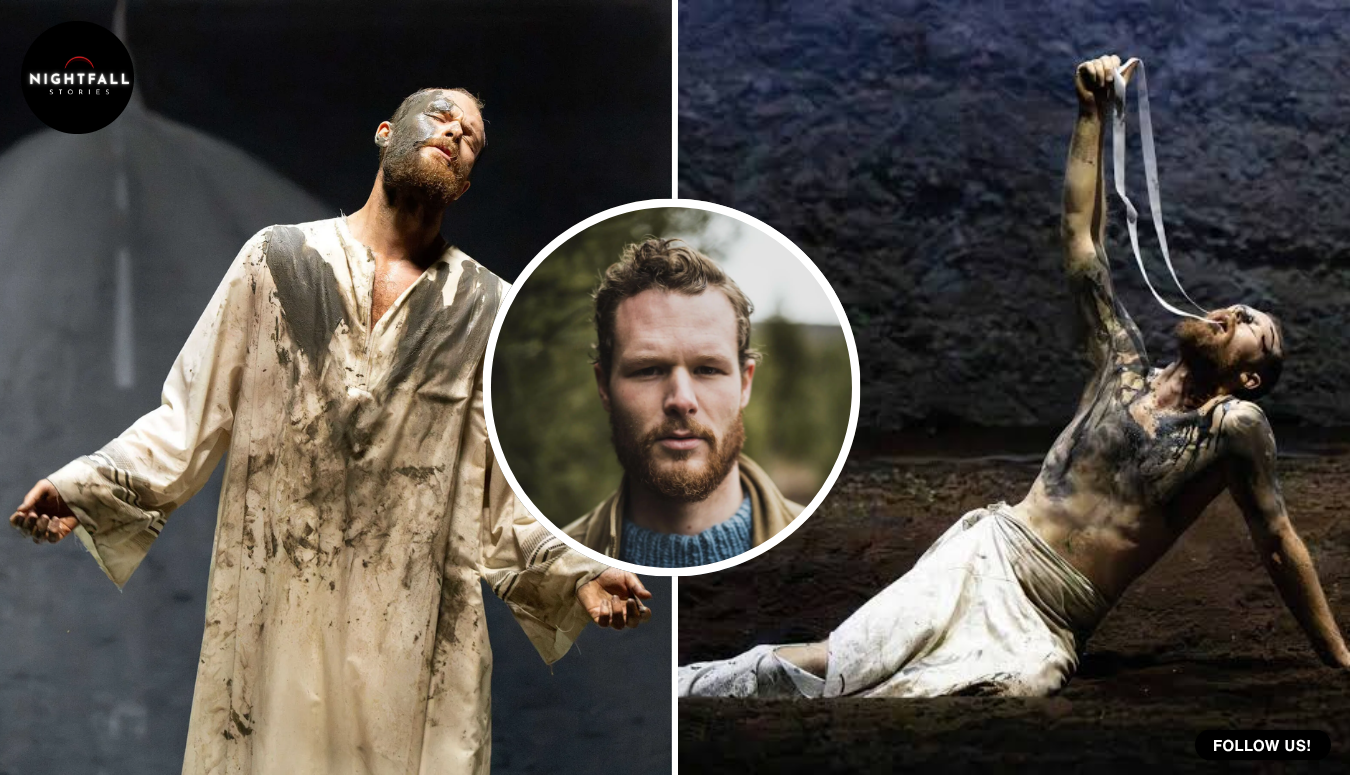
Philippe Sly did not rent an apartment. He climbed a hill above an old European city, knocked on the door of a Capuchin monastery, and asked the friars if he could move in.
They said yes. He stayed for seven and a half weeks, sleeping in a cell with no air conditioning through one of the hottest summers Europe has had, getting up for morning prayers with the community every single day, and walking the long stone stairway down into town and back up again several times a day. He was not on retreat. He was learning a part.
The part was Saint Francis of Assisi, in the only opera Olivier Messiaen ever wrote, and it is widely considered one of the most punishing assignments in the repertoire. Six hours and twenty minutes of music. Eight tableaux. Two intervals of an hour each. A score that runs to around two and a half thousand pages. The title role is on stage for most of it.
Sly is thirty-seven, a French-Canadian bass-baritone from Ottawa who trained at McGill University in Montreal, won the Metropolitan Opera National Council Auditions in his early twenties, came up through San Francisco Opera’s young-artist programmes, and has spent the years since singing Mozart in the big houses. Leporello. Guglielmo. Figaro. Don Giovanni himself at Aix-en-Provence. He is a father of two. None of that prepares you for Messiaen, because nothing does.
What he decided, faced with this, was that the usual approach would not get him there. You can learn notes anywhere. What he could not learn from a score was what it feels like to live the way the man he was playing lived, and the Capuchins are a Franciscan order, which means they are the living continuation of exactly the movement Francis started eight hundred years ago. So he asked, and they let him in.
His day started with Lauds, the morning prayers, and he went to them with the friars every morning for the whole stay. He joined Vespers in the evening. He went to Mass. He did not go as a tourist who watched from the back, and by his own account he did not stay separate from the rhythm of the house. He simply lived inside it for nearly two months and let it work on him.
The monastery sits on a wooded hill above the city, reported at around 1,550 feet above sea level, which means the commute to the theatre was a stairway rather than a road. He walked it repeatedly, in high summer, in the heat. The cell had no cooling. Europe was in the middle of heatwave conditions. He did it anyway, because the discomfort was arguably the point, or at least it was inseparable from it.
What he has said since is the part that sticks. He did not describe it as an exercise he completed. He described it as something he misses. He told a reporter that he longs for it and is excited to go back, which is not how people usually talk about a preparation method. Somewhere in seven and a half weeks the research stopped being research.
And then he had to go and sing for six hours.
It is worth being specific about what Messiaen wrote, because the scale of it is the reason this opera is so rarely staged. He composed it over close to a decade and finished in 1983, nine years before he died. He was a devout Catholic and a serious ornithologist, and both of those facts are all over the score. He spent years transcribing birdsong in the field and building it into his music, and the opera contains a scene in which Francis preaches to the birds, which Messiaen scored with the calls of species he had notated himself, from several continents.
The forces required are enormous. This production used around 120 musicians and a chorus of roughly ninety. The conductor was Maxime Pascal, who has been blunt about the difficulty, pointing out that two and a half thousand pages of music, much of it extremely complex, is simply a different proposition from a standard night in the pit. The rhythmic writing is so intricate that a second conductor was stationed in the pit using a baton fitted with a white light, purely to give the percussion section beats that clash with what everyone else is counting. That is not a gimmick. That is what the notation demands.
The staging around Sly was, if anything, more extreme than the score. The director was Romeo Castellucci, an Italian whose work tends to divide rooms, and his reading of the piece rejected the idea of telling a story in a line. He has described the opera as a deliberate counter-model to conventional opera, something Messiaen designed to be unorthodox, and said he thinks of it as a series of separate images in the way a medieval fresco cycle is a series of separate images rather than a narrative. His job, as Pascal put it, was making inner processes visible.
So there were live animals. A Czechoslovakian wolfdog. A peahen. Seven sheep, which appeared near the end as the roof of the theatre opened above the stage, because the venue is the Felsenreitschule, a fourteen hundred seat theatre cut into the face of a rock quarry, with arcades carved into the stone behind the playing area. Older audiences know it without knowing they know it, because it is the theatre in the final act of The Sound of Music.
And there was bread. Two industrial four-level ovens were brought onto the stage, each weighing roughly 1,200 kilograms, about 2,650 pounds. During every performance they baked thirty-three sourdough loaves. This was not mimed. The ovens worked, and the smell of baking bread filled a fourteen hundred seat auditorium while one of the most complex scores of the twentieth century was being performed in it.
Sly connected the bread to the text rather than treating it as a stunt, pointing to the line about the kingdom of God being like yeast, the small hidden thing that transforms the whole loaf. And the loaves themselves were not thrown away. Following the Franciscan practice of giving bread to the poor, they went to the backstage crew after the show, which is a quietly perfect resolution: the most hands-on, least glamorous workers in the building eating the bread that the opera baked.
The people around Sly mattered too. Soprano Lauranne Oliva sang the Angel. And in the smaller role of Brother Bernard was Willard White, now seventy-nine, one of the great bass-baritones of the last half century, who sang the title role himself in the only major American production this opera has ever had, in San Francisco in 2002.
White mentored Sly through it, and the advice he gave was not technical. His point was that you cannot muscle your way through six hours of Messiaen on craft alone, and that what carries a singer is a mindset in which accepting the moment you are in is what leads you into the next one. Which is, if you think about it, almost exactly what the friars on the hill had been practising in front of Sly every morning at Lauds. The preparation and the performance advice turned out to be the same idea arriving from two directions.
The lineage behind the role is short, because so few singers have ever done it. José van Dam created Francis at the premiere in Paris under Seiji Ozawa. Van Dam sang it again in a celebrated staging directed by Peter Sellars, with Esa-Pekka Salonen conducting the Los Angeles Philharmonic, at the same Austrian festival back in 1992. White took it on in San Francisco a decade later under Donald Runnicles, in a production championed by the company’s general director Pamela Rosenberg, who called the piece one of the two or three most compelling works of the second half of the last century. Then, for years, almost nothing. Sly now joins a list you could count on your fingers.
There were six performances in total, each running well past six hours from curtain to curtain, delivered in a stone amphitheatre in high summer, with animals, ovens, a hundred and twenty players and a ninety-voice chorus, and a Canadian who had been getting up for dawn prayers with friars since early in the summer.
The vocal demand is its own problem, separate from the length. Messiaen was not writing for the voice the way an opera composer usually does. He wrote long, slow, deliberately unshowy lines for Francis, often sitting in an uncomfortable middle part of the range where a singer gets no help from resonance and no chance to ride the orchestra. There are no arias to hide behind and very little repetition to lean on. The role asks a performer to stay quiet and steady for hours while the orchestra around him does enormous things, and to still have voice left at the end, when Francis dies and the whole apparatus, chorus included, opens up into a blaze of sound that the composer intended as the resurrection.
There is also the scene most singers mention first, in which Francis forces himself to embrace a leper and is transformed by the act. It is written as the hinge of the entire piece. Messiaen, who believed all of it literally, built the opera around a handful of moments of grace rather than around events, which is exactly why Castellucci staged it as separate images. Nothing in it develops the way a plot develops. It accumulates.
Knowing that, the choice to move onto the hill starts to look less eccentric and more like the only sensible response. An actor can research a character by reading about him. Sly was being asked to embody a specific inner state for six hours at a stretch, night after night, and there is no library that teaches that. What there is, still operating, eight centuries on, is a community of men who organise their entire lives around the same idea. The Capuchins are one of the Franciscan branches, the reformed one, historically the most austere. Their house above the city has been there for centuries. They keep the hours, they keep the poverty, they get up in the dark.
It would be easy to write all of this as a story about excess, and plenty of the coverage did, because live sheep and industrial bakery equipment make for good headlines. But that misses what Sly actually did, which was quieter and more interesting than any of the staging.
Actors talk about immersion constantly, and most of it amounts to a few weeks of reading and a change of diet. Sly did something that was genuinely inconvenient. He gave up comfort, privacy and air conditioning during a heatwave, accepted an externally imposed daily schedule that started before dawn and did not bend around his rehearsals, and submitted to the routines of a community he was not a member of. He did it for nearly two months. And he did it in service of a role in an opera that will probably not be staged again anywhere in the world for another decade.
There is no career logic to that. There is no version of this that makes him more castable. Saint Francis is not a part that recurs, and the hours he put in on that hill are not transferable to the next Don Giovanni.
The only explanation that holds is that he thought the piece deserved it, and that he could not get where he needed to be by any shorter route. Messiaen wrote an opera about a man who gave away everything he owned and went to live with nothing. It is difficult to argue that the right way to prepare for it is from a serviced apartment.
The most telling thing is what happened to the plan afterwards. Preparation is supposed to end when the run ends. You do the work, you use it, you give it back. Instead Sly has talked about the friars in the present tense, about missing the shape of their days, about wanting to return. The habits stayed with him after the last performance, which suggests that at some point the monastery stopped being a method and started being something he actually wanted.
Francis, the real one, was a wealthy young man who walked away from his family’s money and spent the rest of his life outdoors, talking to birds, and being regarded as either a saint or a lunatic depending on who you asked. Eight hundred years later a Canadian singer climbed a hill to try to understand him well enough to stand in a rock quarry and sing him for six hours.
He came down changed, which is roughly what Francis tended to do to people. The sheep went home. The bread got eaten. And the friars, one assumes, kept getting up for Lauds, exactly as they had before a bass-baritone arrived on their doorstep with an unusual request and exactly as they did after he left.