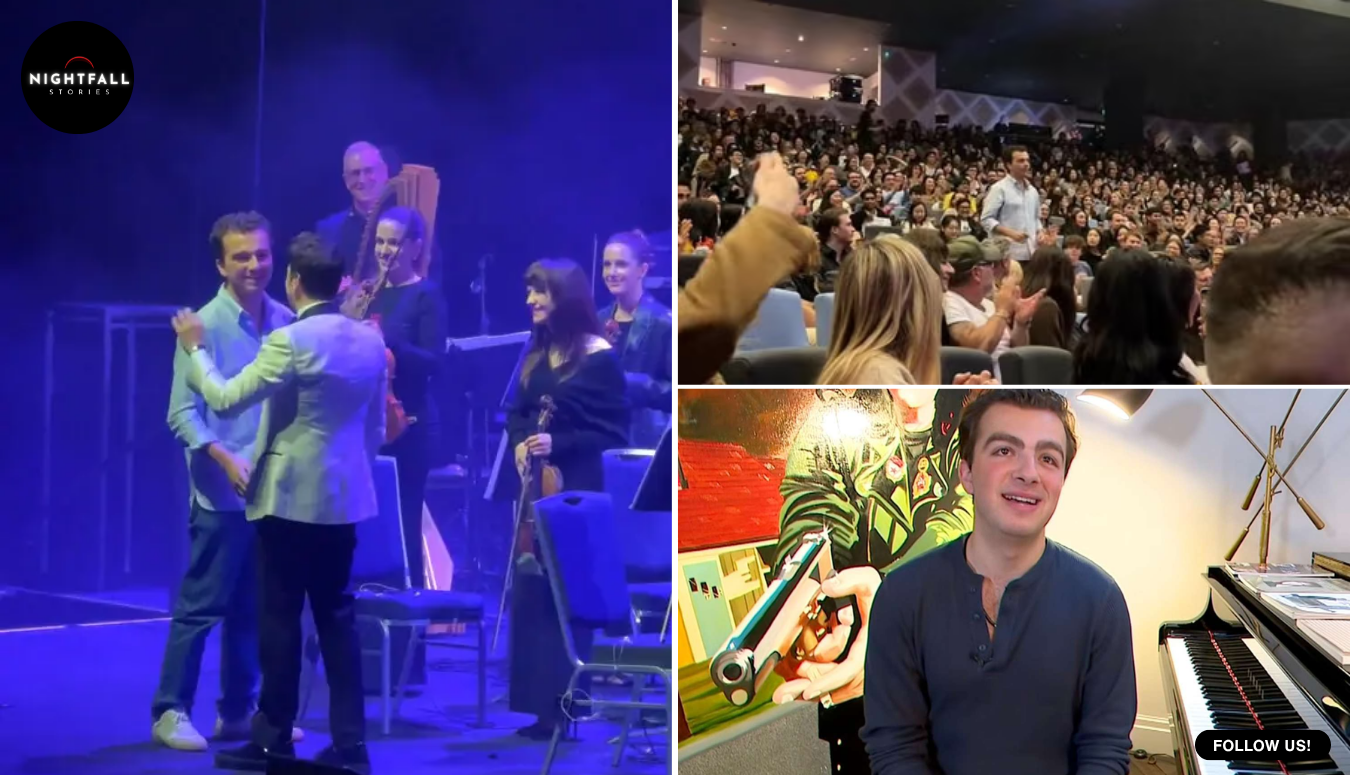
Sterling Nasa had paid for his ticket like everyone else. He was twenty-one, a politics student, and he had come to a Sydney concert hall to watch La La Land on a big screen while a full orchestra played the score live underneath it. Two hours later he was sitting inside that orchestra, in front of a couple of thousand strangers, improvising a synthesiser solo on an instrument he had never touched before, with no rehearsal, no run-through, and the film rolling on above his head whether he was ready or not.
The part that makes musicians wince when they hear this story is that he could not stop. A live-to-film concert is not a normal concert. The picture runs at a fixed speed, the orchestra is locked to it, and if the keyboard drops out the whole thing does not gently sag, it visibly comes apart in front of everybody. There is no pausing to find your place. There is no conductor slowing down to let you catch up, because the conductor is himself chasing a film that does not care.
Here is how a student ended up in that chair. The show was La La Land in Concert, the touring version of the film in which the soundtrack is stripped out and replaced by a live orchestra playing it in real time. It had come to the theatre at Sydney’s International Convention Centre on Darling Harbour, and the man on the podium was Justin Hurwitz, who wrote the score in the first place and won two Academy Awards for it. Reports of the crowd size differ a little, with some putting it around two thousand and others at two and a half thousand. Either way, the room was full and the night was sold.
The first half went fine. At the interval, the keyboard player fell ill and could not come back.
That is a bigger problem in this particular score than it would be in most. Hurwitz’s music for La La Land leans hard on keyboards. There is jazz piano everywhere, there is celesta, there is synthesiser, and several of the film’s best known moments simply do not exist without a keyboard player. You cannot quietly redistribute that among the strings and hope nobody notices.
So the break kept getting longer. What was supposed to be about ten minutes reportedly stretched towards forty while the production tried to find a professional keyboardist who happened to be free on a Saturday night in the middle of Sydney and could be in the building in under an hour. Anyone who has ever tried to book a musician at short notice already knows how that went.
Eventually Hurwitz did the thing that composers do not do. He walked out to the front of the stage, in front of a room that by now knew something had gone wrong, and asked whether anybody out there was an amazing sight reader.
Sterling Nasa did not put his hand up. His friend Scarlett put it up for him.
She had a fairly specific argument for it, too, which was that whatever happened next, it would be worth telling his children about one day. That is how he has described it since, and it is a very good reason to do something terrifying. He says he was reluctant, and that the reluctance lasted about as long as it took him to realise she had already committed him. Then he found enough confidence to stand up.
Somebody walked him backstage. And this is where the story stops being a cute anecdote about a helpful audience member and starts being genuinely absurd, because Nasa is a real musician, just not this kind of real musician. He plays piano. He plays organ. He also teaches bagpipes at a Sydney school, which is a sentence that tells you a certain amount about how his musical education went. What he had never done was play celesta, and the keyboard rig in front of him included one.
He also had no rehearsal. Not a reduced one. Not a quick run of the tricky corners with the conductor. He was handed the second half of a film score and told the show would resume shortly.
Then there were the page turns. In an orchestra, keyboard players and string players usually have somebody to turn pages for them, because you cannot take a hand off the instrument in the middle of a run. Nobody had arranged that. Nasa had to manage his own paper while sight reading music he had never seen, in time with a film he could not slow down.
He has said he was properly nervous for the first ten minutes or so and then something settled, which is roughly what every musician who has ever been thrown into a deep end will tell you happens. The brain runs out of capacity for panic because it is using all of it on the notes.
And then the second half arrived at Start a Fire.
If you have seen the film, you know this one even if you do not know its name. It is the slick, glossy, faintly heartbreaking number that Keith’s band performs, the song that marks the exact moment Sebastian sells the thing he swore he would protect. John Legend sings it. In the middle of it there is a synthesiser solo, and it is not a polite one. It is fast, it is jazzy, it is the sort of writing that a session keyboardist prepares for.
Nasa looked at it and made a decision that a more cautious person would not have made. He decided not to try to play what was written. He improvised instead, in the right key, in the right spirit, at the right speed, in front of the composer who wrote the piece.
He has been refreshingly unromantic about why. Trying to sight read that solo cold would probably have produced a mess. Inventing something that fitted was, in his own assessment, simply the better option available to him at that moment. He took a creative liberty, he has said, and it turned out to be the right call.
The room went up. Not a polite ripple of goodwill for the brave volunteer, but a genuine roar, the kind an audience gives when it has just watched somebody get away with something.
Hurwitz found him afterwards and told him, with what sounds like complete honesty, that he had been worried Nasa would not be able to do it. Which is fair. From the podium, watching a stranger sit down at your score with a film already rolling, worry is the only reasonable emotion. He also said that being able to play a properly good solo with no rehearsal at all was remarkable. Coming from the man who wrote the notes, that is about as high as the praise goes.
What makes this land is not that a hero appeared. It is how close it came to being nothing at all. If Scarlett had not raised his hand, he would have sat there. He has admitted as much. A reluctant twenty-one-year-old in a dark auditorium, doing the arithmetic on public humiliation, would almost certainly have let the moment pass, and the show would have been refunded, and two thousand people would have gone home mildly annoyed and forgotten about it by the following week.
Instead there is now footage, and the footage travelled. Australian television picked it up, then the wires, and within a couple of days Nasa had been booked onto morning shows to explain how a politics and international relations student ends up rescuing an orchestra. He handled it, by all accounts, with the slightly dazed good humour of someone who has not yet caught up with his own weekend.
It is worth saying plainly what he actually did, because the headlines flattened it into student plays piano, and that undersells it. Sight reading is a distinct skill, separate from playing well. Plenty of excellent pianists are mediocre at it, because they learn repertoire slowly and deeply rather than reading it cold. Sight reading a film score is harder again, because the music is written to serve picture rather than to sit comfortably under the hands, and it is full of sudden metre changes and rests measured in seconds rather than bars. Doing that on an unfamiliar instrument, with your own page turns, in a genre that is not your training, while a two thousand seat room waits, is an unusual amount to ask.
It helps to understand what the format actually demands. Live-to-film concerts have become one of the steadier earners in the orchestral world over the past decade, and the reason is simple: they bring in people who would never buy a ticket to a symphony. The audience comes for the film. The orchestra is the surprise. But the musicians are doing something closer to session work than concert work, because the score has to line up with picture to within a fraction of a second, every night, without the elastic give that an orchestra normally enjoys. Many players wear an earpiece carrying a click track. The conductor watches a screen with streamers and punches on it, visual cues that tell him precisely where the beat has to land. It is a discipline, and it is unforgiving, and it is the environment a student was dropped into halfway through a Saturday evening.
The instrument makes it stranger still. A celesta looks like a small upright piano and sounds like a music box, because inside it the hammers strike metal plates rather than strings. It turns up in film scoring constantly, wherever a composer wants that glassy shimmer, and Hurwitz uses it in the dreamier corners of the La La Land score. The keyboard layout is familiar to any pianist. The touch is not. The response under the fingers is different, the sustain behaves differently, and the sound only really works if you play it with a lightness that takes most people a few sessions to find. Nasa had no sessions. He had the second half.
And he was not playing it for a forgiving room, either. Nobody in that audience had come to watch a plucky amateur. They had come to see a beloved film with a professional orchestra, at professional prices, and had already spent forty minutes wondering whether they were about to be sent home. Goodwill in a delayed auditorium is a finite resource.
There is a wider thing here too, about how much of live performance is held together by people who are simply present. Orchestras run on deputies. A player falls ill, a call goes out, somebody who knows the repertoire walks in and does the job, and the audience never learns how close the evening came to collapse. That system works because the pool of available professionals is deep in most major cities on most nights. What happened in Sydney was that system failing on a Saturday, and the gap being filled by the amateur pool instead, which is the far larger and almost entirely invisible group of people who learned an instrument properly and then went and did something else with their lives.
Nasa is one of thousands of them. He is not a conservatorium student. He is not about to abandon international relations for a career in film music. He is a young man who put in the hours as a child, kept playing because he liked it, and happened to be sitting in the right room on the night the machinery broke.
That is the part worth holding onto. The story looks like luck, and some of it was, but the luck only paid out because the preparation was already there, laid down years earlier for no particular reason, by a kid practising scales with absolutely no idea that the payoff would be a synth solo in front of a couple of thousand people and an Oscar winner.
He has been clear that he does not intend to change direction. He still goes to the same lectures. He still teaches bagpipes. The keyboardist recovered. The tour moved on to its next city with its regular player back in the chair, and the run continued as advertised, which is exactly how these things are supposed to end.
What he has, instead of a new career, is the single best answer to a dinner party question that any twenty-one-year-old currently possesses. And he has Scarlett, who was right, and who now gets to say so for the rest of their friendship. The dad lore was secured. It turned out to be worth quite a lot more than that.
There is one more detail that stays with you. When Hurwitz made the appeal, he did not ask for a pianist. He asked for an amazing sight reader, which is a much more specific and much more honest request, because he knew exactly what the job required. In a room of two thousand people, exactly one person eventually stood up, and he was not sure he could do it either.
The gap between those two facts is where the whole story lives. Somebody has to be willing to find out.