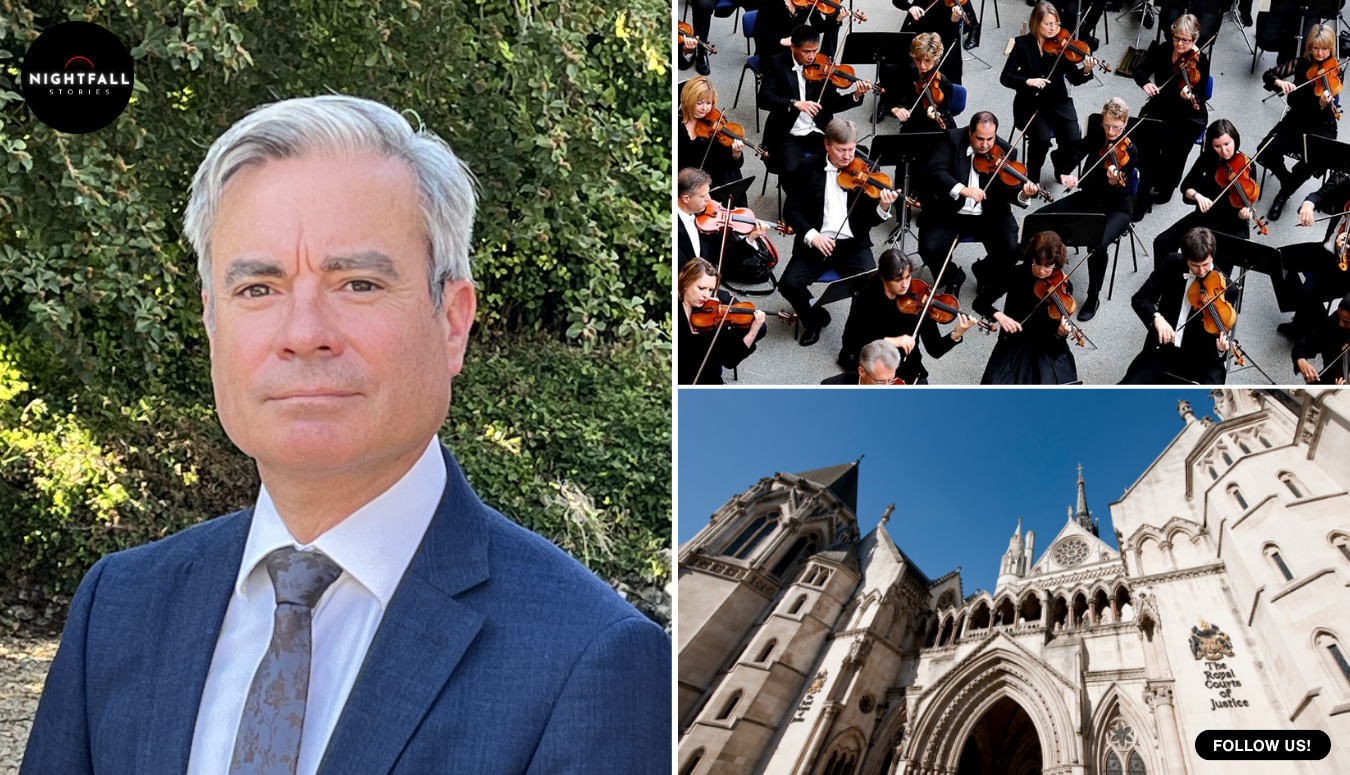
When the King approved ten new judges of the High Court of England and Wales in late September, one of the ten had spent his twenties earning a living with a cello between his knees. This is not a colourful rumour attached to him by the music press. It is in his official biography, published by the Judicial Appointments Commission on the day the appointments were announced, which states that Aidan Eardley KC read French and Philosophy at Merton College, Oxford, completed a postgraduate performance course at the Royal Academy of Music, and then worked as a professional cellist in the BBC National Orchestra of Wales before retraining as a lawyer.
That is the whole shape of it in one sentence, and it is worth slowing down, because almost nobody makes that particular move. Plenty of lawyers play an instrument well. Plenty of musicians end up doing something else for money. A salaried chair in a national broadcast orchestra, given up in order to start again at the bottom of a profession where the entry queue is famously brutal, is a different order of decision.
And there is a detail buried in his chambers profile that most readers, including most lawyers, will glide straight past. Among his qualifications, alongside a First from Oxford and a Diploma in Law from City University taken with distinction, sits a line reading DipRAM, the Royal Academy of Music, 1993 to 1995.
Here is the thing about a DipRAM. It is not a qualification. The Academy’s own regulations say so in plain institutional language: the DipRAM is an institutional prize and not a qualification outcome that follows a programme of study. It is awarded at the discretion of the examination board for outstanding performance in a postgraduate final recital. You cannot enrol in it. You cannot revise for it. You play your final recital, and afterwards a board of examiners decides, entirely at its own discretion, whether what it just heard was outstanding. If it decides yes, you carry three letters for the rest of your life. If it decides no, you carry the course and not the prize.
Those regulations are the Academy’s current ones, and a conservatoire can adjust its awards over thirty years, so the precise wording he was judged against in the mid 1990s may have differed in its details. The principle has been consistent for a long time, though. The DipRAM has always been a distinction, not a certificate of attendance.
So the first fact about the new judge is that when he was in his early twenties, a room full of professional musicians listened to him play and concluded he was exceptional at it. Then he went and did something else.
To understand why that is less strange than it sounds, it helps to be honest about what an orchestral career actually is, because the popular picture of it is wrong in a specific way. People imagine the difficulty is getting good enough. The difficulty is arithmetic. In any country, at any time, there is a small and almost fixed number of salaried orchestral chairs. They do not multiply when a good generation comes through the conservatoires, and they do not open when somebody is ready. They open when somebody retires or moves on. Every year the Academy and its equivalents send out a cohort of players who are, by any historical standard, superbly trained, into a job market that has not grown to meet them.
Eardley got one of those chairs. That is the part of his story that is hardest to do and easiest to skip over. Winning a place in a broadcast orchestra means surviving a blind audition process designed specifically to strip away everything except how you sound, usually against a field of people who have also been told they were exceptional.
Then consider what the job is, once you have it. A section cellist is not a soloist. The work is to make your line disappear into fifteen other people’s and to subordinate your reading of a phrase to the conductor’s and the section leader’s. You rehearse one thing in the morning and record something else in the afternoon, then take a third programme on the road next week. It is craft of a very high order and it is also, structurally, a life of executing other people’s decisions with enormous precision. Some players find that deeply satisfying for forty years. Others find, somewhere around thirty, that they want to be the one deciding.
His chambers profile records what happened next in the driest possible terms. A Diploma in Law at City University in London, taken over a single year around the turn of the millennium, with distinction. The Bar Vocational Course at the Inns of Court School of Law, graded outstanding. Called to the Bar in 2002. Then media and communications law, first at 1 Brick Court and later at 5RB, silk in 2022, twenty years after call.
That one-year law diploma is worth a sentence of its own, because it is the piece of infrastructure that makes this whole story possible. It exists precisely for people who already have a degree in something else and want to convert. Without it, a cellist in his late twenties would have faced starting an undergraduate law degree from scratch. With it, the gap between leaving the orchestra and standing up in court was measured in a handful of years rather than most of a decade. A great many second careers at the Bar run through a door like that one.
What the door does not do is make the years afterwards easy. Converting is the cheap part. The expensive part is pupillage, the apprenticeship year that every barrister in England and Wales has to win before practising, for which there have always been far more applicants than places. Someone arriving from an orchestra had no legal family, no set of chambers with a familiar surname on the door, and a CV whose most striking line was a music prize. He would have been competing against people who had been aiming at the Bar since they were nineteen. He got in anyway, and then spent two decades building a practice before anyone put silk in front of his name.
The beat he chose is also, as it happens, the most explicable area of English law for a general reader, because it is about what newspapers, broadcasters and websites are allowed to say about people. Media and communications work sits on a permanent fault line between two things most people believe in simultaneously. One is that the press should be able to publish uncomfortable truths about the powerful. The other is that an ordinary person should be able to keep their private life to themselves. Almost every case in the field is a fight over where the line between those two falls in one specific set of circumstances.
That is also why it is a field with an unusually high proportion of ordinary people in it. The reported cases tend to involve public figures, because public figures are the ones with the resources to litigate, but the law those cases make applies to everybody. Whether a newspaper may name the children in a story, whether a person acquitted of something can stop that story being republished forever, whether a photograph taken in a hospital car park is private: those are not abstractions to the people involved. A media barrister spends a career deciding, on behalf of one side or the other, how much of a stranger’s life is public property.
The best illustration on his own case list is a contempt case that had nothing to do with privacy at all. A few years ago the UK Supreme Court was preparing to hand down its judgment on the expansion of Heathrow Airport. As is standard, the result went out in advance to the parties under embargo, the ordinary mechanism that lets lawyers prepare and journalists write before publication. Tim Crosland, an unregistered barrister involved with a climate campaign group, deliberately published the outcome early, and said so openly. His argument was that the breach was a proportionate response to what he described as suppressed evidence of extreme danger to the public.
Eardley appeared for the Attorney General. The court found Crosland in criminal contempt and fined him five thousand pounds, roughly six thousand dollars at the time, with costs. Presiding, Lord Lloyd-Jones set out the principle that decided it: there is no such thing as a justifiable contempt of court, though the court accepted that acts of conscientious civil disobedience may attract some leniency in what follows.
It is a small case with a very large idea inside it, and it is a useful window into what the work involves. Crosland was not accused of lying. He published something true. The question was whether a person who believes strongly enough in their cause may decide unilaterally which of a court’s rules bind them. Arguing the government’s side of that is not glamorous. It is the unshowy, structural end of the law, where somebody has to make the case that the machinery matters even when the person breaking it has decent motives.
His profile lists other matters in the same territory, including a Court of Appeal case brought by the businessman Raffaele Mincione against the Italian publisher GEDI Gruppo Editoriale, and a libel claim between two members of the UK Parliament, Andrew Bridgen and Matt Hancock. Read together, the list is a fairly precise portrait of a practice: who can sue a publisher, where they can sue, and what a publisher is entitled to print.
There is an obvious temptation here, and it should be handled carefully rather than indulged. It is very easy to write that a chamber musician and a judge are doing the same thing, that both are trained to hold several lines at once and decide which one governs, and that a person who has spent years listening for the moment a second violin is fractionally early will make a good listener on the bench. There is something in that. Ensemble playing genuinely is the discipline of tracking multiple simultaneous arguments without losing any of them, and a trial is genuinely the business of following several competing accounts of the same events and deciding which one holds.
But it should be said plainly that Eardley does not appear to have made this claim about himself anywhere on the public record, and that the profession is full of excellent judges who cannot read a note of music. The honest version is narrower and more interesting. Both jobs demand an unusual tolerance for preparation that nobody will ever see. A cellist practises a passage two hundred times so that the audience hears it once and notices nothing. A barrister reads eleven thousand pages so that thirty minutes of argument sounds obvious. The person who can do the invisible part without resenting it is rare in either trade.
One more thing in the official biography deserves attention, because it is the least musical and possibly the most consequential detail in it. Eardley grew up in Buckinghamshire and attended state schools, and he is the first lawyer in his family. The senior judiciary of England and Wales has spent years being criticised, accurately, for drawing from an extremely narrow slice of the population, and the Judicial Appointments Commission now says so directly in its own announcements, noting how many of the new appointees were the first lawyers in their families or the first to go to university. A man who financed his twenties playing in an orchestra, with no legal relatives to explain the route to him, is a data point in a slow correction that is nowhere near finished.
The path to the bench itself was gradual and entirely conventional once he was on it. Fee-paid judge of the First-tier Tribunal in the Social Entitlement Chamber from 2013, which is unglamorous work on benefits and entitlements and about as far from media law as it is possible to sit. Recorder from 2020, hearing criminal cases on the Wales Circuit. Deputy High Court Judge from 2024, sitting in the King’s Bench Division, including in the Media and Communications List and the Administrative Court. Fifteen years of sitting part time before anyone made him a judge full time.
That Welsh criminal work is worth pausing on, because it is the opposite of everything else on his record. Media and communications law is a small and highly specialised practice, concentrated in London, with clients who can afford it. Sitting as a Recorder in the Crown Courts of Wales means burglary, assault, dishonesty and the daily traffic of criminal justice, with defendants who have never met a lawyer before and juries who need the law explained in ordinary words. Judges who have only ever done one kind of case are a known weakness of the English system, and part-time criminal sitting is the mechanism by which the profession tries to fix it before anyone gets a permanent seat.
And that appointment is not quite a finished fact yet, which is worth stating precisely rather than dramatising. The ten appointments were approved and published in late September, and they take effect in stages across the following months, into the end of the year. Eardley will sit in the King’s Bench Division, the division that handles, among much else, the media and communications cases he has spent two decades arguing. In court he will be addressed as Mr Justice Eardley, and in writing he becomes The Honourable Mr Justice Eardley, a formula that has been in use a great deal longer than the Royal Academy of Music has existed.
There is a neat symmetry in where he ends up, and it is not the one about music and law being secretly the same. It is about who does the deciding. Thirty years ago a young cellist walked into a recital room and played for an examination board that had absolute discretion over whether what he did was outstanding. He could prepare for it, but he could not control it. Somebody else listened, and somebody else ruled.
Shortly he will take his seat in a division of the High Court, and for the rest of his working life he will be the one doing the listening, with people who have prepared for months standing in front of him, unable to control the outcome, waiting to hear what he has decided. The same room, viewed from the other chair.