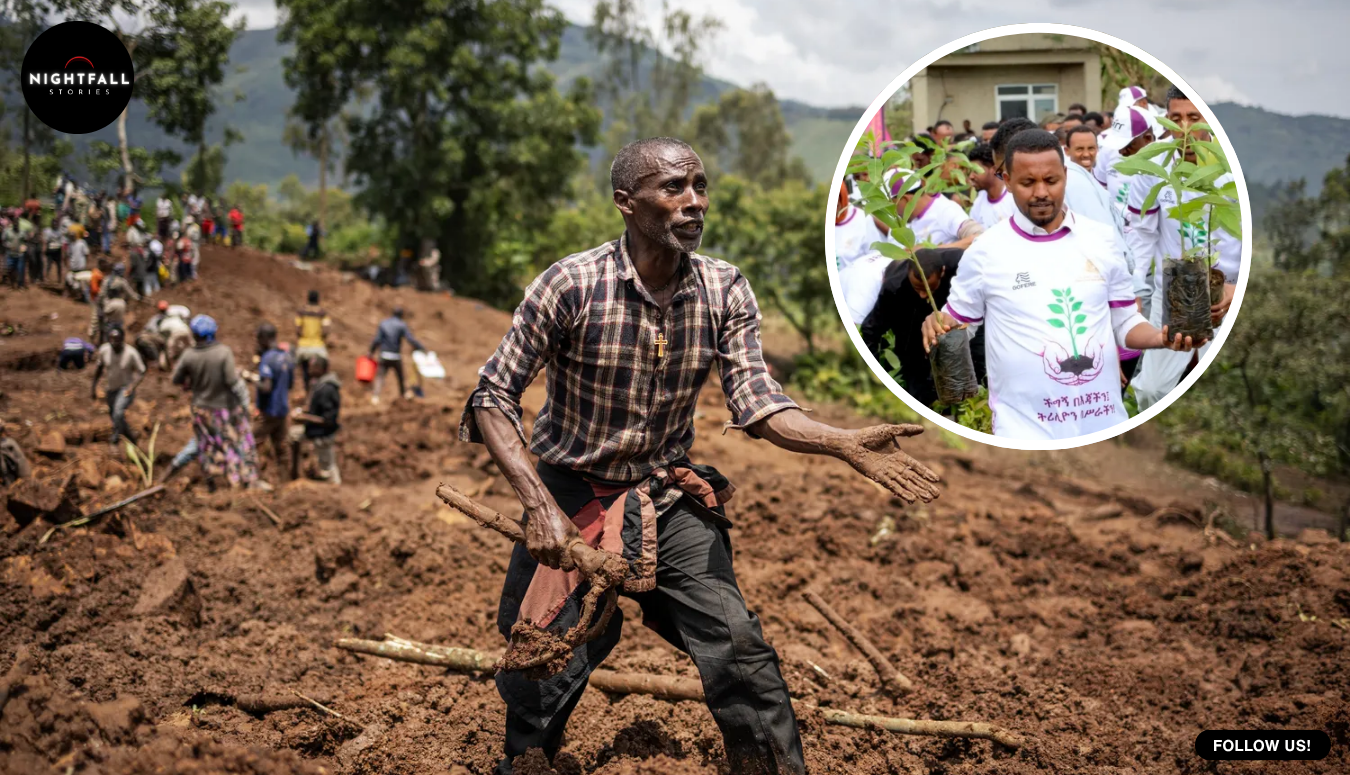
Niku Argane’s farm sits on a steep hillside in the Gurage Zone of central Ethiopia, in a semi-mountainous stretch of country where years of flooding have cut deep gullies straight through the land. He is 32. He has a wife and four children, and the soil on that hillside used to grow enough barley and potatoes to feed all of them and leave a surplus to sell at market.
Then it stopped doing that. The soil eroded, washing downhill every rainy season through the gullies the water had opened. Drought made what was left harder to work. As he put it to a reporter who came to the farm, they never stopped farming, but production fell because the land was degrading underneath them.
What he did about it is unremarkable on paper. Since 2019 he has planted eighty tree seedlings on his own farmland and another fifty in a communal area nearby. Along the edges of his fields he has put in grass, fodder plants, fenugreek and fruit trees, which hold the soil in place and also feed the four cows, six goats and three sheep he keeps for milk and meat. Nothing in that list is clever. Any agricultural extension officer anywhere would recommend it.
His barley harvest has gone from about 1,800 pounds an acre to roughly 3,200.
That number is his own account rather than an independently measured yield, and it belongs to the whole package rather than to the trees alone: seven years of grass and fodder and fenugreek and edge trees, all working together to stop water running off a slope and taking the topsoil with it. But it is close to a doubling, on a hillside that was being written off, and that is the part worth understanding, because according to the researchers who work on this, what happened on Argane’s land is close to a statistical freak.
Aad Kessler is a researcher at Wageningen University in the Netherlands who studies land restoration for a living, and he is broadly supportive of what Ethiopia has been attempting. Here is how he describes the thing he supports: “Reforestation is one of the most difficult things you can imagine. It almost always fails.”
It is rare to get a sentence like that from someone on the inside. Scientists who back a programme usually defend it. Kessler’s position is that the effort is worth making precisely because it is enormous, and that at this scale even a thirty percent survival rate would still represent a vast amount of new tree cover. That is arithmetic rather than optimism, and it quietly concedes that most of what gets planted is expected to die.
Why does tree planting fail? Not for the reasons most people assume. It is not usually about the wrong species, or bad soil, or even drought, though all of those contribute. The mechanism is simpler and more human than that.
Emiru Birhane Hizikias, a restoration ecologist at Nord University in Norway, puts it in a single image: you cannot expect a baby to grow if you do not care for it, and that, he says, is how plantation in Ethiopia is being done. A seedling is not a finished tree. It is a fragile thing six inches tall that needs water in its first dry season, protection from grazing livestock in its first two or three years, and somebody to notice when it is failing and replace it. Planting is the easy, visible, photographable part, and it takes an afternoon. Tending is years of unglamorous attention that nobody films.
This is where the scale comes in, and it is the only place in this article where it will. According to the Ethiopian programme’s own accounting, published by its Ministry of Agriculture and reported by Yale Environment 360, tens of millions of Ethiopians have planted more than 47 billion seedlings in the last seven years, against a stated target of 50 billion by 2030. That figure is the government’s own self-reported total for its own programme and should be read as such. It has never been independently audited at national scale, and nothing in this article depends on it being right.
What can be checked, and has been, is what happened to the seedlings.
A study published last year in the journal Discover Environment did the work properly on one district. Setiye Abebaw Tefera and Vijaya Lakshmi Thatiparthi, at the Centre for Environment at JNTU in Hyderabad, took satellite imagery from Landsat and Sentinel over the Gubalafto district in north-eastern Ethiopia, about a thousand square kilometres, and tracked land cover from 2013 to 2024 using machine classification and vegetation indices.
Some of what they found is genuinely encouraging. High-density vegetation in that district went from under one percent of the land area to more than nine percent over the eleven years, a roughly tenfold increase. Woodland expanded by around forty square kilometres, mostly converted from farmland.
And some of what they found is the uncomfortable part. Actual forest cover in the same district fell over the same period, from a little over sixteen percent to under fifteen percent. Tree planting and forest loss were happening simultaneously in the same place. More importantly, the authors put district-level seedling survival at just under forty percent on average, with a range running from under eight percent in the worst areas to around seventy-six percent in the best. They also note that armed conflict in the region after 2020 disrupted restoration work, which is a reminder that none of this happens in a vacuum.
Just under forty percent survival, with some places losing nineteen seedlings in every twenty. Kessler’s illustrative thirty percent, which he offered as a deliberately pessimistic floor, turns out to have been close to the real figure.
The gap between what is claimed and what survives has been pressed before. Reporting a couple of years ago found that while officials had put survival at eighty-five percent for one year’s planting, sources inside the country’s own environmental commission suggested the true rate might not pass fifty percent. The same reporting carried a far more sobering comparison from Wubalem Tadesse of the Ethiopian Environment and Forest Research Institute, who pointed out that data indicated more than ninety-two thousand hectares of forest were being destroyed every year while the country was planting roughly twenty thousand. That is a national programme of extraordinary ambition running at roughly a fifth of the speed of the damage.
There are other structural problems, and they are the sort that explain a thirty-nine percent survival rate better than any amount of talk about rainfall. The programme has been described as lacking a dedicated budget and a single coordinating office, with responsibility split across three government ministries, which is a reliable recipe for nobody being accountable for what happens to a seedling in year two. The official species target was around thirty percent fast-growing trees, thirty percent indigenous species and forty percent fruit-bearing and ornamental, but farmers have strong economic reasons to favour fast-growing eucalyptus, which earns money and is hard on the water table and on whatever is growing near it.
None of which is an argument that the planting days are theatre. They are not, and the people who turn up to them are not fools.
On one day each August, millions of people across the country go out and plant. One of them, Yeshihareg Teferi, travelled at sunrise from her home in Addis Ababa out to Tulu Dimtu so that she could crouch in the rain and dig holes in the mud. It was her fifth consecutive year doing it. In previous years she had put in indigenous species, African wild olive and African fern pine among them. This time she chose juniper. Her reasoning, as she gave it, was about obligation rather than enthusiasm: that there is a responsibility to make sure the next generations inherit green and fertile ground rather than bare land.
That is the right instinct and it is also, on its own, not enough, and the uncomfortable truth in the survival figures is that her juniper has somewhere around a two in five chance.
It is worth holding on to how hard the underlying problem is, because nothing about this is a story of lazy farmers. Belayneh Mamo is 65 and farms in the Amhara region in the country’s north, which is drought-prone. He depends on the July rains for his teff, sorghum, maize and the wheat he turns into bulgur. He also receives seeds from the government, coffee and neem and gesho. In one recent season the rains simply did not arrive until August, and he could not plant anything until they did. By his account, in earlier years the crops would have been well along by September and food would already have been coming in; the delay hit the seedlings, the crops and the animal feed all at once.
That is one farm in one season and it is weather, not proof that a national programme has failed. But it is a precise illustration of the ground truth. A man who has farmed for decades, who wants the trees, who was given the seed, still lost a season to rain that came a month late. Multiply that across a country and you can see where the missing sixty percent goes.
So what actually works?
Endalkachew Wolde-Meskel, a soil scientist with the Center for International Forestry Research, states the reframe in one line: the objective is not really to plant trees, it is to restore the functioning of an entire landscape. Those are different projects that happen to involve some of the same equipment.
The practical version of that distinction looks like earthworks rather than saplings. Half-moon ditches, which are shallow crescent-shaped trenches dug across a slope, catch water that would otherwise sheet straight downhill and hold it long enough to soak in and feed whatever is planted inside the curve. Check dams are low barriers built across an existing gully, which slow the water travelling down it, so the gully stops cutting deeper and starts filling with the silt the water drops. Neither is a tree. Both are the reason a tree can live on a slope where it otherwise could not.
This is exactly what Argane has been doing, in effect, with living material. Grass and fodder and fenugreek along his field edges are a soil-holding structure that happens to be edible. His trees and grasses have reduced the erosion on his land and slowed the movement of water across it during heavy rain, which is why his barley came back. The crop did not improve because he added trees. It improved because he stopped losing his soil, and the trees were part of how he stopped.
Not everything in the national picture stands up to the same scrutiny. Kumera Wakjira, who is director-general of the Ethiopian Wildlife Conservation Authority, has spoken about wildlife returning to Abijata-Shalla National Park as restoration has progressed there. That may well be true, and it would be good news, but it is the head of a government agency describing an improvement in his own agency’s park, with no independent survey attached, and it should be read with that in mind.
There is a temptation, writing about a programme this big, to score it. Either tens of billions of trees are a triumph or they are a state vanity project and a photo opportunity. Neither reading survives the detail.
What survives the detail is this. The national total is a number produced by the organisation being measured. The one hard, independently measured figure available says that in one district, somewhat under two seedlings in five lived. The researcher most sympathetic to the whole effort says reforestation almost always fails and he means it literally. The ecologist says the reason is that nobody looks after the seedlings once they are in the ground, and he is describing his own country’s programme when he says it.
And on a hillside in the Gurage Zone, a 32-year-old man with four children put a hundred and thirty trees into the ground, plus grass and fodder and fenugreek and fruit along every edge of every field, and then he stayed. He kept at it for seven years. He watched where the water went when it rained and he put something in its way. By his own reckoning the barley coming off that land has nearly doubled.
His seedlings lived for the least mysterious reason there is, and it is the one thing no national target can deliver and no planting day can substitute for. Somebody was there the following year, and the year after that, to look after them.
The planting was never the hard part.