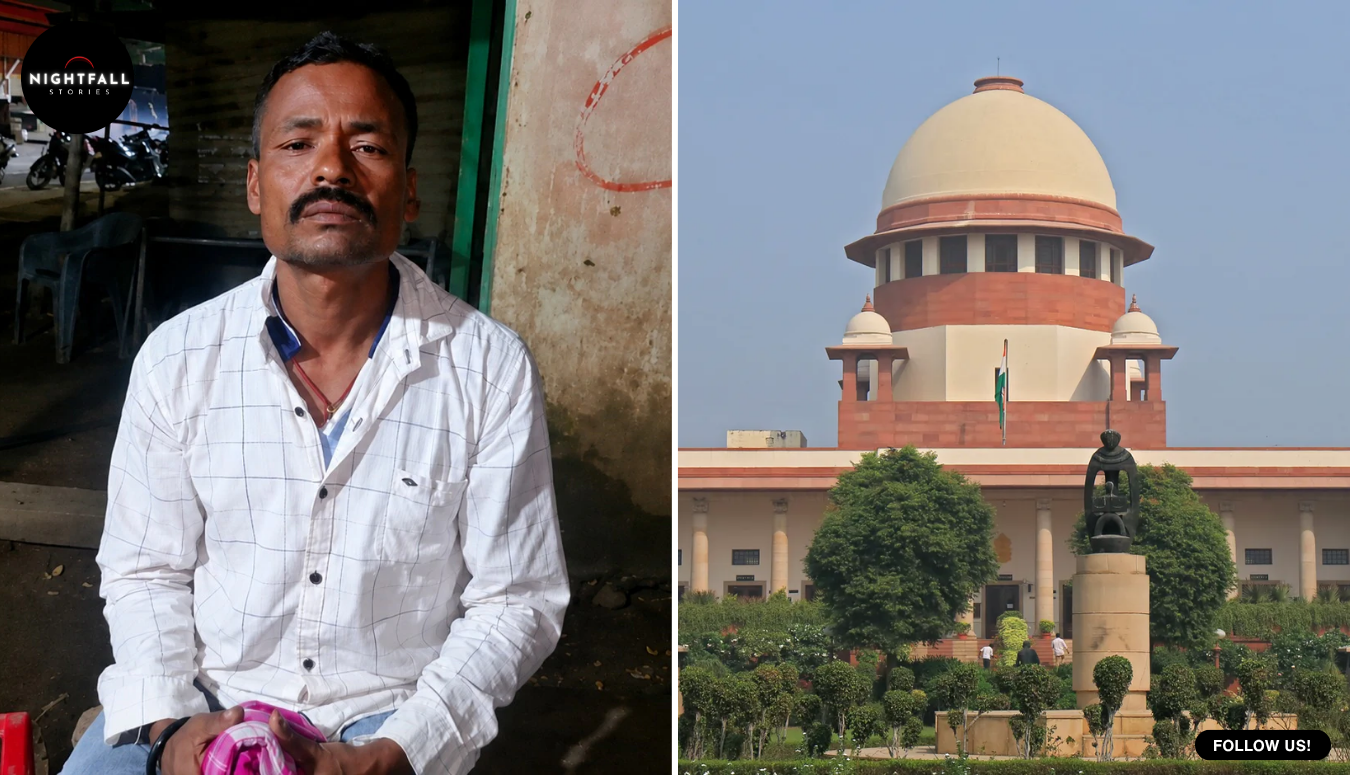
There is a line in India’s criminal procedure law that almost nobody outside a courtroom has ever read, and it is the only thing standing between a convicted man with no lawyer and no money and a life sentence nobody ever checks. It says that if the appellant is in jail, he may present his petition of appeal to the officer in charge of the jail, who shall then forward it to the proper appellate court. That is the whole provision. One sentence, and inside that sentence is the entire safety net.
Arjun Jani used it. He was in a prison in Odisha, in eastern India, serving life for murder, and he did the thing the statute told him he could do: he put his appeal in the hands of the jail. By the time that paper reached the Orissa High Court, it was 3,157 days late. Almost eight and a half years. The High Court did not excuse the lateness, and because it did not excuse the lateness, it never looked at whether the conviction was any good. The appeal was dismissed on the delay alone. He had already served twelve years at that point. He served ten more.
When the Supreme Court of India finally read the evidence against him, it found one eyewitness whose account it called shaky and highly improbable, and a confession it said had been extracted by third-degree methods and could not be relied upon in any case. It set the conviction aside and acquitted him. In the judgment the court wrote that twenty-two years had been erased out of a person’s life without any reliable evidence.
Before anything else, a distinction that matters and that readers collapse almost automatically. An acquittal is not a finding that no crime happened. Three women, Kamala, Sonbari and Ratanai, were beaten to death at night in a locality in the Koraput district of southern Odisha. That happened. Nothing in this case has ever suggested otherwise. What the Supreme Court found is that the state could not show that this man was the one who did it. Those are two completely different things, and the second one leaves three families where they have been for more than two decades, which is to say without an answer. Both facts sit in this story at once. One man lost twenty-two years. Three deaths remain unanswered for. There is no version of this where the reader gets to pick.
Start with the mechanism, because the mechanism is where the twenty-two years actually happened.
The provision is Section 383 of the Code of Criminal Procedure of 1973, now re-enacted as Section 424 of the Bharatiya Nagarik Suraksha Sanhita of 2023, the new code that replaced it. The logic is sound and even generous. A man who has just been convicted is, by definition, in custody. He cannot walk to a court registry. He may not be able to afford a lawyer, may not know one, may not know that a deadline exists. So the law puts the burden on the institution that is holding him. He hands his petition to the jail. The jail is duty bound to forward it.
Think about what that means in practice. There is no receipt in the statute. There is no clock that starts ticking visibly. There is no second copy that goes to anyone with an interest in chasing it. The prisoner hands over a piece of paper and then he waits, and from that moment he has no way of knowing whether his appeal is on a desk, in a file, in a post bag, or nowhere. If it moves, it moves because somebody in an office decided to move it. If it does not move, nothing happens, and nothing continuing to happen looks exactly like the ordinary passage of time in a prison.
That is how a delay of several thousand days is built. It is not a man forgetting to post a letter. A figure like 3,157 days is the measure of how far an unrepresented prisoner’s paperwork can fall into the gap between a jail and a court before anyone notices, which in this instance was most of a decade.
And here the two numbers that circulate around this case need separating, because they are not two versions of the same thing and averaging them would hide the actual shape of the case. The 3,157 days is the delay in the jail appeal before the Orissa High Court, the delay the High Court refused to condone and on which it dismissed him. The 3,703 days is a different and later figure: the delay in the appeal that eventually went up to the Supreme Court, filed with the help of the legal services system after he had already served twenty-two years, and that delay was condoned, by an earlier bench of the same court, in an order made a few months before the acquittal. Two filings, two stages, two measurements. The first number is the one that cost him the merits hearing. The second is the one that got him back into a courtroom.
That earlier order is worth sitting with, because it tells you the second court saw exactly what had happened. The bench condoned the 3,703 days, described the High Court’s approach as very disturbing, and granted him bail after twenty-two years inside. The acquittal came three months later, in a judgment by Justice J. B. Pardiwala and Justice K. Vinod Chandran, with the court invoking its constitutional power under Article 142 to do complete justice.
Now the evidence, which is the part that makes the procedural failure unbearable rather than merely bureaucratic.
He was picked up on suspicion. There was a recovery procedure, the kind where police produce material and witnesses attest to it, and one of the witnesses to that very procedure told the court that the police had beaten the accused to extract a confession. The Supreme Court’s position on that confession was flat: it had been obtained by third-degree methods, and in any event a confession made to police in those circumstances carries no weight. The court stated it, and it is the state’s own conduct that is being described. There is no reconstructed scene here and there should not be. The finding is the fact.
Strip the confession out and what remains is one witness. She said she had seen the assault from inside her own house, looking through a gap in her door, at one o’clock in the night. The court noted that the locality had no electricity. Three women died that night and he was convicted for a single one of those deaths, the one this witness said she saw. The Supreme Court read her account and concluded that it was shaky and highly improbable and did not lead to any definite conclusion that the accused had murdered the three women.
Whether he was formally convicted over one death or all three is one of the few things that was reported inconsistently, and the judgment settles it: the conviction was for one, the one the eyewitness spoke to, out of three alleged. Who, if anyone, was ever held responsible for the other two, or for any of them now that this conviction is gone, is not addressed anywhere in the record this piece rests on. It would be dishonest to imply an answer. The most that can be said is that nothing in the public record shows anyone answering for those three deaths.
The thing that is hardest to write about this case is that there is nobody to ask what it was like, and that absence should be stated rather than covered.
Nobody has spoken to Arjun Jani. Not in English and not, as far as can be established, in any other language. There is no interview with him anywhere. The judgment, which is effectively the only document about his life, records that he is from Koraput district and that he was about forty-five years of age. That is it. His occupation is not in it. Whether he has family is not in it. Whether anyone visited him across twenty-two years, whether anyone was waiting when the bail order came through, where he slept the first night, what he did with the first morning: none of it exists on paper, and inventing any of it would be worse than leaving the space empty.
What the two facts that do exist will carry is arithmetic. If he was about forty-five when the court acquitted him and he had served twenty-two years, he went in at around twenty-three. Everything a person ordinarily does between twenty-three and forty-five, he did not do. He did not work, or build anything, or decide anything, or be present for anybody. Those are not the years at the start of a life or the end of one. They are the whole middle.
The poverty in this is load-bearing and it belongs in the story as poverty, plainly. Koraput is one of the poorer districts in a poor part of the country. The court itself described the locality where the three women died as a place without electricity, lived in by people with very little. That is not background colour. It is causal. A man from that locality, convicted of murder, has no lawyer on a retainer. There is no family member with the money for train fare to a High Court registry, or the literacy to write to a judge, or the standing to telephone anybody and ask where a file has got to. The reason a jail appeal provision exists at all is to cover people in exactly that position, and the reason it failed here is the same reason it was needed. Nobody was going to chase the paper, because there was nobody whose job or means it was to chase it.
It would be convenient to treat this as one unlucky file, except that the Orissa High Court itself has since looked at the pattern. In a separate matter the same court laid down procedural safeguards for jail appeals: registers so that a petition handed over in a prison is recorded as having been handed over, written documentation when a jail declines to forward something, and judicial inspection to check that the system is working. Those are the fixes of an institution that has concluded the old arrangement could lose a man’s appeal and that nobody would find out. Which is to say the gap Arjun Jani fell into was a known gap, and it was identified because of cases like his, which is not much comfort to someone who was inside it for ten years.
None of this makes the Supreme Court the hero of the story, and the court does not present itself that way. Its own account is of a collective failure. Twelve years of imprisonment, then an appeal dismissed without anyone looking at it, then ten more years, then a correction. The correction is real and it is final, with no further appeal and no retrial ordered. But a system that takes twenty-two years to notice that its evidence was worthless has not been vindicated by noticing.
Which brings the story to its last act, and to what that act quietly concedes.
Having set the conviction aside, the court did one more thing. It cancelled the personal bond of ten thousand rupees, roughly a hundred and twenty dollars, on which he had been released. And it directed the District Legal Services Authority, Koraput, in the state of Odisha, to attempt rehabilitation or resettlement of the appellant, with the district collector’s administration directed to assist.
Read the verb. Attempt. Not provide, not guarantee, not compensate. A court that had just removed a man’s conviction understood perfectly well that removing a conviction gives a person nothing back, and so it told an arm of the state to try to find him somewhere to live and some way to live. That is an unusual order and it is an honest one, and it is also the measure of how little the law had left to offer.
What it did not order was money. There was no compensation. No sum for the twenty-two years, no sum for the confession the court itself said was beaten out of him, no sum for the appeal that sat somewhere for eight and a half years while he waited in a cell for an answer that never came. A rehabilitation direction and not a rupee.
Whether the Koraput legal services authority has in fact done anything is not known. Nobody has published a word about compliance, which means that the last verifiable fact in this story is the instruction itself.
So the ending is a man of about forty-five walking out of twenty-two years into a country that had no place prepared for him, and a court with nothing to give him except the name of an office that had been told to try.