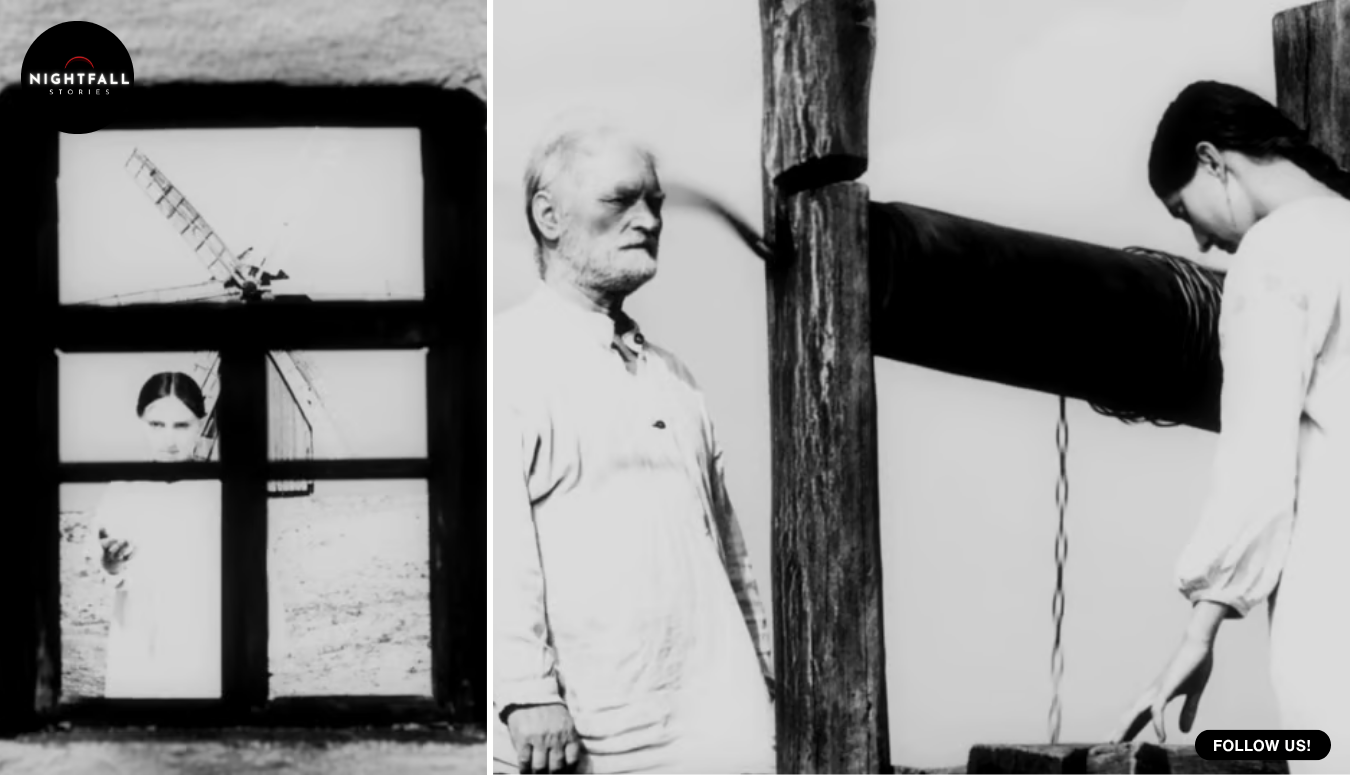
The resolution is dated 30 June 1966 and its title is a piece of pure bureaucratic flatness: on serious shortcomings in the organisation of film production at the Kyiv Dovzhenko Film Studio. Inside it, the Central Committee of the Communist Party of Ukraine dealt with a 73 minute film that had been finished the year before. The director, it said, was inexperienced, and he had permitted ideological perversions. That was the finding. The film went onto a shelf and stayed there for twenty two years.
It was called A Well for the Thirsty, and it was the first feature Yuri Illienko ever directed. He had just come off shooting Shadows of Forgotten Ancestors as cinematographer, the film that made Ukrainian poetic cinema famous outside the Soviet Union, and this was his own turn behind the camera. He never got to find out whether it worked. By the time anybody watched it, in late 1987, he was in his late forties and the movement he had helped start had been taken apart.
Larysa Kadochnykova is the reason this is a story about people and not about an archive. She is in the film. She is billed first in the state catalogue’s cast list, playing the dead wife who appears to the old man in his visions. She was also Marichka in Shadows of Forgotten Ancestors, which means the same woman stands at the centre of the film that made the movement’s reputation and the film that was taken away from it. She is 89 years old. She is still a company member at the Lesya Ukrainka Theatre in Kyiv, still performing, and she gave an interview in which she called that theatre her home and said she could not imagine life without going out on its stage.
So there is somebody alive who was there in 1965, who watched the thing be made and then watched it disappear, and who is still working in the city where it was made. That is not a footnote. That is the spine.
The film itself is strange enough that you can see why a committee reached for a word like perversion. It has almost no dialogue at all. Levko, an old peasant played by Dmytro Miliutenko, lives at the edge of a desert in a village that has emptied out. His children have gone to the cities. His eldest son was killed in the war. His wife is dead. He keeps a well, and he gives water to anyone who passes, and he summons the family home in the hope that someone will drink from it and take something of his with them. Mostly he is besieged by memories and apparitions while he prepares, calmly and practically, for his own death.
That is the plot, and calling it a plot is generous. What the film actually is, is a sequence of black and white images with a sound design that was radical for a Soviet studio feature in 1965: sand moving, a house, faces, a woman who is not there. The Ukrainian public broadcaster’s critic, writing about it decades later, called it a complex, whimsical, surrealist parable and said the censors had evidently detected something dangerously Ukrainian in its magical poetics. The programme note written for its New York screening calls it cryptic and visionary and says it announced Illienko as a worthy heir to Alexander Dovzhenko, the studio’s namesake.
What the official objection actually was is the part most coverage skips, and it is worth being precise about, because twenty two years on a shelf is not a mood. It is an administrative act with a document behind it and the document exists. The Central Committee resolution of 1966 is not a review. It is a production audit of an entire studio, and the film is handled inside it as a symptom of poor organisation. The language is about inexperience and about ideology, not about aesthetics. That is how the system preferred to do this: not by banning a work of art, which would concede that a work of art had been made, but by filing it as evidence that a studio was being run badly.
The composer has his own account of what the real problem was, and it is more specific. Leonid Hrabovsky wrote the score. He has said he believes the film was suppressed because of material read as anti Soviet, and he named what he meant: the poverty in it, and the marks left on Ukrainians by the famine. A film in 1965 about an emptied village, an old man with no family left and no water to spare, is a film about why the village emptied. Nobody needed to say the word out loud for a committee to hear it.
Hrabovsky is worth a moment because of how he came to be there at all. He was one of the central figures of the Kyiv musical avant garde of the 1960s, a composer whose actual work had no commercial prospects whatsoever in the Soviet Union, and he has said plainly that he was dependent on film work because it was his only income. That is a familiar arrangement and it produced a lot of good music. An experimental composer takes a studio job, writes a score for a parable about a well, and the parable is then shelved for longer than most careers last. Everything he was doing in those years ran on the same arithmetic.
Here a small discipline about what can and cannot be stated. Hrabovsky was born in 1935 and emigrated in 1990 at the invitation of the Ukrainian music community, becoming composer in residence at the Ukrainian Institute of America. His publisher’s own biography has him settling in the United States and currently living in New Jersey. No source available here carries a death notice, and no source available here carries a dated confirmation that he is alive now. So he is reported as living and nothing stronger than that will be claimed, and the neat coincidence that would have made a lovely sentence, the composer of a buried film watching it screen in his own city, does not survive contact with his publisher’s page. He does not live in New York. He lives across the river, which is close enough to be moving and not close enough to be a line in an article.
The shelving happened inside a broader shutting down. The early 1960s had been unusually open by Soviet standards, and a generation of film makers in Kyiv had used that opening to make work that looked and sounded nothing like official cinema: slow, image led, drawing on folk material, visibly and unapologetically Ukrainian. Shadows of Forgotten Ancestors, directed by Sergei Parajanov with Illienko shooting it, was the breakthrough. Then the window closed. Parajanov eventually went to a labour camp. Illienko spent his career being made to argue for films. And A Well for the Thirsty, the first thing he had ever been allowed to direct, became the clearest single example of what the closing cost, because it was complete. It was not interrupted or abandoned. It was finished, it worked, and it was put away.
Twenty two years is long enough that the film outlived the reason it was banned. Its first screenings came in November 1987, at a Ukrainian film festival in Zaporizhzhia, as the Soviet system loosened. Illienko was there to see it. But the audience it had been made for, in the year it had been made, in the cultural moment it belonged to, had been gone for two decades, and a film that arrives twenty two years late arrives as a historical document rather than as a new work. That is the quiet injury in all of this, and it is not fixable. You cannot give a film its own year back.
There was a word for what happened to it. Soviet cinema produced a whole category of finished films that were never released, and they were spoken of as being on the shelf, which was both a literal description of where the reels went and an administrative status. A shelved film was not destroyed and not formally disowned. It was simply removed from circulation and left intact, which sounds merciful and was in some ways worse. A banned film at least has the dignity of having been fought over. A shelved film has been declared not worth the argument.
The mercy in it, if there is any, is physical. Because shelving was filing rather than destruction, the materials usually survived, and in this case the thing that mattered survived in the best possible form. Not a battered distribution print struck for cinemas that never showed it, but the 35mm original camera negative, the element closest to what the cinematographers Feliks Rzheshutek and Hryhorii Syhalov actually exposed in 1965. Sixty years of a film sitting in a vault because nobody was allowed to look at it is also sixty years of a film not being scratched by projectors. The same indifference that kept it from an audience is the reason there is anything good enough to rebuild.
The restoration is the part of the story where strangers do the work. The 35mm original camera negative survived, and it is held at the Oleksandr Dovzhenko Centre in Kyiv, Ukraine’s national film archive. The Polish restoration house Fixafilm did the rebuild. The scanning credit names two people, Lukasz Ceranka at Fixafilm and Oleksandr Bertman at the Dovzhenko Centre, and the grading was done with reference to an archival print the Centre lent for the purpose. Fixafilm and the Polish Film Institute funded it between them.
That credit list repays reading slowly, because it describes an arrangement that did not exist a few years ago. A Polish laboratory and a Polish state film institute paid to rebuild a Ukrainian film frame by frame, working from a negative held in Kyiv and a reference print shipped out of Kyiv, in a period when Ukrainian archives have had rather more pressing problems than colour grading. Who keeps whose film heritage safe, and where the physical materials sit while that is being decided, is not an abstract question for a Ukrainian archive at the moment. One paragraph of that context is honest. More would turn a 1965 film into a symbol, and it was not made to be one.
The restored version runs 71 minutes, two short of the 73 in the Ukrainian state catalogue, which is the ordinary consequence of measuring a rebuilt print properly rather than evidence that anything is missing.
It has gone into the Revivals strand of the New York Film Festival, the section the festival keeps for restorations and recovered work, and it screens at the Walter Reade Theater at Lincoln Center with an introduction from the film historian Daniel Bird. The company it is keeping there is instructive: Ken Russell’s The Devils, Powell and Pressburger’s Gone to Earth, Hou Hsiao hsien, a Barbara Hammer, two programmes of Artavazd Pelechian. Films that were cut, suppressed, mangled on release or simply lost track of. A Well for the Thirsty fits that shelf exactly, which is both the point and a little grim: it belongs to a category defined by what was done to it rather than by what it is.
The people who made it are mostly beyond being told. Yuri Illienko died in 2010, without seeing the negative scanned or the film graded or a New York audience sit down in front of it. Ivan Drach, the poet who wrote it, died in 2018; he had been a significant figure in Ukrainian letters and later in its politics, and the screenplay for an almost wordless film about an old man and a well was one of the first things he put his name to. Dmytro Miliutenko, who carried the whole picture on a face and very few lines, has been dead since 1966, the same year as the resolution. He never saw it either.
Which leaves Larysa Kadochnykova, who is 89, who is in both of the films that define this entire chapter, and who still goes to work at a theatre in Kyiv. If anybody is owed an account of what happened in 1965 and what it was like to watch something you had made be filed as a shortcoming in studio organisation, it is her, and she is the only person left who can give it.
The thing they all made, in the end, was a film about an old man who keeps a well nobody comes to drink from, and who refuses to leave it anyway on the chance that somebody eventually will. It then sat untouched for twenty two years and was rebuilt, one frame at a time, by people in another country who had never met him. Nobody planned that. It is simply what happened, and the film is better than the irony.