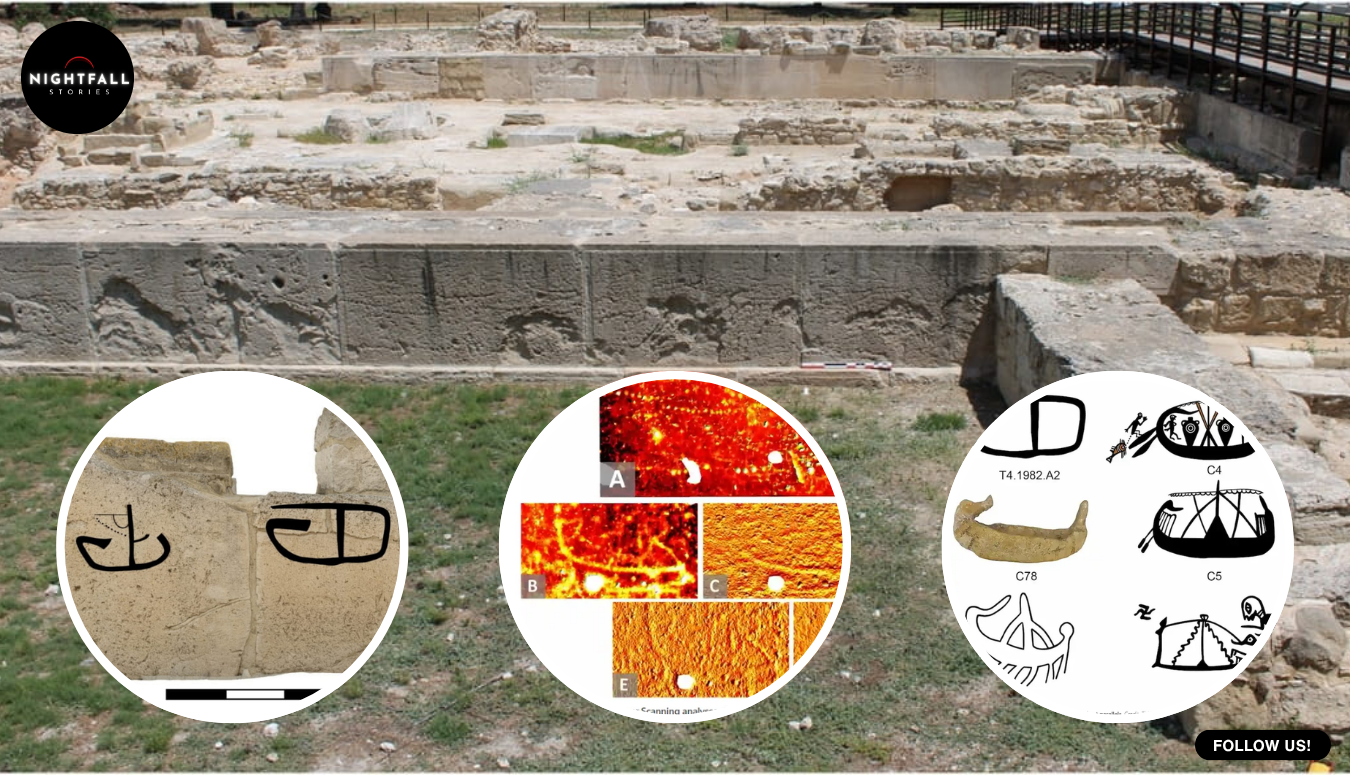
The plan was boring, and that is the point. Three researchers set up a tripod in front of a weathered limestone wall in Larnaca, on the southern coast of Cyprus, and started a terrestrial laser scanner turning. They were there to record the stonework of a Late Bronze Age temple: how the blocks were cut, how they were set, what the builders had done with stone that had been hauled from a quarry on the far side of the bay. Masonry research. Nobody expected to find a fleet.
When the point cloud came back and they began measuring how far each mark dipped below the plane of the stone face, ships started appearing. Twenty three of them, cut into blocks that had been excavated, photographed, drawn, published and walked past by visitors for about forty years. The carvings had never been covered up or sealed behind anything. They were simply too shallow and too worn for a human eye to separate from the general damage of three thousand years of salt air. A machine that measures millions of points in three dimensions, without touching the surface at all, could tell the difference between a deliberate incision and a scratch.
That work is now published in the International Journal of Nautical Archaeology, in a thirty four page paper by Graham C. Braun of the University of Cincinnati, Caroline Barnes of the University of British Columbia, and Tzveta V. Manolova, who is based at Ludwig Maximilian University in Munich. Braun and Barnes were the ones recording the architecture. Manolova built the photogrammetric models and the drawings, work connected to a digital documentation project for ancient Mediterranean material. Between them they turned an accident into a catalogue, which is a less glamorous sentence than it sounds and a much more useful one.
To understand why 23 new carvings matters, you need to know what was already there. The site is Kition Kathari, a temple complex under the modern city of Larnaca, excavated across decades under the Cypriot archaeologist Vassos Karageorghis. In the early 1980s a recording campaign documented 19 ship images on the south face of Temple 1, and those drawings were published in the middle of that decade by Lucien Basch and Michal Artzy. For four decades, those 19 ships were the corpus. They were reproduced in survey books, argued over by specialists in ancient seafaring, and treated as a more or less closed set: a group of carvings, probably made at roughly the same time, probably connected to a single moment or a single ritual.
The new work does not overturn that earlier campaign. It explains it. The 1980s team worked with raking light, tracing, photography and extremely good eyes, and they found everything that method could find. What they could not do was quantify depth. A carved line on Koronia limestone that has lost a millimetre or two to erosion stops reading as a line and starts reading as noise. The laser scanner does not care how a mark looks. It records where the surface is, and the researchers then asked two questions of every candidate: how far below the surrounding plane does this sit, and at what angle does its edge cut in. Tool marks cut at angles that weathering does not produce. Run that test across an entire wall and the invisible becomes measurable.
It is worth picturing the actual labour, because it is not glamorous and it is where the discovery came from. Terrestrial laser scanning means a tripod, a levelled instrument, and a decision at every position about what the machine can and cannot see from there. A wall built of large upright slabs has recesses, overhangs and shadow, so one scan is never enough. You move the tripod, you scan again, you leave targets in the scene so the separate clouds can be stitched into one model afterwards, and you do that around a structure in coastal heat until the coverage has no holes in it. Then the real work starts, which happens at a desk, months later, as you query a surface made of millions of points for marks that your eyes already told you were not there. The 23 ships were not spotted. They were computed.
The team was honest about the limits of that, which is one of the better things about the paper. They did not present 23 equally certain discoveries. They sorted them by confidence: nine they consider high confidence ships, six medium, and eight low. The low confidence group is exactly what it sounds like, marks that behave like carving and may well be carving, offered for other people to argue with rather than banked as fact. Added to the earlier 19, plus two carvings on an altar in a separate building at the site, the documented total at Kition now stands at 43 ship images, 41 of them on Temple 1 and two on the Temple 4 altar.
That is a doubling of the corpus, and it would be interesting on its own. But the finding that actually changes something is not the count. It is the spread.
The researchers sorted the vessels into six groups by hull shape, and the groups are not variations on one theme. At the simplest end there are ships reduced almost to a single curved line, the kind of mark anyone could make in a few minutes with a hard point. At the other end there are galleys with a triangular prow, a curved bow device that looks like a horn, and a tall sweeping stern. In between sit flat, symmetrical hulls with tall vertical posts at each end, a form that matches a known type of Levantine merchant ship, and hybrid galleys with asymmetrical hulls and curved ends that do not fit neatly into either the Cypriot or the Levantine tradition. The team found parallels for individual hulls in material from Enkomi and Lapithos on Cyprus, from Akko and the Carmel coast, and from Tell Tweini on the Syrian coast.
Those traditions did not all exist at once. Some of these hull forms belong to the Late Bronze Age, when Kition was a working harbour town in a Mediterranean tied together by copper, tin, oil and grain. Others belong to the Early Iron Age, after that system came apart. Read the wall as a single composition and it makes no sense. Read it as a wall that people kept coming back to, for something in the order of three centuries, and it does.
That is the argument, and it has teeth, because the period it spans is one that gets written as an ending. Around 1190 BCE, give or take, the eastern Mediterranean went through the collapse that ended the Late Bronze Age palace states. Cities burned, writing systems fell out of use, trade routes that had run for centuries stopped running. Kition itself was founded around 1300 BCE and went through a major rebuilding phase at roughly the moment of the collapse, which is when the monumental south wall of Temple 1 took the form the scanner recorded. If the ship carvings run from that rebuild forward into the Cypro Geometric period of the Iron Age, then people at this one building were still thinking about ships, still looking at ships, and still cutting ships into a sacred wall straight through the rupture.
The carvers also seem to have been looking at each other’s work. One of the more quietly striking observations in the paper is that the carvings share conventions across the whole span, most obviously a habit of rendering lines as rows of dots. That shared habit is partly why the wall looks like one composition at first glance. It may not be a single hand or a single generation. It may be hundreds of years of people copying the local way of doing it, the way graffiti on any long lived surface develops a house style.
There is a detail about the stone that gives this more weight. The south façade of Temple 1 is built of Koronia limestone orthostats, large upright slabs, the biggest of them between 2.4 and 3.1 metres long and about 1.4 metres high. That stone was not local. It was quarried roughly twenty kilometres away, on the other side of Larnaca Bay, and moved. Whoever built this wall chose expensive, imported, visibly special material for the most monumental structure at the site. People then cut ships into it. The researchers take that as evidence the carving was not casual vandalism done in the dark. You do not repeatedly mark the best stone on the most important building unless the marking means something and is tolerated.
What it meant is the part nobody can scan for. The ships on Temple 1 cluster at around eye level along the south wall, which tells you they were made by adults standing in front of it, not by anyone on scaffolding or stretching, and that they were made to be seen at the height a person naturally looks. The conclusion the team lands on is deliberately modest and more interesting for it. Ships were not an exotic subject for these people. They were ordinary furniture of life, close enough to hand that marking one on a temple wall was a normal thing to do, repeated across generations. There is a version of this story where the carvings become sacred maritime offerings in a grand cult of the sea. The paper does not tell that story, and the evidence does not require it.
It is worth being clear about what is still soft here, because the strongest part of this research is its willingness to show its own seams. Dating graffiti by style is an argument, not a measurement. There is no carbon in an incision. The three century span rests on matching hull forms to vessel types known from dated material elsewhere, and those matches are judgements made by specialists who can be wrong, or who can be right about one hull and wrong about the next. A yellow sandstone block in the wall, repaired at a later phase, gives one useful anchor, but one anchor is not a chronology. The eight low confidence marks may turn out to be erosion. None of that undoes the finding. It just means the finding is a case, published with its uncertainties labelled, rather than a verdict.
What the finding changes most directly is an interpretation, and that is a quieter kind of correction than a new object. For forty years the reasonable reading of the Kition ships was that they were a group: a set of images of similar character on one wall, plausibly made in a single phase, plausibly connected to one event or one act of devotion. That reading was reasonable because the visible sample supported it. Double the sample and the picture breaks apart into something less tidy and more alive. Not one moment, but a long habit. Not a composition, but an accumulation. Anyone who has written about Late Bronze Age Cyprus using those 19 ships as a single dated data point now has to decide which of the six groups they were actually talking about.
It also puts a small piece of evidence on an argument that runs well beyond one wall. The end of the Late Bronze Age in this region is usually told as a severing: the networks that moved copper and tin and oil across the sea stopped, and what followed was a different and poorer world. Specialists have been chipping away at the severity of that story for years, pointing to places where life and trade carried on at a lower volume rather than stopping. A wall where people kept cutting ships through the whole transition, in forms that change as shipbuilding changes, is not proof of continuous seafaring. It is one more reason to doubt that the lights all went out at once, and it comes from a source that is hard to argue with, because nobody carves a kind of ship they have never seen.
There is also something in this story for every site that has already been dug. Kition was not a lost ruin. It was excavated over decades, published repeatedly, and is open to visitors. The south wall of Temple 1 had been studied by serious people with serious methods, and everything they said about it was true. There was just more on the stone than their instruments could reach. Somewhere between a quarter and a half of archaeology’s working material is sitting in exactly that condition right now: recorded, catalogued, considered finished, and legible to a machine that did not exist when the trench was backfilled. The team at Kition was not even looking for carvings. They were looking at how blocks were cut.
The carvings themselves have now been published, numbered, drawn and grouped, which is the thing that actually protects them. Koronia limestone on a coastal site is losing a little of itself every year to salt and wind, and the marks that were too faint for the 1980s campaign to see are the ones closest to vanishing. A point cloud is a copy that does not erode. Even if the stone keeps going, the geometry of those 23 ships is now on record at a resolution that lets someone in fifty years re measure them and tell this team it got group four wrong.
That is a decent place for a discovery to end up: not as a headline about hidden treasure, but as 43 catalogued ships on a wall, sorted by confidence, with a dating argument offered up for attack, and with a human conclusion that is almost ordinary. For centuries, people walked up to the best stone on the most important building in their town and drew the boats they knew. Different boats, different centuries, same wall, same height, same habit of making the lines out of dots. A laser scanner pointed at the stonework found them because it was measuring something else entirely.