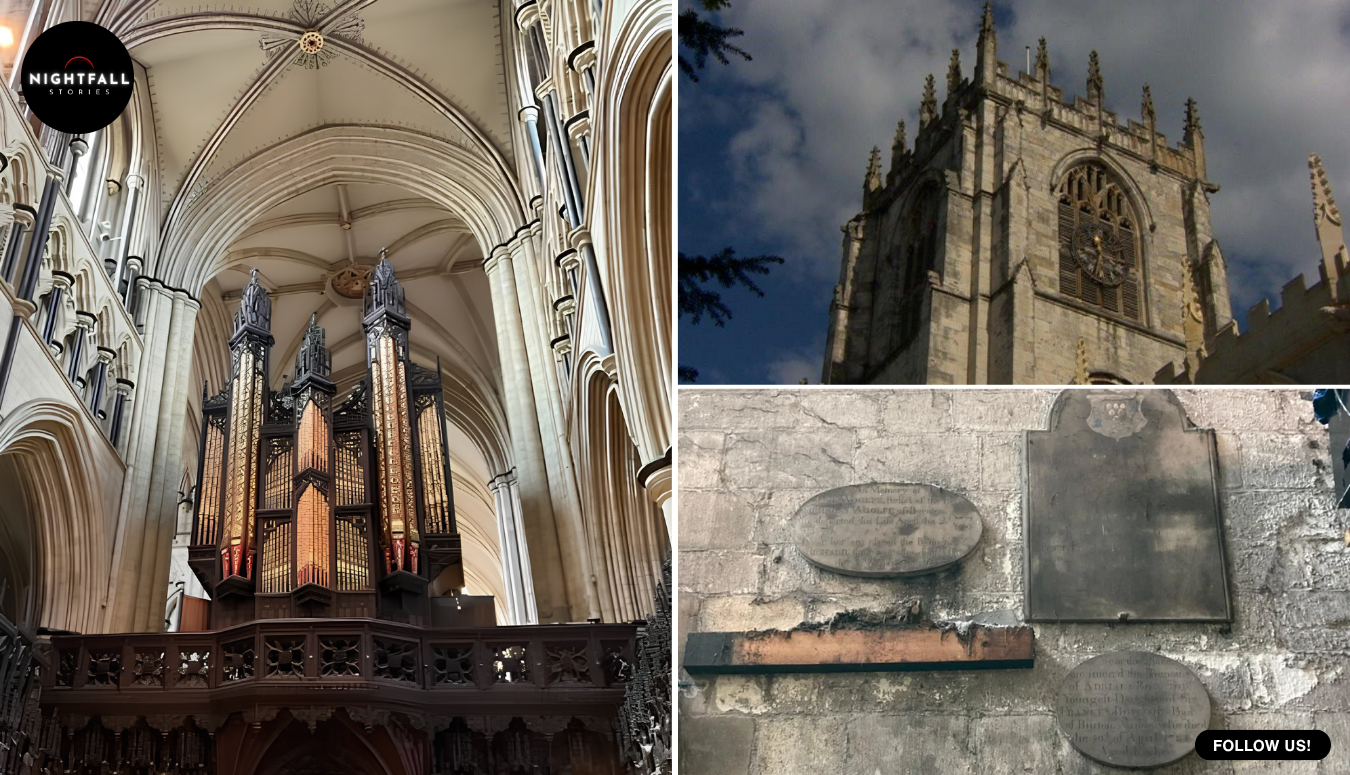
Earlier this year, in a twelfth century church in the East Yorkshire market town of Beverley, a team began taking a pipe organ apart. It was a four manual instrument with thousands of pipes, the largest of them around 40 feet long, and it filled the north transept wall from floor to roof. Nobody was buying it. The church was giving it away, free, to a parish in Oslo, because the alternative on the table was not restoration. It was scrap.
Then the last of the pipes came out, and the wall behind them was visible for the first time in well over a hundred years. There were medieval stone carvings on it. There were windows that had been blocked by pipework since before anyone now living was born, which meant daylight came back into a corner of the building that had not had any. There were memorial stones to people nobody had been able to read about for generations. Above, in the newly opened sightline, were roof bosses from the medieval and Tudor periods, part of a set of around 700 painted carvings that runs across the church’s ceilings. And there were stone gargoyles, including a pair flanking a doorway, that had been sitting in the dark behind an organ.
The first thing to get straight about this story is the clock, because almost every retelling has it wrong. This was not a church that suddenly lost its organ. The organ had already stopped being the church’s instrument two years earlier. A Viscount Regent 361 digital organ was installed at St Mary’s on 5 February 2024 and has been doing the work at services ever since. By the time the pipes came down, they had been silent for a long time. The event of this year was not a loss. It was a removal, and a discovery.
The reason the instrument lost its job is unglamorous and very common. It had chronic electrical faults in the run between its remote console and the pipes themselves. It would simply stop mid service. The temporary fix, by the account of the firm that replaced it, amounted to switching the thing off and on again. An organist can live with a reluctant stop or a wheezing rank. An organist cannot live with an instrument that goes dead during a hymn, in front of a congregation, with no warning and no way of knowing whether it will come back.
St Mary’s organist, Michael Ellerington, played it through that period, which is its own kind of endurance. The vicar, the Reverend Becky Lumley, was the one who had to decide what happened next, and the numbers she was handed did not leave much room.
Harrison and Harrison, one of the most respected organ builders in England, surveyed it. Their conclusion was that repairing or rebuilding it would cost somewhere close to 1.5 million pounds, roughly 1.9 million US dollars, and that little of the existing pipework merited reuse. The diocesan organ advisers agreed with that assessment. That second finding is the one that quietly decides everything. If the pipework had been judged worth saving, a long campaign to raise the money would have been the obvious route, and churches do run those campaigns and sometimes win them. If the pipework is not worth saving, you are not fundraising to rescue a treasure. You are fundraising to build a new instrument inside an old case.
And the church did not have the money, or anything like it. St Mary’s was carrying an urgent repair backlog above 4 million pounds, around 5 million US dollars, on the building itself. Included in that backlog was the roof of the north transept, which is to say the roof directly above the organ. There was a hole over the instrument. Fixing the roof meant getting the organ out of the way regardless of what anyone wanted to do with it.
That is the shape of the decision, and it is worth sitting with before anybody reaches for an opinion about heritage. A Grade I listed building founded in the first half of the twelfth century, with 900 years of fabric to keep standing, had a four million pound bill, a leaking transept roof, and an organ that had been declared not worth the one and a half million it would take to make it work.
The instrument that left Beverley was also not quite the thing it has been described as. One widely shared account called it a hundred year old English organ. The real lineage is messier and more interesting. The church bought an organ in 1792, built by Donaldson of York and set in the rood loft, paid for with 311 pounds raised by voluntary subscription. In 1869 the Hull firm of Forster and Andrews built a new instrument, behind a richly carved oak screen with decorated front pipes. The same firm came back in 1889 to add a detached console and pneumatic action. Then in 1908 Lewis and Co of London rebuilt it completely and discarded the oak case. Between 1954 and 1957 Hall and Broadfield replaced the pneumatic action with an electromagnetic one and converted it from three manuals to four, and the rebuilt organ was dedicated in 1957.
So what was dismantled this year was a Forster and Andrews foundation of 1869, rebuilt wholesale by a London firm in 1908, rewired and enlarged in the 1950s, with its original case long gone. Describing it as a Forster and Andrews organ is a reasonable shorthand for where it started. Describing it as a hundred year old instrument is not really accurate in either direction. It is the sort of layered object most large parish organs actually are, which is part of why the question of what to preserve is harder than it looks from outside.
There is a local poignancy in that 1869 date that is easy to miss. Forster and Andrews were a Hull firm, which is about ten miles from Beverley, and in the second half of the nineteenth century they were one of the busiest organ builders in the country, turning out instruments for churches and chapels across Britain and well beyond it. An organ built by them for a church in their own county was a piece of regional industry as much as a piece of church furniture, made by people who could have walked to the building. What the 1908 rebuild and the 1950s rewiring did, between them, was gradually replace that local object with a national one, and then with a modern one, until the only Hull-made thing left in the transept was the layout. That is not an argument against any of those rebuilds, each of which was done to keep the instrument working. It is just worth knowing when you hear the organ described as theirs.
The other end of the arrangement is a man called Marius Skjolaas, director of music at Trinity Church in Oslo, whose building is in the middle of a major renovation of its own. Oslo wanted pipes. Beverley had pipes it could not afford to keep and could not leave in place. The plan, as reported, is for the Beverley instrument to be combined with recycled parts from decommissioned Norwegian organs and installed in the rebuilt church, which will hold something like 1,200 to 1,300 people and is being set up to work as a concert venue as well as a parish church.
Here is where honesty about sourcing matters. Essentially all of this rests on one piece of original reporting, a BBC item by Sally Fairfax and Paul Johnson. Everything else in circulation is derived from it. The independent corroboration that exists is thin but real: the organ builder’s own published case study on the digital replacement, which supplies the survey figure, the backlog figure, the names and the February 2024 installation date; a local Hull aggregation of the BBC piece; a short, pointed item on a classical music blog; the church’s own description of its building; and, separately and more usefully, Norwegian coverage of the Oslo renovation. For the discovery behind the organ, there is one account. Anyone telling you this story with more confidence than that is borrowing it.
The blog item is also where the only real dispute lives. Norman Lebrecht, writing as the pipes came down, told his readers the organ’s space was to be replaced by a coffee shop, and called the whole thing a wretched example of the Church of England neglecting its heritage. The coffee shop claim does not match what the church says. St Mary’s own stated intention for the cleared area is to leave it open and use it to improve access for visitors with mobility difficulties, a new route into the building for people who could not easily get in before. Those are not the same plan, and one of them comes from the parish and the other does not. A Beverley resident turned up in the comments under the blog item to point out that the organ had been out of use for two years and was in poor condition, which is exactly what the documentary record shows.
The heritage argument underneath the rhetoric is not silly, though. English parish churches are shedding large organs, and when one goes it rarely comes back, because the skills and the money that built them are both scarcer than they were. A report circulated this year warned that church organs across Britain could largely fall silent within fifty years. That is a real trend and Beverley is a data point in it.
The counter-argument is simply the one the church was actually facing. The choice was not between a restored Victorian organ and a coffee machine. It was between an unplayable instrument blocking a damaged roof, and a working digital organ plus an open wall, with the pipes going somewhere they would be used rather than into a skip. Given a survey saying the pipework was not worth reusing and a four million pound hole in the budget, giving the thing away to someone who wanted it is not neglect. It is the least wasteful option available.
Which leaves the question of whether the Oslo end has actually landed, and the answer, at the time of writing, is not yet.
Trinity Church’s own renovation page is specific about a great deal: a new 650 square metre extension with offices and a parish hall, pews replaced with chairs to take capacity to around 1,200, a new wheelchair and lift entrance, new floors, public lavatories in the old sacristy. It says a completely new organ will go into the right side of the front gallery, built in English cathedral style, with pipework consisting mainly of recycled pipes from Norwegian organs. It names no English church at all. Beverley does not appear on it.
Norwegian music press in September put the sequence differently and more usefully: a pre-opening of the church’s new concert stage in November, with the full reopening after complete renovation pushed out to late next year, and two instruments in the room, Norway’s largest recycled organ assembled from decommissioned Norwegian parts and, alongside it, an Anglican instrument brought from St Mary’s Church in Beverley. So the pipes are acknowledged, by somebody, in Norway. They are also not playing, and will not be for a good while, and the parish’s own account still foregrounds the Norwegian pipework.
That is the honest state of the emigration, and it is why the ending of this story is not in Oslo. Crates of pipework waiting on a renovation that has already slipped twice is not an ending. It is a hope with a schedule attached.
The ending is the wall in Beverley.
Go into St Mary’s now and the north transept is open. The organ is gone and nothing is going in its place. The windows it had been covering are letting light into the transept again, which is the single change people notice first and the one no amount of money could have bought while the instrument stood there. The memorial stones are readable. The gargoyles that spent a century facing the back of a soundboard are facing a room again. Above, in a church already known for its painted roof carvings, there are bosses in the newly cleared sightline that were effectively private for over a hundred years. Somewhere in that same building is the white rabbit in a travelling cloak that visitors are told may have given Lewis Carroll his White Rabbit, which gives you a fair sense of what else the place has been quietly holding.
And the floor where a four manual organ used to stand is going to stay empty on purpose, so that someone in a wheelchair can get into a twelfth century church.
There is a tidy way to say this that would be too tidy, so here is the plain version instead. The organ at St Mary’s did not get a restoration, because the people who would have had to do the restoring said it did not warrant one. It did not get a glorious last recital, because it had already stopped working. What it got was a second life abroad that has not started yet, and one final act of use at home that nobody planned and nobody could have arranged: by leaving, it gave the church back a wall, a set of windows, and a way in.