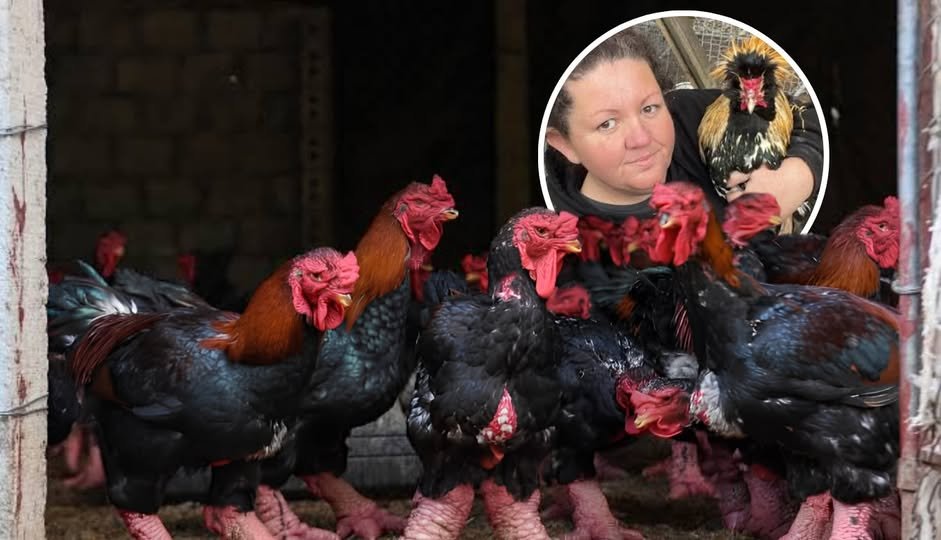
She flew home from Southeast Asia with about sixty fertilised chicken eggs, some strapped against her body and the rest tucked into her luggage, and she got all the way through. Nobody stopped her. She took them back to a small town on the Texas coast, set up incubators, and waited to see what hatched. The plan was a business. A rare Vietnamese breed with legs like tree trunks, birds that can sell for hundreds of dollars each and sometimes far more, and almost nobody in the country breeding them.
Three years later a federal judge sent her to prison for two years. By then every bird from those eggs was gone, including the five that were still alive when investigators arrived. That is the part of the story that gets left out of the headlines about the woman who smuggled dragon chickens, and it is the part that explains why a case about ornamental poultry was worked by agricultural investigators rather than treated as a quirky customs slip.
The woman is Jennifer Mayo, from Aransas Pass, Texas. The eggs came from Vietnam and Cambodia in 2023. The breed is Dong Tao, and to understand why anyone would risk a felony for a box of eggs you have to understand what these birds actually are.
Dong Tao chickens come from a commune of the same name in Hung Yen province, about thirty kilometres southeast of Hanoi. They are an old breed, historically raised as tribute birds for royalty and for temple offerings, and they are famous for one extraordinary feature. Their legs are enormous. Not long, thick. A mature bird stands on scaly red shanks that people compare to a beer can, and that oddity is also the point, because the leg meat is the prized part, firm and gelatinous and served at Lunar New Year banquets as a luxury.
A full-grown bird, at least a year old, has sold in Vietnam for around two hundred dollars, and exceptional specimens for double that or more. Breeding stock with the right leg conformation goes higher still. They are also genuinely difficult animals. They grow slowly, they are sensitive to weather swings, they lay poorly compared with ordinary chickens, and the hens are clumsy sitters because of those legs, so hatching rates are low. Vietnamese farmers have said for years that supply does not keep up with demand even domestically.
All of which makes them exactly the kind of animal that generates a certain type of fantasy. Rare, expensive, hard to get, visually spectacular, and with a ready audience of specialty poultry enthusiasts who will pay well for something nobody else on the continent has. If you could get a founding flock established legally, you would have something close to a monopoly.
The legal route exists. It is slow, expensive and heavily conditioned, and for birds from countries where certain diseases are present it is often simply closed. The United States restricts poultry and hatching eggs coming from regions affected by highly pathogenic avian influenza and virulent Newcastle disease. Vietnam and Cambodia both fall inside those restrictions. Legal imports, where they are possible at all, involve inspection, permits and quarantine at approved facilities, and the whole apparatus exists because of what happens when it is skipped.
The United States Department of Agriculture runs a whole unit for this, dedicated to intercepting prohibited animal and plant material before it gets inland, working with border officers, mail facilities and ports. Most of what it catches is not exotic at all. It is meat in a suitcase, plant cuttings in a coat pocket, eggs in a carry-on, brought home by people who are not criminals in any sense they would recognise and who have no idea that what they are carrying can start an outbreak. The unit exists because the ordinary traveller is the most common route in.
Mayo skipped it. According to the federal case, she travelled to Southeast Asia, obtained roughly sixty fertilised Dong Tao eggs, and concealed them on her person and in her bags for the flight home. Eggs are a smuggler’s item in a way that live birds are not. They are small, quiet, and they do not look like an animal. They can sit in a padded container for a long journey without anyone noticing. She then incubated them at a property in Ingleside, along the same stretch of coast.
Ingleside sits on a bay on the Texas coast, an hour or so from the border of the tropics in feel if not in fact, humid and warm enough that a Southeast Asian breed would have had no trouble with the climate. In practical terms it is a good place to raise unusual poultry and a terrible place to hide it, because specialty breeders are a small and chatty world and word of something genuinely new travels.
The investigation did not start at an airport. It started with messages. Investigators found Facebook conversations in which she discussed her trip and her plans to bring the eggs back, which is a detail that keeps recurring in wildlife and agricultural smuggling cases. The item crosses the border invisibly, and then the person talks about it online, because the entire point of acquiring something rare is that other people know you have it.
When investigators approached her, she told them the animals had died. That was not true. A search warrant executed at the property found five Dong Tao chickens still alive, in poor condition, along with birds that had already died. Veterinarians who assessed the situation concluded that the survivors could not safely be moved off the property because of the disease risk they might be carrying, and the birds were humanely euthanised. That is the end of it for them, and there is no gentler way to put it.
It is worth being precise here, because some coverage has compressed this into the claim that all the birds simply died. They did not. Five were alive, and the decision to euthanise them was a containment decision made by veterinarians, not a punishment handed down by a court. Uninspected poultry from a region with active avian disease is treated as a potential carrier until proven otherwise, and proving otherwise requires facilities and time that a backyard in Texas does not have.
The alternative, quarantine at an approved federal facility, is not something that can be applied after the fact. It has to happen before the animal reaches open country, under supervision, with testing at both ends, and it is expensive precisely because containment only works if nothing has touched anything else yet. Once birds have been living in a backyard for a stretch of time, near whatever else passes through that yard, the option is gone.
That sounds harsh until you look at what these diseases do. Virulent Newcastle disease turned up in backyard flocks in Southern California in 2018 and took until 2020 to push back out. More than 1.2 million birds were euthanised during the response, most of them not sick, killed because they were inside a control zone. Investigators traced parts of the spread directly to people moving birds around in defiance of quarantine orders, carrying the virus from one county to another. Backyard keepers who had raised the same small flock for years lost everything, and commercial operations were exposed too, because a virus does not distinguish between a hobby coop and a shed with fifty thousand birds in it.
Highly pathogenic avian influenza has been an even bigger story in recent years, with outbreaks tearing through commercial poultry across multiple continents and spilling into wild birds, mammals and dairy cattle. Every one of those events begins somewhere. Sometimes it is a wild bird on a migratory route, which nobody can control. Sometimes it is an animal or a product that moved when it should not have, which somebody could have controlled.
So a woman hiding eggs in her clothes on a flight is not a victimless eccentricity. She was, without meaning to be, a potential vector, and the agencies that took the case reflect that. The prosecution was worked by the Department of Agriculture and the Texas Animal Health Commission alongside federal homeland security investigators. Animal health people, not art thieves or drug squads.
The timeline is its own quiet detail. The eggs came in during 2023. The sentence came down three years later. Cases like this move slowly because they are built out of records rather than arrests, and because the agencies involved are not primarily criminal investigators. Somebody had to pull message histories, establish travel, work out what the birds actually were and where they came from, and get veterinary assessments on record. Meanwhile the birds themselves were dealt with early, which is the way these things go. The animals are the urgent part. The paperwork is the slow part.
Mayo pleaded guilty to smuggling goods into the United States. The dates on the plea are a little muddy in the public record. An earlier government release described her admitting the offence in late 2024, while the Justice Department’s sentencing announcement dates the guilty plea to the middle of the following year, so it is possible there was a re-arraignment or a rescheduled hearing. Either way, she admitted she knew importing the eggs was illegal when she did it, which removes the sympathetic reading that she simply did not know the rules.
The exposure was serious. The statute carried a maximum of twenty years and a fine of up to a quarter of a million dollars. At sentencing, US District Judge David S. Morales gave her twenty-four months in federal prison followed by two years of supervised release, and said her conduct was extremely serious and had put a lot of animals at risk. Assistant US Attorneys Tyler Foster and Liesel Roscher prosecuted.
Twenty-four months is a real sentence. It is also, in context, a long way below what the statute allowed, which suggests the court saw what most people see reading this: not an organised trafficking operation, but one person who wanted a niche livestock business badly enough to convince herself the rules were an obstacle rather than a reason.
That is what makes the case stick, rather than the novelty of the birds. There is no cartel here. There is somebody who found a beautiful, valuable, difficult animal, worked out that almost nobody in her country had them, and decided the gap between wanting and having could be closed by not asking. Plenty of people make smaller versions of that decision constantly, with seeds, with plants, with food brought home from a trip. Most of the time nothing happens. The rules exist for the small proportion of times when something does.
There is a second, quieter failure in it. Even setting the law aside entirely, the plan was not going to work. Sixty eggs carried at body temperature and then at airline cabin temperature for a very long journey is a brutal way to treat an embryo. Hatching rates for Dong Tao are mediocre under ideal conditions with a specialist breeder and proper incubation. The birds that did hatch were found in poor condition. Whatever founding flock she imagined, the animals themselves were never likely to deliver it, and they paid the whole cost of the attempt.
Meanwhile the breed is doing fine where it belongs. In Dong Tao commune the birds are still raised the old way, fed on rice and corn, sold live at prices that climb every Lunar New Year, with families who have kept the bloodlines for generations and restaurants built specifically around them. Vietnamese media cover the trade every year, and the birds have become a minor point of national pride, the kind of thing that gets photographed for foreign audiences who cannot believe the legs are real.
There are legal Dong Tao and Dong Tao crosses outside Vietnam, in countries whose import rules and disease status made it possible to bring breeding stock in through the front door. It takes years, paperwork, quarantine and money, which is exactly why so few people do it. The slow route is the only one that ends with living birds.
Mayo is serving her sentence. The eggs, the incubators and the business are gone. The five chickens that made it out of the shell and through the first two years are gone too, and they are the reason the case has any weight at all. She did not set out to hurt anything. She wanted birds with extraordinary legs and a market nobody else was serving, and the shortcut she took to get them is the same shortcut that has ended flocks, closed farms and cost more than a million birds their lives in a single outbreak. The rules she went around were written by people who had already watched that happen.