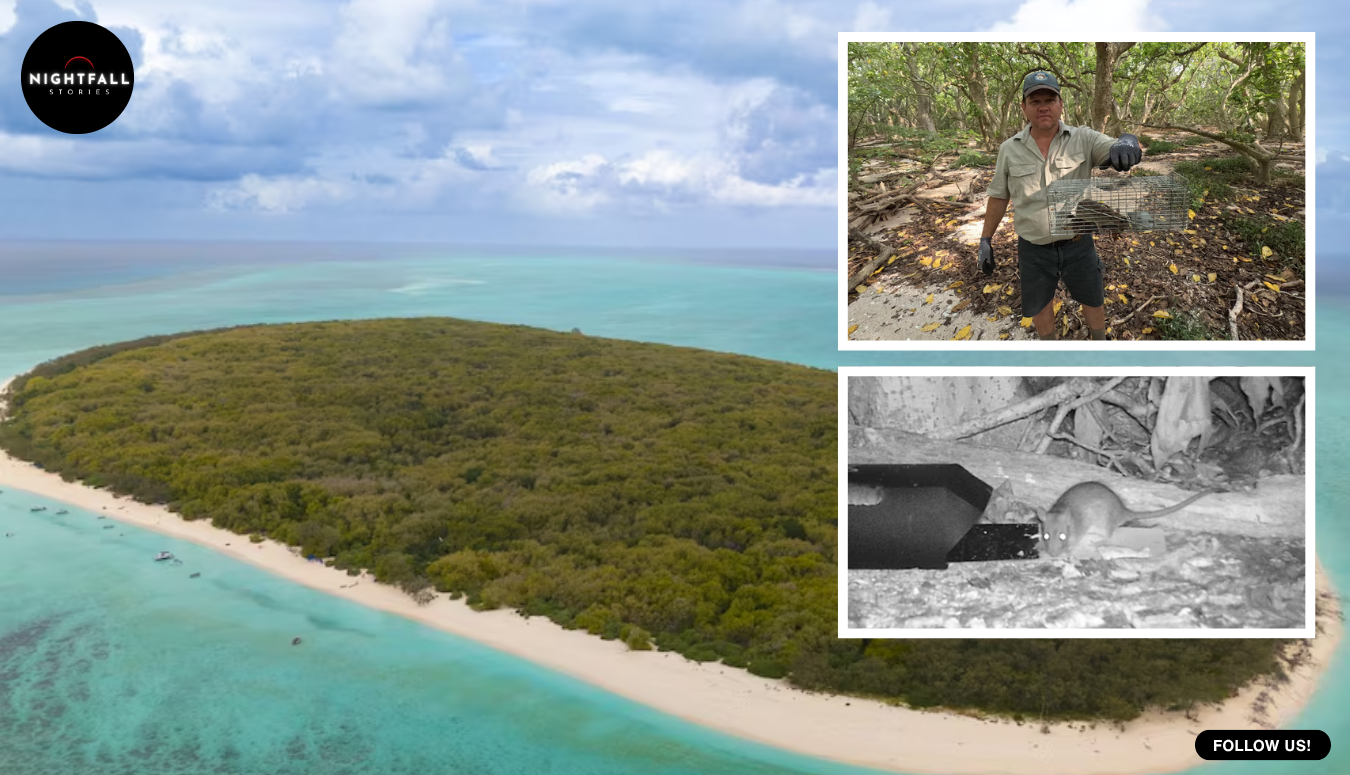
For twelve months, a team of rangers went back and forth to a small coral island on the southern Great Barrier Reef to check cameras and ink pads, and every single time, the answer they got back was nothing. No footprints. No chewed bait. No little pink feet caught on a motion sensor at two in the morning. Nothing at all, over and over, for a full year.
That run of nothing is what finally allowed Queensland Parks and Wildlife Service to declare North West Island free of black rats earlier this year, closing out an operation that began when a campground host noticed something that should not have been there in late 2022.
Senior Ranger Damon Shearer, who has spent a large part of the last few years on this problem, has described the end of it in terms that are almost anticlimactic. Every check that came back empty was another small tick in the right column. By the end, with the tally at zero across the board, what he was left with was mostly relief.
It is a strange job to describe. Most conservation work produces something you can photograph: a chick that fledged, a seedling that took, a number that went up. This one produced an absence. And absence, it turns out, is the hardest thing in the world to prove.
North West Island is about 120 hectares of coral cay in the Capricorn Bunker group, out past Gladstone on the Queensland coast, and it is one of the most important seabird islands in the country. More than 100,000 east coast wedge-tailed shearwaters breed there, which is upwards of 70 per cent of the entire Australian breeding population of that bird. Around 70,000 black noddies turn up annually as well. Green and loggerhead turtles nest on its beaches. It is, by any measure, a place that matters out of all proportion to its size.
Which is exactly why the rats were a catastrophe rather than an inconvenience.
To understand what black rats do to a seabird island, you have to understand what a seabird island is. A coral cay like North West has no native land mammals. Nothing hunts on the ground. Over thousands of years, that absence shaped everything about how the birds there live. Wedge-tailed shearwaters, which Australians often call muttonbirds, nest in burrows dug into the sand and soil under the island’s vegetation. The parents go out to sea to feed and come back after dark. The chick sits in the burrow alone, in the dark, soft and flightless and completely undefended, for weeks.
In a system with no ground predators, that is a perfectly sensible strategy. Introduce a rat, and it becomes a buffet.
It helps to know what a coral cay actually is, because the word island does it no favours. North West is not a mountain poking out of the sea. It is a low heap of broken coral and sand that the reef itself has piled up and that plants have then stabilised, sitting a few metres above the water at best. There is no high ground, no interior, nowhere for anything to retreat to. The whole of it is habitat, and the whole of it is reachable. That geography is why these cays support such enormous bird numbers in such a small space, and it is also why a single introduced predator can work its way through all of it.
Shearer has put the arithmetic plainly. On an island with no predators and plenty of food, a rat population can go from two animals to something like a thousand inside a year. Black rats breed fast, climb well, eat almost anything and are very good at being somewhere without being seen. They take eggs. They take chicks. On seabird islands around the world, they have quietly removed entire breeding colonies while nobody was watching, because the damage happens underground and after dark and is counted in chicks that simply never appear.
So when a campground host on North West Island reported rats in late 2022, the response was not proportionate to the number of animals anyone had actually seen. It was proportionate to what those animals would become if left alone for a few more breeding seasons.
The part of this story that makes it a human one, rather than simply an ecological one, is how the rats almost certainly arrived. Rangers believe they came as stowaways, either on a boat or tucked inside camping gear brought over by visitors. Nobody set out to introduce rats to one of Australia’s most significant shearwater colonies. Somebody loaded a tender, or packed a tent, or stacked some food crates, and a rat was in there.
North West Island is popular. It takes up to 150 campers at a time, and in 2024 it recorded 10,481 camper visits. That is a lot of boats coming in across the shallows, a lot of gear coming ashore, a lot of opportunities. The island’s great strength as a place people are allowed to enjoy is also, in biosecurity terms, its weak point.
Getting rid of the rats took around eighteen months of work by Queensland Parks and Wildlife Service rangers alongside Gidarjil Land and Sea Rangers, delivered through the Reef Joint Field Management Program with funding from the Australian Government’s Reef Trust and from Australia Pacific LNG, QGC and Santos GLNG.
Aerial baiting by helicopter was identified early as the method most likely to actually work. On an island of this shape and size, covered in dense vegetation and riddled with burrows, there is no realistic way to hand-place enough bait to reach every rat, and reaching every rat is the whole game. An eradication is not a cull. If you kill 99 per cent of a rat population, you have not solved anything; you have simply given the survivors more room and better food. The target is total removal, and that is why aerial coverage, which puts bait into every square metre including the places people cannot easily walk, is the standard approach on islands of this scale.
Alongside the aerial work, rangers used ground bait stations and trapping, partly to tighten coverage and partly to reduce the risk to the island’s own wildlife. That tension is real and worth being honest about. Dropping rodent bait onto an island full of nesting seabirds and turtle beaches is not a decision anyone takes lightly, and the operation involved closing the island to visitors for five months while it was carried out. The campers who had booked North West Island for that period did not get their holiday. The shearwaters got their island back.
And then came the harder half of the job.
This is the part that most coverage skates over, and it is the part that actually deserves attention, because declaring an eradication complete is a claim about absence, and absence cannot be observed directly. You cannot photograph the last rat not being there. All you can do is look hard, in enough places, with enough different kinds of equipment, for long enough that the probability of a surviving population going undetected becomes small enough to act on.
So that is what the rangers did. For twelve consecutive months after the baiting finished, they ran remote cameras and Black Trakka ink tracking stations across the island. A tracking station is a simple and rather elegant piece of kit: a tunnel with an inked pad in the middle and a card either side, so that anything walking through leaves its footprints behind for someone to read later. Cameras catch what moves. Ink catches what walks. Between them, and with repeat visits across a full cycle of seasons, the island was checked and rechecked.
Nothing showed up. Not once.
The awkward truth sitting underneath that result is that monitoring of this kind can only ever fail to find something. A camera that photographs no rat has not demonstrated that no rat exists; it has demonstrated that no rat walked in front of that camera during the hours it was armed. Rats are also, unhelpfully, rather good at being the exception. A single surviving pregnant female in a burrow on a 120 hectare island is a very small target, and if she is trap-shy or simply unlucky in where she forages, a short monitoring window could miss her entirely while her descendants quietly rebuild the problem.
What defeats that scenario is not any single clever device. It is time, and it is the rat’s own biology working against it. Rats cannot stay rare. Left undisturbed with abundant food, a surviving pair does not hold steady at two; it multiplies, spreads, and starts using more of the island, which means crossing more tunnels and triggering more cameras. The longer the monitoring runs, the more improbable a silent survivor becomes. The whole method is essentially a wager that no rat population can keep its head down for a year.
It is worth being precise about what that twelve-month threshold actually is, and who sets it, because this is the kind of detail that tends to get reported as though a referee somewhere blew a whistle. Nobody external certified North West Island. The declaration is Queensland Parks and Wildlife Service’s own, made by the agency that manages the island, against a monitoring standard drawn from established practice in island rodent eradication rather than from any binding international register.
That practice does have real shape to it. Published best-practice guidance for rat eradication on tropical islands, set out by Keitt, Griffiths and colleagues in the journal Biological Conservation, recommends that confirmation of success can reasonably occur after one year on tropical islands, as against two years in temperate regions. The reasoning is biological rather than bureaucratic. Rats in the tropics breed quickly, with a generation time of roughly a third of a year, so a full twelve months covers more than three generations. If even a couple of animals had survived the baiting, a year is long enough for them to have multiplied into a population too large and too active to stay invisible. The same guidance recommends using at least two independent detection methods, which is precisely what the cameras and the ink tracking stations were.
So the twelve months is not an arbitrary round number, and it is also not a guarantee. It is a defensible bet, built on how fast rats reproduce, and it is the point at which the people who manage these programmes agree the balance has tipped from reasonable doubt to reasonable confidence. Reading it as absolute proof would be overreading it. Reading it as a shrug would be underreading it badly.
Ranger Anna Darby, based at Gladstone and working across the Capricornia Cays, is one of the people for whom this is simply the ordinary texture of the job: boats, gear, cards, cameras, and the long patient business of looking after islands that most people will only ever see from a tent for four nights.
What makes the North West Island result genuinely significant is the scale of what it protects. Seventy per cent of a national breeding population is not a statistic you get many chances to defend. Had the rats become established and gone through a few shearwater seasons, the island’s colony could have been reduced dramatically before anyone outside the park service noticed, because nothing about the collapse of a burrow-nesting colony is visible from a boat. By the time it is obvious, it is usually historic.
Instead, somebody saw a rat, reported it, and a chain of decisions followed that ended with a helicopter, eighteen months of work, a year of looking at nothing, and a formal declaration from the state agency that the island is clear.
But the declaration is not the end, and this is where the story turns back on the reader.
Pest-free status on an island like North West is not a permanent condition. It is a state that has to be held. The rats got there in the first place because of ordinary human carelessness, nothing malicious, and the same route is still wide open. Every boat that comes in across the reef flat is a potential vector. Every tent bag, every food crate, every kayak hatch is somewhere a rodent can hide for a short crossing. Shearer’s own framing of it is the one that matters most now: getting rid of them is an enormous job, so the real effort has to go into prevention.
Which means the agency’s message, as the island returns to normal use, is not a celebration so much as a request. Check your gear before you leave the mainland. Check the boat. Look in the places you would not normally look. Arrive pest-free. It is an unglamorous ask, and it is the only thing standing between a hundred thousand shearwaters and a repeat of 2022.
There is something quietly worth sitting with in all of this. The rangers who worked on North West Island spent a year deliberately looking for something they desperately hoped not to find, driving out to a coral cay again and again to read blank ink cards and empty camera rolls. In almost any other line of work, a year of no results is a year wasted. Here it was the result. The nothing was the finding.
And the strange thing about a successful eradication is that nobody will ever see the thing it produced. The chicks that will fledge from those burrows over the coming decades would have fledged anyway, as far as anyone looking at them can tell. The colony will not look rescued, because it will not look like anything at all. It will just look like a loud, crowded, slightly smelly island full of birds doing what they have done there for thousands of years, which is exactly what it looked like before.
That is the quiet bargain of this kind of conservation work. Done badly, it leaves a visible ruin. Done well, it leaves no trace of itself whatsoever, and the only record that anything ever went wrong is a file in a state agency, a run of empty data, and a sentence on a booking page asking campers to check their bags.