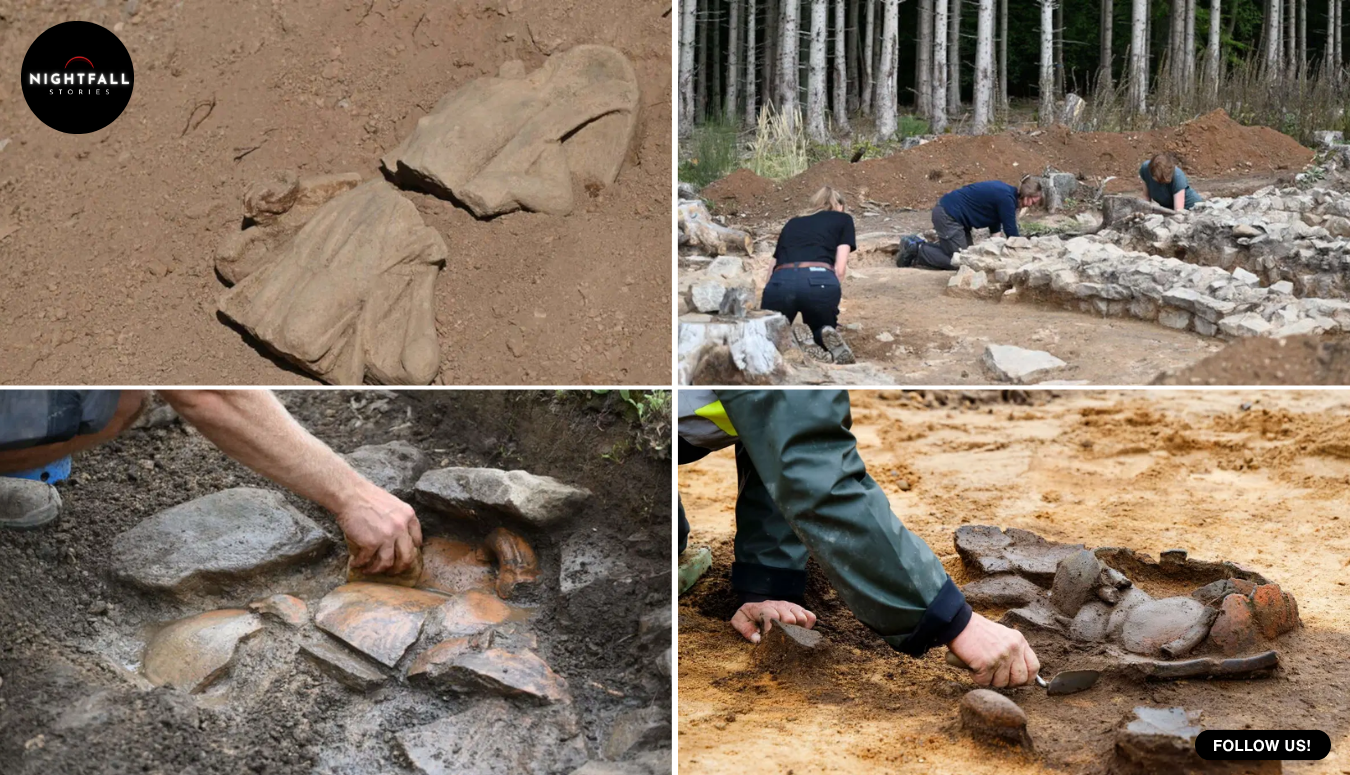
The thing that made the discovery possible was a disaster. Drought and bark beetles killed off a stretch of forest in the Taunus hills north of Frankfurt, the trees came down, and archaeologists were suddenly able to get at ground that had been locked under woodland for centuries. What they found, sitting a few centimetres beneath the forest floor, was an entire Roman village.
That was the headline a year ago. The village, a civilian settlement attached to the small Roman fort called the Kapersburg, turned out to have paved streets, stone buildings, a room with heating channels running hot air through its walls, and the remains of kitchens with hearths built up out of stone and broken pottery. Archaeologists estimated it had been lived in for about a century and a half, and that alongside a garrison of roughly 160 soldiers there were something like 600 to 700 civilians.
What has emerged since is smaller, and considerably more interesting. In the latest work at the site, the team found a temple, two inscribed votive stones, and a statuette of Victoria with her wings and palm branch still recognisable. And lying near the temple, among fragments of handmade pottery, they found a brooch.
The brooch is the reason this story matters. According to the Hessian state heritage office, it is the first archaeological evidence for use of this area after the Roman frontier was given up. Which means that for the first time, there is something physical to say in answer to a question that has hung over this landscape for a very long time: when Rome walked away from its German frontier, did anybody stay?
To see why a single small object can carry that much weight, you need to know what the Kapersburg was part of.
The Upper German and Raetian Limes was the land frontier of the Roman Empire in this part of Europe, a line of palisade, ditch, wall, watchtowers and forts running for hundreds of kilometres across what is now southern Germany. It was not a wall in the sense people usually picture. It was a continuous controlled edge, studded with small installations where soldiers watched, taxed, escorted and reported. The Kapersburg was one of those installations: a modest fort, not a legionary fortress, holding a garrison you could fit into a couple of modern buses.
And then, somewhere in the middle of the third century, the Romans let the whole thing go. The frontier was pulled back to the Rhine and the Danube, the forts were vacated, and a line that had taken generations to build and maintain simply stopped being a frontier. German scholarship calls the episode the Limesfall, the fall of the Limes. The exact dating is argued over, and the honest position is that it was a process rather than an event, with pressure from outside, civil war and imperial crisis inside, and no single day anyone can point to.
What makes it one of the quiet great events of European history is how it is usually told. It tends to be written as a date, or as a line on a map that moves. But every one of those forts had a village attached to it, and every one of those villages was full of people who were not soldiers: traders, smiths, innkeepers, families, the whole apparatus that grows up wherever a few hundred men with regular pay are stationed. When the army left, the army’s pay left with it. What happened to everyone else is one of the least documented aspects of the whole affair, because people leaving quietly is almost archaeologically invisible.
This is exactly why the civilian settlements, the vici, are worth so much more to archaeologists than the forts. Forts tell you about the army, and the army is already comparatively well documented through inscriptions and military records. A vicus tells you how people actually lived on the edge of an empire: what they ate, what they bought, what they made, who they married, what they worshipped.
Before this project, almost nothing was known about the Kapersburg’s vicus. Only a single structure outside the fort had ever been documented, a bathhouse near one of the gates. The rest was under trees.
That is more normal than it sounds. The Limes is a World Heritage site and has been studied intensively since the nineteenth century, but study has always concentrated on the forts and the frontier works themselves, because those are what is visible, what is monumental and what the early investigators were looking for. Louis Jacobi, the nineteenth century investigator whose name is attached to the early archaeology of this region’s Roman military sites, is still cited in accounts of the Kapersburg today. The villages beside the forts were comparatively ignored, and in a case like the Kapersburg, where the whole settlement lay under mature woodland, they were effectively unreachable even for archaeologists who wanted them.
So when the trees died, the project that followed was not a lucky accident so much as a long-deferred opportunity that finally became possible. The excavators have been working a landscape that scholarship had written about for a century without ever being able to open.
The work has been running since 2024, carried out by hessenARCHAEOLOGIE, the archaeological arm of the Hessian State Office for Monument Preservation, in cooperation with the University of Frankfurt. The excavation director is Manuel Pieper. The district archaeologist and Limes coordinator for the region is Dr Kai Mueckenberger. Professor Markus Scholz of the University of Frankfurt, whose field is Roman epigraphy, is working on the inscriptions. Michael Gottwald is also on the team, and Katharina Griesshaber of the Saalburg museum, the reconstructed Roman fort nearby that has been the centre of Limes scholarship in this region for well over a century, has been involved in the finds work.
The area opened up is substantial, roughly 200 metres by 300 metres, and what the team has been able to do is trace the shape of the settlement: lines of road, terraces cut into the slope, and the positions of buildings. One of them held part of a smithy, later flattened when the settlement was reorganised, which is the kind of detail that tells you a village was not static but rebuilt itself over the decades the way any living place does.
The temple is small. The building is around five metres long, rectangular, with the walls of its inner sanctuary about 50 centimetres thick, and the archaeologists have described its state of preservation as unusually good. The finds inside and around it are what identify it: two votive stones carrying inscriptions, fragments of statuary including a hand thought to belong to a figure of Mars, animal sculpture fragments, and the Victoria statuette, of which a nearly complete torso survives with the wings, the palm branch and the victor’s laurel all still legible.
Mars and Victoria, on a frontier. It is not hard to work out what a garrison community was asking for.
Victoria is the more revealing of the two, in a way. Mars in a soldiers’ village is almost expected furniture. Victoria is specific: she is not protection, she is outcome. A community that commissions and keeps a figure of victory is a community with a stake in results, which fits a place whose entire economy depended on the garrison next door continuing to exist and continuing to be paid.
There is something worth pausing on there, though, which is that a temple to the war god in a soldiers’ village is not simply a piece of military decoration. Votive stones are transactional objects. Somebody paid for them. Somebody made a vow, in a specific set of circumstances, and then paid a stonecutter to record that the vow had been kept. Those inscriptions are the thread that could still produce actual names out of this site, which is Scholz’s job, and the team is waiting on the reading of a Latin dedication that may even give the settlement its Roman name. For now, nobody knows what the people who lived there called the place.
Which brings us back to the brooch.
Here is why it carries the weight it does. Dating a Roman site is normally done with the enormous, well-studied mass of Roman material culture: coins, samian pottery, brick stamps, specific forms of vessel whose production dates are known tightly. Those things stop at the Kapersburg where you would expect them to stop, in the third century, because they were made and traded inside a system that withdrew. The problem with trying to find out whether anyone was still around afterwards is that the people who might have been there were not using that system. If they left no coins, no stamped tile and no imported tableware, then as far as the usual methods go, they left nothing at all.
A late antique brooch breaks that silence, because it is datable on its own terms. Brooch typology is one of the more finely resolved areas of the period, and a form that belongs later than the withdrawal, found in the temple area, is a datable object sitting in a layer of time that was supposed to be empty here.
The handmade pottery matters in exactly the same way, and it may matter more. Roman pottery in a settlement like this was wheel-thrown, standardised, produced in workshops and distributed through trade. Pottery made by hand is a different technological signal entirely. It points to people producing their own vessels outside that network, which is characteristic of the non-Roman groups of the region rather than of a Roman provincial village. In a Roman provincial landscape, handmade sherds are not a whisper. They are a shout.
What the archaeologists say about who those people were is appropriately careful, and it is worth reproducing their caution rather than smoothing it over. The state heritage office’s position is that the brooch and the pottery represent the first archaeological evidence for use of the area in the period after the Limes, and that this can potentially be connected to Alamannic settlement in the Wetterau, the fertile basin to the east. Potentially. The language in the release is conditional, and the piece of the claim that is firm is narrower than the piece that is interesting.
It is also important to be precise about the scope of what is being claimed, because it is the sort of thing that grows in the retelling. This is not the first evidence that anybody at all remained in Germany after the Roman period, which would be an absurd claim; the broad outlines of post-Roman settlement in the region are well established. It is the first archaeological evidence for post-frontier use of this area, at this site, on this stretch of the Limes. That is a local claim, and it is a genuinely significant one locally, because it converts an assumption into an object.
And note what the brooch does not do. It does not prove continuous occupation. It does not prove anyone lived in the vicus after the garrison walked out. A brooch and some sherds are entirely consistent with people coming back to a ruin, using it, camping in it, taking stone from it, or simply passing through a place that still had standing walls and a usable road. The archaeologists use the word use rather than the word settlement, and that distinction is doing real work.
What has changed is the shape of the question. For this stretch of frontier, the question was whether there was any physical trace of human presence after Rome gave the line up, and the answer to that was previously no. Now it is yes, and the interesting arguments can begin: who, how long, how often, and whether they knew or cared what the place had been.
The other detail worth verifying rather than simply repeating, because it is the part of this story that travels furthest, is the depth. Every account of the Kapersburg work says the archaeology begins a few centimetres below the present forest floor, and the state heritage office used almost exactly that phrasing as the title of its own announcement: a Roman village a few centimetres under the woodland floor. What no source publishes is an actual measured figure. It is a description, consistently given by the excavators themselves, and not a survey number, so it should be read as what it is.
It is nonetheless remarkable, and it explains both why the site survived and why it is now vulnerable. Woodland is an excellent preservative. Nobody ploughs it, nobody builds on it, and the soil accumulates slowly, so a Roman street surface can lie just under the leaf litter for seventeen centuries and still read as a street. The flip side is that there is almost nothing protecting it. Forestry machinery, root damage from falling trees, erosion on a slope and the simple passage of boots all reach that deep without trying.
So the dead trees that made the discovery possible are also a warning. The reason archaeologists could suddenly see this village is that a drought and an insect killed the forest that had been hiding it, and the same clearance that let them in leaves the remains exposed in a way they have not been for a very long time.
The work is not finished, and the team has been explicit that it does not expect to finish soon. Further seasons are planned with students from the University of Frankfurt, which is how a site like this gets excavated and how field archaeologists get trained at the same time. The inscriptions are still being read. The settlement’s Roman name is still unknown.
But the question that stood over this patch of woodland has already changed, quietly and for good. For as long as anyone has studied the Limes here, the period after the frontier was abandoned has been a blank at the Kapersburg, something inferred from the general history of the region rather than seen in the ground. A brooch the size of a coin, lying in the dirt beside a small temple to a war god whose empire had already pulled back a hundred kilometres, has turned that blank into a fact.
Somebody was there. Nobody yet knows their name, and for now that is a better place to be standing than where the question stood before.