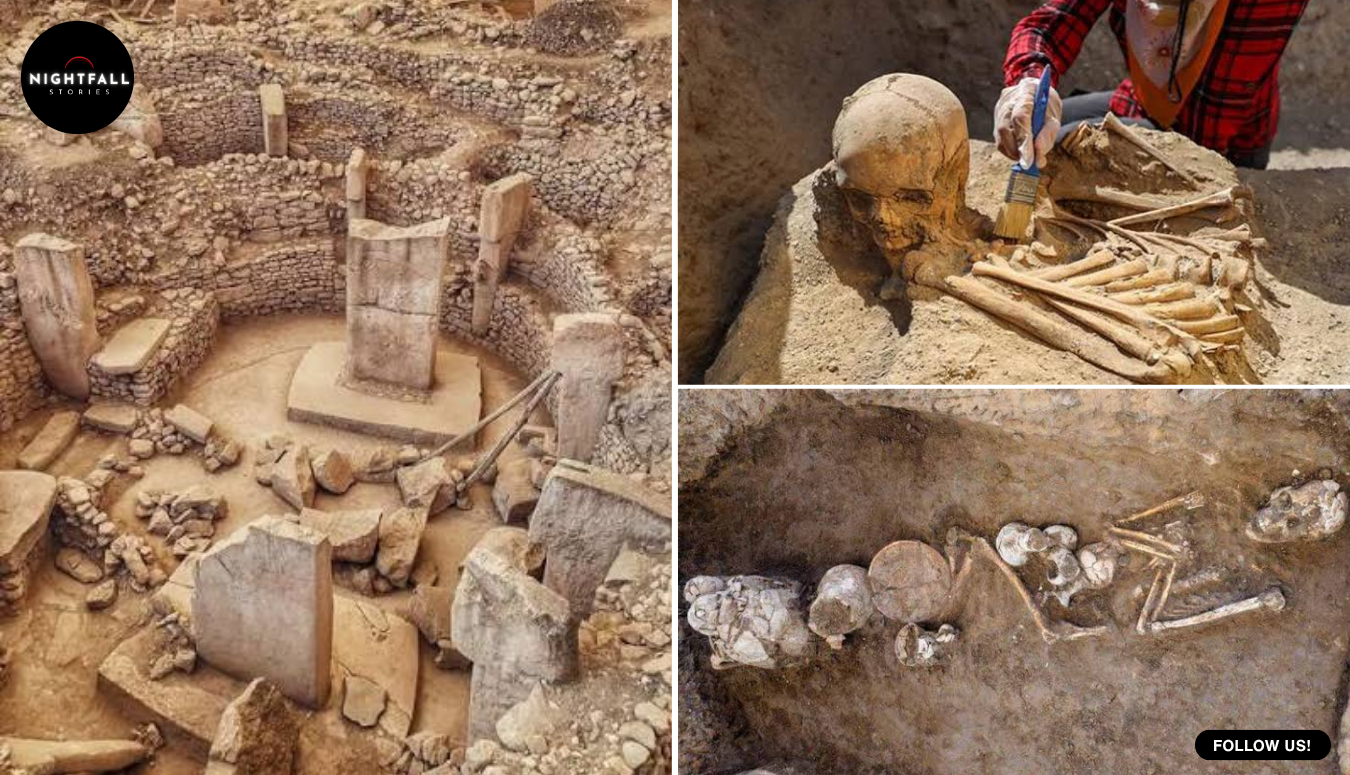
More than nine hundred loose human bone fragments have come out of the ground at Göbeklitepe, by one published count 928. Not one complete skeleton among them for most of the site’s excavated history. Just pieces, turning up in the fill of the great circular buildings with their carved T-shaped pillars, snapped across the shaft, missing their ends, scattered with no body to belong to.
For about three decades that absence was the most suggestive thing about the place. A site with monumental architecture eleven thousand years old, animals carved in relief on standing stones, and human remains that arrived exclusively in fragments. If you wanted to believe something strange had been done to the dead there, the evidence was perfectly shaped for it, because there was no evidence at all of the ordinary alternative.
Then two intact burials turned up, and a physical anthropologist named Julia Gresky spent years reading the damage on the bones in them rather than the bones themselves. Her conclusion, published with her colleague Lee Clare, is that most of those fragments probably never represented a ritual of any kind. They were ordinary graves. The mound they were buried in slid downhill on top of them for eight thousand years.
Before going further, one thing needs saying clearly, because the way this story has travelled makes it sound like a dig that happened last month. It did not. Göbeklitepe has been excavated for around thirty years. Part of the skeleton at the centre of this paper came out of the ground in 2012. The rest of it came out in 2022. The second burial was found under a building floor years ago as well. Nothing was dug up recently. What is new is the analysis, published in a journal this autumn. The find is old. The reading is new. That distinction is the whole reason the paper matters, and it is also why nobody noticed the answer for so long: it was never going to come from digging faster. It had to come from somebody going back to material already in storage and asking a different question of it.
The question Gresky asked is the one forensic anthropologists ask, and it has almost nothing to do with archaeology as most people picture it. It is not what did these people do. It is what happened to this bone after the person inside it died. The discipline is called taphonomy, and it is the study of everything that intervenes between a body and the moment an archaeologist picks it up. Soil chemistry. Water. Animals. Temperature. Weight of earth. Time. Every one of those leaves a signature, and the signatures are distinguishable if you know what you are looking at.
Start with how a bone breaks, because this is the heart of the argument and it is genuinely satisfying once you see it.
Fresh bone is not like dry bone. A living long bone is a composite material, mineral for stiffness and collagen for flex, and it is damp. Break it while it is still fresh and it behaves a bit like green wood. It fails in a spiral. The fracture travels around and along the shaft at an angle, producing what is called a helical break, with edges that are relatively smooth and surfaces that match the colour of the rest of the bone because the inside and the outside have aged together ever since.
Dry bone, bone that has lost its collagen and its moisture after decades or centuries in the ground, behaves like a stick of chalk. It snaps. The fracture runs straight across the shaft, transverse or close to it, with a rougher edge, and the newly exposed surface often looks different from the weathered outside.
So the orientation and texture of a break carries a rough clock. A long bone in a Neolithic grave with a helical fracture broke while it was still relatively fresh. One with a flat transverse break broke long after burial. In the burials Gresky examined, the long bones showed both, and that mixture is informative rather than confusing: it says the damage accumulated over a long period rather than all at once in a single event at the funeral.
Then there are the teeth marks. Rodents gnaw bone, and they do it in a way nothing else does. A rodent’s incisors are paired, chisel-edged and self-sharpening, and they work in parallel strokes, so what they leave behind is not a puncture or a crushing bite but a field of shallow parallel grooves, often in a patch on a flat or prominent surface where the animal could brace. On the bones from one of these burials, rodent gnawing shows up as patches on a shin bone and along the outer edges of ribs and at a bony ridge on an upper arm bone. Rodents did not dig a tunnel to a sealed body and eat it for pleasure. Their access tells you the grave was not sealed for very long, or was reopened, or that the ground above it had broken up.
Third signature: calcareous deposits. Water moving through limestone picks up dissolved calcium carbonate, and where it sits against a surface it leaves a crust, the same process that furs up a kettle. Several bones in the single burial are coated in it, and at least one patch of rodent gnawing is partly or completely buried underneath the crust. That is a sequence, and it is a lovely piece of reasoning. The rodents came first. The water came after. On one shin bone fragment a thick layer of dense outer bone had peeled away from the back surface entirely, which is what happens to bone that has been through repeated wetting and drying and mineral loading, not what happens to bone that somebody cut.
And fourth, the pattern of what is missing. In the single burial the forearm bones are fragmented and both ends of the shafts, the joint ends, are gone. That distribution matters. Joint ends are spongy, porous and thin-walled, the weakest parts of a long bone. They are the first thing to go when bone is crushed, weathered or churned. If you were looking at deliberate dismemberment you would expect damage concentrated at the joints in the form of cut marks and shaving, not simply the structurally weakest parts of each bone having quietly vanished.
Put all of that together and a picture assembles that has nothing to do with ritual. Bodies buried under floors. Long periods during which the ground above them was permeable enough for rodents to reach them. Water passing through, depositing minerals, soaking and drying the bone repeatedly. Breaks happening at widely different points in the process, early ones spiral and late ones snapped. The weakest parts eroding away. And then, over thousands of years, the mound itself moving.
That last part is the mechanism that explains the scatter, and it is specific to this landscape. Göbeklitepe sits on a limestone ridge, and the site is a tell, an artificial hill built up from generations of construction, demolition and refuse. Tells are not stable. Material at the top travels downwards under rain and gravity, slowly and relentlessly, a process geologists call slope wash or colluvial movement. The paper’s argument is that the lower-lying parts of the site, which include the monumental buildings everybody comes to see, became buried under deposits that had washed down from higher up, and those deposits carried with them the broken contents of graves that had originally been dug further up the slope.
Which is why the bones kept turning up in the monumental buildings. Not because anyone put them there. Because the buildings were downhill.
It is worth sitting with how much that reframes. For decades, the fact that human bone appeared inside the special buildings was treated as a clue about what those buildings were for. If the bone arrived as part of the sediment that filled them in, long after they stopped being used, then its location says nothing about their function at all. It is the archaeological equivalent of finding leaves in a gutter and concluding something about the roof.
The two burials themselves are worth describing, partly because they are the first of their kind at the site and partly because one of them has an oddity that is hard to beat.
The first sits in a feature the excavators call Drainage Channel 1, beneath the floor of a rectangular building from the later Pre-Pottery Neolithic phase. Both burials date to roughly 8,700 to 8,000 BCE. It is a collective grave, which is to say more than one person in it, and the people in it are an adult woman, an adult man and an adolescent girl. There is also a cranium, a skull vault, which most likely belongs to the adolescent but might belong to a fourth, older individual. The paper leaves that genuinely open and so does this piece: it is not resolved and the authors do not pretend it is.
The arrangement inside the grave is the interesting part. Three cranial vaults were grouped together in the eastern corner. Some of the long bones were piled in the western corner. That is not how a body comes to rest. Somebody moved the bones of people already in the grave, gathered the skulls to one side, stacked the limbs to the other, and made room. Which means the grave was opened again, probably more than once, to add someone new. That is a mortuary practice, and it is a human and recognisable one, found across the ancient world and in plenty of places still. It is also the opposite of exotic. It is what a family does with a grave plot.
The second burial, in a trench next to the structure known as Special Building A, held a single young adult woman, laid on her left side with her knees drawn up, facing east. And here is the oddity: she was excavated in two halves, ten years apart. Some of her bones came out in 2012. The rest were still in the ground until 2022. For a decade, part of a woman sat in storage while the rest of her stayed in the ground, and nobody knew the two sets belonged together until the second set came out and somebody matched them.
Even then, the match is not total. Of the bones recovered in that first season, some turned out to belong to the same individual as the 2022 material, and others could not be, and may belong to a different person, possibly a man. Which is precisely the kind of ambiguity you get at a site where graves were reopened and the ground has been moving ever since.
Now, the thing this paper does not do, and the place where the headlines have been sloppier than the science.
Göbeklitepe’s reputation for a skull cult is not a tabloid invention. It rests on a 2017 study in which modified human crania from the site were described in detail: deep grooves cut into the bone with flint tools, and on the best-preserved example a drilled perforation, which the authors suggested could have been used to hang the skull from a post or a beam. Those carvings are now documented on several individuals. One of the authors of that study was Julia Gresky.
That is worth pausing on. The person who has just argued that most of the fragmented bone at Göbeklitepe is ordinary burial disturbed by erosion is the same person who established that some of the skulls there were deliberately carved and drilled. There is no contradiction and no retraction. There are two different populations of evidence. Grooves cut with a flint tool and a drilled hole cannot be produced by rainwater, rodents or a hillside moving. Helical fractures, gnaw patches, mineral crusts and missing joint ends cannot be produced by a mortuary ritual. The new paper is not saying nothing unusual happened with the dead at Göbeklitepe. It is saying that the great mass of scattered fragments, the many hundreds of pieces that have carried most of the speculation, do not need an unusual explanation, and that the authors cannot rule out further mortuary practices alongside the ordinary burials.
That is a harder argument to publish than a skull cult, and the reason is structural. A dramatic claim needs you to find one spectacular thing. A deflationary claim needs you to account for everything, and to show not only that erosion could have produced the pattern but that it did, bone by bone, signature by signature. It wins no headlines in proportion to the work. It is also the kind of argument that has to be made before anything else at a site can be trusted, because the alternative is a literature built on an absence.
And it clarifies what the famous pillars have to do with any of this, which is less than most people assume. Göbeklitepe’s T-shaped monoliths with their foxes, boars, snakes and vultures have spent twenty years being read as evidence of a death cult, partly on the strength of the vultures and partly on the strength of bone fragments found nearby. If the fragments washed in from uphill long after those buildings were abandoned, then the carvings have to be interpreted on their own merits. They are still extraordinary. They are just no longer corroborated by the bones.
The graves add something else, quieter. For thirty years the human beings at Göbeklitepe existed only as inventory, a count of fragments in a store. Now there are a handful of actual people: a woman and a man and a girl in their late childhood, buried together under a floor in a grave their community went back and opened again; and a woman in her twenties, laid on her side with her knees pulled up, facing the sunrise, under the shadow of one of the most famous buildings in prehistory, who waited eleven thousand years to be dug up and then another ten to be made whole.