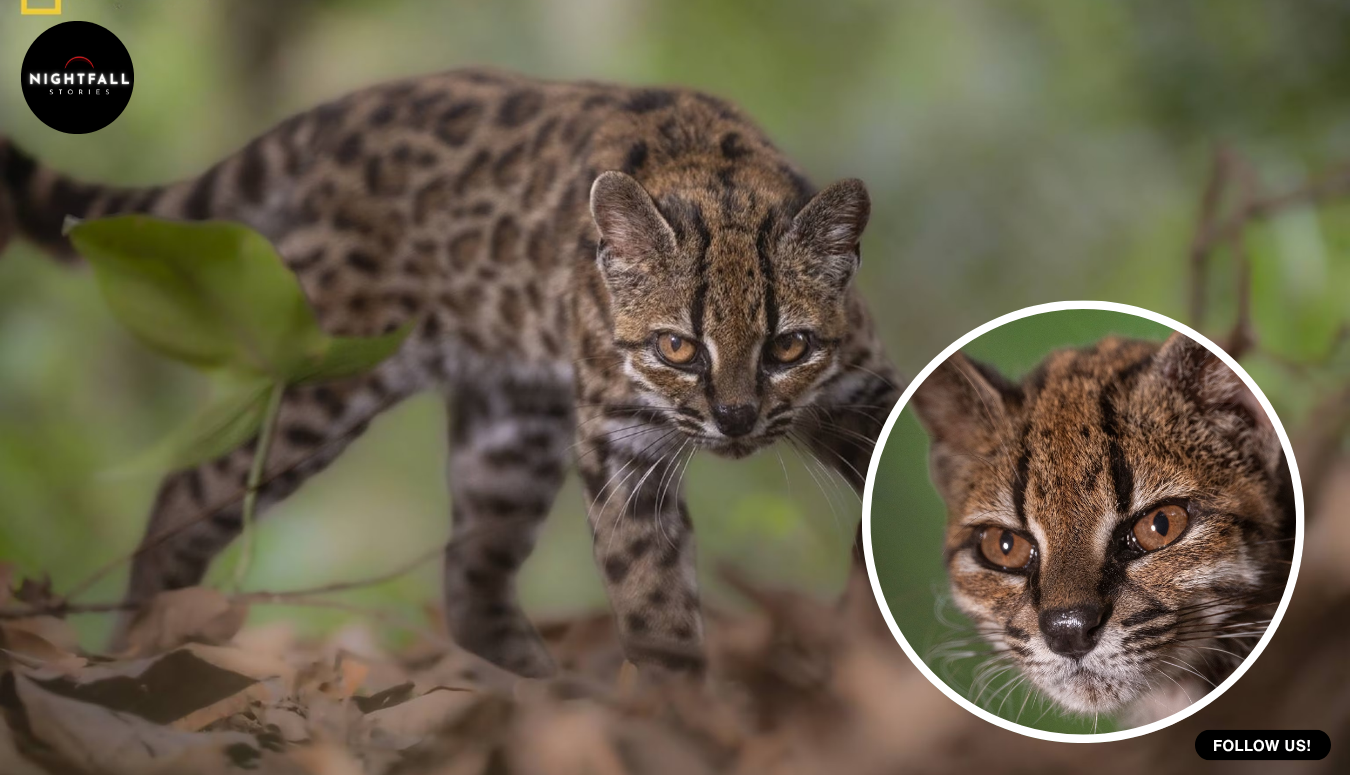
A man walking a road on the eastern slope of the Andes found a kitten and did what most people would do. He took it home. He fed it what he had, which was noodles, rice and eggs, and he assumed it was somebody’s housecat that had wandered off into the cloud forest. It was not. About a year later, once it became obvious that this small spotted animal was never going to behave like a pet, he handed it over to La Senda Verde, a wildlife refuge in Bolivia’s Yungas. The sanctuary staff called a biologist who knew Bolivian cats and asked her to come and look at something odd.
That cat is now roughly ten years old, still living at the refuge, still going by the nickname the keepers gave him, Tigrino. And as of this month he is the living face of the first brand new wild cat species that science has formally described in more than a hundred years.
Its name is Leopardus tilcayo. It weighs about three to four pounds. Its head and body together run somewhere between seventeen and twenty inches, with a tail adding roughly another ten. It is smaller than the average domestic cat, with a slightly squashed face, round ears, light brown fur and unusually large rosettes scattered across it in an irregular, low contrast pattern that makes it look less like a miniature leopard and more like a leopard photographed through fog. If you passed it on a trail at dusk you would almost certainly assume you had seen a tabby.
That is precisely the problem this cat has presented for two centuries, and the reason it took a genome to notice it.
The biologist who answered the sanctuary’s call is Paola Nogales-Ascarrunz, a Bolivian scientist who founded the Bolivian Felids Research Program and works as a National Geographic Explorer. When she first examined Tigrino, she did not think she was looking at a new species. She thought she was looking at a tiger cat, a Leopardus tigrinus, that happened to be unusual. Slightly wrong colour. Spots too big. Tail a bit long and a bit thin. Cats vary, and she filed it away as a curiosity.
Then, a few years later, she was putting together a guide to the cat species of Bolivia. Work like that forces you to be precise, because a field guide has to tell a reader what to look for, and the moment she tried to write down what a tiger cat in the Bolivian Yungas actually looked like, Tigrino stopped being a curiosity. The description she was writing did not match the animal she had in front of her. Not in one detail, but in several, all at once, all pointing the same direction.
This is the unglamorous part of discovery that almost never makes it into the story. There was no moment in a jungle clearing with a torch beam falling on an unknown animal. There was a scientist trying to write an accurate caption and finding she could not.
What happened next took years and required a lot of people. Nogales-Ascarrunz went back to school for the genetics, because proving that a cat is a separate species is not a matter of opinion about spots. She joined an international team that eventually included Jonas Lescroart at the University of Antwerp, who shares lead authorship with her on the resulting paper, and Eduardo Eizirik, a geneticist at the Pontifical Catholic University of Rio Grande do Sul in Brazil who has spent much of his career untangling the small cats of South America. The wider author list runs to more than a dozen names across Bolivia, Brazil, Peru, Belgium and the United States, including the ancient DNA specialist Beth Shapiro.
Their approach was to stop arguing about fur and start reading genomes. The team assembled complete genomes from thirty eight individual cats across the genus Leopardus, sequencing twenty six of them new and pulling another twelve from existing data. Crucially, eight of those genomes came out of historical museum specimens, dusty skins and skull fragments sitting in drawers, some of them collected well over a century ago. That branch of the work has a name of its own now, museomics, and it is quietly rewriting a lot of what we thought we knew about animals nobody can easily find alive.
The museum material mattered more than it sounds, because the whole mess started with a museum problem. The original tiger cat was described in the eighteen hundreds on the basis of a single illustration of an animal from Cayenne, in French Guiana. Not a specimen. A picture. Every argument about tiger cat taxonomy since then has been anchored to a drawing, which is roughly like trying to settle a paternity case using a sketch of somebody’s cousin. Generations of biologists inherited that ambiguity and argued about whether there were one, two or three species of tiger cat, with the boundaries redrawn every couple of decades depending on who was measuring what.
The genomes ended the argument in a direction almost nobody had bet on. What had been treated as a single widespread species, or at best two, turned out to be five genetically distinct species spread across South and Central America. One of those five had never been described at all. That one lives in the Bolivian Yungas, and it is the animal at the refuge.
The team also sorted out a related population in Peru, naming it as a new subspecies, Leopardus tigrinus antisuyo. Tilcayo split off from its nearest relatives roughly one and a half million years ago, during a stretch of climate swings that repeatedly broke the montane forests of the Andes into isolated fragments. Cats got stranded on separate green islands, stayed stranded long enough, and became different animals.
The formal type specimen, the one that anchors the name in the scientific record, was not Tigrino. It was an animal documented near the village of Arapata in the Nor Yungas province of Bolivia, at about 1,570 metres of elevation, in 2021. That is cloud forest country on the eastern flank of the Andes, steep, wet, perpetually fogged in, and one of the more biologically dense places on the planet that most people outside the region have never heard of.
Which brings us to the name, and the part of this story that deserves more attention than the cat’s face is going to let it have.
The team did not invent a name. They did not use a Latin construction describing the spots, and they did not attach a donor’s surname or a colleague’s. They asked the people who live in the Yungas what they call this animal, and the answer came back the same over and over. Tilcayo. Everyone knew the word. Nobody could tell them where it came from. When researchers pressed on the etymology, the answers ran along the lines of, I do not know, my grandfather called it tilcayo, so I call it tilcayo. It does not appear to be Spanish. It does not appear to be Quechua. It is simply a word that has been passed down in that landscape for an unknown length of time, attached to a specific animal that outside science had never managed to see clearly.
So the official scientific name of the newest cat on Earth is a piece of local vocabulary of unknown origin, adopted whole, and the recommended English common name is the same word. The researchers treated it as a noun in apposition, which is the technical way of saying they did not bend it to fit Latin grammar. They left it as it was.
There is something quietly corrective in that. The communities of the Yungas were never confused about this cat. They had a word for it. They had presumably had that word for generations. What they did not have was a genome sequencer and a journal, and so the animal remained, in the official reckoning of the world, nonexistent. The paper closes a gap that only ever existed on one side.
The findings were published in the journal Current Biology, under the title Phylogenomics and museomics reveal five distinct species of tiger cats in South America. It went live earlier this month, and within days the tilcayo had been photographed, filmed and syndicated across more or less every continent, which is a strange fate for an animal whose entire confirmed wild range is a slice of Andean forest and whose only individual most people will ever see is a ten year old male in a refuge.
Now for the part that is easy to lose in the pictures.
Nobody knows how many tilcayos exist. Not approximately, not within an order of magnitude. The International Union for Conservation of Nature has not assessed the species, because until a few weeks ago it was not a species. The research team has handed its data over for a planned reassessment of the whole tiger cat group, and that reassessment is where the real consequences sit.
Eizirik has made the point bluntly. If you treat the tiger cat as one animal ranging continuously from southern Brazil all the way up to Costa Rica, you will conclude it is doing fine, because somewhere in that enormous sweep there are always populations holding on. Split that single reassuring entity into five species, each confined to its own much smaller patch of the map, and the picture inverts. Five separate, smaller, more fragile things, each of which can be lost on its own. The study’s genomic work already found evidence of severe long term population declines across tiger cat lineages through the Pleistocene and Holocene, with some of them, including the tilcayo, showing reductions of more than sixty percent.
A taxonomic revision is not a neutral bookkeeping exercise. It decides which animals are eligible for protection, which habitats get argued over, and which losses get counted. For decades the tilcayo’s decline was invisible because it was averaged into a larger group that looked healthier than it was.
The Yungas is not a stable place to be a small predator. It is being cleared, fragmented and converted, and the description of the tilcayo arrives with the blunt observation from the people who work there that its habitat is vanishing fast. A cat that weighs three pounds and hunts small rodents at night does not need a vast wilderness, but it does need connected forest, and connected forest is the thing in shortest supply on that slope.
Nogales-Ascarrunz has moved on to the next problem, which is finding the animal in the wild in any numbers. She has been setting camera traps through the Yungas forests, and the difficulty is exactly the one that hid the species in the first place. Tiger cats are routinely misidentified on camera surveys. A grainy night frame of a small spotted cat has been logged as a tigrinus for decades, and some unknown share of those frames were probably tilcayos all along. The archive of existing camera trap data across the region may already contain the answer to how widespread this animal is. Somebody now has to go back and look again with different eyes.
Her own summary of what the last decade taught her is worth sitting with, and it is not really about cats. We tend to assume, she has said, that the world is mostly known and mostly mapped, and that the era of finding new large animals ended somewhere in the colonial period. Her experience points the other way. The world is extremely complex, and most of it is not known. It only looks known because we stopped looking hard at the things we thought we had already identified.
That is what actually happened here. Nobody trekked into an unexplored valley. The cat was in a wildlife refuge with a nickname and a feeding schedule, roughly a two hour drive from a major city, being visited by tourists. It was in museum drawers, labelled as something else, in more than one country. It was on camera trap memory cards. It was in the everyday vocabulary of farming communities who had a name for it. The animal was never hidden. Our categories were just wrong, and wrong categories are far better at concealing things than dense forest is.
Tigrino will not be released. He was raised on noodles and rice by a well meaning stranger, he has spent a decade around people, and there is no version of the wild that he could survive now. He will live out his life at the refuge as the only member of his species most of the world will ever lay eyes on, which is a small and slightly melancholy irony for an animal whose name came out of a forest.
But his existence did something. A cat that nobody could classify sat in a sanctuary long enough for one biologist to keep coming back, keep failing to make the description fit, and keep going until she had the tools to prove why. The result is not just a new name in a journal. It is four other species that now have to be assessed separately, a Peruvian population with a formal identity, a century of muddled taxonomy finally resolved, and a word from the Bolivian Yungas printed permanently in the scientific record of the world.
Somewhere on that Andean slope there are more of them, moving at night, hunting rodents, being photographed by camera traps and filed under the wrong name. At least now there is a right name to file them under.