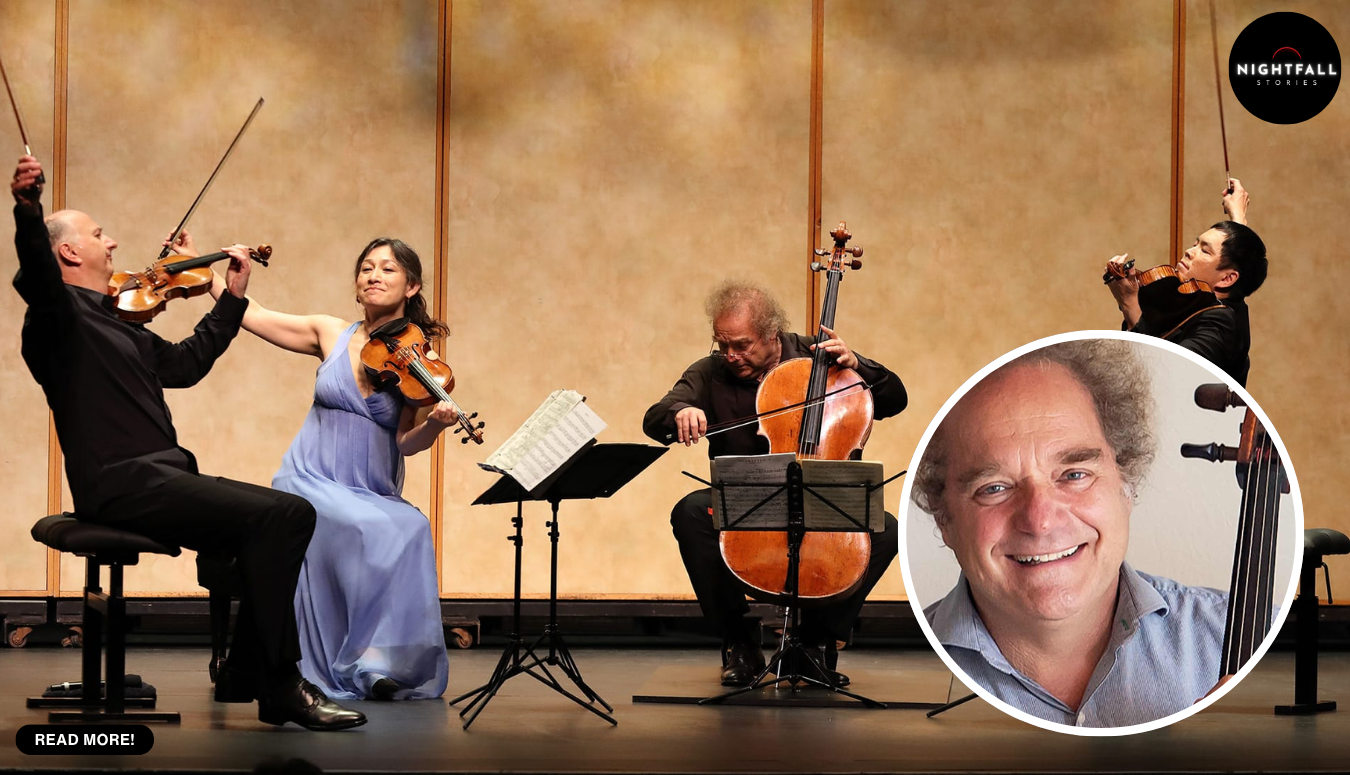
On a Saturday evening at the end of June, in a theatre a few streets back from the ocean in Santa Barbara, a Hungarian cellist in his seventies played three Beethoven quartets and then stopped. The programme was billed plainly as his finale. It was the last time Andras Fejer would sit in the cello chair of the Takacs Quartet, a chair he had occupied without a break since 1975, and the last piece on the list was Beethoven’s Quartet in C sharp minor, Op. 131, which is the one the composer wrote when he could no longer hear any of it.
Two months later the chair belonged to somebody else. The Romanian cellist Mihai Marica became a full member of the quartet on the first of September, and also joined the faculty at the University of Colorado Boulder, where the group has been the resident quartet since the middle of the 1980s. That is the whole event, and it is not a surprise. The retirement was made public by the quartet’s management and by CU Presents in the closing weeks of 2025, which means everyone involved had roughly nine months to get used to the idea. What happened this year was not an announcement. It was the handover.
The number attached to it is 51 years, and it is worth pausing on, because it is not the sort of number that usually turns up in music. The Takacs Quartet was formed in 1975 by four students at the Franz Liszt Academy in Budapest: Gabor Takacs-Nagy on first violin, who gave the group its name, Karoly Schranz on second, Gabor Ormai on viola, and Fejer on cello. Counting from that year to the close of the 2025-26 season gives 51 seasons, which is how the quartet itself and Fejer himself have both described it. Every one of the other three chairs has changed hands since. His did not.
Look at what that actually means season by season and the arithmetic starts to feel strange rather than impressive. Takacs-Nagy left in 1993 to conduct, and Edward Dusinberre took the first violin seat, where he still is. Ormai fell ill, stepped away in the mid-1990s and died shortly afterwards, and the viola chair passed to Roger Tapping, then about a decade later to Geraldine Walther, then to Richard O’Neill, who won a Grammy on the instrument in the year after he joined. Schranz, the second violinist, stayed until 2018, which is a long run by any standard, and Harumi Rhodes replaced him. Set those changes end to end and the cellist who founded the group has made music, as a full-time colleague, with seven different people in the other three seats, on top of the three he started with.
It is worth remembering how quickly the early part of that ran. Two years after four students put the group together, the quartet won first prize and the critics’ prize at the international string quartet competition at Evian in France, which in the 1970s was one of the few doors through which a young ensemble from behind the Iron Curtain could reach a Western career. The North American debut followed in 1982. Dusinberre has described what that period looked like from the inside as four very young musicians living behind that border, working out how a quartet formed in Budapest could possibly build a life playing everywhere. Within about a decade they had moved their families across an ocean and settled into a university town in the Rocky Mountains, and the first of the original four was already on his way out.
There is no other job quite like it. A string quartet is not a band with a leader and it is not an orchestra with a conductor to absorb the disagreements. It is four people who have to agree, in real time and in front of an audience, about matters as small as how long a note lasts and as large as what a piece is about, and who have to keep agreeing for decades in rehearsal rooms that are usually small and often hot. The quartet’s own first violinist has described the real work as the unglamorous business that happens offstage, in the rehearsal room, rather than anything that happens under the lights. When a seat changes, the negotiation starts again from the beginning, because the newcomer did not sit through the twenty years of argument that produced the current answer.
The person who has to hold the line through all of that, in practice, tends to be the cellist. The cello carries the bass of a quartet, which means it sets the harmonic floor and, more often than people realise, the pulse. A quartet can survive a new violinist adjusting to its habits. It has a much harder time if the ground moves. Fejer was the ground for five decades, through three complete changes of personnel in every other part of the texture, and the tribute his colleagues wrote when the retirement was made public put its finger on exactly that: they thanked him for the strength and the integrity of his playing sustained across more than five decades, and then, in the same breath, for his friendship and his humour, which is a very quartet-like way of saying that the second thing is not separable from the first.
Fejer’s own account of the 51 years is notably resistant to being made into a monument. Asked about the length of it in an interview earlier this year, he declined to treat the tenure as the interesting part and described the quartet instead as a wonderfully ever changing organism, something whose identity is renewed by whatever repertoire it takes on in a given season rather than by who is sitting in which chair. He traced his working method back to his coaching at the Liszt Academy, where the question put to the students was always what the composer actually wanted, an answer to be assembled out of other works, the history around them, and even the literature and painting of the period. And he described a change that took most of a career to arrive: when they were young, he said, the four of them assumed there was one correct solution to any musical problem, and decades of study taught them that there are several, as long as each one can be squared with what the composer seems to have asked for or can be made convincing on its own terms.
That is a useful thing to know about him, because it explains how a person survives ten colleagues. A musician who believed in one right answer would have fought every arrival. A musician who believes there are several has something to talk about with each of them.
His reason for stopping was, by his own telling, uncomplicated. After 51 years it felt like the right time, he said, and he described the working life he was leaving as a beautifully rewarding quality of life, spent endlessly on the most inspiring music with colleagues he liked. There is no crisis in that sentence, no injury, no falling out. He chose the season and then he chose the concert.
The part of this that almost never gets written is the succession itself, and it is the part worth the most attention, because a quartet filling a chair is doing something no orchestra ever has to do. An orchestra audition is a competition, usually behind a screen, judged largely on playing. A quartet is choosing a colleague for what could be the next twenty years, in a job with no escape from each other, and the only meaningful test is what happens in a room when four people read something together. Dusinberre’s description of finding Marica was simply that they felt an instant musical connection from the first rehearsal, which sounds like the sort of thing people say politely until you consider that it is, in this line of work, the entire specification.
Marica arrives with a background that rhymes with Fejer’s more closely than the map suggests. He was born in Romania and began the cello at seven in Cluj, a city with a long Hungarian history and a Hungarian name, Kolozsvar, that is still in daily use. He studied there with Gabriela Todor and then with Mihaly Guttman, in a teaching tradition that he has described as a blend of the Soviet and the Hungarian schools. So the cellist replacing a Liszt Academy graduate came up inside a version of the same pedagogy, one province over. He then went to Yale to study with Aldo Parisot, won the Irving M. Klein International Competition, came through the Chamber Music Society of Lincoln Center’s programme for young players, and spent about fifteen years building a chamber career out of New York before this call came. His reaction to the offer was not the practised humility of a press release. He said he could not believe his luck at being given it, and reached for the only comparison in his life that felt the same size, which was being invited to study at Yale.
The handover was arranged with more care than a simple swap would have required. Before the season ended, Marica appeared with the quartet in Boulder in Schubert’s String Quintet in C major, the piece Schubert wrote for two cellos rather than the usual second viola, and one of the few works in the repertoire that puts an extra cellist on the stage as a matter of course. So the audience at the group’s last Boulder concert of the season watched both cellists at once, the one who had been there since 1975 and the one who would take the chair in September, sitting in the same texture, in a piece whose whole sound depends on two cellos holding the bottom of it together. As a way of managing a transition, it is hard to improve on. As an image, it does not need any help.
There was one more piece of timing that nobody planned. The quartet was named the recipient of Chamber Music America’s Richard J. Bogomolny National Service Award, announced in late 2025 and formally presented in August of this year, which is to say in the last month of Fejer’s membership. The award is for service to the field rather than for a recording or a performance, and its arrival in that particular month is a coincidence that happens to be accurate. Half a century of a residency at one university, of teaching student quartets the offstage part of the job, is exactly the kind of work such a prize is meant to notice, and it is the kind of work that only exists if somebody stays.
What Marica inherits is therefore not just a chair but a sound that has been continuous for fifty years in the one voice that anchors it, and the ordinary difficulty of his position is worth stating plainly rather than dressed up. Every listener who has followed this group has the old cello in their ear. The group’s recorded legacy, the Beethoven and the Bartok and the Haydn that made its reputation, is all built on the same instrument at the bottom. He is not being asked to imitate it, and if he tried he would be a worse colleague for it. He is being asked to be convincing enough that the quartet remains recognisably itself while sounding different, which is the job every one of the other seven arrivals also had, and which none of them had to do from the bass upward.
What he is also inheriting is a workload. The Boulder residency is not a title. The quartet teaches there, and the part of the work its members single out is coaching student ensembles in precisely the unglamorous rehearsal-room skills that the concerts hide. On top of that the season Marica has walked into is a full one: a programme built around the music of Gabriela Lena Frank alongside Schubert, Brahms, Haydn and Carlos Simon, dates at Carnegie Hall and at Lincoln Center and at Wigmore Hall in London, and a North American tour with the pianist Jeremy Denk. A new cellist does not get a settling-in year. He gets a diary, and the diary was printed before he arrived.
There is a version of this story that treats Fejer’s fifty-one years as a feat of endurance, and he has fairly clearly declined to tell it that way. His own framing, the ever changing organism, puts the emphasis somewhere less flattering to him and more true: the thing he stayed inside was not fixed, and staying was not the same as standing still. He played the Beethoven cycle with three different first violinists. He played the late quartets with three different violists. The continuity everyone is now praising was, from the inside, fifty-one years of adjusting.
Which brings it back to a June evening in Santa Barbara, and to the running order. Op. 18 No. 2 first, from Beethoven’s twenties, written by a young man with everything ahead of him. Then the Harp, from the middle of his life. Then Op. 131, one of the last things he finished, seven movements that run into each other without a proper stop, written by a man who would never hear a note of it played. Whoever chose that programme was not being subtle, and did not need to be. Fejer sat down and played his way from the beginning of a composer’s life to the end of it, in the order it happened, with the colleagues who were left. Then he stood up, and in September somebody else tuned the C string.