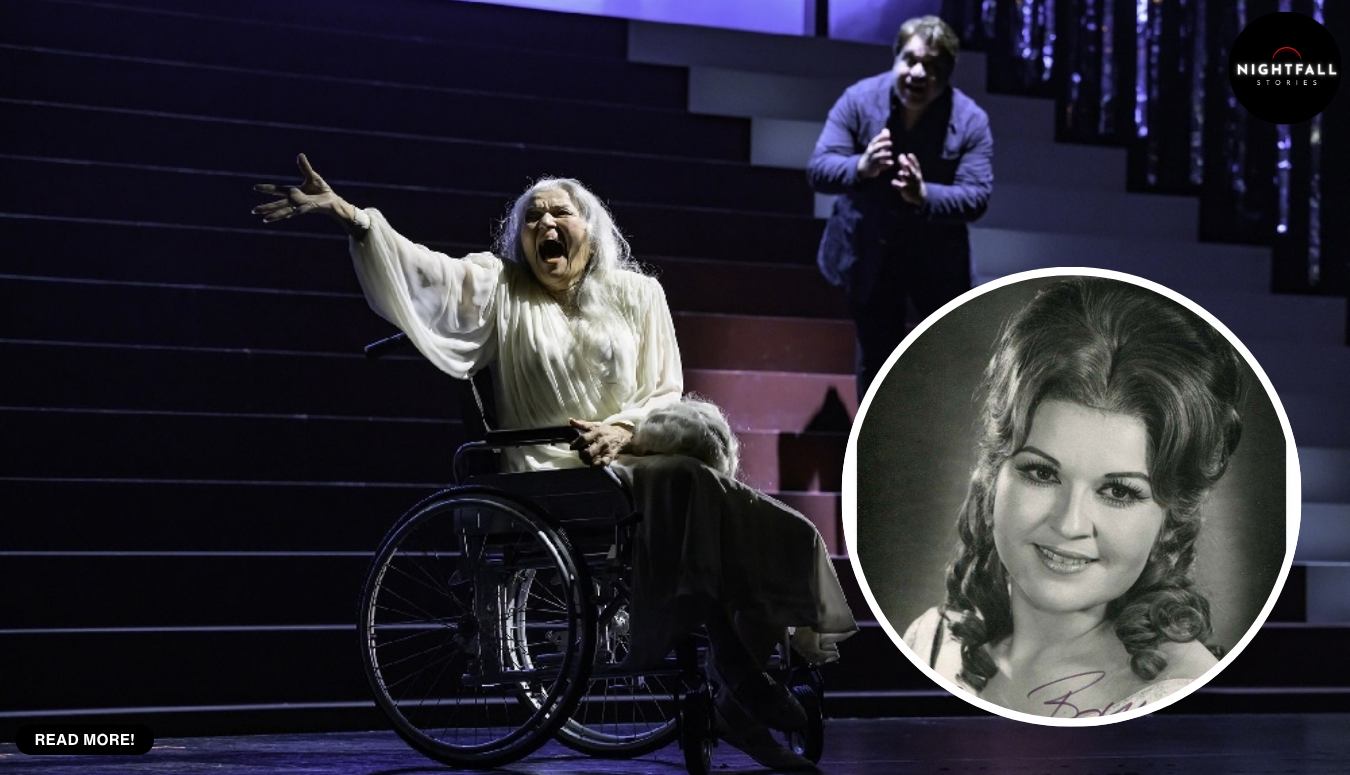
In the cast list for the new production of Tchaikovsky’s The Queen of Spades at Staatsoper Hannover, the Countess is sung by Helen Donath. The line sits there without decoration, between the Lisa and the Hermann, and unless you happen to know the house’s history you would read straight past it. Donath was a member of that company’s ensemble from 1963 to 1968. The stage she walked out onto for this premiere is the one where her operatic career effectively began, and the German critic who reviewed the opening night noted something that even regular attenders would not have guessed: she was singing the old Countess for the first time.
That is the part of this worth sitting with. Not the calendar, though the calendar is remarkable enough. The interesting fact is that a singer with one of the longer and better documented recorded legacies in postwar German opera reached this point in her working life with the Countess still unperformed, and that the house where she started is where she finally did it.
The Countess in The Queen of Spades is one of a small number of roles in the standard repertoire that are written for an old woman and that genuinely require one. She is not a mother figure or a comic relative. She is the plot. The whole opera turns on a secret she is said to hold, the sequence of three cards that will win at faro, acquired long ago in Paris in circumstances the libretto leaves deliberately murky. The young officer Hermann wants it badly enough to frighten her for it, and she dies without telling him, and then she comes back, and the rest is a man being destroyed by information he obtained from a dead woman. Everything painful in the piece runs through her.
It helps to know where she came from. Tchaikovsky’s opera is built on a Pushkin story, and in the story the Countess is a study in a particular kind of cruelty: an ancient woman who was once a celebrated beauty in Paris, now shut in a Petersburg house, tyrannising a dependent young relative and dressing every evening for a society that has long since stopped looking at her. The composer and his brother, who wrote the libretto, kept that and added music to it, which is a harder problem than it sounds. You cannot give a character like that arias. Arias make people sympathetic and coherent, and she is neither.
Musically she is built unlike anything else on the stage. Her part is short, sits low, and is written in fragments: mutterings, half-lines, orders to servants, complaints about the modern world, stretches of something closer to speech than to song. Tchaikovsky gives her almost no conventional singing at all. What he gives her instead, in the middle of her one extended scene, is an old French air borrowed from the eighteenth-century composer Gretry, which she sings alone in her bedroom as a memory of her own youth, when she was the beauty of a foreign court and men queued to look at her. The dramatic effect depends entirely on the sound of a voice that has lived a long time reaching back for something it used to be able to do easily.
That is why houses give the role to singers late in their careers, and why doing so is a musical judgement rather than a sentimental one. A young soprano with a gleaming instrument can be made up to look eighty and will still sound wrong, because the part is not about age as costume. It is about what time does to a voice and what a voice remembers, and those are the actual raw materials of the writing. A singer who has them does not have to act them.
Donath had them, and the review that appeared in the German classical magazine concerti after the premiere located her performance exactly where you would hope. It praised the pianissimi in the Gretry song as the thing that got under the skin, and described a stage presence that left the writer short of breath. That is a specific technical observation, not a compliment about longevity: the hardest thing to do with a small old voice is to sing very quietly and still be heard to the back of a large room, because quiet singing is where technique either survives or does not. Two other German outlets, the public broadcaster Deutschlandfunk and the regional Hannoversche Allgemeine Zeitung, are reported to have reviewed the performance in similar terms, calling her contribution the moving surprise of an otherwise large and ambitious evening. Those two assessments reach this article at second hand, through a specialist classical aggregator rather than from the original pages, and they are described here only as reported, with no attempt to render anybody’s wording.
The production around her is not a museum piece and was not built as a frame for her. It was staged by Roland Schwab, and the premiere was also the debut of Francesco Angelico as the company’s new general music director, which makes it one of the more consequential nights in that theatre’s recent calendar for reasons that have nothing to do with the Countess. Kiandra Howarth sings Lisa and Xavier Moreno sings Hermann. Philipp Jekal and Max Dollinger take the two aristocratic baritone parts. The run continues into the autumn with further performances in October and November. In other words, Donath was cast into a working repertory production in the ordinary way, listed in the ordinary way, and is singing a scheduled series of performances like everyone else in the building.
Which is the most striking thing about it, and the part that has been noticed by the specialist press more than by anyone else. There was no comeback campaign. No farewell tour, no anniversary branding, no announcement treating the engagement as an event in itself. The house put her name in the cast list and on its ensemble page alongside the rest of the company and left it there. People who follow the German houses closely spotted it; the wider world largely did not, until the reviews came out. By one account in the classical press the return arrived essentially unheralded, and nothing in the theatre’s own material contradicts that, because the theatre’s own material simply treats her as a cast member.
To understand why Hannover in particular is the right building for this, you need to know what a German ensemble contract was in the 1960s, because there is no real equivalent elsewhere and it explains her entire career. A young singer was hired not for a role or a production but by a company, for a season or several, and then sang whatever that company’s repertoire required: a small part on Tuesday, a leading role on Friday, a cover on Sunday, several dozen performances a year across a dozen operas. You learned in public, under pressure, in front of an audience that came back every week and knew exactly how good you were. It was an apprenticeship system attached to a theatre, and it produced a generation of singers with enormous repertoires and very solid nerves.
The system also had a side effect that is relevant here. Because a singer belonged to a house rather than to an agent, the house kept a memory of her. Company archives, ensemble pages, the institutional habit of knowing who sang what and when: German theatres maintain that material as a matter of course, and a singer’s first employer stays, in a bureaucratic sense, her first employer forever. Hannover still lists Donath’s years there. That is not sentiment. It is how the institution is built, and it is the reason an engagement like this one can be arranged without anybody needing to explain the connection to anybody.
Donath came into it from about as far away as it is possible to come. She was born in Corpus Christi, on the Texas coast, in 1940. She studied locally, then in New York, and gave her first professional concerts there as a teenager. Her European opera debut came in Cologne at the start of the 1960s, and by 1963 she was in the Hannover ensemble, where she stayed for five seasons. She also met her husband there, the conductor and pianist Klaus Donath, and it is under his surname that essentially her entire career was conducted. That detail matters more than it looks. A soprano named Helen Donath, singing in German, in German houses, season after season, was received by German audiences as one of their own. Many of the people who grew up on her Mozart had no particular reason to think of her as American at all.
From there the career went where an ensemble career went if it worked. She became closely associated with the Salzburg Festival from the late 1960s, above all as Mozart’s Pamina, the role that defined her internationally, and she reportedly held a regular position at the Vienna State Opera across two decades from 1970. She sang at the Metropolitan Opera, Covent Garden and La Scala. She recorded extraordinarily widely, in opera, in oratorio and in song, through the period when the major labels were still documenting the central German repertoire in depth, which is why her voice is available to anyone with a streaming account and why her Pamina is still a reference. She was given the Lower Saxony state prize, later the region’s order of merit, and the Bavarian title of Kammersangerin, which is the closest thing German-speaking opera has to a knighthood for singers.
And she never had a retirement. This is common among singers and almost never described accurately. There was no final performance, no announced withdrawal, no gala. The engagements thinned, the repertoire shifted towards concert work and teaching and the sort of character parts that do not demand a full lyric soprano, and at some point the diary was simply lighter than it had been. Nothing closed. That is the ordinary shape of the end of a singing career, and it is precisely the condition that makes a role like the Countess possible: if you never formally stopped, you have not come back from anywhere. You have been available the whole time, and somebody finally asked.
Somebody finally asking is the decision at the centre of this story, and the person who made it does not get a name in the coverage, which is a shame, because casting the Countess is one of the genuinely difficult calls in running an opera house. Do it wrong in one direction and you get a capable middle-aged singer in grey makeup, technically fine and dramatically inert. Do it wrong in the other and you get a legend brought on for the applause, unable to carry the scene, and an audience made uncomfortable on her behalf. There is no safe version. Whoever cast this had to be confident, from hearing her, that the voice would do the quiet singing and the presence would fill the room, and then had to be willing to stake the opening night of a new music director’s first production on being right.
The stakes were higher than usual for one more reason. A new general music director’s first premiere is the night a German house tells its city and its critics what the next several years are going to sound like. Angelico was conducting for that audience as much as for the drama. Putting an unfamiliar element into that evening, a singer making a role debut in a part that can go badly wrong in public, was not the cautious choice. It was a statement that the production trusted its own reading of the piece.
The reviews suggest they were. But the reason this lands as more than a good night at a regional German opera house has to do with the specific geometry of it, and the geometry is unusually neat. The role’s only real aria is a woman alone, remembering being young and admired, singing a song she learned then. The building where it was sung is the building where the singer learned her trade as a young woman more than sixty years earlier, in a company that no longer contains a single person who was there with her. The stage is the same stage. The song is about exactly that gap.
Nothing about that requires embroidering, and the production apparently did not embroider it. She came out, sat where the staging told her to sit, complained about the noise, sent the young women away, and sang an old French tune about the nights when men were afraid to speak to her. Then she died, as the part requires, and came back as the part requires, and gave Hermann the three cards that ruin him. On the evening it happened, the house’s programme listed her as the Countess and nothing more, which is very close to the correct amount of fuss. The performances run on into November, and the aria will be sung again each time, in the same room, by the woman who started there.