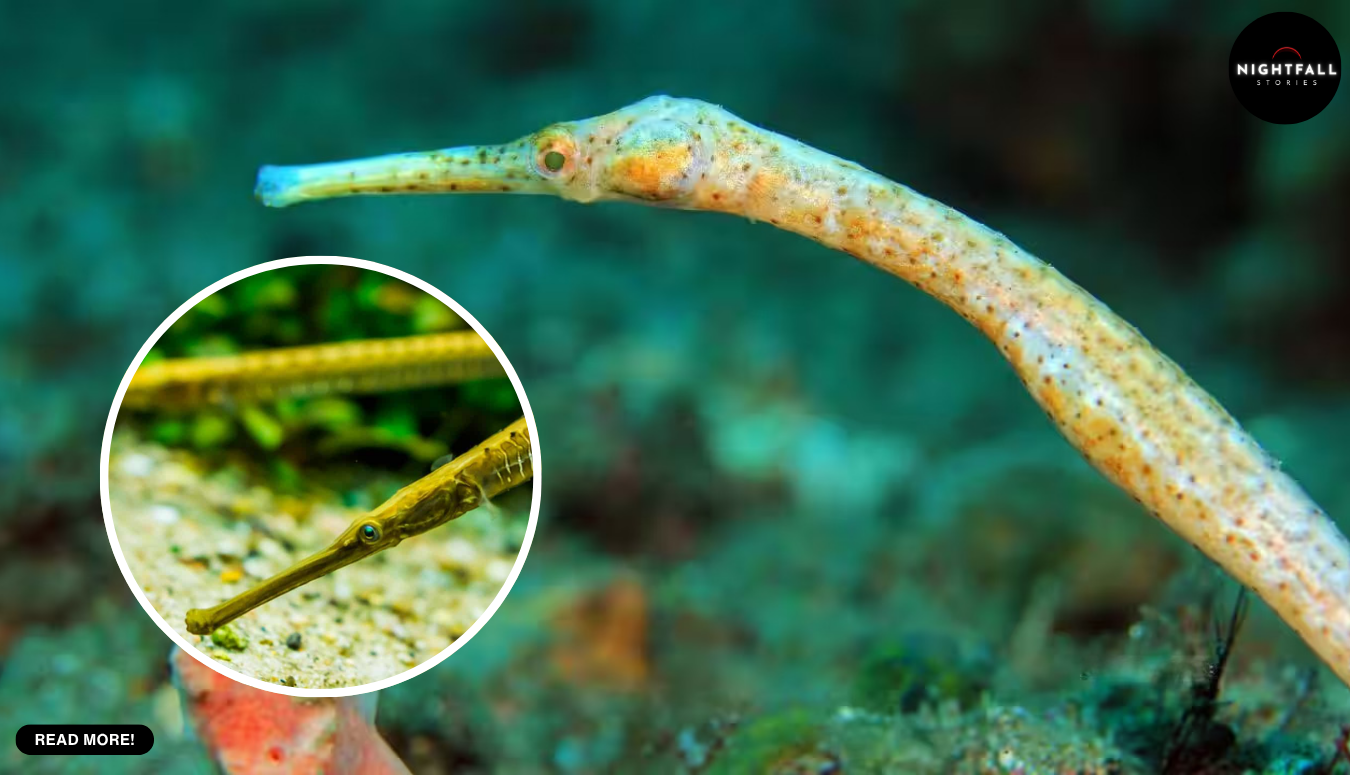
The researchers had spent two weeks working their way through the lower Sepik and its tributaries in Papua New Guinea, checking nets, checking market stalls, asking in village after village, and they had not found the fish. They were near the end of the survey. In Imbando Village they showed their photographs to a woman named Helen Asu, who fishes for freshwater prawns with a traditional handheld net called an umben. She looked at the picture and recognised it immediately. She knew the fish. She knew where it lived, in the weedy margins of the river. She said she would help.
The next morning she came back with two of them.
The fish was the spinach pipefish, Microphis spinachioides, a slender freshwater relative of the seahorse found nowhere in the world except the Sepik and Ramu river systems. Science had no record of a living specimen since 1985. It had sat on a conservation list of the world’s most wanted lost freshwater fishes, one of ten species chosen at the launch of a global search in 2021, for the simple reason that nobody with a collecting permit and a scientific journal behind them had been able to put their hands on one in four decades.
Helen Asu found two in a morning, with a net she already owned, in water she already knew.
That sentence is the whole story, and it is worth being careful about what it means. Because the fish was never lost. It was lost to science, which is a different thing entirely, and the gap between those two statements is where this piece lives.
The people who live along the Sepik and its tributaries have names for this fish. Several names, in fact, depending on where you are: Karuweng, Inap, Karuwena, Sako. Communities the researchers spoke to could describe its habitat, the vegetated shallows and river edges where it hangs in the water column. They were not being introduced to a mystery animal. They were being asked about a fish they had seen. The four decades of silence were a silence in the scientific literature, not in the lives of the people who fish that river. A species can be absent from every museum catalogue and every peer-reviewed paper on Earth while being an ordinary Tuesday for the person holding the net.
That distinction sounds pedantic until you consider what conservation does with it. A species with no recent records gets classified as data deficient, which is what the International Union for Conservation of Nature has listed the spinach pipefish as, and data deficient is a bad place to be. It is not a clean bill of health and it is not a warning. It is a shrug. You cannot argue for protecting a river reach, or against a logging concession, or for a fisheries rule, on the basis of a shrug. The absence of data is itself the problem, and the fastest way to fix it turned out to be asking the people who were there.
The expedition that did the asking was run out of the New Guinea Binatang Research Centre in Madang, an institution built substantially around exactly this principle, that local researchers and local knowledge are the method rather than a courtesy. The survey was led by Jerrica Agebigo, a master’s student at the Papua New Guinea University of Technology attached to the centre, working with her colleague Roger Maikei. They covered the lower Sepik and its tributary systems over roughly two weeks, surveying the river directly, going through what came up in fishing catches, and sitting down with communities to ask what they had seen.
A note on her name, because it is not consistent in the coverage. Her surname appears as Agebigo in the conservation organisation’s own account and in Papua New Guinea’s national broadcaster, and as Agebo in one international outlet. Two independent sources closer to the work, one of them her own programme partner and one of them a national news service in her own country, agree on Agebigo, and that is the spelling used here. The variant appears to be a transcription error downstream.
Agebigo has been direct about who made the rediscovery possible. Without Helen Asu’s knowledge, her initiative and her willingness to help, she has said, it might not have happened at all. That is not a diplomatic aside in a press release. It is a description of the mechanism.
The umben matters here too, more than it might seem. A scientific survey net is built to sample: to sweep a volume of water and catch whatever is in it, indiscriminately, so the catch can be counted and compared. A working net is built to catch a specific thing in a specific place, and the person using it has spent years learning where that place is and what time of day the thing is there. Asu was not out to survey the river. She was out for prawns, which live in the same weedy shallow margins the pipefish does, and she had presumably taken pipefish in that net countless times before without any reason to think twice about it. The survey had the permits and the taxonomy. She had the search image.
The fish itself is not spectacular to look at, which is part of why it is easy to overlook. It grows to about fifteen centimetres, roughly six inches, thin as a pencil lead, armoured in bony rings like all pipefish, and it holds itself in vegetation where its outline disappears. It moves between fresh and brackish water over the course of its life. Records place it as far as 570 kilometres upstream in the Sepik system, in the May River, and it is also known from the Ramu.
And like its relatives, it has one of the more remarkable reproductive arrangements in the animal kingdom: it is the male who carries the young. He holds the eggs in a brood pouch beneath his tail, up to around 150 embryos at a time, and gives birth to live young. That is the family trait that makes seahorses famous, and this freshwater cousin in one river system in Papua New Guinea does the same thing.
It helps to understand the size of the haystack. The Sepik runs more than a thousand kilometres from the highlands to the sea, and it is not a single channel so much as a system: a main river, a web of tributaries with names most atlases leave off, oxbow lakes, floodplain swamps, seasonal wetlands that are water for part of the year and ground for the rest. The whole of it shifts. Channels move, lakes fill and drain, margins advance and retreat with the rains. Dropping a fifteen centimetre fish into that and asking a handful of researchers on a two-week budget to find it is not a reasonable request. It only becomes reasonable if you stop treating the river as a search area and start treating the people who live on it as the survey.
That is also why the four-decade gap is less mysterious than it sounds. Nobody was looking. Sustained ichthyological fieldwork in the Sepik effectively stopped when the surveys of the late twentieth century wrapped up, and fieldwork of that kind is expensive, logistically punishing, and funded in cycles that rarely last. The fish did not hide. The funding moved.
The confirmation route is the part that makes this defensible as science rather than as a nice anecdote, and it turns on one man. Identifying a small fish from a photograph is normally a weak claim. Photographs lose the fin ray counts, the ring counts, the proportions that separate similar species, and a careful ichthyologist will refuse to commit. In this case the photographs went to Gerald Allen, the Australian ichthyologist who knows this fish better than anyone living, because he is the reason there were any modern records of it at all.
Here the popular framing needs correcting. Allen did not describe the species. Microphis spinachioides was described in 1915 by the German ichthyologist Georg Duncker, from material collected long before either living memory or living taxonomy. What Allen did was survey the Sepik. With David Coates, then working for a United Nations development programme in Port Moresby, he carried out an ichthyological survey of the Sepik River system across the years 1978 to 1985, published by the Western Australian Museum, recording 57 species and identifying the spinach pipefish as one of a small handful of fishes endemic to the Ramu and Sepik system alone. Those surveys are where the last scientific records of this fish come from. When the record went quiet in 1985, it went quiet because his survey ended.
So the symmetry is real, and it is better than the version usually told. The man whose fieldwork produced the last confirmed sighting of this fish looked at photographs taken forty years later, checked them against the features he knew mattered, and confirmed that what Helen Asu had in her hands was the same animal. Very few scientists get to close a loop they opened themselves at the other end of a career.
The programme behind the expedition is called the Search for Lost Fishes, run by the conservation organisation SHOAL with Re:wild, and it started in 2021. The scope of what it is trying to do is genuinely startling. There are over 300 freshwater fish species worldwide that have not been scientifically recorded for at least a decade and that nobody is willing to declare extinct. Freshwater fish are the blind spot of global conservation: they live in water nobody surveys, in countries where field budgets are thin, and they are small, and they are not charismatic, and when a river changes they disappear without anyone filing a report.
From the original list of ten most wanted, the spinach pipefish is the third to be found. The Batman River loach in Turkey came back in 2021. The leopard barbel in the Tigris and Euphrates system came back in 2024. Three out of ten in five years is, depending on how you look at it, either an encouraging hit rate or a reminder that seven are still missing.
Amanda Vincent, the marine biologist who chairs the IUCN specialist group covering seahorses and pipefishes, said the news made her heart sing, which for a scientist speaking about a fifteen centimetre fish in a river most of the world cannot find on a map is about as unguarded as it gets. Her group is the body that will eventually have to decide what the spinach pipefish’s conservation status actually is, and that decision needs numbers the rediscovery does not yet provide.
Which is why the finding is a beginning rather than an ending for the researchers. Two fish prove existence. They do not tell you how many there are, how far along the river system they range, whether the population is stable or collapsing, or what a viable habitat looks like. The team’s stated next steps are more surveys across the wider Sepik and Ramu basin, and developing environmental DNA methods, which detect a species from genetic traces in a water sample and mean you can confirm presence over a large area without catching anything at all. For a fish this small and this well hidden, that is likely to be the only practical way to map it.
There is also a warning folded into what the communities told them. People along these rivers report that native fish are declining and that introduced species are becoming more common. They point to sedimentation, to logging, to mining, to riverbank vegetation being cleared, which for a fish that lives in the weedy fringe is the specific habitat being removed. The Sepik is one of the great rivers of the world, over a thousand kilometres of it, largely undammed, and it is not immune to any of that. A species that has just been confirmed alive after forty years of silence has been confirmed alive in a system its own residents say is changing.
So what actually ended here. The spinach pipefish came off the most wanted list. It went from a gap in a record to a living species with a location, a habitat description, a set of local names, and a photograph confirmed by the person best qualified on Earth to confirm it. A master’s student from Papua New Guinea led the survey that found it, in her own country, on her own river.
And the fish was found because a woman going out for prawns was asked what she knew, and answered, and then went and got it. The scientific literature will record a rediscovery in 2026. What it should record is that the information had been sitting in Imbando Village the entire time, available to anyone who thought to ask.