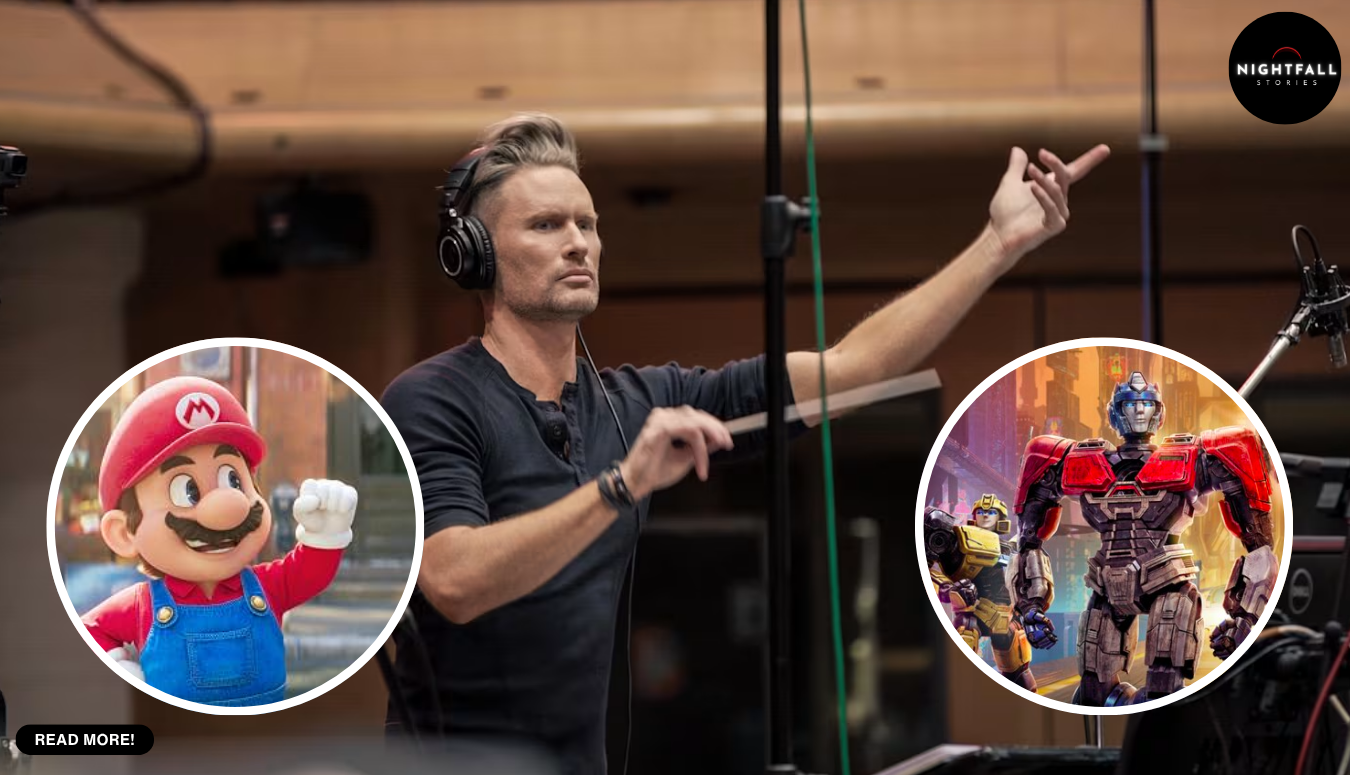
Brian Tyler was in his studio in the late summer of last year, in the last stretch of work on a score about the Nuremberg trials, when something happened in his head that he has since described as thunder. He had no frame of reference for it. He is an active man in his early fifties who had spent the previous two decades conducting orchestras and turning films around on deadlines that do not move. By his own account what he had suffered was a double subarachnoid brain haemorrhage, and he spent the next three weeks in hospital.
Four days in, he started writing music again.
Not in a metaphorical sense. He had no piano and no keyboard and no way of playing anything back, and he has said that the saving grace was that he composes in his head anyway. So from a hospital bed, with two films running at once, he wrote a large part of the main themes for a children’s adventure about a plumber in outer space, and he kept working on the score for a drama about the men who ran the Third Reich. Nobody on either production knew where the music was coming from. He did not tell them.
That is the part of this story that is worth sitting with, because it is not obviously admirable and he has never presented it as though it were. The two films were The Super Mario Galaxy Movie and Nuremberg. The first has taken more than 747 million dollars worldwide and stands among the biggest releases of the year. The second, directed by James Vanderbilt with Russell Crowe as Hermann Goering and Rami Malek as the US Army psychiatrist Douglas Kelley, premiered at Toronto and went out in cinemas a couple of months later, taking about 71 million dollars against a budget of 40 million. Both scores were delivered. Both films came out on time. And the reason anyone knows what it cost is that Tyler decided, months afterwards, to say so.
To understand why he made the choice he made, it helps to know what a composer’s position in a film actually is. The score is close to the last thing added. Everything ahead of it in the queue, the shoot, the edit, the visual effects, the sound mix, has already eaten whatever slack the schedule ever had, and by the time the music is written the release date is not a plan, it is a contract. Cinemas have been booked. Trailers have run. A film that does not deliver its final sound mix on a fixed date does not simply arrive a month late; it collides with other studios’ release weekends and loses its screens. Composers routinely get six to eight weeks to write and record an hour or more of orchestral music, and a scoring stage booking with seventy players on it costs enough per hour that it cannot be casually rebooked.
So when Tyler says he did not want to let anyone down, he is describing a real structure and not a vague feeling. If he had made a phone call from that bed, the honest version of the conversation would not have been about giving him time. It would have been about replacing him. And in the case of the Mario film, replacing him meant handing over a job that had taken years of relationship to earn.
Tyler had scored The Super Mario Bros. Movie in 2023, which put him in an unusual position with Nintendo’s own composer, Koji Kondo, the man who wrote the themes that hundreds of millions of people can hum without being able to name them. Kondo served as a score consultant on the Galaxy film. Tyler has said that after the first film Kondo essentially told him that he knew the material and should see what he came up with, which is about as much creative latitude as anyone is ever handed with somebody else’s melodies. There is also a fair amount of affection in the relationship. When Kondo was inducted into the Academy of Interactive Arts and Sciences Hall of Fame, Tyler was the one who introduced the award.
That is the trust that Tyler was weighing in the hospital, against a medical situation he had no experience of and no way of predicting. He chose the work. He has been open that part of it was not selflessness at all. Composing gave him something to aim at while he was lying still, and he has described coming back to the music as cathartic, a goal to hold onto rather than a burden he shouldered for other people’s benefit.
You can read that as remarkable and you can also read it as a man doing something no employer should ever want from anyone, and both readings survive contact with the facts. He has said that the staff around him were visibly baffled, that people were sitting there wondering what exactly was going on with this guy, and that his answer was simply that he was determined. He also says he stayed quiet later, after he got out, because he did not want people to worry. He went straight back to conducting and recording sessions without telling the musicians in front of him what had happened a few weeks earlier.
What he was writing during that period is worth describing, because the tonal distance between the two jobs is almost comic and it was not a distance he could take a break from crossing.
For Nuremberg, Tyler did not start with the film. He started with 1933. He wrote a four hour concert work in five parts that traces the rise of the Third Reich from the beginning, and only the fifth part became the score of the film. That is an enormous amount of unpaid architecture for a two hour drama, and his reasoning was that the music had to earn the right to be in the room with the subject. He has said he wanted the score to feel emotionally current rather than period correct, because in the span of human history this was yesterday. One detail from that work tells you how carefully he was thinking. He tracked down the musical notation of the alarm bells used in the camps and built them into three chords, and those chords sit underneath Goering’s final scenes, holding the weight of what the man was responsible for without offering him any sympathy.
For The Super Mario Galaxy Movie he was doing something close to the opposite: building a huge, bright, symphonic ride that has to work for a small child who has never held a controller and for an adult who knows every bar of a twenty year old game soundtrack. Tyler has said he packed more than 300 references into the score, pulling from the Galaxy games, other Mario titles and even Star Fox, and he is firm that none of it is decorative. If a reference does not serve the scene, it comes out. He is a fan himself, which he cheerfully admits makes the job fun, but his rule is that nothing is allowed to get in the way of the story.
The recording of that music is the quiet proof of the timeline. A seventy piece orchestra worked on the score at the Eastwood Scoring Stage at Warner Bros in Burbank across the winter and into the spring, and the soundtrack came out alongside the film. Standing on a podium in front of seventy players is not a thing you do gently. That was months after the haemorrhage, and the people in the room did not know.
There is a practical reason the Nuremberg job was the harder of the two to abandon. A film about the International Military Tribunal, built around a psychiatrist’s long conversations with a man in a cell, has almost no action for music to ride on. The score has to carry the moral temperature of a room where two people are talking, and get it wrong in either direction and the film either turns into melodrama or goes cold. Tyler was writing the most delicate music of his year in the least suitable circumstances anyone could design for it, and the only person who knew that was him.
The Mario film had the opposite problem and the same consequence. A studio animation aimed at families is scheduled years ahead, with toys, parks, promotions and a release date that several companies have planned their year around, and the score is the last piece to land. Kondo was involved throughout as a consultant, which means the music was being checked against thirty years of house style by the person who invented it. Handing that relationship to a substitute in the middle of the process would not have been a scheduling problem. It would have been the end of Tyler’s place in it.
Tyler’s route into this work was never conventional. He studied at UCLA and at Harvard, and not in music. Early on he had an ordinary decision in front of him, a desk job or a first film for a dollar, and he took the dollar. Roughly 150 scores later, his films have taken something in the region of 20 billion dollars worldwide, which puts him among the ten highest grossing composers who have ever worked. He wrote the fanfares that play over the Universal and Marvel logos, so a great many people have heard his music without ever seeing his name. He has scored Fast and Furious films, Rambo films, Iron Man 3, Thor: The Dark World, and long stretches of the Yellowstone world. He has said that he does not take films because he has to, which he knows is rare for an artist.
There is one more thing about how he hears, and it matters to the hospital story more than it sounds. Tyler has chromesthesia, a form of synaesthesia in which sound arrives as colour and shape. He calls it a cheat code when he is conducting, because he can see the orchestra’s balance rather than only hear it. It also means that composing without an instrument is less strange for him than it would be for almost anyone else. Music in his head is not an abstraction he has to imagine; it is a thing he can look at. That does not make what he did in that bed reasonable, but it does explain how it was even possible.
He is now building something out of that particular wiring, a live electronic and visual show called Are We Dreaming, which he has described as somewhere between Fantasia and 2001: A Space Odyssey, an attempt to put an audience inside the way he perceives sound. He calls it the most ambitious thing he has taken on. For a man who spent three weeks in a hospital bed a year ago, the choice of next project is not subtle.
None of the medical detail in any of this comes from a doctor. Every word of it comes from Tyler, in interviews he gave long after the fact, and he has been careful about what he claims and no one should add to it. He has not offered a prognosis and there is no reason to invent one for him. What is on the record is that it happened, that he describes it as a double brain haemorrhage, that he was hospitalised for three weeks, and that he went back to work sooner than anyone would have advised.
The part that keeps nagging is the silence. Two productions, several hundred people between them, a studio with a hard release date and a Japanese composer who had handed over his life’s most recognisable melodies, and not one of them was given the chance to say that the music could wait. Tyler made that call alone, on the grounds that the alternative was letting people down, and the alternative he was actually protecting them from was the inconvenience of knowing. There is a version of this story in which that is heroic and a version in which it is simply the logic of an industry that has trained its best people to believe they are replaceable and unmissable at the same time, and the honest answer is that both versions are in play.
What settles it, a little, is how the information finally came out. Not through a leak, not through a publicist managing a narrative around an awards campaign, and not while either film was still in the balance. He first mentioned the medical emergency in a conversation about the Nuremberg score, deep in the craft of it, while explaining why he had come to think differently about what he was doing and why. Only later, once both films were out and one of them was the biggest thing in cinemas, did he sit down and describe the hospital bed and the four days and the themes he wrote there.
By then nothing was riding on it. The scores existed. The films had been seen. Telling it could not buy him a deadline or a job or sympathy that would change anything, and it could only ever make him look less invulnerable than a composer with 150 credits is supposed to look. He told it anyway, which is the actual end of this story. The music was always going to get finished; that was never in doubt, because he had decided it in a hospital bed before anybody else got a vote. What was in doubt was whether anyone would ever know the price of it, and that was a second choice, made much later, and the only one he made in the open.