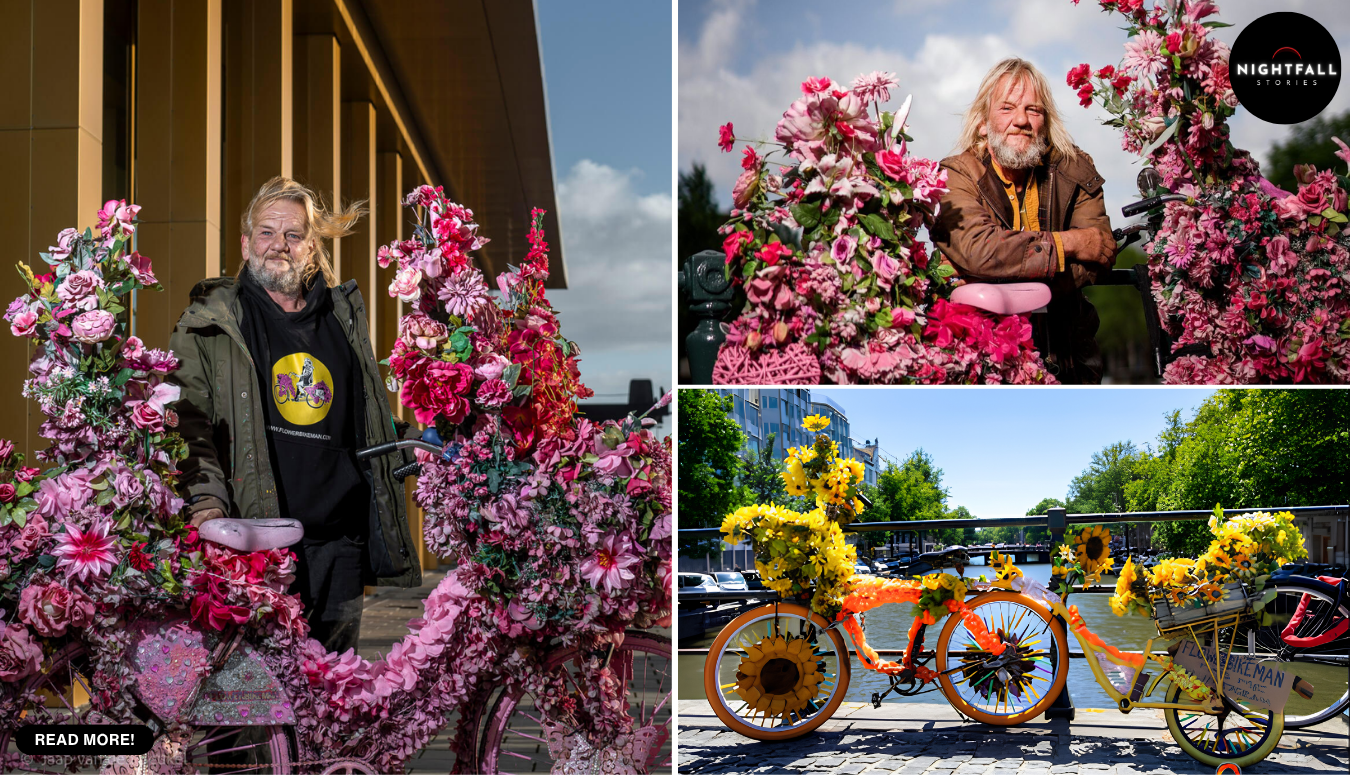
The first flower bike was not art. It was a road sign. Warren Gregory built it in Florida, years before Amsterdam ever heard of him, and he built it for one person, because his wife Michelle had got lost at a busy intersection on her way to work and he needed a way to tell her, from a distance, which way to turn. So he took a blue bicycle, covered it in oversized sunflowers, and set it down to the left of the junction. After that, by his own account, she never took the wrong turn again.
Everything that followed came out of that one practical solution. There are now more than a hundred flower bikes scattered across Amsterdam, chained to railings outside shops, leaning on bridges over the canals, exploding in colour in a city that is already photographed to death. They have become one of the things people look for. Tourists plan walking routes around them. Locals notice when one appears on their street overnight. And the man who put them there has been told he has to leave.
Gregory, who is 55 and originally from Tarpon Springs on Florida’s Gulf coast, was detained earlier this autumn over an invalid residence permit and has been ordered to return to the United States in early October. The Dutch immigration service, the IND, has set out its reasons plainly enough. He has no valid permit. He could not demonstrate sufficient means of subsistence. He has no official registered address. There was a gap between permits, and there was a reporting appointment he did not attend. On paper it is not a complicated case. It is the kind of file that gets closed every day in every country with a border.
The complication is that the file belongs to a man whose entire visible output in this city has been giving things away for free.
Start with the address, because that is the piece that does the most damage and the piece that is hardest for anyone who has never lived abroad to understand. In the Netherlands, an awful lot hangs off being formally registered at a physical residence. Your permit, your paperwork, your ability to prove you exist in the way an administration needs you to exist. Gregory and Michelle live on a boat. He has said openly that he could never afford a registered address, and that he has a Dutch social security number and a bank account, and that the work he has done has been registered. Which is a description of a life that is documented in every way except the one that counts.
Anyone who has tried to settle in a foreign country will recognise the trap immediately. You need the address to hold the status. You need the status to get the kind of work that pays for the address. Housing costs in Amsterdam have been brutal for years, and living on the water is not an eccentric lifestyle choice so much as one of the few remaining ways to stay in the city at all. He was never hiding. He was, quite literally, the most conspicuous person in Amsterdam. He just did not have the one piece of paper that the system reads first.
The other grounds are less about money and more about momentum. A gap between permits sounds minor and almost never is. Once a status lapses, even briefly, the route back is usually harder than the route in, and every subsequent form asks a question that the gap has already answered badly. A missed reporting appointment compounds it. None of this requires anyone to have behaved badly. It requires only that a person be slightly disorganised while living precariously, which describes a very large share of humanity, and then to keep being that for long enough that the file writes its own conclusion.
To understand why so many people are upset about this, it helps to go back to Michelle and the intersection, because the flower bikes were never really a street art project that happened to have a nice backstory attached. The backstory is the project.
Michelle has severe epilepsy. That is as much as Warren himself has said publicly, and it is as much as anyone else needs. What he has described is the practical consequence: after a seizure, she could become disoriented, and a familiar route could stop being familiar. A junction she had crossed a hundred times could suddenly offer no clue which way she was supposed to go.
There is a version of this story where a husband responds by shrinking his wife’s world. Fewer trips alone, more supervision, a smaller perimeter, all of it well meant. Gregory did the opposite. He did not try to make her need less independence. He went out and changed the street so the street could do the work. A huge, unmissable, impossible-to-confuse-with-anything-else object, planted at the exact point where the confusion happened. Not a reminder that something was wrong. A marker that said you are in the right place, go left.
He has described adding more of them afterwards, using colour as a system, matching flowers to particular houses along a street so the route itself carried its own instructions. Some accounts trace an earlier flourish to an Amsterdam visit years before, when Michelle’s bike was stolen and he decorated the replacement with a bouquet so it would be unmistakably hers among the thousands of identical bicycles outside the central station. The details vary slightly depending on who is telling it and when. The shape does not. Every version is the same idea: make the thing findable. Make it impossible to lose.
Which is a strange and rather beautiful origin for what eventually became public decoration. Most street art is about being seen. This started as a way of helping one person see.
By the time the couple moved to Amsterdam permanently in 2018, after a car accident and the settlement that followed, Gregory had built a great many bikes in Florida. He brought a handful of them with him across the Atlantic, somewhere around a dozen by most accounts, which is not a normal thing to put in shipping. Then he started again, in a city that has more bicycles than people and a long tradition of abandoned ones rusting quietly against the railings.
That detail matters more than it sounds. He was not buying new bikes and prettifying them. He was picking up bicycles nobody wanted, wrecks and orphans and machines that had been left to die at the side of a canal, and turning them into the most photographed objects on the street. Something written off, given colour and put back out in public where it could not be ignored. It is not subtle as metaphors go, and he has never presented it as one. But it is there.
There is also the question of what the bikes actually do, which is easy to underrate because they are pretty. Amsterdam is a city of bicycles the way other cities are cities of cars, which means the bicycle there is close to invisible. It is furniture. It is the thing you step around. Racks of them stand outside every station and every shopfront in a grey mass that nobody looks at twice. What Gregory does is take one unit out of that mass and make it impossible not to see, which is the identical trick he pulled at the Florida intersection, applied to a whole city instead of one person.
That is why people stop. Not because flowers on a bike are a sophisticated idea, but because the object has been lifted out of the background of a place where everyone is moving fast and half-looking. For a few seconds you are standing still on a street you were only passing through. Whatever else it is, it is a small, free interruption, handed out to strangers by someone who has no stake in whether they appreciate it.
He does not sell them. He has said he never intended to. Over the years he has accepted the odd meal, the occasional donation from someone who insisted, and once, when his flowers were stolen and wrecked, a small fundraiser from a family who had stopped to admire one of his bikes and found out what it cost him to keep them going. He has given decorated bikes to local businesses. He signs everything with the same four words: love is the cure.
You can be sceptical about a slogan like that until you remember where it came from. It is not a general philosophy about kindness. It is a man describing what he does about a condition he cannot fix. He cannot cure epilepsy. He can build a landmark.
The bikes are also, it should be said, a lot of work. Flowers do not survive a northern European winter on an unheated bicycle. Rain wrecks them, wind strips them, and people steal them, sometimes the whole bike. Keeping over a hundred installations looking good across a city means constant repair, constant replacement, constant riding around checking on them, funded by almost nothing. He has been doing it for years. During the run of celebrations for the city’s 750th anniversary he was one of the images people associated with Amsterdam, which is a peculiar sort of status for someone with no permit, no registered address and no income the state can see.
None of that changes the law, and it would be dishonest to pretend otherwise. Immigration rules exist, they apply to everyone, and the moment they start bending for people who are charming or well liked or good at a particular thing, they have stopped being rules and started being a popularity contest. Gregory himself has not argued that he is a special case. He has said he feels sad, ashamed and like a failure, and he has acknowledged that the immigration service gave him time, repeatedly, to get his affairs in order. That is an unusually honest thing to say about the authority that is removing you. He is not claiming he was ambushed.
What he is worried about is not himself. It is Michelle, and specifically what happens to her care. He has said that healthcare in the Netherlands is far better organised than in the United States, and that is the part of this that keeps him awake. A chronic neurological condition is not a thing you manage well while moving countries, changing systems, losing a doctor who knows your history and starting again in a place where the first question is about insurance rather than symptoms. Whatever the merits of the paperwork, that is the actual stake for the two of them.
The city has responded the way cities do when they like someone. A petition went up and gathered hundreds of signatures within days. People have been posting photographs of the bikes on their own streets. There is a certain amount of civic indignation flying around, some of it thoughtful and some of it the usual noise. Whether any of it changes the outcome is another matter entirely. Petitions are a measure of how people feel, not a legal instrument, and immigration decisions are not usually responsive to affection. As things stand the order is real, the date is set, and nothing has publicly overturned it.
So the likeliest ending here is not a rescue. It is a departure, with a hundred flower bikes left behind in a city that will keep photographing them without the man who maintains them, until the weather gets to them one by one.
But it is worth being clear about what he actually did with the years he had, because the paperwork will not record any of it. A man arrived in a foreign city with almost nothing, having spent his savings and a settlement getting there, and his response to that situation was to go out and decorate other people’s streets for free. Not as a business, not as a brand, not as a run at internet fame. He did it because he had discovered, in the worst possible way, that an object in the right place can change how a person moves through the world, and having learned that he could not really stop.
There is a specific kind of generosity in that which does not get much attention. Most acts of care are private. They happen inside houses, between two people, and nobody else ever sees them. What Gregory did was take a private act of care, one husband helping one wife find a junction, and turn it inside out until the whole city was living inside it. Every single one of those bikes is a copy of the first one. A hundred sunflower signposts saying, to anyone who happens to pass, you are in the right place.
Michelle stopped getting lost at that intersection. That was the point, and that was the whole of it, and it should have ended there. Instead it kept going for two decades and across an ocean and turned into something that thousands of strangers now go looking for on purpose.
If he has to go, he goes. The rules are the rules, and he has said so himself with more grace than most people could manage. But the bikes were never a tourist attraction and never a stunt. They were a man’s answer to a problem he could not solve any other way, left out on the street where anyone could use them, for as long as he was able to keep the flowers on.