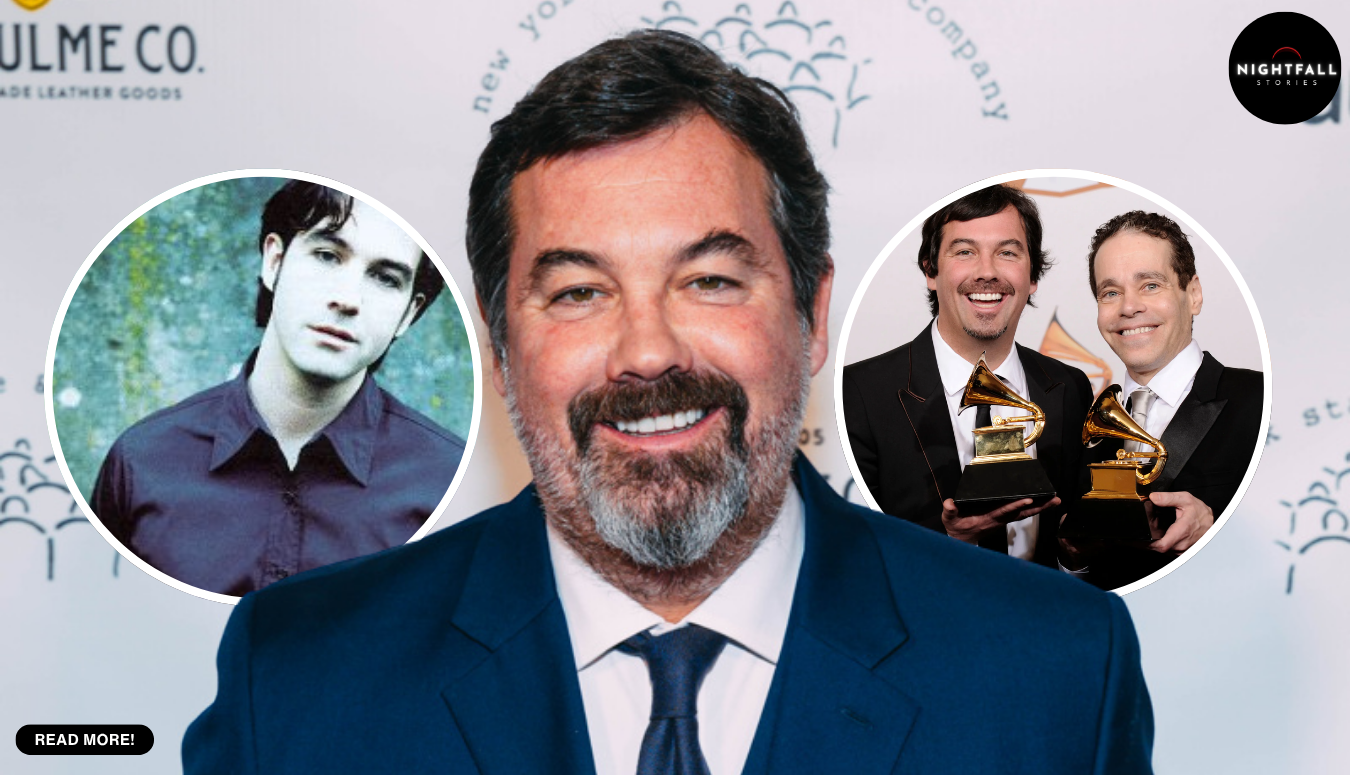
A few days after Duncan Sheik died, a young actress stood in a raw black box theatre on the west side of Manhattan and sang a song called Immured to a room of people who had just found out. The song was his. The show was his. He had chosen the room himself, had argued for it, had wanted something that felt nothing like a Broadway house. He was 56, and he had been working on the piece almost to the end.
His mother, Suzanne, confirmed the death. He died at a hospital in Manhattan, and the cause given was organ failure. The news moved through nine or ten major outlets in a matter of hours, which tells you something about how many different rooms of American culture he had been standing in at once. Rolling Stone ran it as a music story. Playbill ran it as a theatre story. Both were right.
That double life is the whole shape of him, and it is worth slowing down on, because almost nobody manages it.
If you were listening to the radio in the second half of the 1990s, you already know one half. Barely Breathing was inescapable. It peaked at number 16 on the Billboard chart, which sounds modest until you hear the other number: it stayed on the Hot 100 for fifty five straight weeks. More than a year. It outlasted songs that went to number one and vanished. It became one of those tracks that stops being a song and becomes a piece of furniture in people’s lives, the thing playing in the car, in the food court, in a bedroom where somebody was getting over somebody else.
The album went gold. He got a Grammy nomination out of it. He was in his twenties, signed, photographed, on the circuit, doing exactly the thing that a few million people would trade a kidney to be doing.
And then he did something strange with it.
He did not chase the follow up hit. He made records that got quieter and more interior, that leaned on strings and mood, that were reviewed warmly and sold modestly. He started scoring films. And he began circling a project that, on paper, was one of the worst commercial ideas anyone had ever brought to a producer: a rock musical adaptation of a German play from 1891 that had been banned for decades, about teenagers, sexuality, abortion, abuse and suicide, written by an author, Frank Wedekind, whose whole intent was to horrify respectable people.
That is not a pitch. That is a dare.
He worked on it with the lyricist Steven Sater for years. Years plural, with workshops that went nowhere, with readings, with the slow grinding process that kills most shows before anyone outside the room ever hears them. The industry logic was straightforward and it was against them. Nobody wanted a musical about nineteenth century schoolchildren. Nobody wanted the subject matter. Nobody wanted a pop songwriter’s first theatre score.
Spring Awakening opened Off Broadway in 2006 and then moved uptown, and it did not just succeed. It rearranged the furniture.
At the Tony Awards in 2007 it won eight, including Best Musical. Sheik won Best Original Score with Sater, and then won a second award, on his own, for Best Orchestrations, which is a category that rewards the actual sound of a thing rather than the idea of it. The cast album won a Grammy. It is worth noting the year, because the show is often misremembered as a 2006 winner, and worth noting the count, because it gets written down as six about as often as it gets written down correctly.
What the awards do not capture is what the show did to the people in it and the people watching it.
The trick of Spring Awakening was structural. The book scenes played period straight, stiff collars and repression and adults who would not say the word. And then a character would pull a handheld microphone out of nowhere and the band would come in and the nineteenth century would fall away and a teenager would simply say what they actually felt, in the language and the sound of now. The distance between those two registers was the entire point. It is what being young under adults who will not tell you anything actually feels like, and he found a musical grammar for it.
Audiences who had never sat through a musical in their lives sat through that one. Teenagers came back six and eight and twelve times. It travelled, got licensed, got staged in schools and regional theatres and in countries where the subject matter was still difficult, which was rather the idea.
And it made careers. Lea Michele was in the original cast. So was Jonathan Groff. So was a long list of performers who are now recognisable faces, and several of them said, in the days after, some version of the same thing: he took them seriously when they were kids and nobody else had. Michele has said she met him when she was fourteen, and that hearing his demo before her audition was one of the formative experiences of her life. Her response to the news was short and unguarded. It hurt, and it did not seem real.
Kimiko Glenn wrote that his legacy would outlive all of them. Melissa Barrera described his music as the soundtrack of her adolescence, and then, separately, how generous he had been in person with a cast he had no obligation to be generous with. Musicians outside theatre said the same thing from the other direction, that his records had been the reason they moved to New York in the first place.
There is a practical legacy too, and it is easy to miss because it looks like nothing. Before Spring Awakening, a certain kind of show had a ceiling. Producers assumed a young audience would not buy tickets, that a contemporary rock score was a gimmick, that difficult material would not sell. After it, a run of shows that would previously have died in development got made, because there was now a receipt proving the audience existed. You can argue about which ones and how directly, and people do, but the argument itself is the evidence. He moved the line of what a commercial producer would take a meeting about.
It is a particular kind of tribute list. Not the reverent, formal sort that gets issued by publicists. The kind where people mostly want to tell you about a conversation.
The years after Spring Awakening were not a straight line, and he never pretended they were. He wrote Whisper House, a ghost story with songs. He wrote Alice by Heart with Sater, a wartime Alice in Wonderland set in a bomb shelter. He wrote Because of Winn Dixie, which is about as far from Wedekind as a person can travel. He wrote Noir. And he wrote American Psycho, a musical adaptation of the Bret Easton Ellis novel, staged in cold white and neon, which ran on Broadway and closed fast and has since become the sort of show people defend passionately on the internet years later.
Some of those worked. Some did not. He kept making them anyway, and he kept making records alongside them, which is the part that people in each world tended to forget about the other. The theatre crowd sometimes treated him as a pop guy who had wandered in. The music press sometimes treated him as someone who had left. He was doing both the entire time.
His records kept coming through all of it, and they were stubbornly uncommercial by design. Orchestral arrangements where a radio single wanted a chorus. A covers album of 1980s songs rebuilt as chamber pieces, which sounds like a novelty and is not. Film scores that most listeners never connected to the man who sang the song in the food court. He was, by temperament, someone who followed the idea rather than the market, and he had the unusual luxury of a catalogue hit that kept the lights on while he did it. He was open about that. The song that people teased him about was also the song that bought him the years to write everything else.
He grew up between New Jersey, where he was born, and South Carolina, after his parents separated. A grandmother who had trained at Juilliard put him in front of a piano. He picked up an electric guitar later. He went to Brown and studied semiotics, of all things, which is the study of how signs carry meaning, and if you wanted to be neat about it you could say he spent the rest of his working life on exactly that question in a different medium. He played in a band there with Lisa Loeb, before either of them had a hit.
He practised Nichiren Buddhism for most of his adult life, a daily chanting practice, and by several accounts it was not a decorative detail. It shaped how he worked and how he handled the stretch when the industry was not returning his calls. He is survived by his parents, his wife Nora, his daughter Ines, and half siblings.
Which brings it back to that black box on West 27th Street.
The last project was called Memoirs of Amorous Gentlemen, and it is the sort of thing only he would have attempted. It is adapted from a manga by the Japanese artist Moyoco Anno, with a book by the playwright Leah Nanako Winkler, and it is believed to be the first Japanese manga adapted into an original English language American musical. The story follows Colette, a young woman in Paris at the turn of the last century, working in a house of assignation and writing down everything she observes about the men who come through it, until the watching becomes the work and the work becomes hers.
Rob Ashford directs. Scott Pask designed the set, Catherine Zuber the costumes. Sophia Anne Caruso plays Colette. The producers built a three hundred seat theatre in the round inside the Culture Club building, the space that used to house Sleep No More, because Sheik pushed hard for somewhere that was not a traditional house. One of the producers, Tony Marion, put it simply afterwards: Duncan felt strongly that they should do something untraditional, and he looked at a raw black room and saw the show.
Previews begin this week. Opening night is in October. It runs into the new year.
He will not see any of it. And there is a second one right behind it, an Off Broadway revival of Spring Awakening opening in December, which means that for the next several months there will be two productions running in the same city by a composer who is no longer alive to take a note, fix a lyric, or sit in the back of the house on a Wednesday and watch what an audience does with a bar he rewrote eleven times.
There is no way to make that fact sit comfortably, and it should not be made to. A man died at 56 with work still in his hands. His family called him a singular talent and a deeply influential voice, and said they believed his work would keep reaching people who never met him. That is the ordinary, unbearable arithmetic of it.
But there is something else in the shape of that life, and it is not consolation so much as a plain observation.
He had the thing. He had the radio hit, the gold record, the year on the chart, the version of success that the culture actually measures. He could have spent two decades chasing a sequel to it, the way a great many people from that chart did, and he would have had a perfectly decent career doing so, playing the song at festivals to people who wanted to be nineteen again for three minutes.
He went and spent years on a banned German play instead, with no evidence it would work and a great deal of evidence it would not, because he thought there was a way to make teenagers hear themselves in it. It took longer than it should have. It very nearly did not happen. And then it changed what a musical was allowed to sound like, and it put a generation of performers on stage, and it is still being staged in school halls by kids who were not born when it opened.
That was the hard choice, and he made it early, and it paid off in a currency the charts do not track.
The song at that preview was a new one, from the unopened show, sung in an unfinished room. Not a greatest hit. Not Barely Breathing. Something nobody in the audience had heard before, by a man who kept starting over right up to the end.
That is the part worth holding on to. He never treated the best thing he made as the last thing he would make.