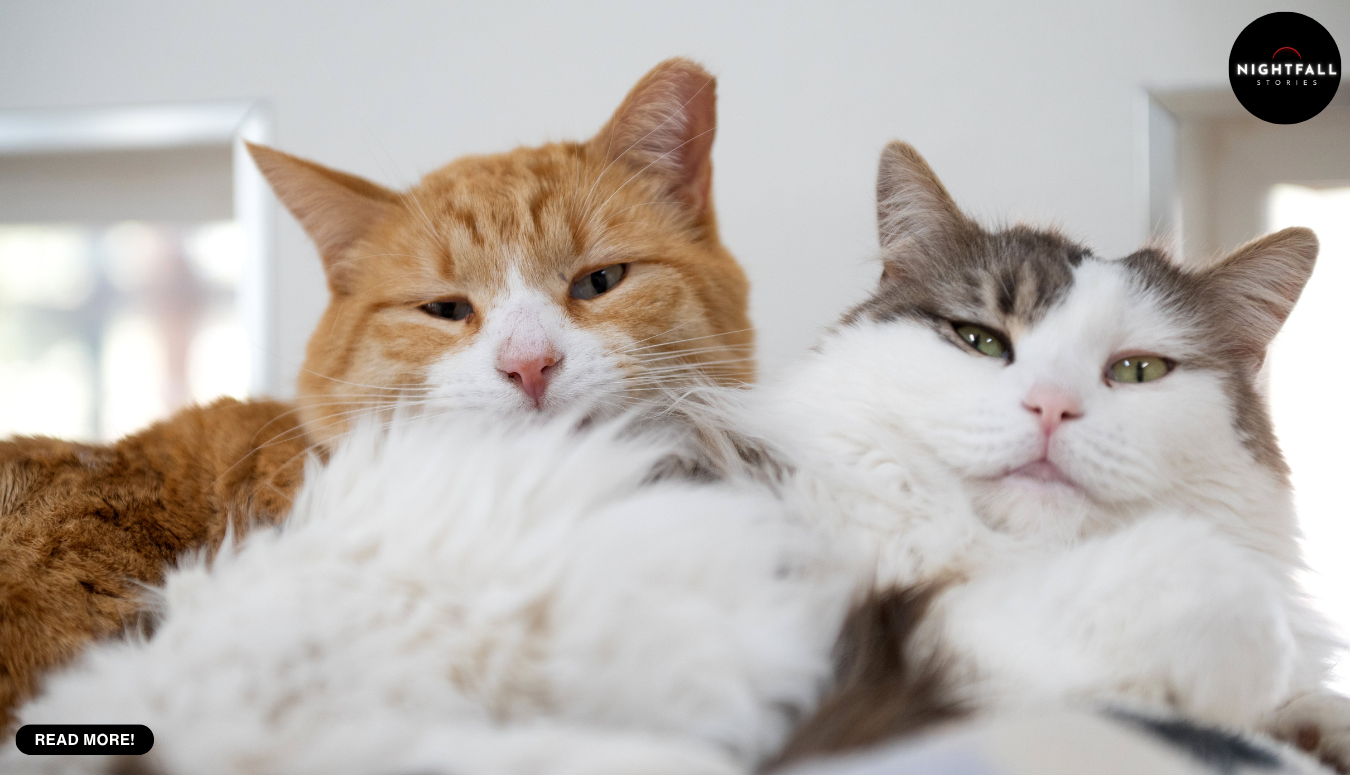
If you have ever watched a cat sniff something and then freeze with its mouth half open, upper lip curled, looking briefly like it has been personally insulted by the smell, you have seen the single most useful clue in this entire story. Cats do it at other cats’ urine more than at almost anything else. It has a name, the flehmen response, and it means the animal is not just smelling. It is pulling the molecule into a second sensory organ in the roof of the mouth and reading it properly.
For decades the obvious question sat there unanswered: reading what, exactly?
A team based at Iwate University in northern Japan, working with chemists in Germany and collaborators in Spain, now think they have the answer, and it is stranger and tidier than anyone expected. Cat urine carries a set of fatty acids that differ measurably from one individual cat to the next and, crucially, stay more or less the same in that cat over time. Not a mood. Not a health readout. An identity. A chemical name tag.
The paper went online in the journal Current Biology, and it is worth being precise about when, because most of the coverage you will have seen is a month late. It was published on 19 August. The wave of articles in September is the print issue catching up, volume 36, issue 17, which is a completely normal thing for a journal to do and a completely normal thing for readers to misread as fresh news. The science is a month old. It is not less interesting for that.
The first author is Shota Ichizawa, a graduate student in the applied biological chemistry programme at Iwate University, and his name has been quietly mangled or skipped in a lot of the write-ups. Plenty of outlets went straight to the senior author, Masao Miyazaki, the professor who runs the lab, partly because Miyazaki is already known internationally for earlier work on why cats roll in catnip and silver vine. The romanisation of Ichizawa’s surname also varies between the journal record and his own university’s release, which has not helped. The journal listing is the one to go by, and it has Ichizawa first.
The rest of the team includes Stefan Schulz and Jana Kaspers, chemists at Braunschweig in Germany, and the collaboration matters because of what the work required. This was not a behaviour study with some chemistry bolted on. It was a chemistry study with behaviour used to check the answer.
Here is the problem they were up against.
Cats mark. Everyone with a cat knows this and everyone with a garden knows this. The assumption for a long time was that the information in a scent mark lives in the volatile compounds, the light molecules that evaporate fast and hit your nose from across a room. That assumption has a serious flaw. Volatile compounds are unstable. They change with what the animal ate yesterday, with the weather, with how long the mark has been sitting on a fence post. If your identity badge rewrites itself every few hours, it is not much of an identity badge.
So the team went looking lower down the scale, at semi-volatile compounds. Heavier molecules. Slower to leave. Harder to detect with standard methods, which is part of why they had been overlooked.
They found thirteen branched-chain fatty acids. Branched, meaning the carbon chain has side spurs off it rather than running straight, which gives you an enormous number of possible variations from a small number of building blocks. The team sampled urine from 44 domestic cats and the pattern held: the particular blend and the proportions between those thirteen compounds varied clearly from one animal to another, while staying recognisably consistent within the same animal across separate collections.
Then they tested the stability directly, which is the part that turns a curiosity into a mechanism. Samples left at room temperature still carried a readable branched-chain profile after 24 hours. A mark on a wall is still saying whose mark it is a full day later, long after the sharp smell that made you wrinkle your nose has faded.
The chemistry alone would not prove cats care. So they asked the cats.
They ran behavioural trials with 27 animals, with several of the core recognition tests built around the same seven males. The design used habituation, which is a clean trick: present an animal with a smell over and over until it gets bored and stops investigating, then change one specific thing and see whether the boredom breaks. If nothing changes in the animal’s behaviour, it cannot tell the difference. If it starts sniffing hard again, it can.
They swapped out the branched-chain fatty acid fraction while holding the other lipids steady. The cats started sniffing again. Change that one component and, as far as the animal is concerned, the mark now belongs to somebody else.
It is worth pausing on how unglamorous that design is, because it is what makes the result trustworthy. There is no mind reading involved and no interpretation of feline facial expression beyond counting seconds. A cat either investigates or it does not. Habituation strips out the animal’s general curiosity, its mood that afternoon, its fondness for the researcher, and leaves one variable standing. Run it enough times with enough animals and the only thing that can explain renewed interest is that the chemistry changed and the cat noticed.
That is a tight piece of work, and it would be a decent paper if it stopped there. It does not stop there, and what comes next is the part that has people genuinely excited, with a large asterisk attached that most of the coverage has dropped.
For well over a century, anatomists have known that cat kidneys are unusual. Slice one and the cortex is packed with lipid droplets, tiny globules of stored fat, in a quantity you simply do not see in the kidneys of most other mammals. It has been written up, illustrated in textbooks, noted and shrugged at for generation after generation of veterinary students. Nobody had a convincing explanation for what all that fat was doing there. Kidneys are filters. Filters do not normally need a pantry.
When the team looked inside those droplets, they found the branched-chain fatty acids, bound up in triacylglycerols, the storage form of fat.
So the proposal on the table is this: the kidney droplets are a reservoir. A buffer. A cat’s diet swings, and the raw material in its bloodstream swings with it, but if the relevant fatty acids are being held in a slow-release store in the kidney and fed steadily into the urine, the signature stays constant even when the input does not. The identity survives a change of food.
That is an elegant idea and it would explain a hundred-year-old anatomical oddity in one stroke, which is precisely why it needs saying clearly: it is a proposed mechanism, not a demonstrated one.
The researchers themselves are careful about this in a way the headlines have not been. Miyazaki’s own framing is that the droplets have been known for more than a century, that why cats have so many has remained a mystery, and that these findings suggest one of their functions may be to support a stable chemical signature in urine. Suggest. May be. One of their functions. The team states outright that how the stored fatty acids actually get released into urine is an open question for future research. Nobody has traced that pathway. The correlation is real and it is striking. The plumbing between the store and the mark has not been shown.
If you read a headline this month announcing that a century-old mystery has been solved, that is the headline writer talking, not the scientists.
The team also looked outward, beyond the house cat, and this is where the story opens up. They checked urine and kidney lipid patterns across other members of the cat family and found the same chemistry in lions, tigers, leopards, jaguars, servals, Iberian lynxes and the leopard cats of Tsushima. The specific profiles differ by species and even by geographic population, but the underlying system appears to be shared across Felidae.
That points at something old. Not a quirk your cat picked up while being domesticated, but a signalling system that predates domestication by a very long way, running through solitary territorial hunters who needed to leave reliable information about themselves on a landscape they could not patrol continuously.
Here again, though, the honest caveat: the behavioural tests were done on domestic cats only. The compounds are there in the wild species. Whether a lion reads another lion’s mark the same way has not been tested, and the team says so.
There is one more reason the finding lands the way it does, and it is about how cats live rather than how they smell. Most of the cat family is solitary. A tiger, a leopard, a serval spends the great majority of its life alone across a range far too large to defend by being physically present in it. The only way to hold territory under those conditions is to leave messages and trust that they will still be readable when a rival arrives days later. Seen that way, a stable chemical identity is not a curiosity. It is the minimum requirement for the entire lifestyle to work, and the surprise is less that it exists than that it took this long to find the molecules carrying it.
What makes this a human story rather than a chemistry story is the shape of the lab it came out of.
Miyazaki’s group has form for taking questions that everybody else treats as too trivial or too obvious to bother with, and then refusing to let go. The catnip work is the famous example. Cats rolling in catnip and silver vine had been a party trick for centuries, filed under cats are weird. His team asked what the behaviour was actually for, and found that rubbing the plant compounds into their fur gives cats a measure of chemical protection against mosquitoes. A joke turned out to be pest control.
This is the same instinct applied to something even less glamorous. Cat urine is the least appealing research material imaginable, the sort of thing that makes people laugh when you say it at a dinner table, and the team spent years on its heavier molecular fraction because the light fraction did not add up. Somebody had to collect forty four cats’ worth of samples. Somebody had to sit through habituation trials watching whether a bored cat would bother lifting its head. That somebody, on the paper at least, is a graduate student whose name a lot of the world’s science desks did not bother to print.
There is a practical edge to it as well, and it is not trivial. Cats are notoriously difficult to assess in a clinic. They mask illness, they hate carriers, they behave nothing like themselves on an examination table, and kidney disease in particular is both extremely common in older cats and extremely hard to catch early. If the kidney really is running a lipid store that feeds this signature, and if that store is disrupted when the organ starts failing, then the chemistry of a cat’s mark might eventually carry an early warning. The researchers have not claimed this, and nothing in the paper supports it as a diagnostic yet. It is simply the obvious next question, and it is the kind of question that follows from having identified the mechanism in the first place.
There is a smaller, more domestic payoff that lands immediately, though, and it is the reason this story travelled.
If you have two cats and they have never quite settled with each other, you have probably noticed how much of the tension runs through smell. A cat comes back from the vet and gets hissed at by a housemate it has lived with for eight years. Introduce a new cat and the fight is not over the food bowl first, it is over the furniture, the doorframes, the corners of the sofa, everything that gets rubbed and marked and marked over.
That has always been treated as territorial in a vague sense. What this work suggests is much more specific. They are not just claiming ground. They are writing names on it, in a stable chemical script, in a format that survives a day of weather and a change of diet, and they are reading each other’s names off the wall every time they do that ridiculous open-mouthed face at the doorframe.
The next time you see it, the curled lip, the vacant thousand-yard stare, the expression of an animal that has just remembered something embarrassing from years ago, you are watching a cat check the signature on a message. The letter is still legible. Who wrote it, and how the ink gets made, is the part still being worked out.