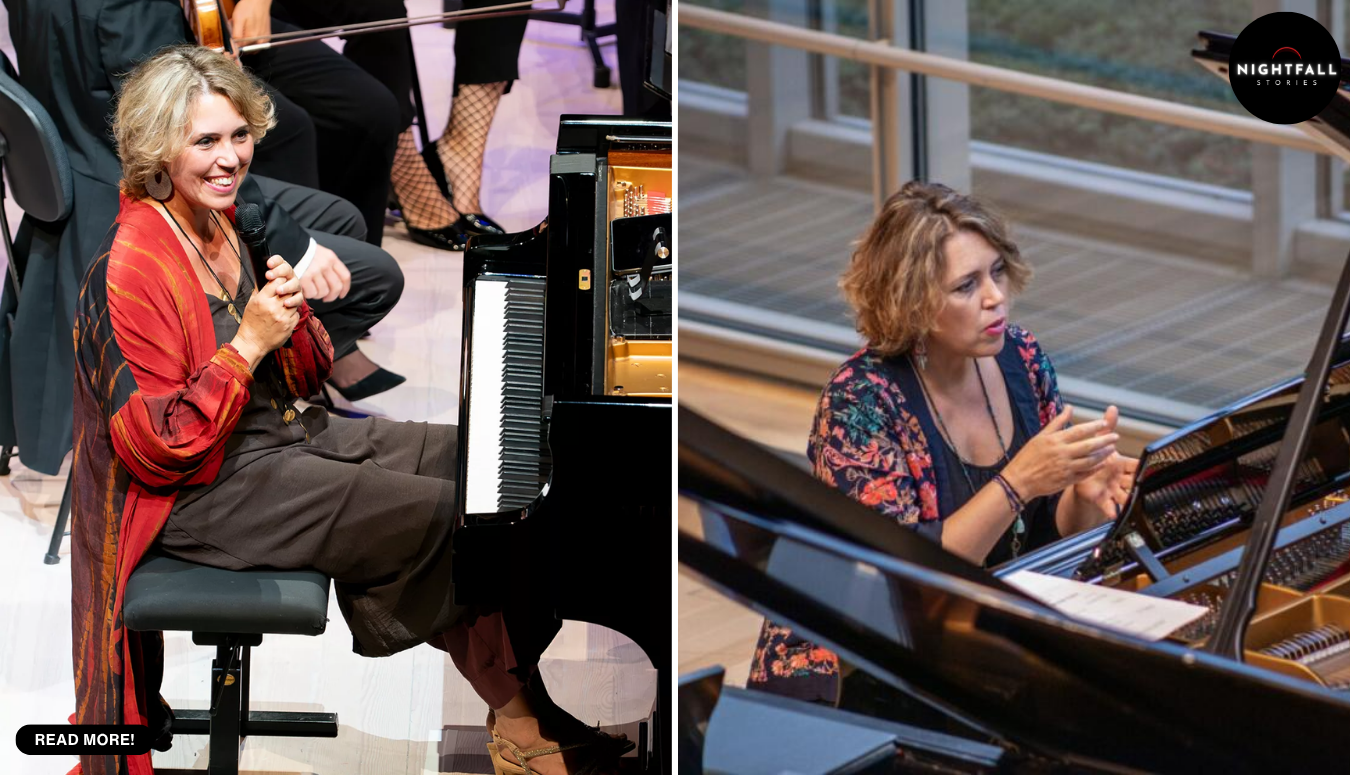
Gabriela Montero knew she was going to win about a week before she stood up to receive anything. And in that week, rather than saying thank you and waiting for the applause, she did something that made the eventual ceremony almost beside the point. She announced, publicly and in advance, that the entire prize was already spoken for. Ten thousand euros, roughly eleven and a half thousand dollars, going to a Venezuelan lawyer most of the world has never heard of.
Her name is Tamara Sujú Roa, and the reason so little coverage bothered with her name is itself part of the story.
The award is the Pau Casals Award, given by the Kronberg Academy in Germany and presented during its festival. Kronberg is a serious place in the cello world, built in part around the memory of Pablo Casals, and the prize carries his name because it is meant to recognise something beyond playing well. Plenty of prizes reward technique. This one is explicitly about the other thing Casals was famous for, which was refusing.
Casals was Catalan, one of the greatest cellists who ever lived, the man who rescued Bach’s solo cello suites from being treated as dry exercises and made them central repertoire. He was also a man who, after the Spanish Civil War, went into exile in southern France and then made a decision that cost him most of his career. He would not perform publicly in countries that extended recognition to Franco’s government. He was in his sixties. He had the sort of international reputation that would have made him welcome anywhere, on any terms he liked, and he chose instead to fall largely silent in public for years. He lived in a small town near the border, he taught, he played privately, and he made his silence into the loudest thing about him. He was still doing this in his nineties, when he addressed the United Nations and played a short Catalan folk song about birds that he had turned into a kind of portable homeland.
So a prize with his name on it carries an implication. It is not just for the person who plays beautifully. It is for the person who has been asked to trade the playing for something and said no.
Montero has spent most of her adult life in that position.
She was born in Caracas, picked out melodies before she could talk, started lessons at four, and played her first concerto with a national youth orchestra at eight. At nine she had a government scholarship to study abroad. She went on to the Royal Academy of Music in London, placed at the Chopin competition in Warsaw, and built the kind of career that takes a pianist to the New York Philharmonic and the Los Angeles Philharmonic. She has a Latin Grammy. She played at Barack Obama’s presidential inauguration.
She is also unusual among classical soloists in that a substantial part of what she does on stage is invented on the spot. Audiences suggest a theme, any theme, and she improvises on it, sometimes for a long time, in whatever direction the material takes her. It is a skill that was once entirely normal among keyboard players and then quietly disappeared from concert life for about a century, and she has spent her career insisting it belongs back there. It also means her concerts are not repeatable. What happens in the room happens once.
And for well over a decade now, her name has been attached to something considerably less comfortable than improvisation.
Montero became one of the most persistent public critics of the Venezuelan government from inside the classical music world, which is a small world and one that depends heavily on not upsetting anybody. She was blunt about El Sistema, the country’s celebrated youth orchestra programme, arguing that its international reputation had been used as political cover, that the world was applauding a beautiful image while looking away from what was happening around it. This was not a popular thing to say. El Sistema was, for a long stretch, one of the few unambiguously good news stories anyone could tell about the country, and a great many people in music had invested their reputations in it.
She wrote music about it too. Ex Patria is a tone poem she composed as a protest piece, about lawlessness and killings and the ordinary violence of a collapsing state, and it is not a comfortable listen because it is not trying to be. Her first piano concerto, the Latin Concerto, does something stranger, taking dance rhythms from home and using them as the structure for a work by someone who cannot go home.
That is the underlying fact. She lives in the United States. She has not been able to return.
Exile of that kind does not look dramatic from the outside. There is no border scene, no dash to an airport. It is mostly an accumulation of small permanent absences. Family gatherings you hear about afterwards. A language you keep speaking to people who are all somewhere else. A hall in the city you grew up in that books other pianists. Musicians in her position often describe the strangest part as professional rather than personal, the fact that the audience who would understand exactly what you are doing, and why a particular rhythm lands the way it does, is the one audience you cannot play to.
She has kept working anyway, and kept saying the same things, through years in which it would have been far easier and far more lucrative to stop. A soloist’s career runs on invitations, and invitations come from institutions, and institutions as a rule do not enjoy controversy. Every festival that did not call, every orchestra that quietly chose somebody less complicated, is a cost that never appears on any list of achievements because there is no way to count it.
Along the way she was named an Honorary Consul for Amnesty International, and she received the Václav Havel Prize for Creative Dissent, which is awarded to artists whose work puts them directly at odds with the power around them. Havel, who spent years in prison before becoming a president, is not a bad patron saint for a musician who decided that a career was not worth a silence.
Then last year, in Oslo, she closed the Nobel Peace Prize ceremony.
The prize had gone to María Corina Machado, the Venezuelan opposition leader, who did not appear at the ceremony in person. Her daughter accepted it on her behalf. Montero, invited by Machado, sat down at the end of the proceedings and improvised on Mi querencia, a song by the Venezuelan composer Simón Díaz that is roughly about the place you belong to, and then played the Venezuelan national anthem. An exiled pianist playing her country’s anthem in Oslo, at a ceremony her country’s most prominent dissident could not safely attend in person, is the kind of image that does not need any explaining.
Which brings us back to the ten thousand euros.
When Kronberg named Montero as this year’s recipient, she did not wait for the ceremony to make her gesture. The announcement of the prize and the announcement of what she would do with the money arrived together, more than a week before she actually appeared in Germany to receive it. That sequencing matters more than it sounds. A donation revealed at a podium is a moment. A donation announced before anyone has clapped is a decision, made in advance, in writing, with nothing theatrical about it. It also meant that for the entire week leading up to the event, the story people were discussing was not Gabriela Montero. It was Tamara Sujú.
Sujú is a criminal lawyer, trained in Caracas, who has spent years doing the least glamorous and most necessary work in human rights, which is documentation. Not protest, not speeches. Records. Names, dates, places, medical details, testimony taken carefully enough that it will survive being challenged by government lawyers years later in a different country.
She has built what is generally described as the largest single archive of torture and arbitrary detention cases in Venezuela, assembled from the testimony of hundreds of victims. She testified before the Organization of American States about hundreds of documented torture cases, a large proportion of which involved sexual violence. She founded organisations to support political prisoners and their families, and previously directed a group providing free legal help to Venezuelans who had been detained or abused. She is now executive director of the CASLA Institute, and a senior fellow at a human rights centre named for Raoul Wallenberg.
What that looks like in practice is unromantic in the extreme. It is sitting with someone who has been through the worst weeks of their life and asking them, gently and repeatedly, for specifics. Which floor. Which uniform. What time of day. How many others were in the room. It means cross-referencing accounts that were given years apart by people who have never met, so that a pattern becomes something a court can look at rather than a collection of individual horrors. It means keeping all of it secure, because the archive itself makes everyone in it a target, and because a leak would cost lives rather than credibility.
She does this from exile. She requested asylum in Prague years ago and was granted protection there, and from that distance she has filed submissions at the International Criminal Court accusing the Venezuelan leadership of crimes against humanity. She has continued to document conditions inside specific prisons and the marking of opposition supporters’ homes. She has done all of it under the sort of threat that makes people change their routines permanently.
Montero’s description of her work turns on that word, tirelessly, and on the image of a person assembling evidence for courts in other countries while never being certain of her own safety. It is work that produces no applause at all. Nobody stands up when a case file is completed. The entire value of it is deferred, sitting in a folder, waiting for a legal system that may or may not ever be in a position to use it.
So a pianist who improvises for a living, whose art exists only in the moment it is made and then evaporates, handed her prize money to a woman whose entire life’s work is the opposite. Montero makes things that cannot be preserved. Sujú preserves things nobody wants recorded. It is hard to imagine two more different ways of being useful, and the gesture reads like an acknowledgment of that.
The connection Montero drew publicly was to Casals himself, and it was not a decorative flourish. Her point was that the value of art does not separate the person who makes it from responsibility for the world they make it in. Casals could have kept performing under Franco’s recognition and been forgiven for it by almost everyone. He decided the concert hall was not a neutral space. Montero’s argument is that it still is not, and that a prize honouring him ought to end up somewhere he would have sent it. She has said, in effect, that a living Casals would not have traded his music for a regime’s gold either.
María Corina Machado, the Nobel laureate herself, publicly praised the gesture.
There is a practical point in here too, and it is worth being plain about. Eleven and a half thousand dollars is not a life-changing sum for an institution. For a small documentation outfit run out of exile, funding legal filings and the travel and translation and secure storage that evidence work actually requires, it is real money that arrives with no strings and no grant cycle attached. Human rights documentation is chronically underfunded precisely because it is unphotogenic. It produces no rescues, no reunions, nothing that plays well. It produces paper.
What Montero did with the announcement was redirect a week of international arts coverage onto that paper, and onto the woman producing it, which is worth considerably more than the cheque.
The ceremony in Germany happened as scheduled. Montero collected the Pau Casals Award, and the money went where she had already said it would go, and nothing about the evening was a surprise, because she had made sure of that in advance.
It would be easy to read the whole thing as a nice gesture from a successful artist, filed under generosity and forgotten by the weekend. But look at what she actually gave up. Not the money, which she was under no obligation to keep but also under no obligation to give away. She gave up the moment. She gave up the version of this where she stands at a podium, pauses, and announces her donation to a room that gasps and then applauds her for it. That version would have been about her. She chose the version where the news broke in a press release a week earlier with somebody else’s name in the headline, and by the time she reached the stage the story had already moved on to a lawyer in Prague with a filing cabinet full of testimony.
That was the point. That was always the point.