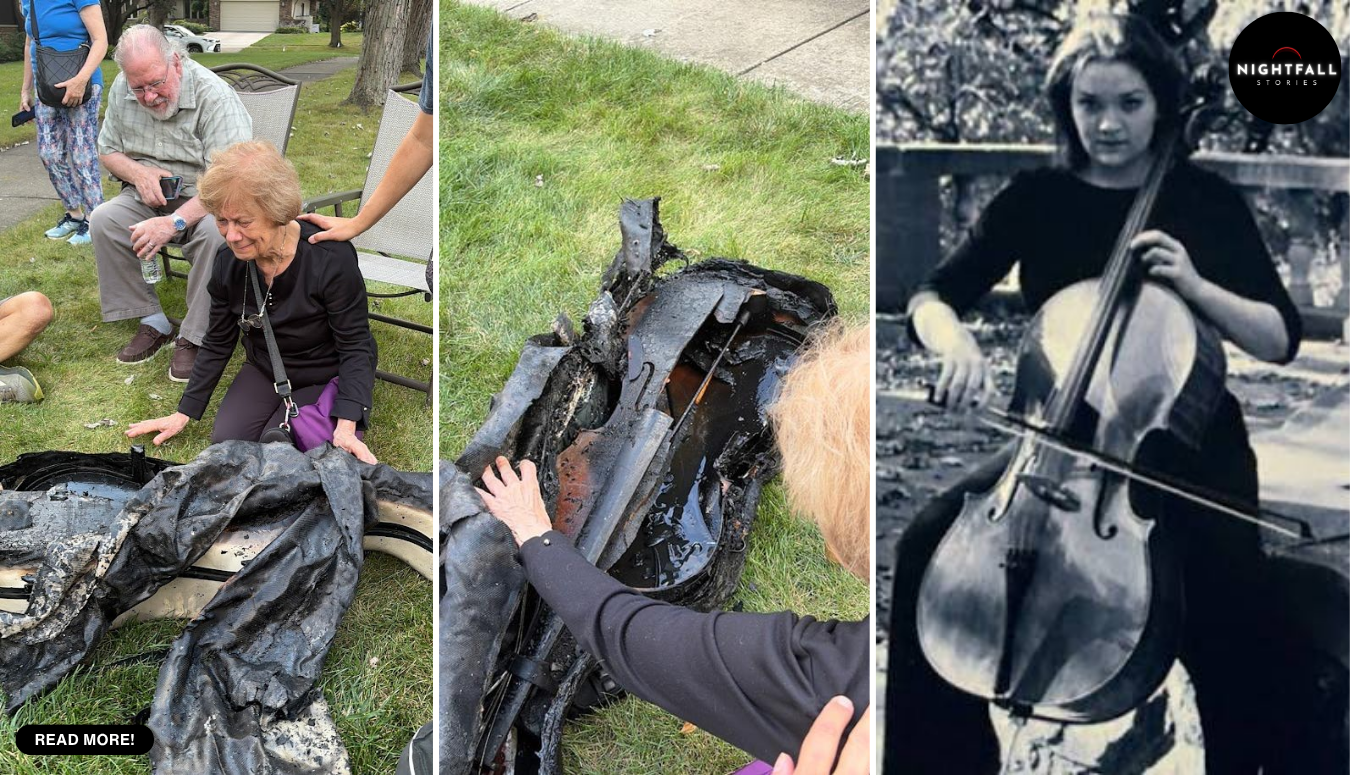
The cello was made in Cremona, Italy, around 1704, in the workshop world that also produced Stradivari. It passed through roughly three hundred years of owners, wars, border crossings, customs desks, repair benches and concert halls, and it arrived intact in a house in Chicago, where an 87-year-old woman played it, taught on it and lived beside it. Then there was a fire, and the cello is gone.
That sentence is the part most people have read. What it leaves out is almost everything that makes the story worth sitting with, because the instrument was not the only thing in that house, and the two people who lived there are not simply an elderly couple who lost their belongings. They are Tanya Lesinsky Carey and Gerald V. Carey, and between them they have spent something close to a hundred and twenty combined years shaping how children in dozens of countries are taught to hold a cello and a flute.
Start with the basic, merciful fact: they were not home. Both of them were out when the fire started, and neither was hurt. In a story with this much loss in it, that is the thing to hold onto first.
Here is what is not known, and it matters that it is said plainly rather than filled in. No public source establishes what caused the fire. No fire department finding, no insurance determination, no official statement on point of origin has been released. A family fundraising appeal circulated afterwards reportedly described the damage as beginning in the part of the house where the instruments and teaching materials were kept, but a fundraiser description written by grieving relatives is not a cause determination, and nobody outside the investigation has published one. Anybody telling you confidently why this happened is guessing. The honest position is that the cause is not public.
What is documented is the inventory of what burned, and it is long. Tanya’s cellos. Gerald’s flutes. A piano. Decades of personal sheet music, much of it annotated in their own hands. Teaching tools built and refined over a working lifetime. Recordings. Artwork. Antique furniture and family heirlooms. Material stored in the loft. For a household that was also, functionally, an archive and a studio and a small publishing operation, the loss of the building and the loss of the career are close to the same event.
The cello itself has been reported as a 1704 instrument attributed to Joseph filius Andreae Guarneri, one of the Guarneri family of Cremonese makers whose surviving instruments are counted in the low hundreds worldwide. Every one of them that still plays is, in a real sense, a piece of working infrastructure for classical music. They are not ornaments. Musicians perform on them, students learn from hearing them, and the supply is fixed forever, because the people who made them died three centuries ago. When one is destroyed, the total in the world goes down by one and stays down.
It is worth being precise about the name, because the Guarneri family produced several makers and they are constantly confused with one another. Andrea Guarneri founded the workshop. His son Giuseppe, known in the trade as Joseph filius Andreae, meaning Joseph son of Andrea, ran it into the early seventeen hundreds and was the father of the maker usually called del Gesu, whose violins now trade for sums that make headlines. Instruments from the filius Andreae bench sit in that lineage. Cellos from any of these makers are far rarer than the violins, because fewer were made and fewer survived, and because a cello is large, fragile and awkward to move, which over three centuries is a slow filter.
But an old cello is also, for the person who plays it, an extremely personal object. It has a particular response under the bow that the player has spent years learning. It has a smell. It has a place in the room. Tanya Carey did not own a museum piece she kept in a case. She owned a tool she used.
And she used it hard, for a very long time.
Carey holds a doctorate from the University of Iowa and both a bachelor’s and master’s degree from the Eastman School of Music, with performer’s certificates at both levels, which at Eastman is not a routine line on a transcript. She played as assistant principal cellist of the Milwaukee Symphony and as associate principal of the Quad City Symphony. She recorded with the Rochester Philharmonic. She played chamber music in the Lydian Trio alongside Almita and Roland Vamos, two of the most respected string teachers in the United States. She has given recitals at Carnegie Hall and at Alice Tully Hall.
None of that is the reason her name is known in the cello world.
She is known because she worked out how to teach very young children to play the cello well, and then she wrote it down. She studied directly with Shinichi Suzuki, the Japanese violinist whose teaching method spread worldwide on the premise that any child can learn music the way any child learns to speak, and with John Kendall and Doris Preucil, two of the figures who carried that method into American classrooms. Her doctoral work was on Suzuki cello instruction.
The interesting thing about applying that approach to the cello is that it is genuinely difficult. The violin adapted to small children fairly readily once makers started building fractional sizes. A cello is a different problem. The child has to sit correctly, reach around a body that is large relative to their own, control a bow arm that works against gravity in a way a violinist’s does not, and produce a tone without the instrument sliding away. Getting a five-year-old to do that without building habits that will have to be painfully unlearned at fifteen is a real engineering question, and much of Carey’s working life went into answering it in small, teachable pieces. Out of that came the Cello Playing Is Easy series, which has been sitting on teachers’ music stands for decades, and which is the reason a cello teacher in Auckland or Seoul or Ohio might recognise her name without ever having met her.
She served as president of the Suzuki Association of the Americas and as president of the Chicago Cello Society. She was named outstanding studio teacher of the year by the Illinois chapter of the American String Teachers Association back in the early nineteen nineties. She taught at Western Illinois University, where she holds an emeritus professorship, and at DePaul, at Wheaton College, at Roosevelt University’s Chicago College of Performing Arts, and for around twenty one years at the Music Institute of Chicago. She has given masterclasses in more than thirty American states and across Canada, Europe, Britain, Australia, China, Japan, Korea, Taiwan, New Zealand and South America.
That is a career measured in other people. Every one of those masterclasses was a room full of teenagers who went home and played differently.
Her husband’s career runs on a parallel track and is, in its own field, just as consequential. Gerald Carey was principal flute of the Quad City Symphony from the late nineteen seventies and professor of flute at Western Illinois University until he retired at the end of the nineteen nineties. He performed internationally and recorded for several labels. He also spent decades doing the unglamorous organisational work that keeps an entire instrument’s professional community functioning.
He was president of the National Flute Association at the start of the nineteen nineties and chaired its board immediately afterwards. Before that he had coordinated its student competitions, then its general competitions, and served on its board of directors. He chaired a national convention programme. He worked on the convention programme books in a partnership with the flute historian Nancy Toff, and the formats they established are reportedly still in use. He pushed the association to commission new works for its high school soloist competition, and some of those commissioned pieces became standard repertoire, which means a teenager preparing an audition today may be playing music that exists because Gerald Carey argued for it.
His presidency also included a hard stretch. The association’s executive coordinator, Myrna Brown, died during his term, and he was the person who had to hold the organisation together through the transition. In 2008 the association gave him its Distinguished Service Award, which is the flute world’s way of saying that it noticed.
The two of them recorded together as well. They released an album called Golden Celebration, cello and flute, husband and wife, made late in two long careers.
So the house that burned was not a house with a valuable object in it. It was the physical accumulation of two complete working lives in music, including the teaching materials of a woman who reshaped how her instrument is taught to children, and the papers and instruments of a man who helped build the professional structure of his.
There is one more strand to the story that deserves honest handling, because it has caused confusion. In the days after the fire, word spread through the classical music press and the online forums that a fundraising appeal had been launched. Almost immediately, a family member posted publicly that no fundraiser had been started by the family, or requested by them, or set up by colleagues, at that point. Shortly afterwards, an appeal did appear, written in the first person by a relative, describing what had been lost and what the couple needed: somewhere to live, help with daily expenses, an insurance deductible, and the beginning of a rebuild.
Both of those things can be true. Well-meaning strangers often move faster than a family does, and a family in the first week of something like this is usually not in a position to organise anything. But the sequence is worth knowing, because it is also the sequence that scammers exploit. In an emergency involving a famous instrument, appeals multiply, and not all of them are connected to the people they name. Anyone moved to help would do well to find the appeal the family itself has acknowledged rather than the first one that appears in a feed.
It is tempting to build a redemptive ending onto this. There is not one available yet, and inventing one would be a disservice. The cello is not coming back. Neither are the annotated scores, or the recordings, or the furniture that came down through a family. The Careys are in their late eighties, staying with friends from their church, starting again with the administrative grind that follows a fire: forms, adjusters, inventories of things that cannot really be inventoried.
That last part is worse than it sounds. Insurance works by valuation, and valuation works by comparison, and there is nothing to compare a 1704 Cremonese cello to except other instruments that almost never come to market. Owners of historic instruments are routinely underinsured for precisely this reason, and the gap is often discovered at the worst possible moment. Meanwhile the items with no market value at all, the marked-up scores, the lesson notes, the boxes of correspondence with former students, are simply written off as contents, because there is no column on any form for the working papers of a life’s teaching.
There is also the quieter problem that nobody puts on a claim form. Two people in their late eighties have lost the room they worked in. Not the house, the room. The place where the stand was, where the light fell a certain way in the afternoon, where sixty years of muscle memory knew exactly how far to reach for the rosin. You can rebuild a house. Rebuilding that is a different task, and it is not one that money solves.
But there is something true that is not consolation and is not nothing.
Almost none of what Tanya and Gerald Carey actually made was in that house. The method is not in the manuscripts; it is in the hands of tens of thousands of people who were taught by them or by their students or by teachers who read their books. The commissioned pieces Gerald pushed for are in circulation on every continent. The Cello Playing Is Easy volumes exist in print runs long since dispersed across the world, and no fire reaches those. The recordings they made are copies of copies by now.
A three hundred year old instrument is irreplaceable because it is singular. A teaching method is durable for exactly the opposite reason: it was copied, deliberately and relentlessly, for sixty years, into as many people as would take it.
Somewhere today a seven-year-old is being shown how to relax a bow arm by a teacher who learned it from a teacher who learned it from Tanya Carey, and neither of them has any idea. That is the part of the estate that the fire could not touch, and it is by a very wide margin the larger part.