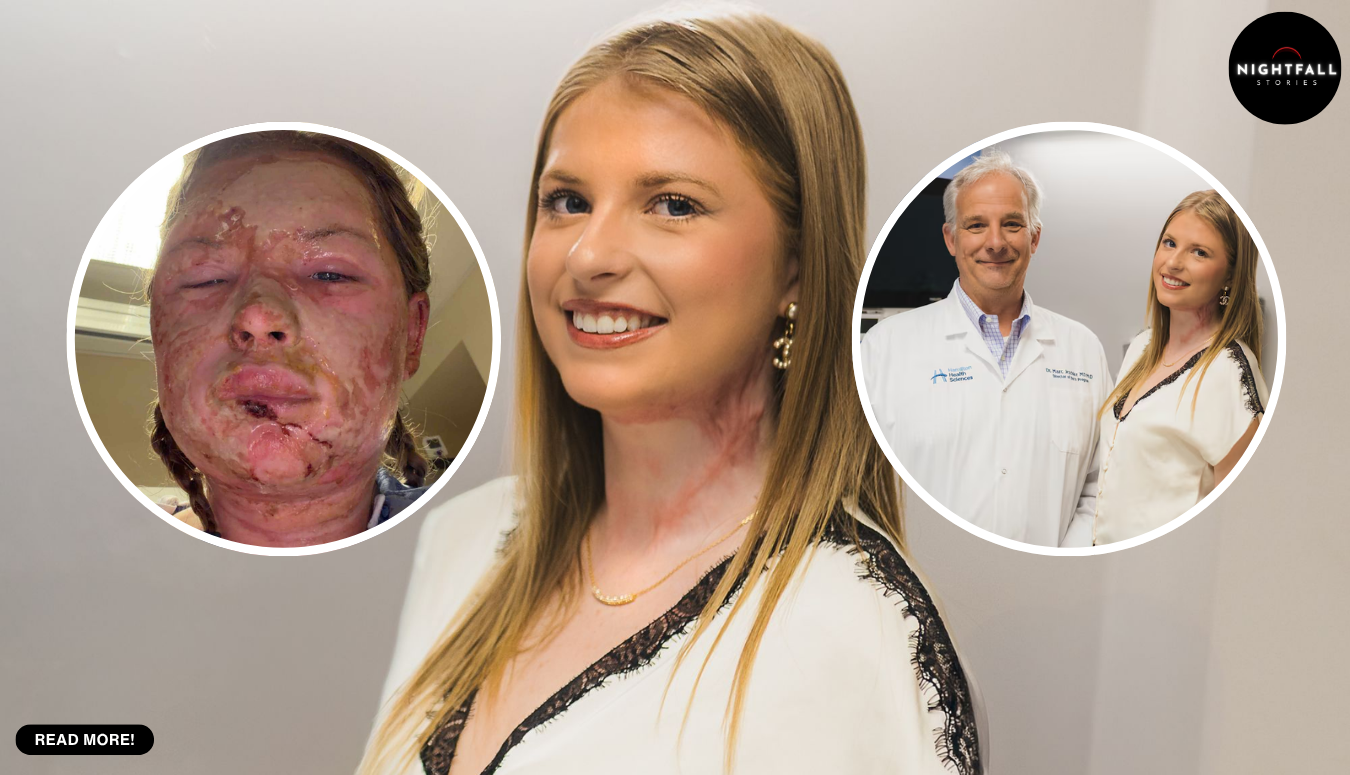
The offer on the table was skin grafts to her face and neck. Kaitlin Jeffrey was eighteen years old, a first-year university student, and the offer was not a mistake or a failure of care. It was the correct treatment, the standard of care, what any good burn centre anywhere in the world would have recommended for burns as deep as hers. Her surgeon simply did not want to do it, and he had a specific reason that he has said out loud since: you can perform the best skin graft on the planet and you still will not give someone their face back.
So instead he wrote to Health Canada and asked permission to put roughly one trillion microscopic particles into her wounds, a therapy that had been studied in laboratories for years and given to a burn patient exactly zero times.
She said yes. That is the part of this that tends to get skipped when the story travels, because the headline goes to the surgeon and the science. But the person who had to decide whether to be the first human being on Earth to receive an unproven treatment on her own face, while lying in a burn unit at eighteen, was her.
The fire happened in a student house in London, Ontario, late in 2025. It was a flash fire at a party, and five people were taken to hospital. Jeffrey, a student at Western University and originally from Toronto, was the most seriously hurt of them. Her burns covered her face, her neck, her hands and her right arm, and they ran from deep partial thickness into full thickness, which is the clinical language for damage that has gone through the layer of skin that can regenerate itself and into the layer that cannot. Nothing about how the fire started has been established in anything I could verify, and this piece is not going to speculate about it.
She was transferred to the regional burn centre at Hamilton General Hospital, one of only two specialist burn units in the province. There is no gentle version of what the following weeks involve, and this story is not going to walk through it in detail, because the details are not what makes it worth reading. What matters is a single decision point, and to understand it you have to understand what a graft actually costs.
Grafting works. It has saved an enormous number of lives, and for a large burn it is not optional. But what it does is take skin from somewhere on the body that is undamaged and move it to the place that is. The donor site becomes a new wound. The grafted area heals, but it heals as something slightly other than skin. It is often a different colour and a different texture from what surrounds it. It does not sweat or move quite the same way. On an arm or a back, that is a trade almost anyone would take without hesitating.
On a face, the arithmetic changes. A face is not a surface, it is the thing other people look at when they talk to you, and it is the thing you see when you look in a mirror for the rest of your life. Dr Marc Jeschke, the surgeon in this case, has spent his career in burn medicine and is a vice president of research and innovation at Hamilton Health Sciences, medical director of the regional burn programme, and a professor of surgery at McMaster University. He is one of the more cited burn researchers in the field. His concern was not vanity. It was that for a young patient, a facial graft carries a psychological weight that outlasts the wound by decades, and that in his judgement a good graft was still the wrong answer if there was any alternative worth trying.
It also matters that the person making this argument was in a position to act on it. A surgeon cannot simply decide to try something unlicensed on a patient. Getting an unapproved biological product into a hospital, through a pharmacy, past an ethics review and into a wound requires a specific kind of standing: a research record long enough that regulators take the request seriously, an institution willing to carry the risk, and the administrative reach to move it in weeks rather than years, because a burn will not wait. Jeschke has spent decades on burn biology and healing, and he holds a senior research post inside the hospital organisation itself. Someone with the same idea and none of that would very likely not have been able to do this, and that is worth noticing before anyone treats the case as a template.
There was one, and it had been sitting in research literature for years without ever being used this way.
Exosomes are one of those biological objects that sound made up until you understand how ordinary they are. Cells talk to each other. One of the ways they do it is by packaging up molecular instructions inside tiny bubbles of membrane and releasing them, so that other cells can pick them up and act on them. Those bubbles are exosomes. They are not cells and they are not stem cells. They are messages, in the most literal sense biology allows, and the signals they carry include instructions about repair, about building new tissue and about turning inflammation down.
The therapeutic idea follows fairly directly. If a wound heals badly partly because the signalling in the area is overwhelmed, then flooding the area with the right messages, harvested from cells that produce them in abundance, might tip the process toward proper regeneration instead of scar. Exosome preparations have been studied in wound healing for some time, with encouraging results in other kinds of wounds. Nobody had given them to a burn patient.
The particles used in Jeffrey’s case were derived from stem cells taken from umbilical cord and amniotic tissue, and they were sourced from a supplier in the United States. That distinction matters and the article is being careful with it: she was not given stem cells. She was given the material stem cells secrete, which is a far less unpredictable proposition, and one reason Jeschke has described the treatment as extremely safe.
Getting it into a Canadian hospital required a regulator’s cooperation. The route the team used was a compassionate-grounds application to Health Canada, and it is worth being precise about what that is, because it is routinely misdescribed. This was not a clinical trial. Nobody was randomised, there was no control group, and there was no protocol being tested. A compassionate or special-access pathway exists for the situation where a specific named patient has a serious condition, the conventional options are inadequate, and there is a plausible unapproved option available. The regulator’s part is not to declare the treatment effective. In this case, as reported, Health Canada raised no objection, and the team proceeded on that basis.
No objection is a phrase doing a lot of quiet work. It is not an approval, not an endorsement, and not a statement that the therapy works. It means the regulator reviewed a request for one patient and did not stand in the way. Everything after that sat with the surgeon’s judgement and the patient’s consent.
She was given two treatments, several days apart, totalling somewhere around one trillion exosomes, injected into the injured areas. Platelet-rich plasma, a preparation made from a patient’s own blood that is already used fairly widely in wound and tissue medicine, was applied topically alongside it as a complementary therapy.
Then they waited, and the waiting is the part nobody can shortcut. Skin heals at the speed skin heals.
What happened is that her face closed. It healed without grafting, which was the entire point of the exercise, and it healed to a standard Jeschke has publicly called absolutely remarkable, a phrase he is on the record using and which is notably strong from a researcher who spends most of his professional life being careful. Jeffrey’s own description was that it is honestly a miracle, and that you would not know from looking at her face that she had been burned at all.
Here is where a great deal of the copy circulating about this case gets it wrong, and it is worth correcting flatly, because the wrong version is unkind to her as well as inaccurate. She has not fully recovered. That framing has appeared in wire and social copy and it overstates what happened.
Her face healed without grafts. Her neck did not need grafting either, but it is still in an active healing phase, still scarring, and still being treated with further platelet-rich plasma and laser work. Her hands and her right arm did require grafts. And she has spoken plainly about the part of this that no photograph shows, which is that being injured in a fire has had a deep effect on her mental health and is something she is still dealing with. She has said that having good results, particularly to her face, is helping her move forward. Helping her move forward is not the same sentence as fully recovered, and she never claimed it was.
There is one more detail that gives this case whatever early suggestion of an effect it has, and it also happens to be the detail that should make everyone cautious. Another student was injured in the same fire and did not receive the exosome treatment. By the account given at the announcement, Jeffrey healed faster and with better results. That is the closest thing to a comparison that exists here, and it is nowhere near enough to prove anything. Two people, different burn depths, different anatomy, different areas of the body, different everything. It is a hint. It is not evidence, and no one should present it as such.
What exists in the formal record, so far, is a case report that has been submitted for publication in the scientific literature. A case report is the smallest unit of medical evidence there is. It says this happened to this person. It cannot tell you whether it will happen to the next one, or whether the outcome would have been similar without the intervention, or whether there is a rare harm that only shows up when you treat a thousand people instead of one. Burn medicine has a long history of treatments that looked transformative in a single dramatic case and did not survive a proper trial. Anyone reading this and hoping for it should hold that in mind.
There is a harder question underneath all of this, and it is the same one that follows every compassionate-access story. Jeffrey got this because of where she happened to be taken. She was burned within reach of one of the two specialist burn centres in the province, and the surgeon on duty at that centre happened to be one of the small number of people in the world with the research standing and the institutional position to ask a national regulator for an unapproved biological product and get an answer quickly. People sustain facial burns everywhere, every day, in places where none of those conditions apply. For them the treatment did not fail. It was never on the table.
Both Jeffrey and Jeschke have said they want exosome therapy to become standard care for severe burn patients in Canada. He wants it because he thinks he has seen what it can do to the outcome for a face. She wants it for a more specific reason, which she has expressed as a wish that when something horrific happens to someone, it does not have to change their life permanently.
But standard care is a status a treatment earns, not one it is granted. The path from one compassionate-access case to a therapy that any burn unit can offer runs through trials, through regulators making actual approval decisions rather than raising no objection, through cost and supply and manufacturing consistency for a biological product measured in trillions of particles. That process exists for good reasons and it will take years. Nothing about this case shortens it. What this case does is make it much harder to argue that nobody should bother starting.
So the honest place to leave this is not on her face, remarkable as the outcome there appears to be. It is on the two things running at different speeds. One of them is finished: the grafts that were scheduled for her face and never happened, and a decision made by an eighteen-year-old in a hospital bed that turned out well. The other is not finished. Her neck is still healing. The research is barely begun. And the part of this that lives behind her eyes rather than on her skin is going to take as long as it takes, on nobody’s timetable but her own.