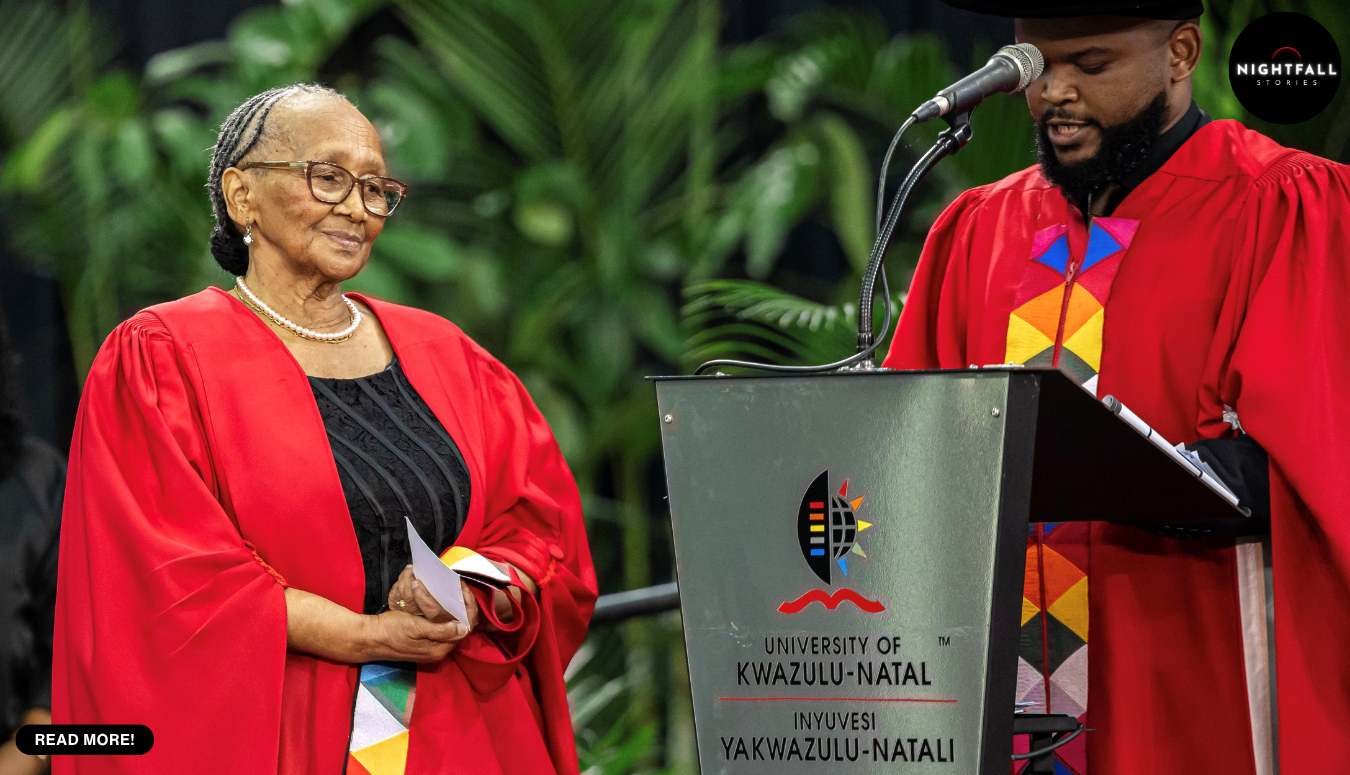
In a graduation hall at the University of KwaZulu-Natal, a dean of research stood up and read out the title of a doctoral thesis about postnatal care in rural districts, and the woman it belonged to was 82 years old. She had first walked into a hospital as a trainee nurse in 1964. She had spent the intervening years delivering babies, teaching other people to deliver babies, and writing the provincial guidelines that told still other people how to do it. And she had only just finished putting on paper the thing she had been turning over since her first year on the wards.
Dr Dolly Nontuthuzelo Nyasulu received her doctorate in public health earlier this month, and the detail that makes her story worth more than a nice photograph is what the thesis is actually about. It is not a memoir. It is a piece of research called a family-centred postnatal care approach in rural KwaZulu-Natal, and it asks a question that sounds almost too simple to need a doctorate: what would happen if the family were treated as part of the care team after a baby is born, rather than as visitors.
She is the eldest of nine children, born in King William’s Town in the Eastern Cape. Accounts of her early years differ slightly on where the interest began. One national report has her growing up in Flagstaff, watching midwives work and listening to women tell their birth stories long before she had any professional reason to care. Another has the spark arriving in 1964 itself, during her general nursing training at Livingstone Hospital in Port Elizabeth, when older midwives described what a home delivery looked like: the whole household present, aunts and grandmothers and sometimes the neighbours, everybody with a job to do. The two versions are not really in conflict. Either way, the thing that stuck was the picture of a birth surrounded by people, and the contrast with what the hospital system was starting to build, which was a birth surrounded by staff.
Entering nurse training in South Africa in 1964 meant entering a profession that was one of the very few routes into skilled work available to a Black woman, and one that was shaped at every level by the laws of the time. Training was segregated. Where you could work, what you could be promoted into and who you were permitted to supervise were all constrained. Nursing was a genuine ladder, and it was also a ladder with a ceiling, and a great many capable women spent forty years climbing it without anyone once asking them to write down what they had learned. Hold that thought, because it is the quiet argument underneath everything that happened in the graduation hall.
What she did instead was collect qualifications the way other people collect stamps. General nursing first, then midwifery. Then psychiatric nursing, which is an unusual pairing and turns out to matter, because a great deal of what goes wrong in the weeks after a birth is not obstetric. Then advanced midwifery. Then neonatal nursing, the care of the smallest and sickest newborns. Then a nursing degree covering community health nursing and nursing administration. Then a clinical master’s specialising in maternal, child and women’s health. She worked in KwaZulu-Natal hospitals including Madadeni and King Edward, and eventually she was the provincial coordinator for maternal, child and women’s health, which is the post where you stop doing the work with your hands and start deciding how thousands of other people will do it. She contributed to midwifery education and to national and provincial guidelines.
The psychiatric nursing is worth pausing on, because it is the qualification that looks like a detour and is not. A significant share of what damages women in the weeks after a birth is not bleeding or infection. It is depression, anxiety, and the particular isolation of a woman who is expected to be delighted and is not. A midwife who has also trained in mental health notices a different set of things in a room, and a policy written by someone with both trainings asks different questions of a follow-up visit. Sixty years later, when her research participants listed what they watch for on a household visit, the mother’s emotional state sat in the list alongside the physical checks, as though that were obvious. In a lot of systems it still is not.
Put plainly, she was not a nurse who happened to go back to school late. She was one of the people the system consulted, and one of her former colleagues, in a public tribute after the graduation, called her the mother of midwifery in the country. That is affection rather than an official title, and it should be read as affection. But it tells you who she was to the people in the field.
So why does someone like that need a doctorate at all. The answer is the gap between knowing something and being able to prove it.
Postnatal care is the weak joint in maternal health almost everywhere. Pregnancy gets attention. Labour gets attention. The first six weeks after a birth get a discharge slip and a follow-up appointment that a large number of women never attend. That is the stretch where most maternal deaths and a very large share of newborn deaths occur, and it is also the stretch where the mother is at home, out of sight of the health system, with a body that has just done something enormous and a baby who cannot tell anyone what is wrong.
On paper, most health systems in the region schedule a handful of contacts in those weeks, a visit within the first days and then a check at around six weeks. On paper is the operative phrase. A clinic appointment requires a woman who has just given birth to find money for transport, arrange care for the newborn or carry the newborn with her, and present herself somewhere she may expect to be spoken to sharply. Miss it and nothing happens, because nothing is designed to happen. The system’s answer to the riskiest weeks of a mother’s life is an invitation she may not be able to accept.
The family-centred idea is that the people already in that house are the only continuous presence available, and that the health system should be preparing them deliberately rather than hoping for the best. Not just handing the mother a pamphlet on her way out, but working out before the birth who will be watching for heavy bleeding, who will be checking the cord, who will protect the mother’s sleep, who will notice if she stops speaking. It is the pattern those older midwives were describing in 1964, translated into something a district health service could actually run.
Her doctoral work was supervised by Professor Myra Taylor and Dr Nelisiwe Khuzwayo at UKZN, and part of it has already been through peer review, which is the strongest thing anyone can say about a piece of research. A paper carrying her name alongside both supervisors appeared in the African Journal of Primary Health Care and Family Medicine last year, and it is worth walking through, because it shows what she was actually doing in the field rather than what a graduation write-up can convey.
The study was set in the uMgungundlovu district of KwaZulu-Natal, a largely rural municipality of roughly a million people. The participants were 23 community caregivers drawn from seven sub-districts, the people who do household visits, almost all of them women, ranging from their twenties to their sixties. They were brought together in four focus groups, and the transcripts were worked through by hand using a grounded theory approach, which means you do not arrive with a theory and test it, you let the categories emerge from what people say. It received ethics approval from the university’s biomedical research ethics committee, and it received no external funding.
It is worth saying why a study like that is built out of conversations rather than numbers, since to some readers that will sound like the soft option. You count things when you already know which things to count. When you do not, when the question is why a service that exists on paper is not reaching the people it was designed for, the only honest first move is to ask the people standing closest to the failure and let them tell you what the categories are. That is what a grounded theory approach is for, and it is also, not coincidentally, the method that treats community health workers as witnesses rather than as data points. Which is the same instinct that ran through the whole thesis.
Five themes came out of it. The first was continuity: the caregivers were emphatic that what happens after the birth is set up during pregnancy, and that a mother who has been properly monitored antenatally is a different proposition afterwards. The second was the scope of their own role, which they described as far wider than the job description suggests, covering the mother’s physical recovery, her emotional state, the baby’s checks, immunisation, feeding and nutrition.
The third theme is the uncomfortable one. Asked why young mothers do not come to the clinic, the caregivers did not talk about ignorance or distance first. They talked about judgement. Fear of being judged by health workers, by their own families, by the wider community. A young woman who expects to be lectured, or shamed, does not attend, and then she becomes a statistic about non-compliance.
The fourth theme follows from it. When mothers miss appointments, the caregivers said, nurses can read it as the caregiver having failed, and the caregivers are then carrying blame for things outside their control, including something as small and as decisive as not having the money for transport. The fifth was practical: what these caregivers should be trained and equipped to do, from watching for postpartum bleeding to cord care to supporting feeding.
The recommendations are correspondingly unglamorous. Train community caregivers properly in the family-centred approach, including hands-on demonstration rather than modules. Build real collaboration between them and the clinic staff through joint training and regular meetings, so the relationship is not one of quiet mutual blame. Give them workable caseloads and the resources to travel. And, the authors note themselves, do a larger study across more than one province, because 23 people in one district cannot speak for a country.
That last point deserves saying out loud, because this is a story about research and the research should not be oversold. A qualitative study of community caregivers in one district is a piece of groundwork, not a proof. Her own position, as reported, is that a family-centred approach remains underused in the South African system and that implementing it could strengthen the chain of care and save lives. That is her professional argument, made on the basis of sixty years in the field and a doctorate, and it is reasonable. It is not yet a demonstrated outcome, and she has not claimed it is.
The doctorate took years, and the years were not kind. Her daughter died in 2019. She lost two brothers. And her husband Guy, whom she has described as the person who backed the whole undertaking, died roughly two and a half years before she graduated. None of them saw the thesis finished.
There is no good way to make that sound like part of a plan, and it would be wrong to try. What is on the record is narrow and worth keeping narrow: she kept working, she has said the period after her husband’s death was the hardest, and she has said that people around her carried her when she could not carry herself. She also dealt with the ordinary indignities of doing a doctorate in her eighties, including knee trouble, high blood pressure, and the software. Anyone who has watched an older relative fight with a word processor’s reference manager will recognise that last one as less trivial than it sounds.
There is one more thing the provincial coordinator job explains. When you have written the guidelines, you know exactly where they are thin. You know which paragraph was a compromise, which recommendation was inserted because it was cheap, and which part of the document everybody nods at and nobody funds. Postnatal care is that part almost everywhere. Someone who spent years writing those documents and then chose, in retirement, to go and examine one of their weakest joints with a formal method and an ethics committee was not looking for a title. She was closing a loop she had left open on purpose.
She has said that reaching the end felt hard to believe, and that it had been a long journey. On the day itself, the dean of research at the College of Health Sciences read out her thesis title, and a woman who started training when the guidelines she would later help write did not exist yet sat and listened to her own work being announced.
She is a grandmother of five with two great-grandchildren. She is formally retired, and by her own account still available if anyone wants to use her in maternal, newborn and women’s health, which on the evidence would be a straightforward decision for whoever is hiring. Her advice to younger people, as reported, runs along the lines that education is a passport, and that you go on learning until you die.
It would be easy to file this under inspiring pensioner and move on, and that would miss what is interesting about it. The remarkable part is not that an 82-year-old completed a doctorate, although that is difficult and she did it while grieving. The remarkable part is the content. The thing she researched, the idea that a family should be prepared before the birth to look after the mother and baby after it, is not new knowledge that she discovered in a library. It is what she was told by working midwives in her first year of training in 1964, describing how births had been managed in households for generations.
That knowledge was in the room the entire time. It was held by women who were trusted enough to deliver babies and were never asked to write anything down, in a system that had no mechanism for taking them seriously as a source. It sat inside one nurse’s career for six decades while she rose to the top of a provincial health department, and it only entered the formal record, with a methodology and an ethics number and a peer-reviewed paper attached, when she was 82 and had to go and get a doctorate to put it there.
Nobody is better placed to point out the cost of that than she is. Which is presumably part of why she bothered.
The gown came off the same afternoon. The thesis is in the university’s record, the paper is in a journal that district health managers actually read, and the question she carried out of a hospital corridor in 1964 now has an author, a title and a citation. That is the part that outlasts the photograph.