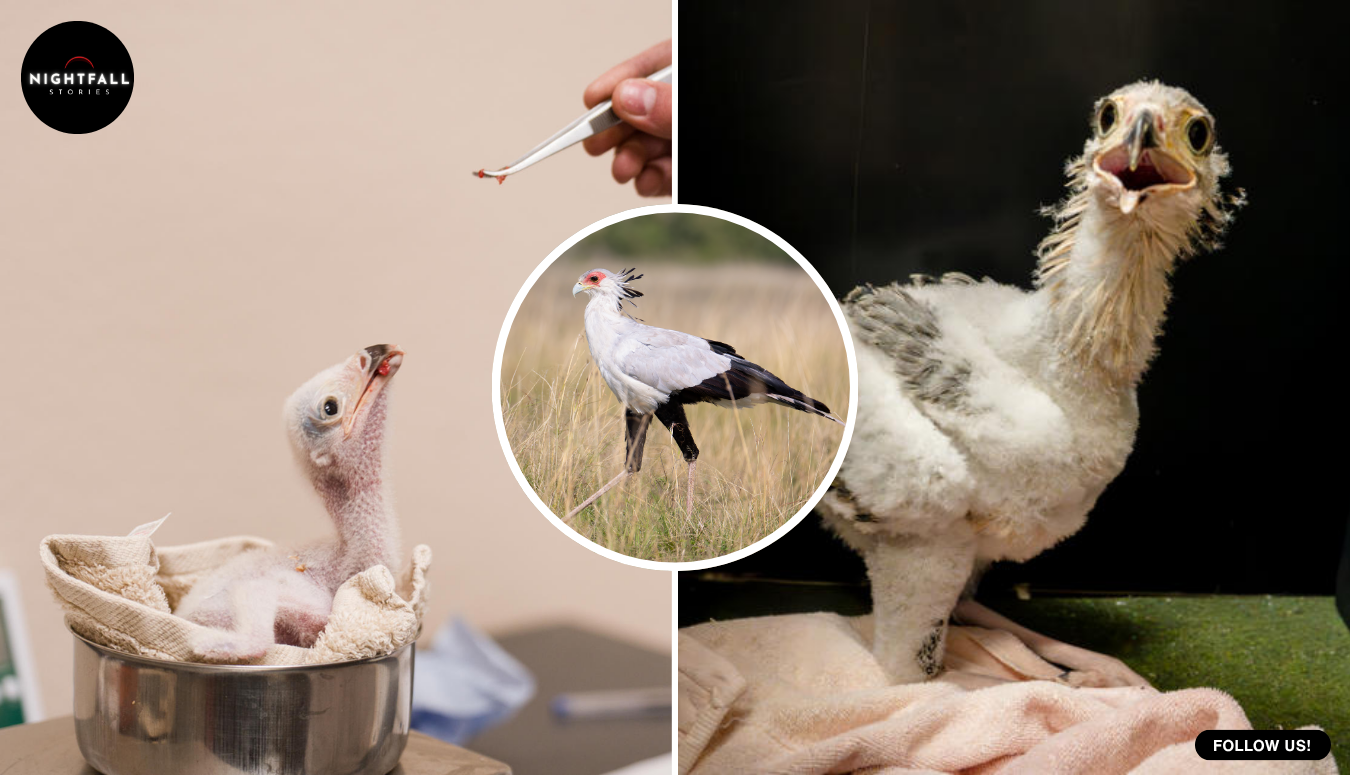
Chester Zoo opened in 1931. In all the decades since, through every rebuild and every generation of keepers, one thing had never happened there: a secretarybird had never come out of an egg. Last year, five of them did. And the part that the bird team will tell you matters most is not the five. It is that the first two chicks were lifted out of the nest by human hands, and the last three were not.
That decision, to take eggs away from a pair of endangered birds that had finally produced them, is the whole story. It sounds like the opposite of conservation. It is closer to a calculated bet, and the people who made it knew exactly what they were risking.
Start with the bird, because the secretarybird is genuinely strange and most people have never really looked at one. It is a bird of prey, in the same broad family business as eagles and hawks, except that it has almost entirely given up flying to hunt. It stands roughly four feet three inches tall on legs that look borrowed from a crane, with a wingspan that can reach close to seven feet and a body weight of only about four kilograms. Nearly all of that height is leg. It walks across African grassland in long, deliberate strides, sometimes covering many miles in a day, and it kills things with its feet.
The feet are the famous part. Researchers who measured a captive adult male striking a target found that he hit with a force equal to about five times his own body weight, and that the contact lasted only ten to fifteen milliseconds. That is an extraordinarily short window. A bird that stomps a snake has to be accurate in a fraction of the time it takes a human to blink, because the thing underfoot is also trying to kill it. The stiff black quills fanning out behind the head, the feature that probably gave the bird its name because they look like pens tucked behind a clerk’s ear, are the least interesting thing about it.
It is also a fussier predator than its reputation suggests. The snake-killing footage does the species a slight disservice, because snakes are an occasional item rather than a staple. Most of what a secretarybird eats is small and unglamorous: insects, rodents, frogs, lizards, the occasional young bird or hare. It hunts by walking, flushing things out of the grass with its feet and then striking, and it often works in pairs or as a loose family group. That feeding style is precisely why the species is so exposed. A bird that hunts on foot across open ground needs open ground. Fence it, plough it, plant it, burn it at the wrong time of year, and the bird has nowhere to walk.
This is also a bird that is disappearing, and it has been doing so quietly. In 2020 it was uplisted to endangered on the global red list of threatened species, which puts it one step below critically endangered. Conservation groups that follow African savannah raptors describe rapid decline across its entire range, from Senegal across to Somalia, and point to habitat loss, degradation of grassland, poisoning, poaching and general disturbance as the likely drivers, while being honest that nobody has fully pinned down which factor is doing the most damage.
Chester Zoo’s own announcement said that as few as 6,700 birds may remain in the wild. That figure is worth handling carefully. The published estimate for the species is a very wide band, running from roughly 6,700 at the pessimistic end up to around 67,000 at the optimistic one, which tells you something uncomfortable in itself. Nobody knows, within a factor of ten, how many secretarybirds are left. The zoo quoted the low end. That is a legitimate thing to do when arguing for urgency, but it is the zoo’s framing rather than a settled count, and the honest version of the sentence is that the population is falling fast and the total is genuinely uncertain.
Which brings us to the two adult birds at the centre of this. They are called John and Jolene, and they live in a behind-the-scenes breeding facility at the zoo rather than on the public route. That is a deliberate choice. Secretarybirds are nervous, and a pair that is being asked to do something no pair at that zoo has ever done does not need an audience.
Secretarybirds build a wide, flat platform of sticks, up to about five feet across, usually in the crown of a thorny tree. The female typically lays one to three eggs. Both parents incubate, for roughly forty-five days. The chicks then stay in the nest for an unusually long stretch, fledging somewhere between sixty-five and a hundred and six days, most often around seventy-five to eighty. In good years, when prey is plentiful, all the chicks can make it. In bad years they do not.
That long nestling period is exactly where inexperienced captive parents tend to fail. A pair can incubate perfectly and then lose a chick in week three because they do not feed it enough, or because they get restless, or because something spooks them at the wrong moment. For a species with this few individuals in managed care, losing a chick is not a sad footnote. It is a meaningful percentage of a year’s global output.
So when John and Jolene produced their first eggs, the keepers made the call to hand-rear. The zoo’s account is that two of the five chicks were reared by staff and the remaining three were hatched and raised by the parents themselves. The exact split has been reported slightly differently in different places, with at least one version suggesting only the first chick came in, so the two and three figures should be read as the zoo’s own description of what happened.
Consider what the forty-five days of incubation mean for the humans involved. A keeper watching a first-ever clutch at their institution has roughly six weeks in which they can do almost nothing except monitor, and during which the whole thing can quietly fail for reasons nobody will ever identify. Eggs go infertile. Pairs abandon. Temperature and humidity in a nest drift out of range. By the time you know something has gone wrong, the season is usually over, because these are not birds that lay again in a hurry.
Then, if eggs do hatch, hand-rearing begins and the timetable becomes brutal. A chick that will stay in a nest for seventy-five to eighty days in the wild needs the equivalent of that entire period covered by staff. Feeds measured out, weights logged daily against a growth curve, a constant low-level judgement call about whether a chick is tracking where it should be or falling behind. Two chicks reared that way is not two weeks of extra effort. It is most of a season, for a team that also has an entire bird collection to run.
Hand-rearing is not a shortcut and it is not a kindness. It is a lot of work, it produces a bird that has grown up around humans, and it removes the parents from the equation entirely. What it buys you is control. A chick in a brooder gets weighed, fed on a schedule, and watched around the clock. The odds of it surviving to fledging go up substantially. When the population you are working with is measured in dozens, that trade can be worth making.
Here is how small the pool actually is. Across the entire European conservation breeding programme for this species, the zoo says, there are just seventy-nine birds. In the twelve months around these hatchings, only three other chicks hatched anywhere else in that programme. Seventy-nine individuals and three chicks a year, spread across a continent.
Sit with that arithmetic for a second. A breeding programme is essentially a managed pedigree. Institutions across many countries pool their animals into a single studbook, and a coordinator works out which individual should be paired with which, so that the genetic diversity of the whole group does not quietly collapse over the generations. It is matchmaking with a spreadsheet, conducted across borders, over decades.
A programme producing three chicks in a year is not a functioning population. It is a holding action. Every pair that turns out to be capable of breeding changes the shape of the plan, and every pair that cannot narrows it. Five chicks in one season from one previously unproven pair is not a rounding error in a system like that. It roughly doubles the year.
And that is the reason the second brood matters more than the first. Two hand-reared chicks prove that the zoo’s keepers are good at their jobs. Three parent-reared chicks prove something different and far more useful: that this pair can do it without help. Jamie Cartwright-Stock, one of the bird keepers, described the team as having refined every aspect of the birds’ care to reach that point, and called it a breakthrough. Andrew Owen, the zoo’s head of birds, made the wider point that every chick hatched in a conservation zoo is becoming more important to this species’ future.
Strip away the institutional language and the distinction is simple. A hand-reared chick is a result. A parent-reared chick is a method. The first one you can produce by trying very hard. The second one you can repeat.
Repeatability is the thing that separates a press release from a programme. If a zoo can only get secretarybirds by pulling eggs and running an intensive round-the-clock operation on every single one, then its output is capped by staff time and it stops the moment a key keeper leaves. If the adults will incubate and rear their own young, the ceiling lifts. The keepers become supervisors instead of substitute parents. That is a structural change, and it is the sort of change that a studbook coordinator three countries away will notice and plan around.
There is a smaller detail in this that is easy to sentimentalise and worth stating plainly instead. In secretarybirds, both parents incubate. Both parents feed. This is not a species where the male turns up for the interesting parts and vanishes for the work. So when coverage of these hatchings leaned on the idea of a father unexpectedly stepping up, it was reaching for a story that the biology does not quite support. What the keepers observed was a male taking a real share of the rearing, which in a first-time captive pair is genuinely encouraging, because plenty of inexperienced pairs do not manage it. The encouraging part is that this pair worked, not that a male did something out of character.
It is also worth being clear about what these five chicks are not. None of them is going to Africa. Nothing in the record suggests any of them is destined for release, and it would be dishonest to imply otherwise. Releasing a large terrestrial raptor into grassland it has never walked on, with no parental training in how to hunt there, is not a thing anyone does casually, and it is not what this programme is for.
What a breeding programme is for is holding a viable, genetically diverse group of animals in managed care while the reasons for the wild decline are addressed, or fail to be. That is a less thrilling mission than a release, and the people who run these programmes are usually the first to say so. A captive population is insurance, not a solution. The solution is grassland that has not been converted, and poison that has not been laid out, and that work happens thousands of miles from any zoo.
So the five chicks do not save the species. They were never going to. What they do is more modest and more real: they add five birds to a group of seventy-nine, they prove that a specific pair of adults can reproduce without human hands in the nest, and they give a continent-wide programme a better year than it had any reason to expect.
The ending here is genuinely a good one, and it does not need inflating. All five chicks came through. The pair demonstrated they could rear their own. Chester Zoo went ninety-five years without a secretarybird hatching, according to its own institutional record, and then in one season stopped needing to hand-rear in order to get one.
Somewhere in a spreadsheet maintained for a studbook, five new lines appeared where a coordinator had been expecting none. That is what a breakthrough actually looks like most of the time. Not a rescue. A year that went better than the plan allowed for, and a method that might work again next year.
The birds themselves have no idea any of this happened. They are long-legged, short-tempered, snake-stomping animals who will spend their lives walking in circles around an enclosure in northern England because the grassland their ancestors crossed is being taken apart faster than anyone can protect it. The keepers who took those first two eggs away were not being cruel and were not being sentimental. They were doing arithmetic on a species that has run out of room for optimism, and this time the arithmetic came out in the birds’ favour.