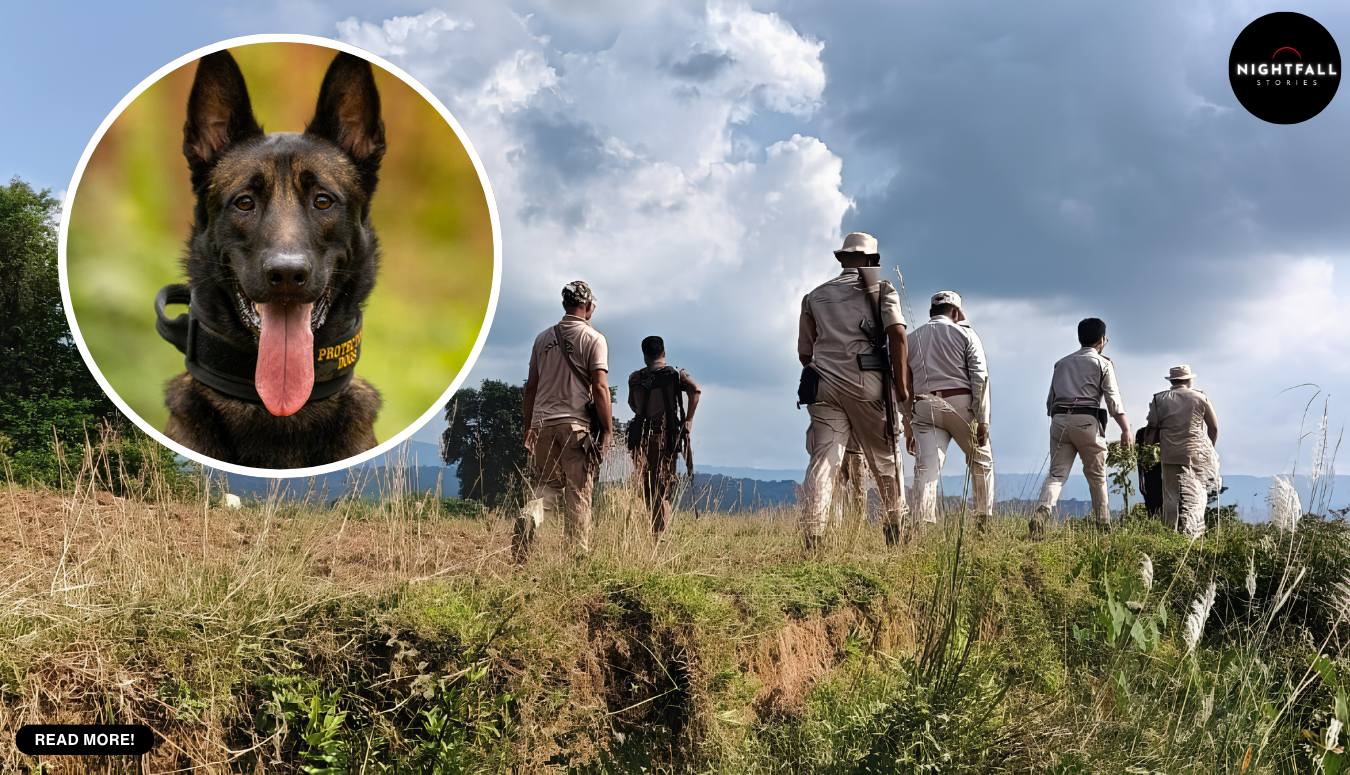
Somewhere in a 300 square kilometre block of Malaysian rainforest, a Belgian Malinois named Phiri has spent most of his working life doing something almost no dog on earth is asked to do: follow the smell of a human being who did not want to be followed, through heat and humidity that would put most working dogs on the ground within the hour.
His team has now published a paper about him. And the strange thing about that paper is which numbers are in it.
A counter-poaching unit writing up its own dog has an obvious option available. You lead with the best figure. Phiri has one: on scent trails between roughly twenty-five minutes and five hours old, he located his target in about ninety-seven percent of exercises. That is a spectacular result. It would make a fine headline, and nobody outside the team would ever have known what else was in the dataset.
Instead the authors also published what happens as a trail gets older. At thirty minutes, Phiri succeeded every time. At twenty-four hours, roughly two thirds of the time. At seven days, about one time in three.
That last number is the one that matters, because it quietly contradicts the way this kind of work usually gets described, including by Phiri’s own organisation. The conservation group he works for has published a profile of him stating that his nose can follow a human scent trail more than seven days old, across rivers and jungle slopes and thick undergrowth. That is true in the sense that he sometimes can. The paper puts a figure on how often, and the figure is thirty-three percent.
There is one honest caveat that has to go alongside that, and the authors state it themselves: the track-age testing was small. Twenty-three trials in total, split across age bands, which means each individual percentage rests on a handful of runs. At the three-day mark he succeeded in both of the two attempts recorded, which is why the paper’s own summary says performance was highest on tracks up to three days old rather than describing a smooth slide from perfect to poor. The decline is real and the seven-day result is genuinely weak. It is not a clean curve, and anyone who presents it as one is overselling a small sample in the opposite direction.
It helps to understand what the dog is actually smelling, because the intuition most people have is wrong. A tracking dog is not following a smell that a person carries. It is following the disturbance a person leaves: crushed vegetation, bruised leaf litter, bacteria and skin cells shed onto the ground, soil turned over by a boot, and the chemical aftermath of all of that decaying. That is why the clock matters so much. The trail is not fading because the dog’s nose is tiring. The trail is being eaten. In a rainforest at ninety percent humidity, with rain arriving most days and an entire ecosystem of microorganisms working on the forest floor, organic traces do not sit around politely waiting to be found.
Which means the honest way to read Phiri’s decay figures is not as a measure of one dog’s ability at all. It is a measure of how fast a rainforest erases a footprint. Another dog in the same forest would be fighting the same chemistry.
Either way, the conclusion the team draws from its own data is a restriction on its own work. A tracking dog in this environment is a response tool, not a patrol tool. You do not send him out to wander and hope. You send him when something has just been found, and the clock starts the moment a boot leaves the ground.
That reframing sounds technical. In practice it moves the whole problem somewhere else, onto the people who report a snare line.
Kenyir State Park sits in the state of Terengganu in Peninsular Malaysia, and it is not a pristine wilderness. It is secondary and logged-over forest with patches of remaining lowland and hill dipterocarp forest, running from about sixty metres above sea level up to six hundred. Its real value is connective: it forms part of a forest corridor linking protected areas across three states, which is exactly the kind of ground that large cats need and exactly the kind of ground that is hardest to guard.
The animals that corridor is meant to carry include the Malayan tiger, which is listed as critically endangered. The threat described in the paper is not glamorous. Poaching there is carried out by both local and transnational teams working inside protected forest, and the method is snaring and shooting, aimed at tigers and at the prey animals tigers depend on. A snare is a loop of cable. It costs almost nothing, it can be set in minutes, and it does not care what walks into it.
The climate is the other adversary, and the paper is unusually specific about it. Annual rainfall of 2,500 to 3,500 millimetres. Relative humidity typically between eighty and ninety percent. Mean temperatures running from about twenty-two to thirty-three degrees Celsius. That is a difficult place for a person to work and a genuinely dangerous one for a dog bred in and for a different climate.
Phiri came from South Africa, acquired at two years old through a specialist supplier of anti-poaching canine capability. He is an intact male Belgian Malinois, a breed chosen for this work everywhere in the world for a fairly narrow set of reasons: extreme drive, high pain tolerance, a nose that holds up under exertion, and a psychological need to work that borders on a design flaw in a pet. He is now around eight. Off duty, according to his handlers, he likes destroying coconuts.
The heat findings in the paper are worth reading carefully because of how they are reported. Success dropped from about seventy-eight percent under moderate conditions to about fifty percent when the heat index climbed above thirty-four degrees. That is a big-looking fall. The authors ran the statistics on it and reported that the trend was not statistically significant. They published the p-value. They did not round the caveat away or describe the pattern as a finding.
That is a small thing and it is the tell. A team writing promotional material does not include the p-value that undermines its own observation.
The paper covers work from 2019 through 2025, with a pause across 2021 and 2022 when pandemic restrictions stopped field operations. Across that stretch there were a hundred covert-tracking trials, the twenty-three track-age trials, and nine live deployments: five routine patrols and four actual counter-poaching operations. The lead author is Sai Sanggkeeth Narayanasamy, working with colleagues across the conservation organisations Panthera and Rimba, and the field programme was funded through a United States government grant aimed at rhino and tiger conservation.
It is also worth noting how few programmes of this kind ever get evaluated at all. Counter-poaching canine units have spread widely over the last decade or so, across Africa and increasingly into Southeast Asia, largely on the strength of the idea that a dog is obviously useful. The idea is reasonable. What has generally been missing is anyone measuring it under real operating conditions and then reporting what came back, including the parts that argue for using the dog less. An operational performance evaluation is a dull phrase for a genuinely unusual document.
Nine live deployments over six years is not a lot. It is also, if you think about what a deployment involves, probably about right. You do not send a dog and a team of humans into that forest on a hunch.
Buried in the trial data is the figure that most people skip and that the team almost certainly cares about most. On successful trials, Phiri and his handler remained undetected eighty-five percent of the time.
Concealment is not a performance statistic. It is a safety statistic. A tracking team in that forest is walking towards people who are committing a serious crime in a place with no witnesses, and who are frequently armed. Being good at finding them and bad at staying hidden while you do it is not a partial success. It is the worst possible combination. Fifteen percent of successful approaches ended with the team being noticed, and the paper reports that plainly rather than leaving it out.
The other thing the paper documents, almost in passing, is turnover. Phiri has been handled by four different people across the programme’s life, in two phases: two handlers in the early years, and two more from 2023 onwards. One of the later handlers holds international scent-work certification and has completed formal conservation-handler training.
Four handlers is a lot for one dog. A tracking dog is not a piece of equipment that gets passed between operators without cost. The working relationship is the instrument. A dog learns to read one person’s tension in the lead, one person’s timing, one person’s way of asking. When that person leaves, the dog does not simply carry on at the same standard with the next one. It has to be rebuilt, and rebuilding it burns months.
The paper lists handler integration among the factors that influenced performance, alongside canopy cover. Which means that part of what the numbers measure is not the dog’s nose at all. It is how well a particular human and a particular dog were working together on a particular day, years into a programme that had to keep restarting that relationship from scratch.
The daily cost sits underneath all of this and rarely gets written down. A Malinois working in equatorial humidity needs hydration management, forced rest cycles, and veterinary attention in a place where specialist veterinary care is not next door. His handlers have said plainly that heat and humidity exhaust dogs quickly. Every deployment is therefore a negotiation between what the dog could do and what the dog should be asked to do, made by the person holding the lead, usually with nobody watching.
It is important to be clear about what this paper does not say. It does not describe an arrest. It does not describe a prosecution. There is no named individual anywhere in this story who was caught by a dog, and nothing here should be read as implying one was. The word poacher belongs to the paper’s title and to a general description of an activity, not to any claim about a person.
What the paper offers instead is a stated limit on deployment, which is a stranger and more useful kind of result. Tracking dogs, the authors conclude, can be a genuine force multiplier in this environment, but only when supported by clear operating procedures, skilled handlers, cultural integration with the teams they work alongside, and logistics built for multi-day tropical operations. Performance was best on trails up to about three days old. It fell under heat stress. It depended heavily on canopy cover and on the handler.
Read that as a shopping list and it is uncomfortable reading for anyone funding this kind of unit. It says a dog alone buys you very little. The dog is the cheap part. Everything that makes the dog effective is expensive, human, and slow to build.
And read alongside the decay curve, it points at something that no amount of canine ability can fix. If a dog’s usefulness has largely evaporated by day seven, then the binding constraint on the whole programme is not the dog. It is the gap between a poaching team walking into that forest and somebody finding evidence of it and getting word out. Shorten that gap and Phiri becomes formidable. Leave it at a week and he is a coin flip.
That is not a conclusion that makes anybody’s programme look impressive. It makes it look contingent, and dependent on unglamorous things like patrol frequency, reporting speed and radio coverage.
Which is exactly why publishing it counts. A small field team in a difficult forest, funded on grant cycles that reward demonstrable success, had a ninety-seven percent figure in hand and a legitimate reason to lead with it. They put the seven-day number in the same paper, with the sample sizes attached and the failed significance test printed, and then wrote a conclusion that narrows the conditions under which their own dog should be used.
Phiri is still working. He is around eight years old now, which for a Malinois in that climate is not young, and at some point in the next few years someone will make a decision about when he stops. When that happens, the thing his team leaves behind will not be a heroic anecdote about a dog who caught a poacher, because that is not what the record contains.
It will be a set of numbers honest enough to be useful to the next unit that tries this, including the number that says what their dog could not do. In a field that runs on donor confidence and hopeful press releases, that is the harder thing to publish, and it is worth more.