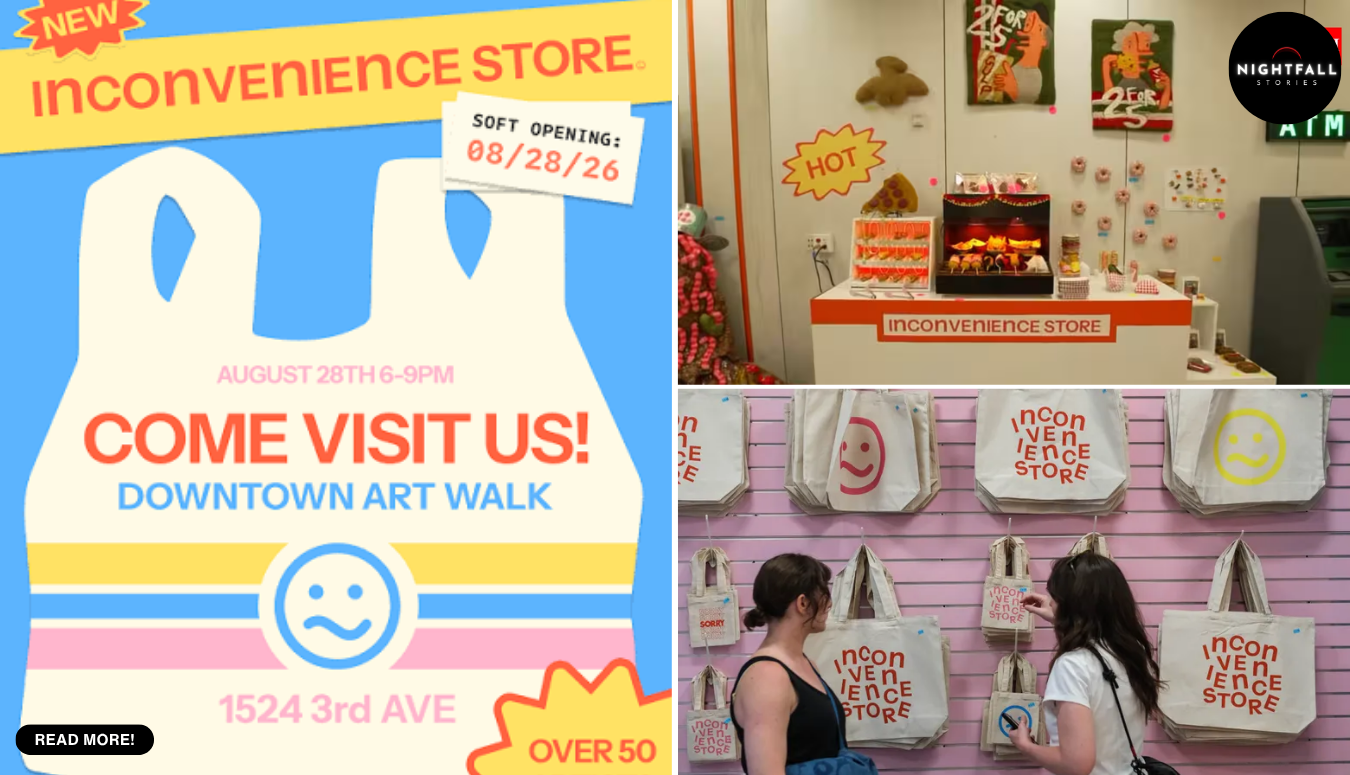
Walk in off the street and the first thing you notice is that everything is where it should be. There is a hot food counter near the front. There is a wall of refrigerators at the back. There are aisles, shelves, a checkout, the slightly too bright lighting every corner store in the world seems to buy from the same catalogue. Then you pick something up and the whole thing falls apart in the best possible way.
The charging cables are tangled. Not accidentally tangled, the way the one in your bag is tangled. Somebody sat down and tangled them, deliberately, by hand, and then priced them and put them on a hook. The mugs are beaded so beautifully that it takes a second to register they have holes in them and will leak the moment you pour anything in. There are corn dogs on the hot counter with googly eyes glued to them. There is a landline telephone shaped like an iPhone that, when you pick it up, plays exactly one song by U2 and nothing else.
This is the Inconvenience Store, and it lives in a former 7-Eleven on one of the most argued-about street corners in downtown Seattle. Entry is free. Everything inside is for sale. Prices start at one dollar and run to ten thousand, which is a range you do not usually see inside a single room, let alone a single room with a slushie machine footprint still visible on the floor.
More than seventy artists, most of them local, made the stock by hand. The organisers count fourteen departments, laid out the way a real convenience store is laid out, with food and pantry in one place, health and beauty in another, office supplies in a third. That arrangement is the entire trick. If you hung these objects on a white wall with little cards beside them, most people would walk past and feel vaguely told off. Put them on a shelf under a department sign and the same people pick them up, turn them over, and ask how much.
The two people behind it are Lilia Deering and Mary Anne Carter, and they have done a version of this before. Two years ago they built STÖR, an art exhibition shaped like a trip through a Swedish flat-pack furniture warehouse, complete with arrows on the floor telling you which way to walk and meatballs served on certain evenings. Thirty-four other artists made work for it. You could buy a mirror framed entirely in dentures for two hundred and seventy-five dollars. There was a vase shaped like a traffic cone for sixteen. There was a chaise longue built to look inflatable but actually hand-made out of stretched canvas, at fifteen hundred. There were meatball pillows, fifty dollars each, and yes, people bought them.
STÖR was supposed to be a gag and turned into something closer to a phenomenon. It reportedly pulled well over ten thousand people through the door, which is a number most small galleries would consider a fantasy. Carter and Deering had accidentally proved something that the art world has been circling nervously for decades, which is that an enormous number of people are genuinely interested in art and are simply put off by the room it is usually kept in.
Deering has been fairly blunt about the reasoning. Galleries with white walls and no visible prices can feel intimidating. You walk in, somebody at a desk looks up, nobody tells you what anything costs, and the unspoken message is that if you have to ask you are not the customer. A convenience store says the opposite thing before you have taken two steps. It says: browse, touch things, leave without buying anything, nobody is watching you. Carter has described the aim as turning the usual dynamic upside down, putting out things that can stay with a person for the rest of their life rather than things that stay behind glass.
So that is what the Inconvenience Store is, in the plainest terms. It is a gallery that has disguised itself as the least intimidating building type humans have ever invented.
The location is not an accident, and it is where the story gets more interesting than a good joke about cables.
The corner of Third Avenue and Pine Street has spent years as shorthand for everything people worry about in an American downtown. It is a transit spine, a place where bus lines converge and a light rail station sits directly underneath, which means enormous numbers of people pass through it and almost nobody lingers. Retailers left. Storefronts went dark and stayed dark. Local coverage and civic argument circled the same block so often that the block itself became a symbol, which is a miserable thing to happen to a street, because symbols are very hard to live on.
The 7-Eleven on that corner closed and the space sat empty, which is roughly the most ordinary thing that can happen to a piece of American retail and also the most demoralising, because an empty convenience store is a building admitting that not even the lowest bar of commerce is worth clearing here.
Then a nonprofit bought the whole building.
The tower above the shop went up in 1910 and spent most of a century as offices. Base Camp, an arts nonprofit, closed on it last spring for somewhere around two point eight million dollars, working out at roughly sixty-six dollars per square foot, which in a major American city is less than people pay for parking spaces. The plan is to turn the upper floors into housing and studio space for artists, with the middle floors deed-restricted for people earning well below the area median, a community space on the second floor, market-rate apartments at the top, and the ground floor kept as retail. Habitat for Humanity is lined up to steward the affordability side long term. Residents are not expected to move in for another couple of years. The building has been given a new name, Parnassus, after the mountain the Greeks assigned to the arts, which is either very grand or very funny depending on your mood as you walk past the old slushie counter.
The man behind Base Camp is Nick Ferderer, and his path to owning a hundred-and-sixteen-year-old tower is not the one you would guess. He grew up in the Pacific Northwest, worked in government relations and legislative advocacy, spent time at the US Department of Commerce and then at Microsoft, and picked up an MBA along the way. In 2022 he opened a small studio and gallery space in Belltown, mostly to give local artists somewhere to show work. By his own account, word spread and the thing snowballed faster than he had planned for. When Microsoft laid him off the following year, he stopped treating it as a side project. He has said he was having too much fun to go back to corporate life, which is the sort of line people usually say to be charming and in his case appears to have been a straightforward description of events.
A second space followed, in a long-abandoned building on Third Avenue that required clearing something in the region of fifty-five thousand pounds of debris before anyone could stand in it safely. It now holds studios and galleries, and it drew a two hundred thousand dollar grant from a major regional foundation, spread over three years. Other businesses have opened nearby since. Whether the block’s foot traffic has genuinely improved is a claim you will hear in local coverage rather than a figure anyone has measured, so treat it as an impression rather than a statistic, but it is an impression a lot of people on that street seem to share.
Seattle is not alone in trying this. The city runs a programme that pairs artists and small businesses with empty shopfronts, and it has put work or pop-ups into dozens of vacant storefronts over the past few years. The logic is simple and slightly cynical and completely correct: an empty window tells everyone walking past that this place has given up, and a window with something weird and hand-made in it does not. You cannot fill a downtown with galleries. You can stop a street from looking abandoned while the slower fixes are argued over.
What makes the Inconvenience Store land harder than most of those efforts is that it did not soften the building to make it presentable. It kept the fixtures. The refrigerator section, the bit where the energy drinks used to live, has been converted into an actual white-walled gallery with its own rotating shows, a small climate-controlled room inside the shop where the serious art is kept, which is a joke and a sincere curatorial decision at the same time. There is a sound sculpture built to behave like a cash machine. The hot bar holds fake food. The aisles hold the abstracted versions of everything you would run in for at eleven at night.
The stock list is where you start laughing properly. Shoulder bags stitched together out of snack packaging, the foil insides of Cheetos and Lay’s bags turned into something you would genuinely carry. Beeswax candles shaped like eggs, sitting in the spot where the egg cartons ought to be. Ceramic eggs meant for your face. Soft sculpture keychains by the textile artist Shiloh Davies, starting around twenty dollars and rising to about a hundred and twenty depending on the piece. Lighter cases encrusted entirely by hand by Emma Kates-Shaw, sixty-five dollars each, an object worth more than the lighter inside it by a factor of about twenty.
The ten thousand dollar figure at the top of the range gets quoted a lot, and it is worth being careful about it. It is the ceiling of the stated price range, the most expensive object in the room. It is not a sale anyone has recorded. The far more revealing number is the other end. One dollar. There is something in there that costs one dollar, which means nobody who walks in off a bus is priced out of leaving with an original piece of art made by hand by a person who lives in their city.
The show grew as it went. When it soft-opened at the end of last summer, the preview coverage counted more than fifty artists involved. By the official launch a few weeks later the count had passed seventy. That is not marketing inflation, or at least it does not read like it. It is what happens when a project becomes the thing local artists want to be in, and people keep asking whether there is room on a shelf. The organisers supply the headline counts themselves, seventy artists and fourteen departments, so they are the house’s own figures rather than an audited inventory, but the growth between the two openings is visible in the coverage on either side of it.
It is open on Saturdays and Sundays only, noon until four. That is twenty hours a month, which is not much, and it is also the one genuinely inconvenient thing about the Inconvenience Store, a fact nobody involved seems remotely embarrassed by. It is scheduled to run through the middle of next year, which gives it an unusually long life for a pop-up and means it will still be there when the construction above it gets going in earnest.
There is a line Deering has used about why the whole thing is called what it is called, and it is better than the gag suggests. Art is inherently inconvenient. We live in an economy that rewards speed and scale and doing things the cheap way, and artists insist on doing things the hard way, by hand, slowly, one at a time. A pre-tangled cable is funny for about four seconds. Then you realise somebody tangled it deliberately, spent their time on it, and is asking you to notice the difference between a thing that was made and a thing that was manufactured. Convenience is the whole promise of the building you are standing in. The stock is quietly arguing that the promise costs more than it looks like it costs.
What is easy to miss, standing in there holding a mug that will leak, is how much ordinary municipal machinery had to line up for a silly shop to exist. A tax programme for converting empty offices into homes. A nonprofit willing to buy a hundred-year-old building at a price that only made sense because nobody else wanted it. A housing charity agreeing to hold the affordability line for decades. A city scheme for filling dead windows. Two artists with a proven record of making people queue for a joke. None of that is glamorous, and all of it had to happen before anybody could glue a googly eye onto a fake corn dog.
The building’s future is already written in planning documents. The upper floors become homes for people who make things, at rents they can actually pay, on a corner that spent years being described as a problem. The shop downstairs will keep selling hand-tangled cables until the middle of next year, and then it will presumably become something else, a real shop, a café, whatever a ground floor becomes when the block around it has a reason to slow down.
For now, on weekend afternoons, people get off the bus at a corner they have been told for years to hurry past, see a lit-up convenience store, walk in expecting a drink, and find seventy of their neighbours’ imaginations arranged by department. Some of them leave with a one dollar object they will keep for thirty years. That is a strange outcome for an empty 7-Eleven, and a much better one than the block had any right to expect.