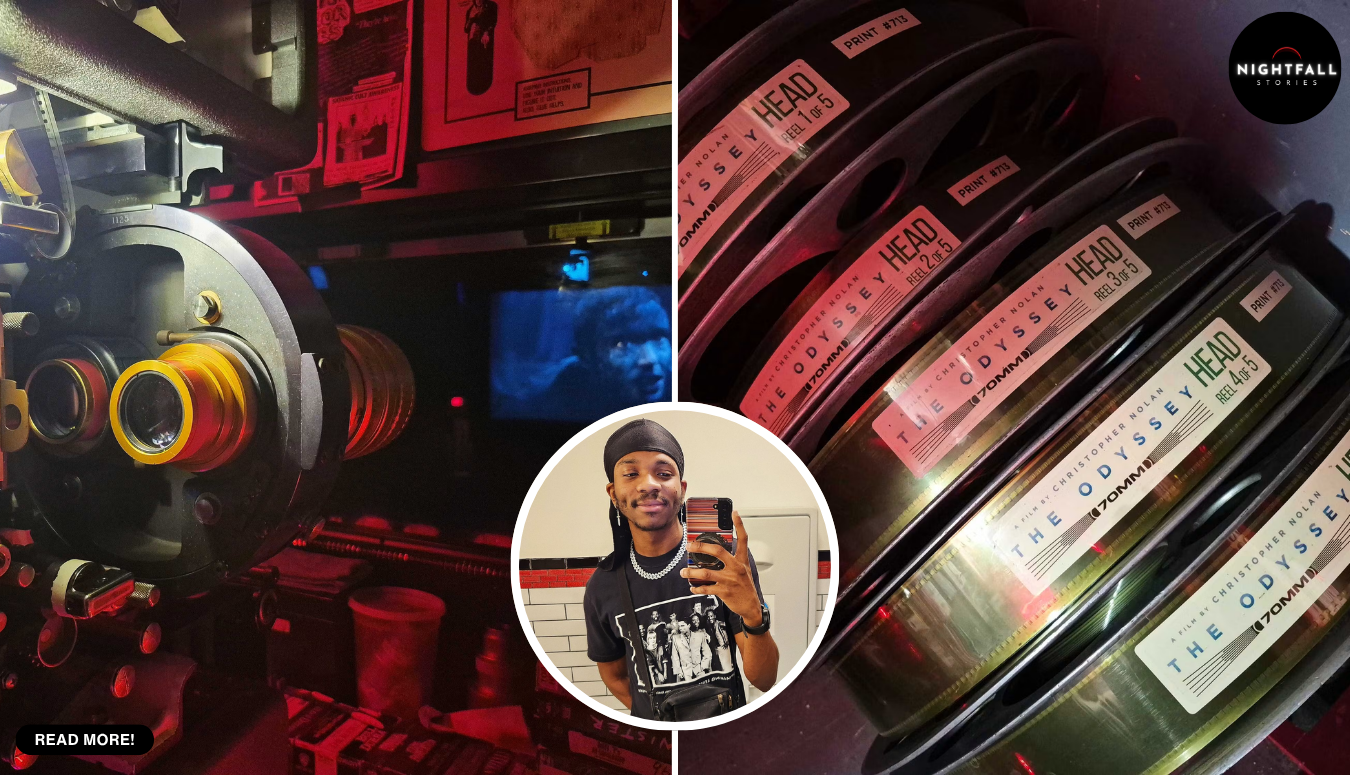
The room held 324 people and every seat was sold. Upstairs, behind a small window most of them never thought about, Chrishaun Baker was watching a corner of the screen for a mark that would flash for a fraction of a second and then be gone.
When it came, he had six seconds. Six seconds to start the second projector, swing the light and the sound across, and put the next reel in front of an audience that had paid to see the most technically ambitious film of the year the way it was actually made. If he missed, several hundred people in Atlanta would watch the story of Odysseus fall into darkness.
He did not miss. He has now done it five times at the same venue.
Baker is a projectionist at the Plaza Theatre in Atlanta, and he threaded a 70mm film print of Christopher Nolan’s The Odyssey on its opening weekend last summer. He wrote about the experience afterwards in a first-person piece for Inverse, and the thing that makes it worth reading twice is not the film. It is the quiet revelation that a job most audiences assume was automated out of existence around twenty years ago is still being done by hand, by people, in real time, with an audience already seated.
Here is what that actually involves. The Plaza runs Century JJ dual-gauge projectors, machines that can be set up for either 35mm or 70mm. The print of The Odyssey arrived as five reels. Four of them weigh upwards of fifty pounds each and hold somewhere between thirty-five and forty minutes of film. You do not load a film like that and walk away. You build it, you inspect it, you thread it through a path of sprockets and rollers and loops that has to be exactly right, and then you stand there.
As a reel nears its end, a cue appears in the upper corner of the frame. Thirty seconds left. Then a second cue, and from that moment the window is six seconds wide. Two projectors, one running out and one waiting, and a human being deciding when to hand the film from one to the other. Done well, nobody in the audience notices anything at all. That is the entire point. The craft is invisible by design, which is exactly why almost nobody knows it survived.
What makes the Nolan film a genuinely hard case is how it was shot. The Odyssey was photographed entirely on IMAX film cameras, reportedly the first feature ever made that way, burning through more than two million feet of 15-perforation 65mm negative. That is an enormous amount of physical material for one story, and it creates a problem at the other end of the pipeline that no amount of marketing can solve. A film shot that way can only be shown in its full form in rooms that can physically run it.
And there are very few of those rooms. How few depends on who is counting and when. Wikipedia’s entry for the film lists 41 screens worldwide capable of true IMAX 70mm projection, broken down as 25 in the United States, nine in Canada, three in the United Kingdom, and one each in Australia, Belgium, France and the Czech Republic. Axios reported that only around 25 or 26 US theatres could manage it, with the headline and the body of the piece giving slightly different figures. One trade write-up put the global number at about thirty. The counts moved as venues were brought back online during the run, so the honest version is this: the number was small enough to fit on a single page, and for most of the planet the nearest one was a flight away.
The reason is not demand. It is manufacturing. IMAX film projection is essentially 1960s engineering, and nobody has built a new IMAX film projector in roughly half a century. The company’s chief executive, Richard Gelfond, has said as much publicly. Theatres that want to run film are not buying machines, they are rebuilding survivors, hunting parts, and relying on technicians who learned the system from people who learned it from people.
The machines themselves are absurd objects by modern standards. A 70mm IMAX projector weighs around two tons. It stands more than five and a half feet tall and runs over six and a half feet long. It needs a xenon lamp with a dedicated pump and a water cooling system, because the amount of light required to fill a screen that size generates the kind of heat you do not want near plastic. The film does not travel vertically through it the way it does in a conventional projector. It moves horizontally, on a rolling loop, because the frames are laid out sideways across a strip of film wider than your hand.
The print for a film of this length is close to ten miles of material. Assembled onto a platter it weighs somewhere around 550 pounds, and it reportedly costs in the region of $36,000 to strike a single one. That is one copy, for one venue, for one run.
In Melbourne, at the only venue in the southern hemisphere equipped for the format, technical manager Dan Drobik described the job in terms that anyone who has ever moved a piano up a staircase would recognise. Before you get to the artistry, he said in essence, there is the sheer logistics of getting the thing into the building, building it up, putting it on the platter and running it. His booth involves pivot rollers, some of them deliberately tacky so they catch dust before it can reach the gate, and a speed-control system keeping ten miles of film moving at a steady rate. And once it starts, he stays. You do not leave the room. You listen and you watch for anything that sounds or looks slightly wrong, because by the time an audience notices, it is already too late. That venue had presold around 30,000 tickets before the film even opened, making it one of the biggest titles in the cinema’s history.
The Plaza, it is worth being precise about, was not one of those true IMAX rooms. Nolan’s film played in a whole hierarchy of formats, each with its own shape on the screen. The tallest, most immersive version at 1.43:1 existed only on IMAX 70mm prints. IMAX digital screens showed a 1.90:1 image. Conventional 70mm film prints, the kind Baker was handling, ran at 2.20:1. Regular 35mm prints came in at 2.39:1. Baker is straightforward about this in his own account. His theatre could not give audiences the native IMAX ratio. What it could give them was a real film print, running through a real machine, with all the detail and colour depth that comes with a 70mm frame roughly three and a half times larger in area than a 35mm or digital one.
That distinction matters, and it gets flattened constantly in coverage. Running a 70mm film print is not the same as running IMAX 70mm. But it is still a thing only a small, stubborn population of venues on earth can do at all, and it still requires someone who knows how to build a print, thread a gate and make a changeover without the audience feeling a bump.
The Plaza is exactly the kind of place where that knowledge survived. It opened in 1939, an Art Deco house designed by the architect George Harwell Bond, and it calls itself Atlanta’s longest continuously operating independent cinema. Its first feature was The Women. It has had a long, bumpy life since: a balcony converted into a second auditorium in the 1980s, a stretch as the city’s home for arthouse and international cinema, the usual near-death experiences that independent theatres collect. It went digital in 2013, like almost everyone else.
Then Christopher Escobar, who also runs the Atlanta Film Society, took the place on. Under his ownership the theatre was upgraded with 4K digital and, crucially, with 35mm and 70mm film capability restored. That decision looked, at the time, like sentiment. A decade later it is the reason several hundred people in Atlanta got to see the biggest film of the year on film, and the reason a projectionist in that city has a skill the industry spent twenty years deciding it no longer needed.
The Plaza had been building toward this. The year before The Odyssey, the theatre landed one of the rare 70mm prints of The Brutalist in the run-up to awards season, which is not the kind of booking that lands in a city by accident. It lands where somebody has the machines, the trained hands and a track record of returning a print in the condition it arrived in. Studios impose strict handling rules on prints, and a venue that damages one does not get offered the next.
That is the part of the job nobody sees at all. Before a single frame reaches a screen, a print has to be inspected, reel by reel, for damaged perforations, bad splices and anything that could tear at speed. It has to be built and set up for a specific pair of machines. Focus and framing get adjusted during the show, by eye, because film breathes slightly as it runs and a lens that was perfect at the start of a reel may not be perfect twenty minutes in. Every one of those decisions is made by a person standing in a hot room listening to an audience through a wall.
The demand was real, too, which is the detail that undercuts the assumption that any of this is a hobbyist concern. Tickets for the large-format screenings of The Odyssey reportedly went on sale roughly a year ahead of release. Shows sold out weeks in advance. The 70mm IMAX run was extended well past its original window because the handful of rooms that could host it could not meet the demand. People travelled hundreds of miles, in some cases across borders, to sit in a specific auditorium. In a decade of constant argument about whether anyone still wants to go out to the cinema, several thousand people answered by buying a plane ticket.
There is a version of this story that is about nostalgia, and it is the boring version. Baker’s argument is not that old technology is better because it is old. His argument is about what happens in a room. He wrote about the electricity in the crowd as it left the auditorium, the feeling of several hundred strangers having gone somewhere together and come back. That is not a format. That is what the format is for.
The numbers around the film make the whole thing slightly surreal when you line them up. The Odyssey cost a reported $250 million and has taken around $1.66 billion worldwide, the second-biggest release of the year and, by most tallies, the highest-grossing film of its rating ever made. An enormous industrial machine, hundreds of millions of dollars, two million feet of negative. And at the very end of that chain, on the night, the whole thing came down to individual people in small rooms above the audience, lifting fifty-pound reels and counting to six.
There is something genuinely moving about that, and it has nothing to do with romanticising the past. The most expensive, most computerised, most globally distributed art form on the planet still has a handful of points where it cannot be done without a person who has done it before. Nobody has written software that can build a print. Nobody can remotely operate a changeover.
It is also, quietly, a labour story. The skills involved in film projection were shed at scale when cinemas converted to digital, and the people who kept them did so mostly because they loved it, often in independent venues running on tight margins. When a studio decides to release a film on film, it is drawing on a reserve of expertise that no institution deliberately maintained. It survived in places like the Plaza, in repertory houses, in festival booths, in the hands of people who were considered slightly eccentric for holding on.
That reserve is finite. Every venue that keeps a working film projector is keeping alive a chain of instruction that only passes person to person. You cannot learn a six-second changeover from a manual. You learn it standing next to someone who has done a thousand of them, and then you do it badly a few times where it does not matter, and then one night you do it in front of 324 people who have no idea you are there.
The print eventually went back. The film moved to digital release a few months after its run, which is what happens to every film now, and most of the people who eventually watch The Odyssey will watch it on a screen they can carry. That is fine. Nobody in the projection booth is arguing otherwise.
But for a stretch of last summer, in a small number of rooms scattered unevenly across the world, the biggest film of the year existed as a physical object that had to be carried, built, threaded and handed from one machine to another by a human being paying close attention. In one of those rooms, in a 1939 theatre on a busy avenue in Atlanta, Chrishaun Baker did it five times and nobody in the audience noticed a thing.
Which, if you ask anyone who has ever stood in a booth waiting for a cue mark to flash, is the highest compliment the job allows.