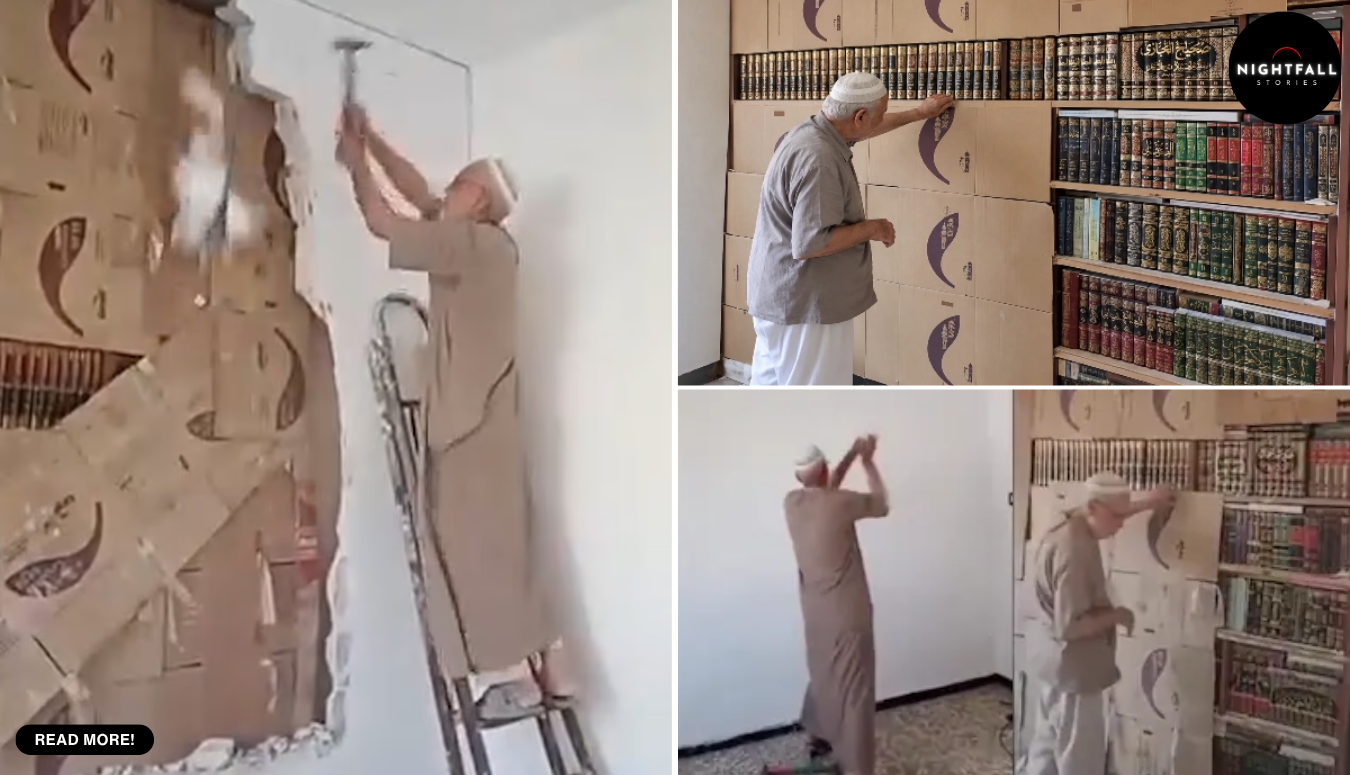
The video is about a minute long and there is almost nothing to it. An older man in a plain shirt swings a hammer at an interior wall in his own house. Plaster comes away, then brick. Someone off camera is filming on a phone and not saying much. Behind the wall, in a room that has not existed for roughly fifteen years, are shelves of books exactly where he left them.
He is identified only as Abu Bilal, which is not really a name. It is the customary way of saying the father of Bilal, and in this case the detail is the story. According to most of the reporting, the books he sealed away were not his. They belonged to his son.
Near the end of 2011, as Syria came apart, he built a false wall inside his family home. Not a cupboard, not a hidden panel, a proper wall, rendered and painted so that the house simply looked like it had one room fewer than it did. Then he lived alongside it, or left it behind and thought about it, depending on which account you read, for the next decade and a half.
What was on the other side, according to the reports that describe the contents, was a private library. Hundreds of books and magazines, described as political, religious and intellectual. Alongside them were Quranic ijazat, the certificates that record a person’s authorisation to teach or transmit a text, which are as much family documents as religious ones. There were prayer beads. There was some money.
The reason a man would wall all of that up is not mysterious, and it does not need dramatising. Under the Assad government, what you owned on your shelves could be treated as evidence of what you thought. Certain books were banned outright, others were simply dangerous to be found with, and the people who did the finding were not obliged to explain themselves afterwards. Multiple reports of this story make the same point in almost the same words: the mere presence of the wrong book in a house could be enough to put someone in a cell.
So this was not an act of sentiment. It was risk management, carried out with a trowel.
The ijazat are worth pausing on, because they are the detail that turns a bookshelf into an inheritance. An ijaza is a written permission, granted by a teacher to a student, confirming that the student has studied a text closely enough to pass it on. They are issued by hand, they carry the chain of who taught whom going back generations, and they cannot be reprinted or reissued from an archive. A library can, in theory, be rebuilt. Those certificates cannot. Whatever else was behind that wall, some of it was irreplaceable in the literal sense.
The family’s circumstances after that are where the accounts start to diverge, and it is worth being honest about that rather than picking the neatest version. One report says the family fled to Kuwait and that the father stayed behind specifically to protect his son’s collection. Another says he left too. The city is given as Damascus in some versions and Homs in others. The duration is reported as fifteen years by Al Jazeera and The National, and as thirteen by a Gulf paper. None of these outlets were in the room. What they have is a piece of phone footage and a family’s account of what it shows, and the honest way to write it is to say so.
The number discrepancy probably has a simple explanation, and it is worth spelling out rather than leaving as a shrug. If you count from the wall going up near the end of 2011 to the government falling in December 2024, you get about thirteen years. If you count from the wall going up to the hammer coming out this year, you get about fifteen. Both numbers are defensible depending on which ending you think the story has, and neither outlet is wrong so much as measuring a different thing. What it suggests, and this is inference rather than reporting, is that the wall did not come down the moment it became safe. Something like a year and a half passed between the danger ending and the wall ending, which is its own quiet detail about how long it takes to believe a thing is really over.
What is consistent across all of them is the shape of the thing. A father built a wall around his son’s books because the books could have cost someone their freedom. The wall stayed up as long as the government did. When the government fell at the end of 2024, the wall stopped being necessary, and at some point after that he picked up a hammer.
It should be said that this is a family’s account of a family’s house, circulated as a short video, and it has not been independently verified by anyone who was present. The footage has been carried by large international broadcasters, which is not the same as those broadcasters having stood in the room. Readers should take it as what it is: a credible, widely reported account with details that do not entirely agree with one another.
The video of him doing it went around quickly, which is not surprising. There is something about watching a person demolish their own house on purpose, calmly, with an expression that is not quite joy and not quite anything else. He is not performing. He hits the wall the way you hit a wall when you have thought about hitting it for a very long time.
When the hole is big enough, you can see the room. Dust, mostly. The shelves are upright. The spines are legible. By his own account, relayed in the reporting, only a small amount of dust had got in, and the books and the other things were essentially as he had left them.
That is the whole event. There is no reunion scene, no music, no crowd. A room that had been sealed for most of two decades turned out to be, on opening, a room full of books with dust on them.
It would be easy to make this beautiful and it should not be made beautiful. The reason that room existed is that a family concluded, correctly, that owning the wrong literature in their own home could destroy them. Fifteen years of a house with a missing room is not charming. It is the physical shape of a fear that people organised their lives around. The books came out intact; a great many things in Syria did not, and a great many people did not, and this story sits inside that without being separate from it.
What makes it worth telling anyway is the specific, slightly odd human decision at the centre of it, which is that a man spent years guarding somebody else’s bookshelf.
Think about the practical version of that choice. A collection of books is heavy, bulky and, in the calculus of an emergency, close to worthless. You cannot eat it, sell it easily, or carry it. Everyone who has ever left a home in a hurry has made a list in their head of what is coming and what is being abandoned, and books are almost always on the wrong side of that list. They are the first thing sacrificed and the last thing anyone expects to see again.
He chose differently, and he chose it on behalf of someone who was not there to argue. The son’s books were, presumably, the son’s whole intellectual life up to that point: what he had read, what he had been permitted to teach, what he had spent money on when there was money. A father cannot protect a grown son from a government. He can, apparently, protect his library.
It is also the least verifiable emotional claim in the story, so it should be said carefully. Nobody has published an interview with the father explaining his reasoning. What exists is a short piece of video, a handful of syndicated writeups, and the family’s own framing. We are taking their word for what that wall was for, and that is a reasonable thing to do while being clear that is what we are doing.
The other reason the footage travelled is that it belongs to a category of story that has been accumulating since the end of 2024. When a government falls after that many years, what follows is not one big event but thousands of small ones, mostly domestic and mostly unrecorded. People go back to houses they have not seen. They find out what is still standing. They dig things up, unbrick things, retrieve papers from behind water tanks and inside walls and under floors, because a lot of people hid a lot of things.
Most of those retrievals produce nothing. Damp gets in, or a roof goes, or someone else found the hiding place years ago. The hidden-book story that goes around the world is by definition the one that worked, and it is worth holding that in mind so the story does not accidentally represent something it does not. For every sealed room that opens with the contents intact there are many that opened onto ruin, and those do not get filmed.
This one worked because of how it was built. A dry interior wall in a standing house, with no external exposure, is a genuinely decent way to store paper. No sunlight, no rain, very little air movement, stable temperature. A conservator would not recommend it, but it is a great deal better than a cellar or a buried box, which are the other two things people reach for and which destroy paper reliably. Whether he knew that or simply got lucky is not something the reporting establishes.
There is one more layer to this that is easy to miss, and it is about what books mean in a place where they have been treated as contraband.
A banned book is not usually banned because it is dangerous in itself. It is banned because it proves that someone, somewhere, thought something other than what they were supposed to think, and wrote it down, and found a printer. The act of keeping one is small and stubborn and mostly private. You are not organising anything. You are just declining to agree that a book should stop existing.
Multiply that by hundreds of volumes, and add a father who decided they should survive whether or not the rest of the household did, and you get a sealed room in a family house that nobody mentioned for fifteen years.
There is a practical afterwards to all of this that rarely makes the coverage. A family returning to a house after that long does not walk into a home. They walk into a building that has aged without them, with whatever plumbing and wiring and roofing failures accumulate over fifteen years of nobody fixing anything. The room behind the wall may well be the best preserved part of the property, precisely because it was sealed. That is a strange thing to discover about your own house, that the only part of it that survived properly is the part you closed off.
As for what happens now, the honest answer is that the reporting stops at the wall. There is no published follow-up on where the collection has gone, whether the son has seen it in person, or what condition the rest of the house is in. Some accounts name the son as an activist who had left the country; that name appears in one outlet and not others, and it is not repeated here for that reason.
What we do know is that the books came out. They were carried into a room that has daylight in it for the first time since they were put away. They are dusty and they are intact, and the wall that kept them is now a pile of rubble on the floor of a house belonging to a man who built it himself, waited out a government, and then took it down himself as well.
That is not a triumphant ending and it should not be written as one. Fifteen years is a long time to live next to a room you cannot go into, and no amount of good news at the end of it gives those years back. But there is something worth sitting with in the ordinariness of the footage. No speech, no flag, no crowd. An older man in his own house, making a hole in a wall he never wanted to build, checking that the thing he promised to look after was still there.
It was.