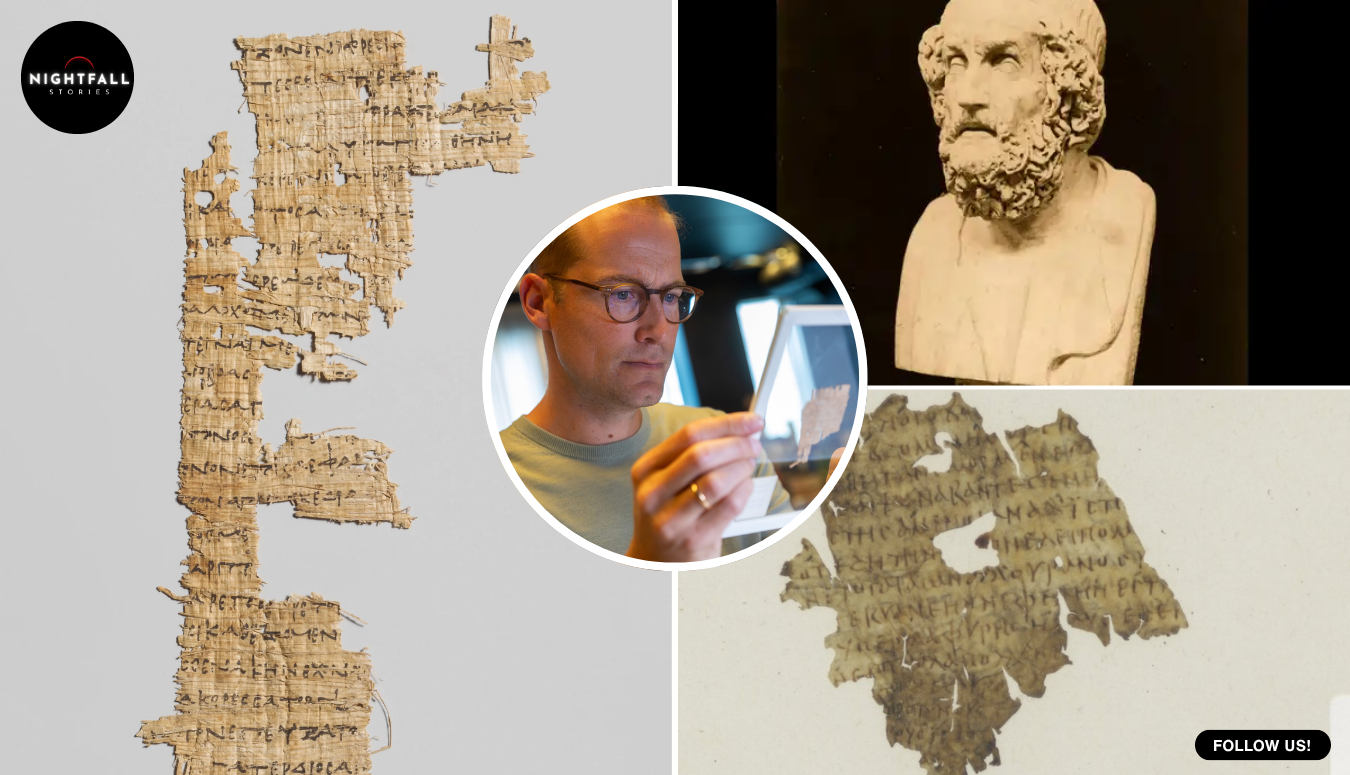
It is roughly the size of a playing card, stained with old moisture, written on both sides in small Greek letters, and for decades it sat inside another book in a Dutch university library while everyone who walked past it assumed it was a scrap of nothing much. The catalogue said seventh century. The catalogue said damaged. The catalogue did not say Homer.
Then a specialist in ancient Greek sat down with it, read a few words, and realised he was looking at a piece of the Odyssey written around 1,700 years ago, one of only about thirty comparable fragments known anywhere in the world.
The man who found it is Mark de Kreij, who teaches and researches ancient Greek at Radboud University in the Netherlands. He was not hunting for Homer. He was working through a collection of early Christian manuscripts held at Utrecht University Library, the kind of long, patient project that involves going object by object through material nobody has looked at closely in a very long time, checking what each piece actually is against what a previous generation of cataloguers said it was.
Most of that collection is Egyptian, written in Coptic and Greek script, and most of it is exactly what it claims to be. This one slip was filed in among the rest, and because it was small and battered and covered in Greek letters, it had been slotted into the same broad category as its neighbours and left there.
De Kreij read it and recognised the language as Homeric. Not the Greek of a Christian text, not the Greek of a letter or a receipt or a contract, but the old formulaic poetic Greek that anyone who has spent years with the epics knows on sight, the way a musician knows a melody from three notes. He worked out where in the poem it came from. It is Book 12 of the Odyssey.
If you were going to pick one passage from the whole poem to find on a scrap of parchment, you could hardly do better. Book 12 is where Odysseus and what is left of his crew, exhausted and starving and stranded by bad wind, come ashore on the island of the sun god. Odysseus has been warned, twice, in the clearest possible terms, that the cattle grazing there belong to Helios and must not be touched. He makes his men swear they will leave the animals alone. Then he falls asleep.
The crew, hungry and out of options, break the oath. They kill the cattle. And the verses on the Utrecht fragment sit right around the moment the sun god finds out what has happened and goes to Zeus about it, which is the point where the crew’s fate stops being uncertain. Zeus answers with a storm. Every one of those men dies. Odysseus alone survives, and everything that happens to him afterwards happens to a man travelling alone.
Book 12 is dense with the material everyone half remembers from the Odyssey even if they have never read it. The Sirens are in it. So are Scylla and Charybdis, the six-headed thing in the cliff and the whirlpool that swallows a ship whole, and the terrible choice between them where Odysseus is told outright that he will lose six men no matter what he does. The cattle of the sun come after all of that, when the crew are already frightened and grieving and have been pinned in one place by a month of contrary wind with their supplies gone. By the time they break the oath, the reader has watched them lose almost everything else.
It is the hinge of the entire back half of the poem, and it is also, as de Kreij has pointed out, simply a good bit. A lot of the Odyssey is slow going if you are honest about it, long stretches of sailing and genealogy and hospitality rituals. This is not one of those stretches. This is the part where the bill comes due.
There is a second thing worth noticing about the material, which is that it is parchment rather than papyrus. Papyrus was the ordinary writing surface of Greek-speaking Egypt, cheap and locally made from a river plant. Parchment is treated animal skin, more expensive, more durable, and in this period increasingly the choice for books meant to be kept and handled rather than read once and discarded. A small parchment codex of the Odyssey is not the object of someone who wanted the text for an afternoon. It is the object of someone who wanted to own it.
The parchment itself measures about 6.6 by 7.7 centimetres, which is roughly the size of a playing card or a small phone screen, and it is written on both sides. That detail matters more than it sounds. Writing on both sides means it came from a codex, a bound book with pages, rather than from a scroll. And a page that small means the book it came from was small too, a pocket edition, something a person carried rather than something a library shelved.
That is a surprisingly human thing to learn about an object from around the year 300. Somebody in Egypt owned a little travel-sized copy of the Odyssey. Not a display copy, not a scholar’s edition, just Homer in a size that fits in a bag.
The university dates it to the third or fourth century and places its origin in the Faiyum, the fertile depression southwest of the Nile valley that has given up an enormous share of what we know about everyday writing in the ancient world. The Faiyum’s dry conditions preserved paper and parchment that would have rotted almost anywhere else, which is why so much of what survives from the Greek-speaking Mediterranean survives as Egyptian rubbish.
How this particular slip travelled from there to a library in the Netherlands is not fully documented, and it is worth being honest that the chain has gaps. What is known is that the collection it belongs to came to Utrecht in the middle of the twentieth century, bought from the heirs of the German scholar Carl Schmidt, who spent his career assembling early Christian material from Egypt. The Homer fragment was part of that batch, and it seems to have arrived tucked in with manuscripts it had nothing to do with, which is how it ended up misfiled in the first place.
Schmidt is a name that turns up repeatedly in the history of how Egyptian Christian texts reached European institutions. He worked in the decades when a great deal of material was leaving Egypt through dealers and private buyers, often with thin or nonexistent records of where a given piece had actually come from, and much of what he handled ended up in university and museum collections across Europe after his death. That is why the provenance of individual items in such collections is so often a shrug. The purchase is documented. The excavation, if there ever was one, usually is not.
Nobody did anything wrong, exactly. When you receive several hundred pieces of Egyptian parchment and papyrus at once, and most of them are Christian texts in Coptic, and one of them is a small damaged piece with Greek letters on it, the reasonable working assumption is that it belongs with the others. Cataloguing is triage. You record what a thing appears to be, you assign it a shelfmark, and you move on to the next one, because the alternative is that nothing ever gets catalogued at all.
The fragment sat at Utrecht under the reference Gr. Ms. B6.39a, listed as a damaged seventh-century text, for decades. Its survival probably owes something to exactly that neglect. A piece of parchment wedged between the pages of a larger book is protected from light, from handling, from the slow grinding damage that destroys the outer leaves of any old volume first. The reason we have this scrap of Book 12 at all may be that nobody thought it was worth taking out and looking at.
The identification happened roughly two years ago. The announcement came only recently, and the university has been straightforward that the gap exists rather than presenting it as a discovery made last week. Academic publishing runs on a slower clock than news does. De Kreij’s full treatment of the fragment is due to appear in a scholarly volume covering the hieratic, demotic, Greek and Coptic texts in the Utrecht collection, and a find like this is normally held until the proper description is ready to go with it.
There is also a less lofty reason for the timing, reported in Dutch coverage, which is that the wider world happens to be paying attention to the Odyssey right now because of a major film adaptation. A university sitting on a genuine 1,700-year-old piece of the poem, in a year when a lot of people are suddenly curious about it, is going to choose that moment to say something. It is hard to be cynical about it. If the alternative is that the fragment gets a paragraph in a specialist volume and nobody outside a small field ever hears about it, then a bit of timing seems fair enough.
What makes the find genuinely rare is not the age on its own. Fragments of Homer from Roman Egypt are not unheard of. The Iliad in particular turns up constantly, because it was the standard school text across the Greek-speaking world and generations of children copied out its opening lines the way children later copied out their letters. The Odyssey survives in far fewer copies, and parchment pieces from small codices of it are rarer still. The university’s own estimate is that around thirty comparable fragments exist worldwide, a figure worth attributing to them rather than treating as a hard census, since what counts as comparable depends on where you draw the line.
Either way, the number is small enough that each one carries real weight. Every ancient copy of a text is a separate witness to what that text actually said, and the version of the Odyssey we read today is the product of centuries of scholars comparing witnesses and arguing about them. Most of those witnesses are medieval manuscripts written more than a thousand years after this fragment. A scrap from around the year 300 is closer to the source than almost anything else on the shelf.
It also tells you something about how the poem lived. We think of Homer as monumental, as the foundation stone of Western literature, as something studied. The Utrecht fragment suggests something looser and more ordinary. Somebody in a provincial Egyptian town, a long way from Athens and a long way from anywhere that considered itself the centre of Greek culture, owned a small cheap-ish book of the Odyssey and presumably read it. Possibly on a journey. Possibly for pleasure. The poem was not only a monument. It was also just a story people liked.
There is a symmetry in the passage itself that is hard to ignore, though it is entirely an accident of survival. The lines that came through seventeen centuries are the lines about men who could not wait. The crew on the sun god’s island are not villains. They are starving, they have been trapped by weather for a month, their leader is asleep, and they make the choice that hungry people make. The poem does not let them off, but it does not sneer at them either. It just shows you what it cost.
Homer’s audiences would have known that story was coming, the way you know a song’s chorus. The person who owned the pocket codex in the Faiyum would have known it. A seventh-century cataloguer, if there was one, did not know what they had. A twentieth-century cataloguer in Utrecht did not know either. And then somebody who had spent his career learning to recognise that particular flavour of Greek sat down at a table with it, and the recognition took a moment.
That is the part worth sitting with. The fragment did not change. Nothing about it was hidden. It was in a public university collection with a shelfmark, in a building people walk into every day, catalogued and accounted for and completely invisible. What changed was that the right reader finally opened it.
Libraries and museums everywhere are full of objects in exactly that position, described a little wrong by someone doing their best under pressure a long time ago, waiting for the one person whose training happens to match the object. Most of them will wait a good while longer. There are far more uncatalogued and miscatalogued items in the world’s collections than there are specialists with time to go through them, and the work is slow, unglamorous and almost never funded on the assumption that it will produce a headline.
This time it produced one. The fragment remains at Utrecht University Library, where it has been all along, now correctly identified, correctly dated, and about to be properly published. It will not be read for its own sake by many people. It is a few dozen letters on both sides of a stained piece of animal skin, and you need training to make sense of it.
But it is a real, physical thing that a real person in Roman Egypt held, from a book somebody carried, containing the words of a poem that was already ancient when that book was made and that people are still queuing up to see retold. It came very close to being nothing at all, filed under the wrong century in the wrong pile, and instead it turned out to be one of about thirty.