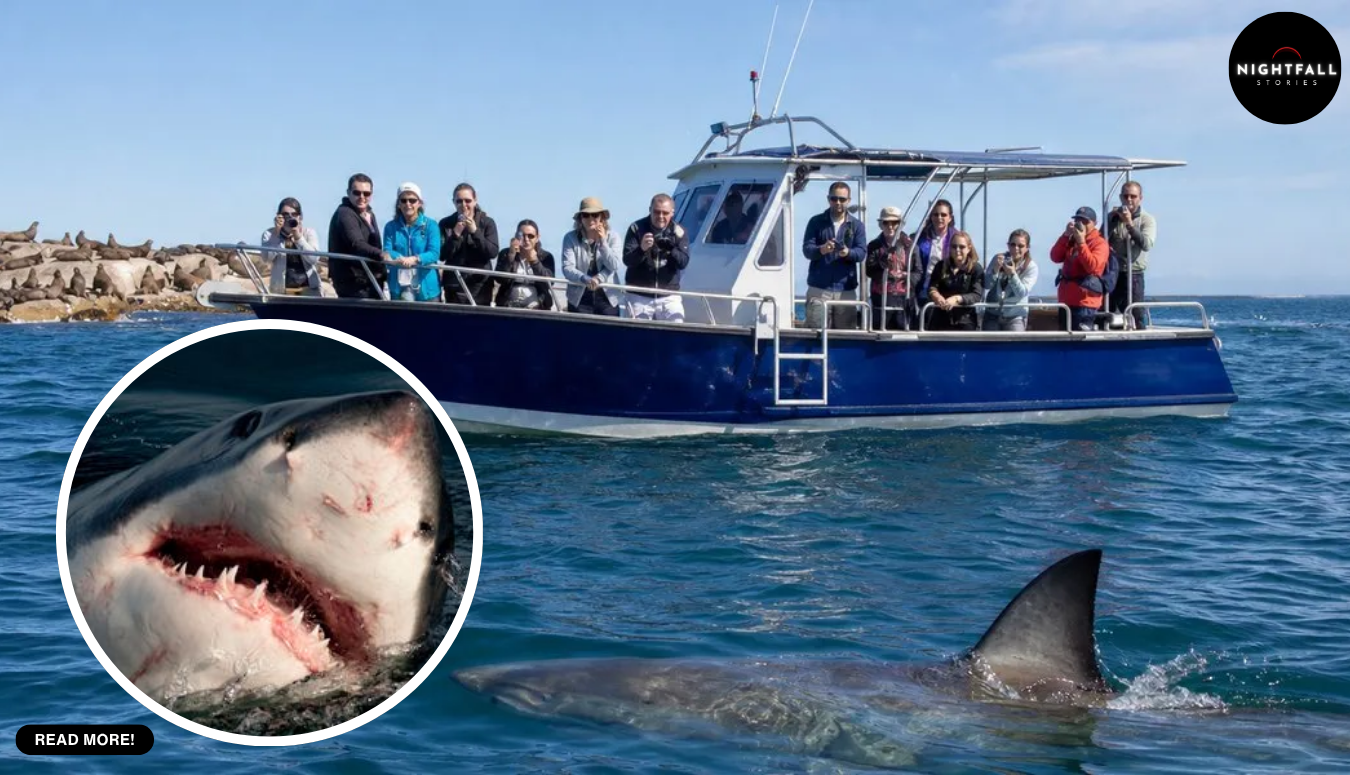
Late in September, a charter boat out of Simon’s Town ran north of Seal Island in False Bay and the people on board saw a sub-adult great white shark. They filmed it. For the crew of African Shark Eco-Charters this was the animal their entire business was built on, the animal that had stopped appearing in that water years earlier, and the reasonable thing to do was to call it a comeback. Rob Lawrence, who runs the operation, did not do that. He said it had been a big surprise, and then he said it was too early to say anything was back to normal.
That second sentence is the reason this is worth your time, and it is worth knowing why a man in his position would be so careful. He has heard the good news before.
Start with what False Bay used to be, because the scale of it is hard to exaggerate without sounding like you are exaggerating. This stretch of water off Cape Town was, by common agreement, the most filmed shark aggregation on the planet. Seal Island sits in the middle of it with a seal colony on top, and in the southern winter the white sharks came for the young seals and hunted them with a vertical attack from below that threw whole animals clear of the surface. If you have ever watched a nature documentary of a great white launching itself into the air, there is a good chance you were looking at this bay. An industry grew around it. Cage diving boats, surface viewing, film crews, researchers with tags and drones, a whole working economy in a small naval town.
And there was a record of it, which matters more than the documentaries. Shark Spotters, the programme that puts human lookouts on the mountainsides above the swimming beaches to watch for sharks and warn bathers, has been logging what it sees since 2004. In 2011 the programme recorded more than three hundred white shark sightings in False Bay. Three hundred, from beach lookouts, in one year.
By 2020 that annual figure was zero. It stayed at zero.
That is an unusual kind of data point, and it is worth pausing on what makes it credible. The Shark Spotters count is not a research survey that can be defunded or a tagging programme that can lose its grant. It is a public safety service. People are paid to sit above the beaches and watch the water during daylight hours because swimmers and surfers are in it, and the flags go up when something is seen. The observers did not stop watching and the beaches did not stop being used. The effort stayed roughly constant and the sharks stopped being in the frame. When a count built on continuous human attention goes from three hundred to nothing, the simplest explanation is that the thing being counted left.
Here is where the story needs to be told carefully rather than cleanly, because the clean version is not quite true. It is tempting to write that the sharks vanished completely for eight years and that nothing was seen until this September. The actual record does not say that, and the actual record is better. The Shark Spotters log carries occasional white shark entries through the dry years, including a pair of sightings off Muizenberg in 2021. And in the last days of November and the first days of December of 2023, the bay produced a small cluster of them: one at Muizenberg, then another at Muizenberg two days later, then a report from spear fishermen at Smitswinkel Bay and another near the Roman Rock lighthouse within the same few days. Across a slightly wider window there was a white shark hooked and released by a fisherman off Macassar and a report from a boat operator at Miller’s Point. Four confirmed inside a week, six or so in total depending on what you count.
The headlines at the time said the great whites had returned to False Bay. One of them said exactly that, in those words, and it ran on the first day of 2024.
You can see why. After three years of nothing, four animals inside seven days looks like a trend rather than a coincidence, and everybody involved wanted it to be one. The operators wanted their winters back. The researchers wanted their study population back. The town wanted its visitors back. Nobody was being dishonest. They were reading a small number of data points in the direction they hoped it pointed, which is the most ordinary mistake there is.
Sarah Waries, who runs Shark Spotters, was more measured even as it was happening. She said it was exciting to have four sightings in a week and that she hoped it signalled a return, and in the same breath she said it was unclear whether these were sporadic one-off sightings or the beginning of something. She raised the possibility that conditions had simply favoured a few sharks passing through.
Nearly three years later we know which it was. It was sharks passing through. The log did not fill up. The cage diving boats did not get their winters back. The 2023 cluster was a flicker, not a recovery, and anyone who wrote it up as a return was wrong, not maliciously but confidently.
So when Rob Lawrence looked at a young shark off Seal Island this September and declined to declare victory, he was not being coy and he was not managing expectations for the sake of it. He was declining to make the same mistake twice in three years, in public, about his own livelihood.
His own description of the gap is more precise than the shorthand that travelled with the story. He acknowledged that there have been anecdotal reports of white shark sightings from time to time. What he said had not happened in eight years was his operation seeing one. That is a narrower claim and a more defensible one, and the distinction it rests on is geographical. The scattered sightings of recent years have been inshore, off the swimming beaches and the rocky points on the edges of the bay, single animals moving through. What disappeared was the aggregation: the reliable, seasonal, offshore gathering at Seal Island that you could plan a business and a film shoot around. An individual shark cruising past Muizenberg and a predictable winter congregation at a seal colony are not the same phenomenon, and the first one coming back does not bring the second one with it. The report that broke the September sighting framed it as the first white shark both seen and filmed in the bay in nearly eight years, and the filming is part of the point, because a boat with cameras at the aggregation site is precisely what had gone quiet.
Which raises the question everyone asks and almost nobody answers honestly. Where did they go.
The explanation that has travelled furthest involves two killer whales. They are males, they are known by name, and they are known by name because their dorsal fins make them individually identifiable at a distance, one of them bent over to the side. Dave Hurwitz, a veteran naturalist who runs boat trips out of the same small town as Lawrence, was among the first to document them behaving in a way nobody had recorded locally: hunting large sharks, killing them, and taking the livers. Port and Starboard, the two of them are called, and they have become probably the most famous pair of individual orcas in the world.
The research caught up with the observations. A 2022 paper in the African Journal of Marine Science, led by the biologist Alison Towner with a long list of co-authors including the South African National Parks shark researcher Alison Kock, the Mossel Bay marine ecologist Enrico Gennari and the whale specialist Simon Elwen, examined what happened at Gansbaai, the other great white site along that coast. Its title names the mechanism it argues for, which is fear at the top of the food chain. Between February and June of 2017, five white shark carcasses turned up. The sharks that survived left. At a site where white sharks had been present year round, they abandoned it entirely for about two and a half years. The important nuance in that finding is that the sharks did not die in large numbers. They emigrated. They went somewhere the researchers had not expected them to go, and the paper reads as a study of displacement rather than of mortality.
That is a strong case, and it is not the only one in the literature, and the scientists who co-authored it do not all read it the same way.
Gennari has argued publicly that the orcas are the end of a longer process rather than the cause of it. His observation is a simple and awkward one: the white shark decline at Gansbaai started before anyone saw those orcas killing white sharks. In his account, shark nets installed along the coast more than sixty years ago began the decline, poorly managed fisheries then removed the sharks’ prey, and the orcas arrived as the final blow on a population already thinned out. He has put numbers to the fishing side that are difficult to wave away. According to a parliamentary reply from the national environment minister in 2019, just two or three demersal shark longline boats were between them taking roughly twenty thousand smoothhound sharks, six thousand soupfin sharks, two thousand bronze whalers and two thousand skates in a year. Gennari has pointed out that a single one of those boats can take more than thirty sharks in a day, which is more than a pair of orcas manages in a feeding event. His conclusion is less about blame than about leverage: nets and drumlines and coastal fisheries are things people control, and killer whales are not.
And there is a third reading, less dramatic than either, which is that the white sharks of this coast have redistributed rather than declined. Tagging work has shown animals moving along and away from the old aggregation sites, and a shark that has relocated eastwards is absent from False Bay without being absent from the ocean. Waries, for her part, has said that food scarcity was not a factor in the False Bay disappearance, which cuts against at least the simplest version of the prey depletion argument in this particular bay.
Pick one and you are overstating the evidence. The people closest to it have not picked one.
What is not in dispute is what the absence cost, and that it was paid locally. Cage diving and shark viewing operators in Simon’s Town and Gansbaai had a product that swam away, and no amount of good weather replaces it. Kock has noted that the sharks abandoning key habitats had significant knock on effects for both the ecosystem and for shark related tourism, which is a scientist’s way of saying that an ecological event turned into an economic one for a few hundred people in two small coastal towns. Hurwitz himself is a working tour operator, which gives the detail of his position a certain weight: the man who helped document the orcas earns his living on the same water they changed.
It is worth noting too that the white sharks were not the only ones affected. The same two orcas have been linked in reports to the disappearance of sevengill sharks from another part of the coast, and the broader pattern of large sharks washing up with their livers removed has been recorded well beyond this one bay.
There is also a quieter cost that does not show up in a tourism figure. A study population that has been watched continuously for two decades is a scientific asset, and you cannot pause it and come back later. The tagging records, the identification catalogues of individual sharks recognised by their fin notches, the long run of behavioural observation at a single predictable site, all of that depends on the animals showing up. When they stopped, a research programme that had made False Bay one of the best understood pieces of ocean anywhere lost its subject at the same moment the charter boats did. Part of what the people watching that water are hoping to recover is simply the ability to keep asking the question.
So the September sighting sits in the middle of all that. One sub-adult white shark, north of Seal Island, filmed by a crew and a boatload of guests who had been waiting years to point a camera at exactly this. Hurwitz said there had been a great deal of excitement in town when word went round, and then added the honest qualifier, which is that nobody knows whether the bigger adults will follow, though that is what several of the shark diving companies are hoping for. Whether the animal being a sub-adult rather than a full grown adult means anything ecologically has not been established, and neither of the operators claimed it did.
It would be easy, and it would get more clicks, to write this as the moment the sharks came home. The difficulty is that the last time somebody wrote that sentence it ran at the start of 2024 and the bay spent the next three years proving it wrong.
The men who make their living on that water know it. One young shark is one young shark. The only thing that will settle whether the great whites of False Bay are back is a sighting log that starts filling up again across a season, and the only way to find that out is to keep going out and looking, which is what they will do. Lawrence had every commercial reason in the world to stand on his boat and announce a recovery. He stood on his boat and said it was too early to tell. On this coast, after the last eight years, that is the more impressive thing to be able to say.