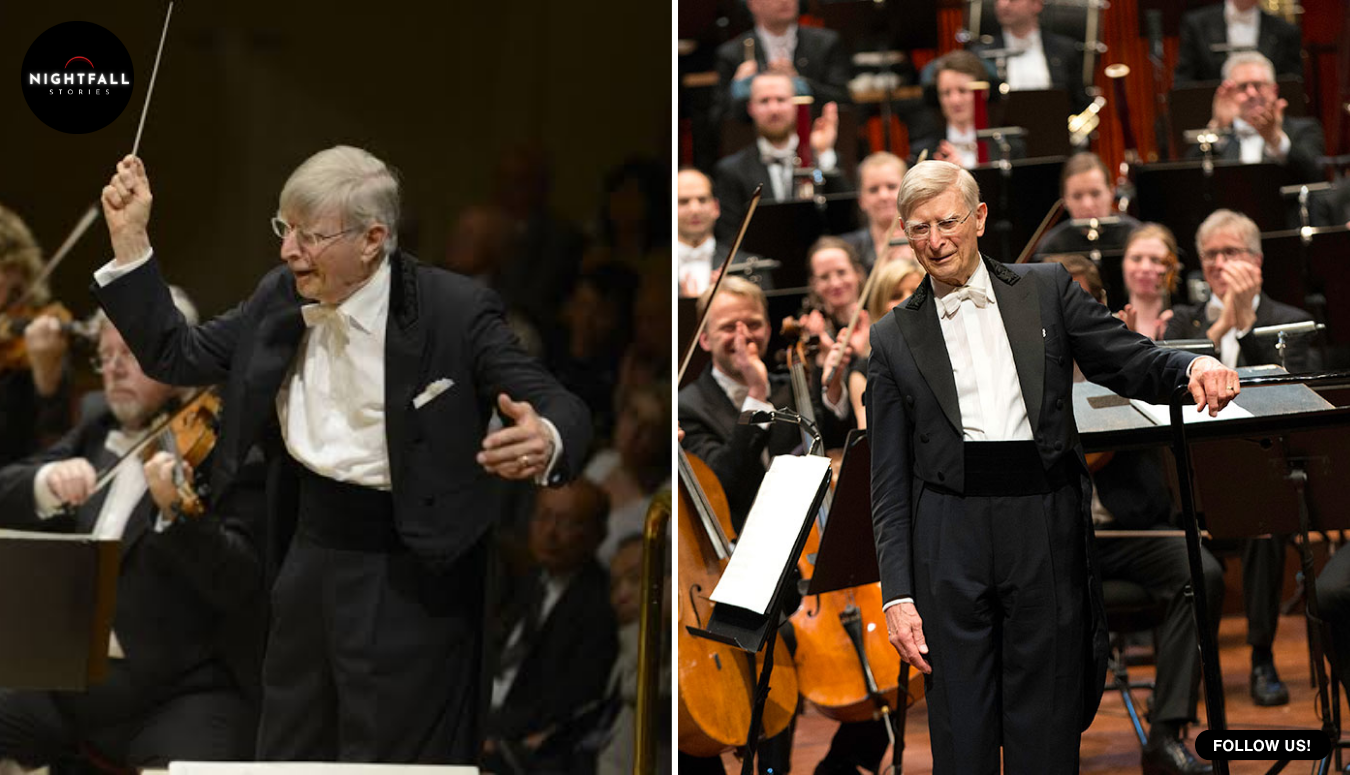
Sometime in the early 1950s, a young Swedish conductor was in conversation with the Gävle Symphony Orchestra about a job. The orchestra was interested. Then the question of his availability came up, he explained that he would not work from sunset on Friday until nightfall on Saturday, and that was the end of it. They turned him down because of it. The Norrköping Symphony Orchestra, a little further south, decided to make an exception for him, and in 1954 he took the post there and kept it for eight years.
Seventy-two years after that rejection, in September, the Japan Art Association announced that the music laureate of its 2026 Praemium Imperiale was Herbert Blomstedt. He is 99 years old. The other four laureates were the artist Jenny Holzer, the sculptor Andy Goldsworthy, the architect Daniel Libeskind and the actor Cate Blanchett. The citation praised the depth and balance of his readings across an unusually wide repertoire, and said his authority comes from meticulous preparation and complete command of the score.
Which is a slightly extraordinary thing to say about a man who spends one day in seven refusing to prepare.
Blomstedt is a Seventh-day Adventist, and the Sabbath observance follows from that. Adventists keep the biblical Sabbath on the seventh day rather than Sunday, counting it from sunset on Friday to sunset on Saturday, and treat it as a day set apart from ordinary work. In Blomstedt’s case the practice is more specific than most people assume, and the detail is the whole point. He does conduct concerts on Saturdays. What stops at Friday sunset is the preparation. He does not rehearse with an orchestra, and he does not sit down with a score and study it. The work ends; the performance does not.
That distinction is not a loophole he found. It is the result of a conversation he has described having, as a young man, with Johannes Norrby, who ran the Stockholm Philharmonic and was a believing Christian himself. By Blomstedt’s own account, given to a church publication when he turned 90, Norrby said he respected the position on rehearsals but did not understand the rest of it. If you say you make music to glorify God, Norrby asked him, why would you not want to glorify God on the Sabbath?
Blomstedt went away and thought about it, and read the Gospels, and noticed how often and how deliberately Jesus is described as doing things on the Sabbath. He settled on a model drawn straight from his own father, who was an Adventist pastor: a minister spends his week writing the sermon and then stands up and delivers it on the Sabbath, and the delivery is not work in the sense that the writing is. So Blomstedt rehearses all week and studies scores all week, and when the sun goes down on Friday he stops studying, and whatever happens on the podium on Saturday happens on what the orchestra and he have already built together. He has described it in almost exactly those terms: on the Sabbath they do not practise any more, they play what they rehearsed.
Now consider what that costs in this particular profession.
A symphony orchestra is a weekend business. Its revenue comes from the nights when the hall is full, and the hall is fullest on Friday and Saturday. The working week of a guest conductor is built backwards from those nights: a series of rehearsals across the week, tightening as it goes, with the last and most important one commonly falling on the Friday, sometimes a public general rehearsal, sometimes a final sitting the same day as the first concert. That is the session where everything that has gone wrong gets fixed. It is the one a conductor would least willingly give up.
Blomstedt gives it up, every single week, in winter especially. In northern Europe in December the sun sets in the middle of the afternoon. In Stockholm at the turn of the year it is dark before four o’clock, which means a Friday is not a working day with an inconvenient ending; it is most of a working day gone. Any orchestra engaging him has to shift rehearsals to earlier in the week, compress them, or lose one. It has to do that around the schedules of eighty or a hundred players, a hall booked months ahead, soloists with their own commitments, and in some cases a broadcast slot. Doing it once is a courtesy. Doing it for every engagement of a seventy-year career is a structural accommodation, and somebody at every one of those orchestras had to decide it was worth it.
In the 1950s nobody had decided that yet, which is why this is a hard-choice story rather than an anecdote about an eccentric maestro. A conductor in his twenties applying for a provincial orchestra job has no leverage of any kind. He is not a brand, he is not a draw, and there are more qualified young conductors than there are posts. The only thing he can offer is total availability, and that is precisely the thing he was not offering. Gävle’s decision was not unreasonable from where Gävle was standing. It is simply what the choice cost, in the only currency a young musician has, which is the chance to be in front of an orchestra at all.
Most stories about a costly decision are about one decision. This one is the same decision, made again, every seven days, for the length of a working life. Nobody renegotiated it as he got more famous and could have. If anything the stakes rose, because the bigger the orchestra the more expensive its rehearsal time.
And the career did get big. After Norrköping he went to the Oslo Philharmonic in 1962, then the Danish Radio Symphony, then the Swedish Radio Symphony, which established him as one of Scandinavia’s leading conductors before he was fifty. His international reputation turned on his decade as chief conductor of the Staatskapelle Dresden, from 1975 to 1985, a partnership with one of the oldest orchestras in Europe that produced recordings people still argue about favourably. Worth noting, and worth noting carefully: Dresden in those years was in East Germany, a state that was officially atheist, and nothing I could find suggests his observance was obstructed there. From 1985 to 1995 he was music director of the San Francisco Symphony, where he is generally credited with lifting the orchestra into the front rank of American ensembles through sheer rehearsal discipline. Then Hamburg, and then from 1998 to 2005 he was Kapellmeister of the Gewandhaus Orchestra in Leipzig, which is about as serious a chair as the art form offers.
His Beethoven is admired for rhythmic drive and architectural clarity. His Bruckner is admired for patience, which is the hardest thing in Bruckner. He has done as much as anyone alive to put Carl Nielsen, Jean Sibelius and the almost forgotten Franz Berwald in front of audiences who would otherwise never hear them. He conducts from memory routinely. His reputation is built explicitly on serving the composer rather than himself, which in a profession full of personalities is a position as much as a method.
The honours accumulated accordingly: two Grammy awards in the 1990s, Sweden’s Rolf Schock Prize, Denmark’s Léonie Sonning Music Prize, and in 2022, in Dresden, the Great Cross of Merit with Star of the German Order of Merit, presented by the state premier of Saxony, who remarked on his vitality and mental elasticity. He already held the Great Cross from nearly twenty years earlier. The star was the upgrade.
He also kept working into his nineties in a way that has very few parallels. After a fall put him in hospital in late 2023 and forced a string of cancellations, he was back on a podium within months, conducting the Leipzig Gewandhaus in Schubert and Berwald, and at that point had engagements booked more than a year ahead.
This past year was harder, and this is the part that has to be reported precisely, because the temptation to round it off in either direction is strong and both roundings would be wrong.
In the late spring he conducted Mahler’s Ninth Symphony with the Detroit Symphony, then travelled to San Francisco to conduct the same piece with the orchestra he once ran. He led the Friday concert. During it he became visibly tired, and afterwards he was taken to hospital, which a San Francisco Symphony spokesperson described as a decision made out of an abundance of caution. He withdrew from the Saturday and Sunday performances and David Robertson took them over. A week later he cancelled two Mahler Ninths with the Swedish Radio Symphony in Stockholm, where he is honorary conductor; the orchestra said he had been through a period of health problems, was on the road to recovery, and had been prescribed rest. Alan Gilbert stepped in at very short notice.
At that stage he was still intending to conduct a special concert in Bamberg in July, Beethoven and Brahms, programmed in honour of his own ninety-ninth birthday, with the Bamberger Symphoniker, whose honorary conductor he also is. According to a statement from that orchestra reported at the time, he was unable to travel for health reasons and did not conduct it. I was not able to reach the orchestra’s own notice directly, so that one rests on a secondhand transcription of an official statement rather than on the document itself. He is also reported to have withdrawn from concerts in September, in a trade report I could not open.
What I can establish is this, and no more than this. He has cancelled engagements this year for reasons of health. No orchestra, agency or family statement announcing a retirement exists that I could find, and his management in Munich was still publishing news about him in September. Around the time of the award, reports described him as scheduled to return to conducting in April and July of next year, around his hundredth birthday. The San Francisco Symphony’s current season carries three concerts in January under the title Celebrating Herbert Blomstedt, and when he withdrew in the spring the orchestra said he was expected back at that hall in the new year. Whether he will stand in front of an orchestra again is not something anyone outside his family is in a position to say, and nobody who respects a 99-year-old man should pretend otherwise. What is documented is that the diary is not empty and nobody has closed it.
Into the middle of that came the telephone call from Tokyo.
The Praemium Imperiale is not widely understood outside Japan, which is a shame, because it is one of the largest arts prizes in the world. It was established in 1988 by the Japan Art Association, the country’s oldest cultural foundation, in memory of Prince Takamatsu, who had been its honorary patron, and first awarded the following year. The structure is deliberate. There are five fields, painting, sculpture, architecture, music, and theatre or film, chosen precisely because they are the areas of human achievement that the Nobel prizes do not touch. Each year an international panel of advisers nominates candidates and the association selects one laureate per field, for a lifetime body of work rather than a single piece. Previous music laureates stretch across composers, performers and conductors from every major tradition.
Each laureate receives 15 million Japanese yen, which at the exchange rate prevailing when the 2026 announcement was made comes to roughly 96,000 US dollars, along with a medal and a testimonial letter. The presentation takes place in Tokyo at the end of October, at the Meiji Kinenkan, where Prince Hitachi, the association’s honorary patron, hands the medals over in person. This was the thirty-seventh edition.
It is a prize for a life, in other words, awarded by a committee that had the whole of a life to look at, and what it chose to praise in Blomstedt was his preparation.
That is worth sitting with for a second. The quality the award singled out, complete command of the score, is the direct product of the week he spends working, and it exists alongside a rule that shuts that work down for roughly a seventh of his existence and has done since before most of the people in the hall in Tokyo were born. The constraint did not dilute the thing he was eventually honoured for. On his own account, the two are not in tension at all: the week is for building, and the Sabbath is for whatever you have built.
None of which required anybody to agree with him. The interesting thing here is not the theology, it is the arithmetic. He decided something in his twenties that made him more expensive and less convenient than every one of his competitors, in a business with no shortage of conductors, and he never once traded it away for a better job. He lost at least one post over it that we know about. He almost certainly lost others nobody recorded, because orchestras that decline to hire you do not usually explain why.
The Gävle Symphony Orchestra, for what it is worth, is still going. It plays in a hall on the Gävle river, it has had a long line of chief conductors since the 1950s, and it is a perfectly respectable regional orchestra in a country full of them. It is the job Herbert Blomstedt did not get. He went on to Dresden, San Francisco and Leipzig instead, and at 99, with his diary half empty and half full, he was handed a prize in Tokyo for the thoroughness of his preparation by people who had no idea they were describing six days of the week.