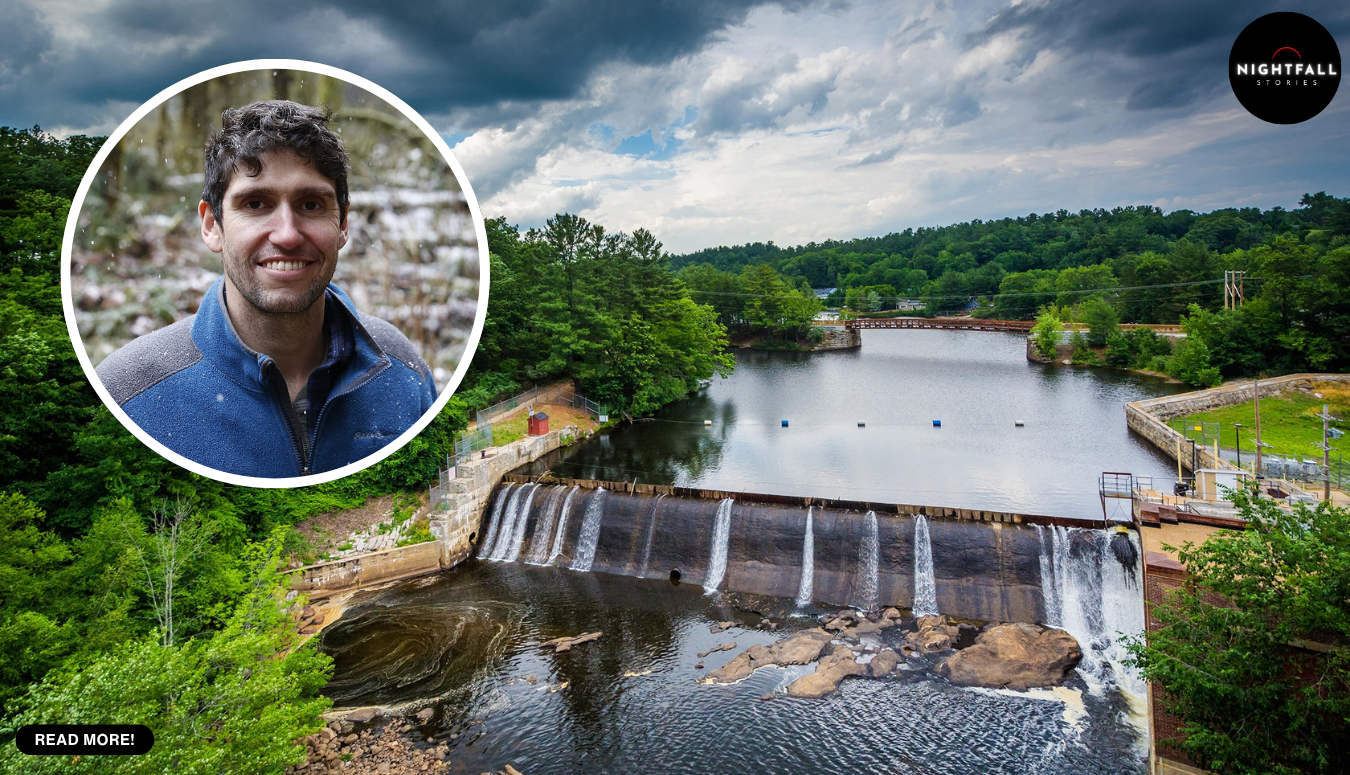
Town Brook runs about a mile and a half through the middle of Plymouth, Massachusetts, from a freshwater pond down to the sea, and for roughly two centuries a fish trying to swim up it had to get past six dams. Five of them are now gone. Before the removals began, something like 25,000 river herring came up the brook in a year. Recent runs have come in above 200,000, and in one recent season the camera that counts them logged more than 276,000 fish. The man most responsible for that is David Gould, who runs the town’s Department of Energy and Environment, and who has quietly pulled out so many barriers that a retired federal biologist told the writer Ben Goldfarb that Gould has probably removed more dams single-handedly than anyone east of the Mississippi.
Up the coast, in Durham, New Hampshire, somebody on a lawn above a different river had put out an all-capitals sign. It read HELP SAVE MILL POND DAM.
That sign is the whole problem in four words, and it is a much better story than the usual one about rivers.
The famous dam removals are the enormous western ones. The Klamath, where four hydroelectric dams came down and opened more than 400 miles of spawning water in a single project. The Elwha in Washington State before that. Those are the ones that get documentaries. But the great majority of dam removals in the United States happen in the east, where the barriers are small, old, and almost completely unknown outside the towns that own them. By the accounting of the conservation group American Rivers, more than 1,100 eastern demolitions have reopened over 20,000 miles of river. The same organisation counts about 2,350 documented removals across the whole country since 1912, with a hundred of them in a single recent year, reconnecting nearly 4,900 miles of water, the most ever recorded in twelve months.
And then there is what is left. One regional inventory puts at least 35,000 dams still sitting across eastern fish runs. More than 3,000 of them are in Massachusetts alone, a figure the state’s own restoration programme confirms, along with the detail that roughly 541 of those Massachusetts dams, about eighteen percent, are in poor or unsafe condition. Connecticut has something like 5,000. New York has around 9,000. Almost none of these are the concrete monsters of the Colorado basin. Most are low walls of granite block or mortared fieldstone, built when the only thing that could turn a wheel was falling water.
To understand why there are so many, you have to picture the economy that made them. From the middle of the 1600s, colonists in New England dammed essentially every stream capable of turning a wheel. Gristmills to grind corn. Sawmills to cut boards. Fulling and textile mills. Paper mills. Tanneries. Anchor forges. By the mid 1800s, by one calculation, more than 65,000 mills had been stapled across eastern creeks. Town Brook’s six dams, in that mile and a half, had powered grain, cloth, leather shoes, and anchors.
The fish paid for it. The great migratory runs of the northeast were alewives and bluebacks, collectively called river herring, silvery things about a foot long that spawn in freshwater and feed at sea. They came in volumes it is hard to credit now. One historian called them the passenger pigeons of the sea, and scientists have estimated that New England’s dams have cost the region’s ecosystems more than 20 billion pounds of alewives over four centuries, something close to the weight of 300,000 humpback whales. Shad went the same way, along with Atlantic salmon, sturgeon, sea lamprey, tomcod and eels.
One of the earliest people to get properly angry about this was Henry David Thoreau. In 1859 a committee of farmers in Billerica, Massachusetts, hired him to survey the Concord River, because they believed a dam owned by an industrialist named Charles Talbot was flooding their hay fields and they wanted a court to order it destroyed. Thoreau found the work tedious and said so in his journals. But he took the job partly because he already hated that dam. A decade earlier he had written about it blocking the spawning runs, and asked, in a line that has outlived every mill it was aimed at, where the poor shad was to find redress. His surveys proved the farmers right. The state let the dam stand anyway. Thoreau predicted gloomily that it might take a few thousand years for nature to level the Billerica dam, if the fish could be patient.
He was wrong, which is the good news. It has taken about 167 years rather than a few thousand, and the Talbot Mills dam may finally come down. But Thoreau was also right about something else, which is that dams make intractable opponents. He just had the wrong idea about why.
Gould’s education in this began in the early 2000s, when Plymouth went looking for federal help to repair a bad fish ladder on the Billington Street Dam. The ladders on Town Brook were a disgrace. They were too long, badly sited, and hard for fish to find in turbulent water, and Gould has described watching thousands of herring wash back downstream bruised and cut. The request landed on the desk of Eric Hutchins, then a restoration biologist with the National Oceanic and Atmospheric Administration, who suggested something nobody in the town had seriously proposed: do not fix the ladder, take out the dam.
In 2002 they did. An Army Reserve engineering battalion pulled the Billington Street Dam apart with excavators in exchange for food, fuel and lodging, which is the kind of arrangement that only happens once. It became the first coastal dam removed in Massachusetts. Then Gould went after the others, one at a time, with whatever money he could assemble: Off Billington Street in 2013, the Plymco dam in 2015, the Holmes Playground dam on Newfield Street in 2018, which also restored 2,000 feet of channel.
What he discovered along the way is that in a town with four centuries of industry layered on top of itself, dam removal is mostly not dam removal. Asbestos shingles had to come off mill buildings. Rights of way had to be legally extinguished. Contaminated sediment that had settled behind the walls for generations had to be dug out and landfilled. The brook itself had to be rebuilt afterwards, because the bottom of a drained reservoir is not a river, and boulders, bends and streamside plants all had to be put back by hand. And the permitting was enormous. Gould’s own summary of it is that you are working through the same regulatory framework that would permit a large retail store.
The masonry of a couple of the old Town Brook dams had crests that doubled as town streets, and those were converted into bridges, so that the road still crosses where it always did and the fish now run underneath. Walk the trail upstream today and Gould will point at a field, a park, a patch of oak and pine, and tell you it used to be underwater. The evidence is subtle once you know to look: a rotting dock skeleton, a high water stain on a glacial boulder.
So that is the success. The complication is that nobody is entirely sure how big it is.
Nathan Furey is an associate professor in the biological sciences department at the University of New Hampshire, where he studies fish ecology and animal movement. He came to the state in 2018 having done most of his doctoral research on relatively undeveloped Pacific salmon rivers in British Columbia, and found himself cast in a role he had not trained for. When you are the fish person at a state university in New England, people expect you to tell them what happens after a dam comes out.
The honest answer is that very often nobody knows. Furey works the Great Bay watershed, a tidal estuary fed by seven rivers. On one of them, the Bellamy, two old dams at a defunct woollen mill funnelled the whole river through a narrow pipe until a coalition of agencies, nonprofits and the mill’s current owner demolished them a few years ago. After that, the state tried to count returning alewives by visual survey, which means a person standing by the water tallying fish. Furey’s assessment of what that tells you is blunt. They have no idea how many fish come back there.
Alewives are not salmon. As Furey puts it, they cannot jump, they are not powerful swimmers like sturgeon, and they are not eels that can climb and crawl. Taking a wall out does not automatically mean a foot-long herring can get through the rapids left behind. So Furey and his students catch them as they enter the river and implant rice-grain microchips called passive integrated transponders, then chain a battery box to a streamside tree with a cable running down into a riffle, so that every tagged fish that wriggles past gets logged by serial number. It is a very old migration being surveilled by very new equipment, and it exists because the celebratory numbers everyone quotes have mostly never been properly measured.
Which brings us back to the sign on the lawn in Durham.
The Mill Pond Dam on the Oyster River was built in 1913, about 140 feet across, originally for water power it had not generated in decades. It was one in a series of dams that had stoppered that river since the 1600s. Water sheeted over its lip and frothed at its base and the pond above it was, by any ordinary standard, lovely. Families skated on it in winter and paddled it in summer. People fed the ducks.
It is very easy to write about those people as an obstacle. They are not. They are the reason this story is interesting, because what they are defending is real.
A millpond is not a mistake to someone who learned to swim in it. It is a view from a kitchen window that has not changed in three generations, a place where a grandmother watched her children and then her grandchildren, a fixed point in a town that has lost most of its other fixed points. Dam enthusiasts are sometimes labelled NOOMBYs, for Not Out of My Backyard, which is a clever enough joke and also a way of not taking the argument seriously. In Billerica, officials objecting to the demolition of Thoreau’s old enemy argued that the Talbot Mills dam had long served as a symbol of the Industrial Revolution and remained one of the major focal points in the area. That is a historical claim, and it is true. Eric Hutchins once found himself arguing with a man whose objection was that his golden retriever played fetch in the impoundment. Hutchins countered that the dog was stirring up toxic sediment and probably poisoning itself, which is also true, and which is not the point the man was making.
Here is the asymmetry that actually decides these fights, and Furey named it exactly. On the west coast, salmon runs collapsed inside living memory, so people remember what the river used to be. In New England the rivers have been plugged for so long that almost nobody alive has seen one run silver with herring. The pond is in living memory. The fish are not. Two biologists, John Waldman and Karin Limburg, gave the resulting feedback loop a name: eco-social anomie. The fewer fish there are, the less anyone cares, and the less anyone cares the fewer there will be.
So the millpond defenders are not being sentimental against the facts. They are being loyal to the only version of the river they have ever been shown.
Durham is what it looks like when that changes. In 2002 the state declared the Mill Pond Dam structurally deficient and told the town to repair it, and engineers worked out that repairing it would cost considerably more than demolishing it. Residents protested, and the town dropped the idea. The logic did not go away. Opponents of removal gathered over a thousand petition signatures and forced the question onto a ballot, and in 2022 the town voted 1,706 to 596 to take the dam out, close to three to one. The project, about 3.1 million dollars with most of it covered by grants, began last summer and is due to finish next year with native planting around the drained pond bed. The town administrator’s summary was that the Oyster will run free for the first time since colonial settlers began damming it.
The pond is gone. People who loved it have lost something, and saying so is not a concession to nostalgia; it is just accurate.
Not every dam is an easy call either. Hundreds of northeastern dams are twentieth-century structures still feeding electricity into regional grids, some owned by towns, some by utilities, some by investors holding them inside renewable energy portfolios. A few power only a handful of houses. But with energy prices rising and data centre construction expanding, it is genuinely hard to argue for switching any generation off, and the people who say so are not being unreasonable. What is moving those dams toward removal is less often fish than money: as small hydroelectric plants age, repair costs and the flood risk of a failure can turn them into liabilities their owners would rather be rid of.
The money for all of this is unsettled. A great deal of federal infrastructure funding was directed at fish passage, and by one independent tally about 2.2 billion dollars of it was earmarked specifically for removing blockages in waterways, of which roughly 1.78 billion has been awarded and around 420 million was still waiting to go out. That same tally found none of the projects had been targeted for cancellation. Goldfarb’s reporting, though, describes a programme that put a billion dollars toward culverts and barriers falling into administrative limbo, with applications unreviewed and money unspent, alongside staffing and budget cuts at the federal agency that has driven dozens of New England removals. Andrew Fisk, who runs American Rivers’ northeast region, told him the reductions in funding and the pressure on partner agencies have made the work no easier. American Rivers has set a target of 30,000 dams removed by the middle of the century. At the current rate, hitting it would require going roughly ten times faster.
Fisk also said the thing that explains why Plymouth matters more than any funding table. Proximity to abundance, he said, is transformational. You cannot argue someone out of loving a pond. You can show them a river with a quarter of a million fish in it.
Which is what Plymouth now does every spring at its Herring Festival, where parents and children walk up the path beside the brook, someone has chalked LOOK FISH on the asphalt, and the alewives stack up thicker and thicker the higher you climb. Malissa Costa, a Mashpee Wampanoag cultural leader, keeps a kiosk there. Massachusetts has banned alewife harvest since 2005 and the Wampanoag are exempt; Costa takes around twenty each spring, sometimes with her bare hands, salts and smokes them, and gives them away to elders and tribal members who need them. She does not especially like the taste. She goes anyway, every year, because she feels she owes it. Her family has been meeting these fish at this brook since the end of the last ice age.
And here is how Plymouth is finishing the job, which is the part that nobody expected.
One dam is left on Town Brook, at the old grist mill, and the town is not going to remove it. The mill is a working museum and the pond is part of the town. Instead, with a ten million dollar federal habitat grant, Plymouth is building what engineers call a nature-like fishway, a constructed channel that routes the river around the dam, along with dredging the pond and repairing the dam itself. When it is done, herring, eels and the rest will get access to another 1.6 miles of brook and 270 acres of spawning water in the pond at the top of the watershed. The mill stays. The millpond stays. The fish get through.
It took twenty-odd years, five dams, an Army battalion, thirteen partner agencies and an unreasonable number of permits, and it ends not with a wall coming down but with a river being given a way around the last one. Gould sometimes pushes a kayak out onto the spawning pond to watch the fish swirl in the willows, by himself, which is a strange hobby for a municipal department head and a reasonable one for a man who has spent his career on this. He has said that to him the single most historic thing in Plymouth is this brook. In a town that has built an entire identity out of its history, that is a provocative thing to claim, and he is probably right. The mills ran for two centuries and stopped. The herring have been coming since the ice left, they are still coming, and nobody has yet managed to count them properly.