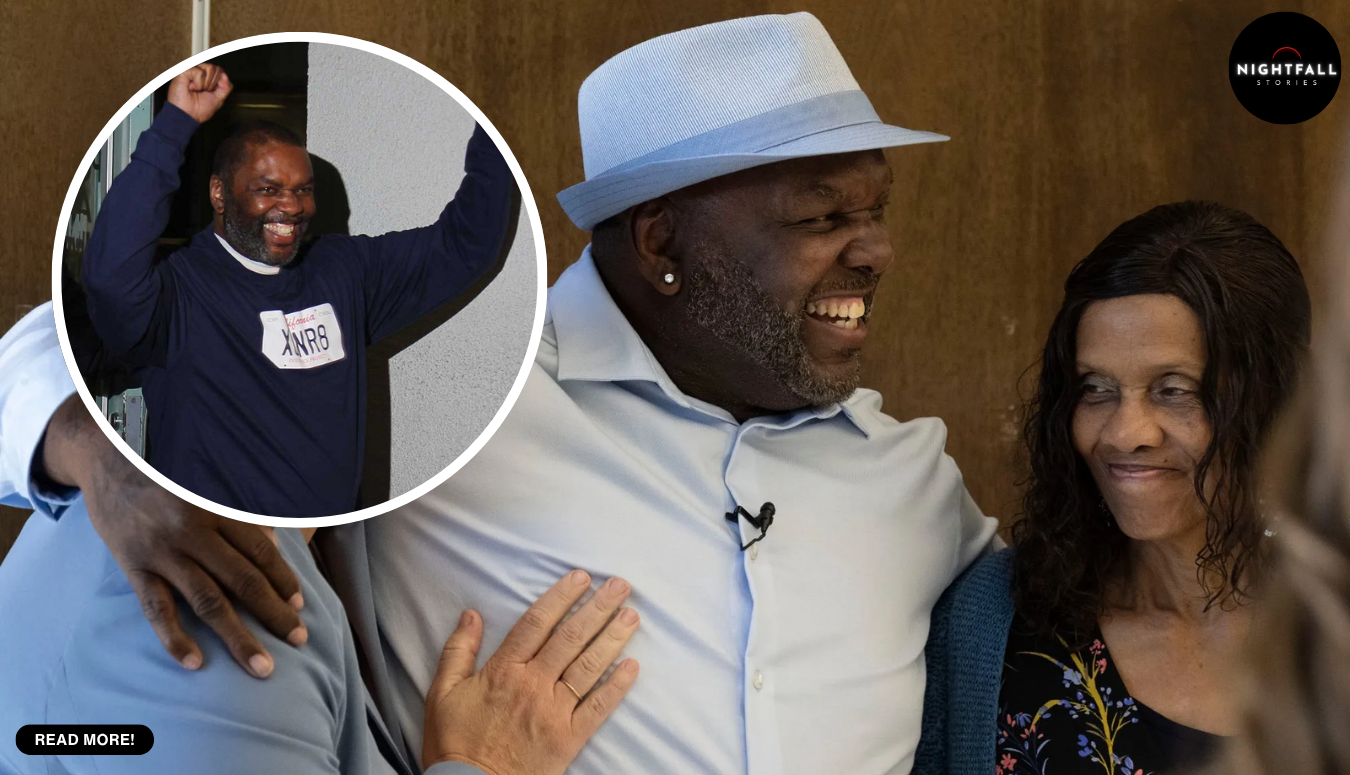
Guy Miles was not in Orange County on the morning of 29 June 1998. He had collected his twelve year old son from Carson at around three in the morning and driven him to Las Vegas, arriving somewhere between seven and eight. His parents said so. His son said so. A neighbour in Las Vegas said she saw him there that morning. Flight records and telephone records backed up the timeline, and the trial judge kept those documents away from the jury on the grounds that they had not been properly authenticated.
Three men robbed a loan office in Fullerton that day and left with roughly 5,400 dollars in cash and cheques, at 1998 values. Two of the people who were in that office picked Guy Miles out. He was convicted in 1999 and sentenced to 75 years to life.
Three other men later said, under penalty of perjury, that they had done it and that he had nothing to do with it. Bernard Teamer, who by his own account planned the robbery. Jason Steward, who went inside. Harold Bailey, the third man. None of that got Miles out of prison for another decade and a half, and when he finally did walk out, he walked out carrying a robbery conviction he had agreed to accept.
That last part is the piece of this story most people have never heard of, and it is worth slowing down on, because it is the bargain at the centre of everything that happened to him.
Start with how the identifications were made, because the appeal court eventually spent a great deal of time on them. The photographic lineups put more than one suspect into a single array. There were not enough filler photographs. Nobody had bothered to find people who actually resembled the description the witnesses had given, which meant that a stocky man in a six pack of thinner ones was the only face that could possibly be the answer. Miles was the stocky man. His photograph stood out.
Then there was what happened in the courthouse hallway. One of the two witnesses, an employee of the office, could not identify Miles in the courtroom. During a morning break, with the jury out, she told the prosecutor she could not do it. The prosecutor showed her a colour photocopy of Miles’s booking photograph. After looking at it, she said she was certain. The booking photograph carried his arrest date on it, which told her, without anyone having to say a word, that the police had already decided he was the man.
The National Registry of Exonerations lists four factors in this case: mistaken witness identification, false or misleading forensic evidence, official misconduct and inadequate legal defence. The hallway photograph is what sits behind the third of those. It is not a dramatic act. It is a tired prosecutor in a corridor handing a wavering witness the reassurance she was looking for, and it took twenty seven years to undo.
There was no physical evidence putting Miles in that office. The prosecution leaned on the two identifications and on an argument about who he was associated with. The jury convicted.
For the next several years he worked his own case from inside. He filed something in the order of thirteen appeals himself, without a lawyer, and lost all of them. In 2001 he wrote to the California Innocence Project, which took the case and then spent roughly fifteen years on it. Its investigators found the three men. Teamer, Steward and Bailey all gave accounts saying Miles was not there.
And it still did not work, because of the standard that applied. For decades, a Californian prisoner bringing new evidence after conviction had to produce something that pointed unerringly to innocence and completely undermined the prosecution’s case. That is close to an impossible test. Three people saying they committed the robbery does not point unerringly at anything, because a court can always decide they are lying for a friend. Under that standard the confessions were not enough, and Miles stayed where he was.
What changed was a piece of legislation. In 2016 California lowered the bar. The new wording asks whether the evidence is credible, material, presented without substantial delay, and of such decisive force and value that it would more likely than not have changed the outcome at trial. More likely than not is an ordinary human question. Pointing unerringly is not. The amendment took effect at the start of 2017, and by one account Miles’s case was the first to benefit from it.
On 19 January 2017 the Court of Appeal, Fourth District, Division Three, granted his petition and vacated his convictions in a thirty five page opinion. Justices Eileen Moore, Richard Aronson and Richard Fybel sat on it. Moore wrote separately about the identifications, and her language was restrained and damning at the same time: the pretrial lineups were unduly suggestive, and the booking photograph had given the witness positive feedback that converted her doubt into false confidence.
Here is where the story stops behaving the way people expect it to behave. The convictions were gone. Miles was not free.
The ruling gave the prosecution a choice. It could retry him within a set period, or he had to be released. The prosecution said it would retry him. Bail was set at a million dollars, which he could not pay. So the real choice was not between freedom and a second trial. It was between sitting in custody for however long it took to get to that second trial, in front of a new jury, with the same 75 years to life waiting at the end of it, or taking a deal.
The deal was a plea entered under a California rule known as a West plea, after the case that established it. It is a strange instrument. It lets a defendant accept a conviction and a sentence without admitting that he did the thing. On paper the conviction is real and enforceable. Underneath it, nobody has said the words. In Miles’s case it covered two counts of second degree robbery and a firearm enhancement, and it came with credit for the time he had already served, which meant he could go home.
He took it. He was released on 20 June 2017, after 6,895 days in custody, a figure that comes from the state body that later paid him compensation and works out at more than eighteen years.
Talk to anyone who has been through this and the plea is the part they come back to. Miles gave an interview to a prison newsroom at San Quentin later that year and he was plain about his reasoning. The prosecution was ready to take him back to trial. He needed to get back to his mother and father, and he suspected they were hiding health problems from him. He also said something that explains the shape of the whole bargain better than any legal commentary could. It felt, he said, like having to prove it all over again, starting the trial from the beginning, and that was not a good feeling.
So he went home with a conviction. Not a cloud, not an allegation, a conviction, on a record, for a robbery that three men had sworn he had no part in. He had refused for nineteen years to say he had done it, and in order to walk out of a county jail he had to accept the court’s finding that he had.
The organisation that eventually took over his case has a name for this. A dark plea is a plea entered not because someone committed the crime but because the alternative is too dangerous to risk, and it happens most often to exactly the people in Miles’s position: someone whose conviction has just been overturned, who is standing one inch from the door, and who is told that fighting on means years more inside and a chance of never coming out. The pressure does not appear anywhere in the paperwork. The record simply shows a plea.
What the plea cost him was not only the record. In 2021 the California Victim Compensation Board paid him 965,300 dollars, which is calculated per day of wrongful imprisonment, and that payment reflects a state determination in his favour. But the conviction itself stayed on his file for another five years after the money arrived. A robbery conviction is a background check, a rental application, a job interview, a licence, a form that asks a question with only one honest answer. For nine years after his release he carried the thing he had never admitted to.
Then, on 21 August 2026, something happened that does not happen very often.
The Orange County District Attorney’s office has a Conviction Integrity Unit, a team whose job is to look back at the office’s own work. It reviewed the Miles file. It concluded, on the totality of the evidence, including the confessions of the three men and the identification procedures, that the office had lost confidence in the conviction. That phrase is doing a lot of work. It is not an apology and it is not a finding of innocence. It is a prosecuting office saying it is no longer willing to stand behind a result it obtained.
Then it did the thing that matters more than the phrase. Rather than waiting to be sued or petitioned, the unit filed a joint motion with Miles’s own lawyers, Claudia Salinas and Audrey McGinn of The Innocence Center, asking the court to set aside his plea and vacate the conviction. District Attorney Todd Spitzer’s office put its name on the same piece of paper as the people who had spent years arguing against it.
The court granted it, and it is worth being exact about what the court actually did, because two separate things happened that day and they are not the same thing.
First, vacatur. The conviction was set aside. The plea Miles had accepted in 2017 was undone, which means that in law the conviction no longer exists and never did. That alone would have left the case technically open, with charges still on file and a theoretical possibility of the whole thing starting again.
Second, dismissal. The charges themselves were dismissed. There is nothing left to retry, nothing to revive, nothing pending. The registry of exonerations records both the vacatur date and the dismissal date as 21 August 2026, which is the paperwork equivalent of closing a door and then taking the door off its hinges.
The arithmetic of this is worth separating out, because two different numbers get quoted and both are correct. He was in custody for more than eighteen years. The conviction stood for twenty seven. The gap between those two figures is the nine years he spent at home, free, with a robbery on his record that he had accepted in order to be at home at all.
A few things in this story remain unresolved and are worth saying rather than smoothing over. It is not established in the public record whether Teamer, Steward or Bailey were ever charged with the robbery they described. The registry’s reference to false or misleading forensic evidence is not explained in the material available, and should not be assumed to mean anything more than the registry’s own classification. And the organisations involved have themselves been inconsistent about the year of his release, with some of the 2026 material saying 2018; the court’s opinion, the contemporaneous reporting and the registry all put the appeal ruling and the release in 2017.
What is not in doubt is that there was a robbery. Three men went into a workplace with a gun, and the people who were behind that counter had a morning they presumably still remember. Nothing that happened to Guy Miles makes that less true. Two of them gave an honest answer to a badly built question and were then nudged, by the people who were supposed to be testing their memory, toward the answer the police had already chosen. That is not a failure of the witnesses. It is a failure of procedure, and the procedure was not theirs.
Miles is around sixty now. The lawyers who finished his case have used it to argue for something small and specific: that when a court reverses a conviction and the prosecution then offers a plea, the trade being made should be stated out loud, on the record, so that the coercion is visible rather than buried in a form. It is a modest ask. It is also an admission that the system currently has a mechanism for making an innocent person agree to a conviction and leaves no trace of having used it.
For twenty seven years the state of California held that Guy Miles robbed a loan office in Fullerton while he was several hundred miles away with his son. He never said he did it. He agreed, once, in order to go home, to let a court say it for him. And in the end the office that had put him there was the office that stood up and asked for it to be taken back.