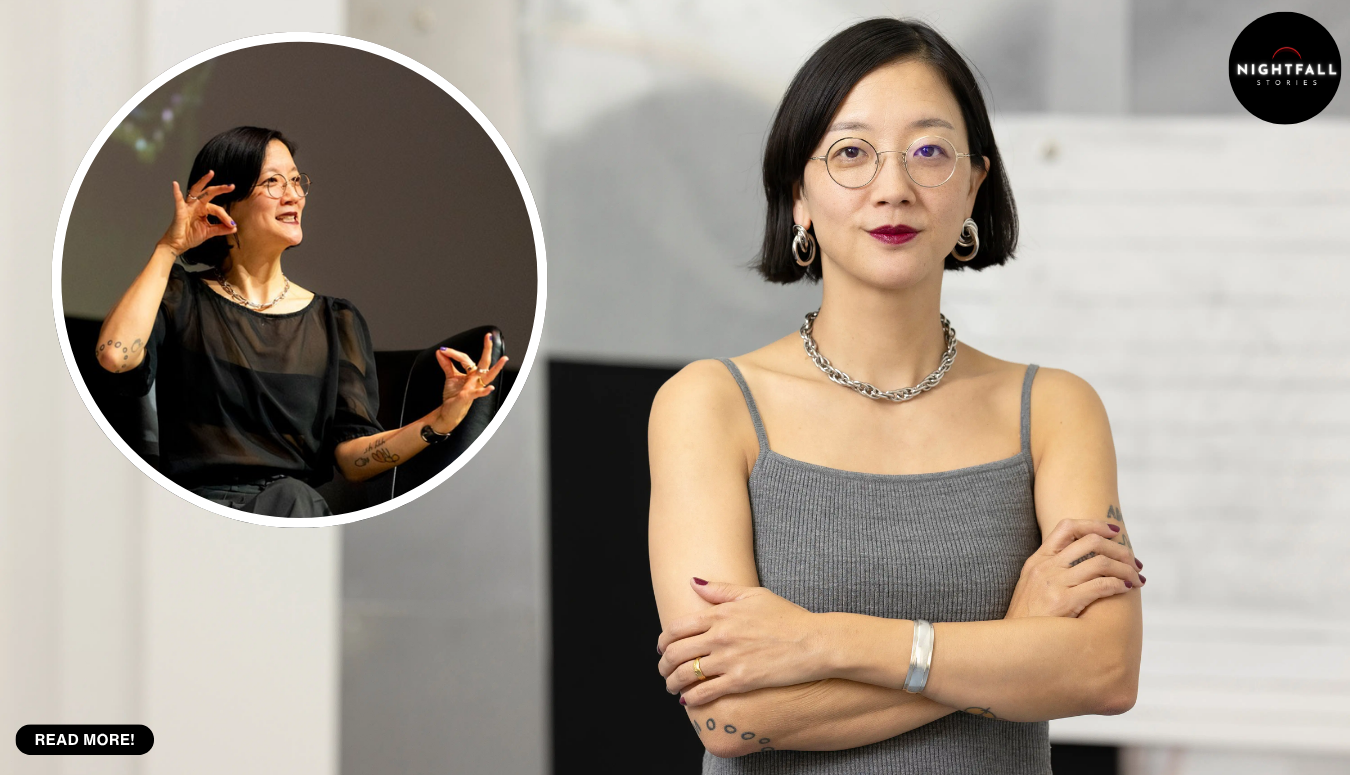
Inside the stadium, the whole thing was visible. The giant screens carried Christine Sun Kim in real time as she performed the American national anthem and America the Beautiful in American Sign Language, in front of a stadium full of people and alongside the singers who were doing the audible half of the job.
Everyone else got something else. In her own words, the people watching on their televisions, computers and phones got a seriously truncated version. One estimate of her total screen time across both songs is about ten seconds. The network cut between angles repeatedly and showed a couple of snippets of her. There was even a dedicated feed on the broadcaster’s own website, set up for exactly this, and that cut away too. Two days later the National Association of the Deaf, which she was there representing, posted the full performance on Facebook so that anyone who wanted to watch it finally could.
Kim wrote about it afterwards in a newspaper op ed with a headline that functioned as a shrug and an accusation at the same time: she had performed at the Super Bowl, and you might have missed her. The question she put in that piece is the one nobody at the network appears to have asked beforehand. Why stage a sign language performance that is not accessible to the people who would like to see it.
If you only know one thing about Christine Sun Kim, that is probably it, and it is the least interesting thing about her. What makes the episode worth more than a complaint is that she had already spent fifteen years making work about precisely this: who gets to decide what counts as communication, what hearing people assume sound is, and the specific texture of being left out of something while being thanked for taking part in it.
Last week the MacArthur Foundation named her one of twenty fellows for 2026 and attached 800,000 dollars to it, paid over five years, to spend however she likes. The citation does not mention the Super Bowl. It says the fellowship is for exploring the political, cultural and multisensory dimensions of sound, spoken language and communication, which is a dry way of describing a body of work that is frequently very funny.
Here is what that work actually looks like, because it is nothing like what people expect when they hear that a Deaf artist makes art about sound.
Kim draws, mostly in charcoal, and what she draws looks like the kind of thing a management consultant would put on a slide. Pie charts. Bar graphs. Musical notation. Flow diagrams with labels. She takes the visual grammar of information, the stuff we all accept as neutral and objective, and uses it to deliver observations that are personal and pointed. One series is called Deaf Rage, and it is exactly that: her frustrations with living in a world organised around hearing, plotted as angles on a diagram. Degrees of rage, measured and sorted.
She has been explicit about why she works that way. The best way to reach a wide audience that is not Deaf, she has said, is to use a format people already understand instantly. Nobody needs a wall text to read a pie chart. The joke lands before the viewer has a chance to get defensive about it.
She also likes charcoal specifically because it is messy, and because that mess sits oddly in the very clean white rooms where her work ends up hanging. That is not an accident either.
Her relationship with musical notation is the part that tends to make people stop and think. Notation is a system invented to put sound on paper for people who can read it. Kim takes that system and runs it in a direction it was never designed to go, borrowing its symbols for volume and duration and rest to describe things like social attention, politeness, interruption and the way a conversation gets handed around a room. A rest in music is a measured absence. Used her way, it describes a person being left out of a group chat.
American Sign Language is her first language, and a great deal of her work involves translating its movement and its grammar into something fixed. ASL happens in three dimensions and in time. It uses space, direction, facial grammar, the body’s position relative to other people. Putting that on a flat surface means losing almost all of it, so instead of trying to transcribe signs she traces what they do. One of her large murals, Prolonged Echo, treats the gallery floor as a flat open palm and runs the walls as the rebounding path of the sign for echo. The sign has a shape in the air. She gave the shape a building.
At the MIT List Visual Arts Center, in a show called Off The Charts that opened weeks after the Super Bowl, she put up drawings that broke the ASL alphabet into three separate points of view, which she labelled speller, bird and lurker. The speller is the person whose hands are doing it. The bird is the view from above, which is to say the view nobody in a conversation ever has. The lurker is the person watching from the edge of a group, trying to follow a language they half know. Anyone who has sat at a table in a country whose language they are still learning recognises the lurker instantly, which is the point. She was asked what she wanted visitors to take away and declined to offer a lesson, saying only that she wanted it to sit at the back of their minds and stay with them in terms of respecting Deafness and sign language.
Another drawing is titled sorry zero, sorry not sorry, which tells you most of what you need to know about the tone. The work is not polite. It is precise, and precision about social behaviour tends to read as rudeness.
It is worth saying plainly what a job like the Super Bowl one actually involves, because the public assumption is that signing is a kind of decorative accompaniment. It is not. Performing song lyrics in ASL is a translation problem with no good answers, done live, in front of an audience, with the prosody and rhythm and emotional register of the music all having to be carried by a body rather than a voice. It takes preparation and it takes judgement. It is work, and it was commissioned as work.
Her scale varies wildly and deliberately. There are small charcoal drawings. There are site specific murals that take over an entire wall. There are sculptures, videos and installations. One piece made with Thomas Mader, called ATTENTION, puts two oversized red inflatable arms through opposite walls of a white room, their index fingers pointing at each other and meeting over a rough stone sitting on the floor. It is an enormous physical pun about getting someone’s notice, which, if your access to a room depends on people looking at you, is not an abstract subject.
And then there is a work that answers the broadcast directly. In 2020 she made a piece called The Star Spangled Banner. She did not write a letter to the network. She put the thing into her own medium, where nobody can cut away from it.
There is another strand of her practice that gets less attention and is arguably the most radical thing in it. She has made audio works. One Week of Lullabies for Roux came out of her becoming a parent: she wrote a score, then invited seven other artists who were also parents to make songs from it, and required each of them to write a description of their song so that the piece would be conceptually accessible to Deaf audiences. Think about what that inverts. The audio is not the work with a translation bolted on afterwards for the people who cannot hear it. The description is part of the composition, commissioned at the same time as the music, from the same person. Access is not an accommodation added at the end. It is a material the piece is made of.
Kim has described what shifted her thinking, and it happened after she moved to Europe. She found that the Deaf community knew an enormous amount about sound. Not about hearing, about sound: how it moves, who controls it, what it does to a room, who is permitted to make it and how much. She has talked about sound as something auditory, visual and spatial all at once, which is a definition that includes vibration through a floor, the behaviour of a crowd, the way a loud room makes people stand, and the social fact of being shushed.
Once you have that definition, the Super Bowl stops being an insult and becomes a case study. A performance was commissioned in a visual language. It was transmitted on a medium that is almost entirely visual. And the people controlling the pictures spent the available seconds on other pictures. Not out of malice, as far as anyone can establish. The network does not appear to have offered a public explanation at the time, and nobody should fill that silence with invented motive. What happened is more ordinary and more useful than malice: a room full of professionals making rapid decisions about what was worth showing, and a sign language performance never making the cut, over and over, in real time.
Others who watched described it as feeling tokenised, the camera pulling away mid song on both songs. That is the right word. The performance was booked. It was announced. It was presented as inclusion. The part that would have made it inclusion was the part that did not get aired.
Her career, to be clear, is not a story of someone being overlooked. The institutional record is substantial and it predates all of this. Her work has been shown at the Museum of Modern Art and the Whitney Museum of American Art in New York, the Art Institute of Chicago, the Walker Art Center in Minneapolis, Secession in Vienna, the Contemporary Art Gallery in Vancouver and the National Museum of Modern and Contemporary Art in Seoul. She holds a bachelor of science from the Rochester Institute of Technology, taken in 2002, and two master of fine arts degrees, one from the School of Visual Arts in 2006 and one from Bard College in 2013.
The gap between that record and ten seconds of airtime is the actual story. Somebody whose work hangs in several of the most heavily visited museums on two continents was, for one afternoon, a logistical problem for a camera operator.
Last year she had her first major museum survey, which is the point in an artist’s life where the work stops being a series of shows and becomes a body. All Day All Night opened at the Whitney in New York and ran through to late September, co organised with the Walker Art Center, curated by Jennie Goldstein at the Whitney and Pavel Pys at the Walker with the independent curator Tom Finkelpearl, and assisted by Rose Pallone and Brandon Eng. It pulled together work from 2011 onwards: drawings, site specific murals, paintings, video installations and sculpture. It then travelled to Minneapolis, where it ran from the spring of this year through to the end of the summer, closing only weeks before the fellowship was announced.
That survey is the context for the prize, and it matters, because a fellowship given to someone in the middle of a career can look like a response to a moment. This one is not. The Foundation’s description of her is of an artist conveying the experiences of Deaf people and finding new ways to understand sound through drawings, large scale murals, video and interactive work. That is a description of twenty years of practice, not of an incident.
The money is the part that is difficult to explain to anyone who has not been a working artist. Grants normally come with a shape. There is a project, a budget, a timeline, a report at the end, a funder with a view about what the work should be for. The MacArthur has none of that. It is paid out across five years, there is no application, there is nothing to deliver, and the Foundation does not get a say in what she does next. It is money given to a person on the theory that the person is the thing worth funding.
For an artist whose subject is access, there is something quietly appropriate about being handed a sum with no conditions on it. Access, in her work, is rarely about generosity. It is about control: who holds the frame, who decides what gets transmitted, who gets to be in the room and who gets described to afterwards. An unconditional fellowship takes the frame out of anyone else’s hands for five years.
Kim is forty six and lives and works in Berlin. She was born in California, grew up in a Korean American family, trained in New York, and has spent well over a decade in Germany, which is where that realisation about the Deaf community and sound arrived. The MacArthur announcement lists her as a Berlin artist and that is accurate in the plain sense, though the work does not belong to anywhere in particular. Pie charts are universal. So is being talked over.
She has not, as far as anything published shows, made a public statement about the fellowship yet, which is in character for someone whose response to being cut from a broadcast was to make an artwork rather than issue a press release.
What is on the record is this. Six years ago she was given the largest audience available to any performer on the planet, and the apparatus in charge of that audience looked somewhere else for almost all of it. This year an institution read the entire body of work she had built about exactly that problem, and gave her the one thing no camera operator can take back, which is the next five years, to make whatever she wants, with nobody at a desk deciding how much of it the rest of us get to see.