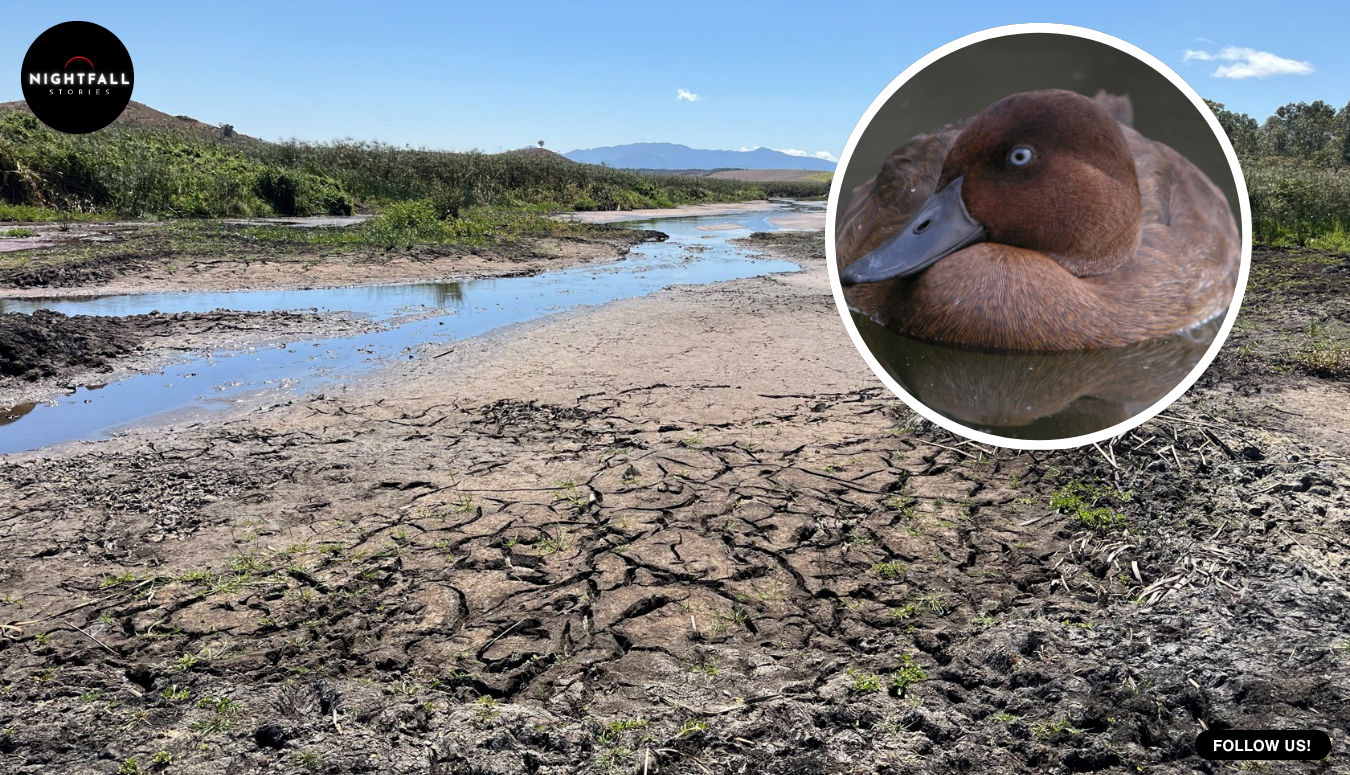
The water was going out of Lake Sofia like a bath with the plug pulled, and the people who lived around it went down to the gap with sandbags and timber and started filling it in by hand.
The gap had been a channel about two metres wide, the sort of outlet a lake has and nobody thinks about. Heavy storms widened it. By the time anyone fully understood what was happening it was more than a hundred metres across, and the lake had lost about nine tenths of its water. What had been a wetland of international importance in northern Madagascar was becoming a bed of reeds with puddles in it.
The temporary barrier the villagers built was around a hundred metres long and made of sandbags and wood. It was not an engineering solution and nobody pretended it was. It was a way of buying weeks.
Among the things drying out in that lake bed was the entire free living population of the rarest duck on earth.
The Madagascar pochard is a brown diving duck with a dark red eye, and if you saw one on a park pond you would walk past it. For most of the second half of the twentieth century it was thought to be gone. The last confirmed sighting was in the early 1990s, and the species was written off as extinct, which is a thing that happens to small brown animals in remote places far more often than it happens to tigers.
Then in 2006 a survey team from the Peregrine Fund, working in the north of the country, found a few dozen of them on a volcanic crater lake called Matsaborimena. It was the kind of find conservationists dream about and then immediately start worrying about, because the lake was the wrong lake. It was deep, steep sided and poor in the shallow food the ducklings need, and almost none of the young were surviving. The species had not been saved by that refuge so much as parked in it.
What followed is one of the odder rescue stories in modern conservation, and the early stages of it were genuinely improvised. Three clutches of eggs were collected from the wild and incubated, at first, in a hotel bathroom. The hatchlings were then housed for over a year in a facility that had been built for turtles. Only after funding came through from the Darwin Initiative was a purpose built breeding compound put up in northern Madagascar, and from 2012 the ducks began breeding reliably inside it.
The whole point of a captive population, though, is to stop being one. Somewhere there had to be a lake that was actually suitable. Lake Sofia, in the Sofia region of the north, was shallow, productive, surrounded by marsh and already recognised as a wetland of international importance. In 2018 the Madagascar pochard was returned to the wild there for the first time.
If you have not spent time with a map of Madagascar, here is what you need. It is the fourth largest island in the world, sitting in the Indian Ocean off the southeast coast of Africa, roughly four hundred kilometres from Mozambique at the nearest point. It has been separated from any continent for so long that an extraordinary share of what lives there lives nowhere else, which is why the island keeps turning up in conservation stories out of all proportion to its size. The north, where Lake Sofia is, is a long way from the capital on bad roads, and in practical terms that distance governs everything about this story. A problem at that lake cannot be fixed by driving out for the afternoon.
So when the lake drained, the question was not simply whether the ducks could be saved. It was whether a lake could be put back, in a place where getting a bag of cement to the site is a logistical exercise.
The population numbers at this point need handling carefully, because three different bodies have published three different figures and they do not reconcile neatly. Durrell Wildlife Conservation Trust, which runs the project with the Wildfowl and Wetlands Trust, stated in early 2025 that the breeding programme had taken the species from 26 birds to roughly 119, with around 60 of those at Lake Sofia. The Wildfowl and Wetlands Trust, writing within the same few weeks, said the duck population had come back to around 70. The Daily Maverick, reporting from the ground in Madagascar last month, put the population in the hundreds.
As far as can be established, these are measuring different things. Durrell’s 119 reads as a total known population figure, captive and wild together, counted against the 26 birds the programme began with. The Wildfowl and Wetlands Trust’s figure of about 70 reads as the flock on the water at Lake Sofia, which matches an earlier Durrell field account describing somewhere between 40 and 60 birds visible during the drainage and about 70 regularly seen before it. The hundreds figure is the one that cannot be reconciled against the others from published material, and it is best read as a project estimate of total birds produced and surviving rather than a count of anything. An earlier report noted that more than 130 birds had been released at Lake Sofia over the years, which is at least consistent with a larger cumulative figure.
None of which is an accounting quibble, because the practical number is the small one. A flock in the low double figures on a single body of water is the kind of population that one bad season removes.
The decision about what to do was not made in an office. Felix Razafindrajao, who coordinates the Madagascar Pochard Project, has described starting work at Lake Sofia in 2015, when the people living around it knew essentially nothing about conserving the lake’s wildlife, and he has been explicit that when the lake collapsed the first move was to sit down with the communities and the local authorities and ask them what they wanted to do next. They wanted a dam.
That was not altruism toward a duck. Around ten thousand people depend on Lake Sofia. It irrigates their rice paddies, it supplies domestic water, their wells were already failing as the level dropped, and it holds fish they eat and sell. It also controls flooding. The emergency grant docket that funded the repair describes the aim in flat language: conduct emergency repairs to an earth embankment to prevent the permanent loss of Lake Sofia. Both constituencies, the birds and the rice, were on the same side of that sentence, which is rarer in conservation than outsiders tend to assume and is probably the single most important reason the work got done.
The money was unglamorous. A ten thousand dollar emergency grant, running from late 2024 into the following May, went to the Wildfowl and Wetlands Trust for the embankment work, with the larger funding coming through Durrell’s private supporters and a partnership with Oppenheimer Generations Research and Conservation. A construction company called CEDRE did the engineering, with diggers, sand and cement. The finished structure was around 140 metres wide and reportedly went up in about a hundred days.
So the hand built sandbag barrier was never the dam. It was the thing that held the gap while the real one was arranged, and that distinction matters, because the version of this story in which villagers single handedly built a dam for a duck is more charming and less true. What the villagers actually did was plug a hole in an emergency and then agree to live with a permanent structure on their water supply. The second decision is the harder one.
It worked, as far as it has gone. By early 2025 the main dam was essentially complete, with irrigation channels and the spillway still being finished, and the water had come back by around two thirds from the worst point. Razafindrajao has since reported the lake close to its previous depth, with better hatching rates among the pochards and the fish populations recovering. Harison Andriambelo of the Wildfowl and Wetlands Trust, who co manages the project, put the stakes in a single sentence that is worth more than any success metric: if they had not acted as they did, he said, Lake Sofia would certainly be lost by now.
Read that again, because it is an admission as much as a boast. He is not saying the lake was at risk. He is saying there was a window, the window was short, and it closed.
Then came the cyclones. Madagascar sits in a cyclone basin and gets storms most years, usually on the east and south coasts where the currents make landfall more likely. Early this year two came through in quick succession. According to the Daily Maverick’s account, Cyclone Fytia arrived about ten days ahead of Cyclone Gezani, which made landfall in February, and between them they affected more than 424,000 people across some 105,000 households in 25 districts, with 59 people killed and more than 800 injured. Those figures come from one source and have not been independently checked here.
Aaron Hawkins, Durrell’s country director in Madagascar, has said the storms took out the communication infrastructure completely, no internet and no mobile service, so that for a period the organisation could not even establish whether its own staff and field centre were all right. He also noted that the area hit hardest was not one that normally gets cyclones.
It is worth being precise about where the damage landed, because it is easy to merge it all into one disaster. The heaviest documented damage to Durrell’s own work was at Baly Bay on the west coast, where roughly two thousand households lost homes, boats and fishing gear, not at Lake Sofia. The dam held. What the storms did to the pochard project was subtler and in some ways more telling. Hawkins described it as a reality check that in the face of weak infrastructure, political instability and extreme remoteness, even something as simple as collecting an egg becomes complicated.
That sentence is the honest centre of this whole story. Egg collection is the routine operation the entire recovery depends on. Eggs are taken from nests at the lake, carried out across rough ground, and incubated. The Daily Maverick reported fifteen eggs collected during the period with most of them hatching, which is a good result. But the fragility being described is not about ducks at all. It is about whether a van can reach a lake, whether a phone works, and whether the country is calm enough for people to do their jobs.
The project has been getting more sophisticated in the places where technology can substitute for access. Tsito Rakotozoely, who coordinates Durrell’s drone work, has described counting animal populations using drone imagery combined with AI analysis, and thermal imaging is being used to survey the Alaotran gentle lemur. Heavy lift drones carrying up to 45 kilograms of seed are being used for mangrove and forest restoration, reaching five kilometres into terrain nobody can walk into, with a couple of hundred hectares restored in the southwest and a hundred on the west coast. There are real limits to it. Of the two mangrove species being planted, only one can survive being dropped from the air, and the seeds are available for about a month a year.
Rakotozoely also said something that does not sound like conservation PR and is probably the most useful line in the whole project’s public record. The drone team, he said, needs to communicate more with local communities to keep them comfortable, because conservation does not mean taking anyone’s field. Someone flying a machine over your rice paddy without explanation is not obviously on your side. The project appears to know it.
The rest of the work around the lake is the slow kind. Village savings and loan associations. Beekeeping at Lake Sofia. Sustainable fishing at Baly Bay. Brinah Razafiharimiando coordinates the community conservation side and Fidy Ralainasolso the protected areas work, and his framing of the goal is modest to the point of being easy to miss: the hope that if the restoration work continues, the plants and animals will go on living alongside the people. Hawkins describes what success would look like in similarly unexciting terms, a more stable community with the resources it needs and less pressure to exploit the protected land it lives next to.
Which brings us to the part that should not be dressed up. This is not a rescue. It is a holding position.
The Madagascar pochard’s recovery sits on one lake, and that lake now sits behind one earth bank, in a region where a cyclone is a normal annual event and where the nearest real road is a long way off. The crater lake where the species was found in 2006 was never going to carry it. The breeding compound is insurance, not a future. Everything about the long term depends on Lake Sofia continuing to be a lake, which depends on a structure built in a hundred days on a ten thousand dollar emergency grant and a charity’s private donors continuing to hold, through every rainy season, indefinitely.
The people running it do not seem to be pretending otherwise. The grant paperwork named the risk as permanent loss. The country director’s summary of the storm season was that the simplest task on the project became complicated. The co manager’s verdict on the dam was that without it the lake would already be gone. That is not the language of an organisation that thinks it has won.
What it is, instead, is a group of people who found a thing almost nobody had noticed was missing, built it back up from 26 birds by way of a hotel bathroom and a turtle shed, watched the water drain out from under it, and went down to the gap with sandbags. The ducks are breeding. The rice is being irrigated. The wells are working.
And every year the rain comes, and somebody goes out to look at the bank.