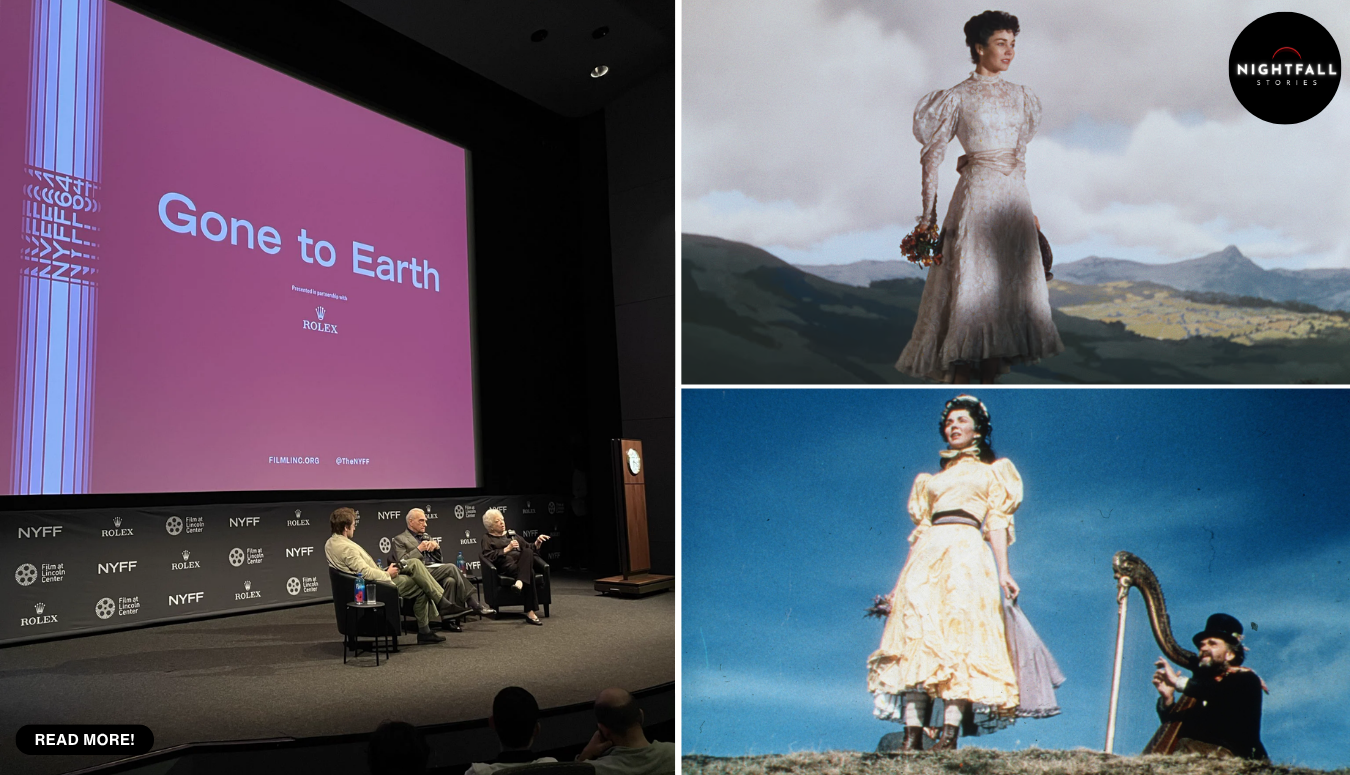
In 1950 Michael Powell and Emeric Pressburger finished a Technicolor film in the hills of Shropshire, in the west of England, and their American producer hated it. That part is ordinary. Producers and directors have been falling out since the first week anyone pointed a camera at anything. What David O. Selznick did next was not ordinary, and it is the reason a group of archives, a studio and one of the most decorated film editors alive have spent years on a single 111 minute picture.
Selznick had the film re-edited, had extra scenes shot in Hollywood by a different director, and released the result in 1952 under a different title, The Wild Heart, running 82 minutes instead of the original 110. And he made his changes directly onto the negative.
If you have never worked with film, that sentence lands softly. It should land like a dropped plate. The negative is the original. It is the strip that was actually inside the camera when Jennifer Jones walked across that hillside, and it is the only piece of film in the world that holds the full image. Everything else is a copy, and every copy is a step down: a little more grain, a little less detail, a little more contrast crushed into the shadows. When an editor cuts a film, they cut a work print, a cheap positive copy made for exactly that purpose. The decisions get written down as a list of numbers, and only at the very end does a specialist cut the negative to match. You can change your mind a hundred times before that point. After it, you cannot change your mind at all, because the frames you removed are no longer attached to anything.
So when Selznick re-cut Gone to Earth on the negative, he did not simply release a version he preferred and leave the directors’ version sitting on a shelf. He took the directors’ version apart and threw pieces of it away. There is no undo on a pair of scissors.
It gets worse, technically, because of how the film was shot. Three strip Technicolor did not use one roll of colour film. The camera held three separate black and white negatives behind a prism that split the incoming light, so one strip recorded the red information, one the green, one the blue. Put them back together in a dye transfer printing process and you get those saturated, slightly unearthly Technicolor colours. What it means for anyone trying to repair the film seventy odd years later is that the original negative is not one object but three, and all three have to line up frame for frame, perfectly, or the image goes soft and fringed with colour. Three strips of film that have sat in cans for three quarters of a century do not shrink at the same rate. They do not pick up damage in the same places. And if someone has gone through them with a blade, they have gone through all three.
That is the raw material. Thelma Schoonmaker has known about it for a long time, and she has said out loud, years before this restoration was finished, that it frightened her a little. Speaking to the film magazine Little White Lies a few years ago about which Powell films were still waiting to be rescued, she said that Selznick had cut into the original version, that frames and things were therefore missing, and that it was going to be a really hard one. She was not managing expectations for a press release. She was describing a job she already knew the shape of.
Schoonmaker is 86. She has been editing Martin Scorsese’s films since his first feature in 1967, she won an Academy Award for Raging Bull and two more for The Aviator and The Departed, and she holds the record for nominations in the editing category with nine. Woodstock, the film that made her name in 1970, is still studied for what she did with split screens and superimpositions on a mountain of unruly documentary footage. If you wanted to assemble a list of the people on earth best qualified to judge where a cut belongs in a picture, you would have a very short list and her name would be on it.
She was also married to Michael Powell. They married in 1984, when he was in his late seventies and his reputation had already been through a long cold stretch, and he died in 1990. She became his executor. In the decades since, she has worked on restoring his films the way other people tend gardens, patiently and repeatedly and for a long time with very little public reward: The Red Shoes, The Life and Death of Colonel Blimp, The Tales of Hoffmann, Peeping Tom. She has said that watching these films forty times over during a restoration does not wear her down, because they sustain her. She has also said, plainly, that when Powell died she did not much want to go on living, and that having to finish Goodfellas with Scorsese is what carried her through.
It would be easy and wrong to write her into this story as a widow guarding a legacy. The reason her involvement matters is not sentiment. It is that the central problem of this restoration is an editing problem, and she is one of the great editors. Someone has to decide, shot by shot, where a missing piece went. Someone has to look at a sequence reassembled from a print and say that the rhythm is wrong, that the cut lands two frames late, that this is not how Powell and Pressburger would have let it play. Nobody alive is better placed to make that call, and the fact that she also knew the director personally is a bonus on top of a professional qualification, not a substitute for one.
The route back ran through positive film. The restoration, credited as the work of Walt Disney Studios in association with Martin Scorsese’s Film Foundation and with the participation of the British Film Institute, the George Eastman Museum and the Museum of Modern Art, was built from positive materials held at the BFI together with what the festival programme calls the film’s tattered negative. Image restoration was handled by Cineric in New York and the audio by Audio Mechanics, with Schoonmaker credited as supervisor and special thanks to Scorsese and Steven Spielberg.
Unpack what that credit is actually describing. Where the negative survives, you scan the negative, and you get the best possible image. Where the negative does not survive, because somebody cut those frames out in 1952, you have to find a print that still contains them, and you scan that instead. Then you have two kinds of picture in the same film, and they do not match. A print is a generation away from the negative, so it carries different grain, different contrast, different colour. A print has also been through a projector, which means scratches, splices, dirt ground into the emulsion and sprocket damage down the edges. Matching the two so a viewer does not notice the join every time the film cuts to a repaired shot is the entire craft. It is painstaking, frame by frame work, and it is why a restoration of this kind takes years and why a list of institutions that long is on the credit.
The colour is its own nightmare. Three strip Technicolor was never meant to be read off a print and copied. The look of the film was created at the printing stage by laying dyes onto blank film, and the person deciding how saturated that green hillside should be was working inside a system that no longer exists in commercial form. So the grade on a 4K restoration of a Technicolor film is a judgement call every single time, informed by surviving prints, by what the technology could do, and by how the people who made it said it was supposed to look. Get it wrong in one direction and the film looks like a faded postcard. Get it wrong in the other and it looks like a modern film wearing a costume.
There is one claim around this restoration worth being careful about, and it is better to be straight about it than to repeat it. The Film at Lincoln Center programme note describes the screening as the first complete restoration of the original version of Gone to Earth. That phrasing is doing a lot of work, because the original full length version has been reassembled before. London’s National Film Archive, the BFI’s own archive, put together a full length Powell and Pressburger version decades ago, and it circulated in retrospectives; programme notes from those seasons describe the authentic version as having been triumphantly restored and revived at its original length. The BFI’s own listing for the new version, screening in London this month, calls it a major new restoration and does not claim it is the first complete one.
So the honest version is this. The original cut has not been missing from the world entirely. What is new is the level of the work: a 4K restoration built from the best surviving elements, with the colour reconstructed and the sound repaired, supervised by an editor of Schoonmaker’s standing. That is a smaller claim than first ever, and it is still a considerable one, because the earlier reconstruction was limited by the same physical problem and by the tools of its time. A film can be put back more than once, and each time the question is how much of the original information you can recover.
As for what Selznick actually did, the record is murkier than either side would like. He was involved during the shoot, disliked the finished picture, and went to court to force changes. He lost, but kept the right to alter the American release, which he used thoroughly. The reported alterations include a new prologue, explanatory scenes added to make the plot more legible, additional close ups of Jones, and the deletion of plot points he thought lacked impact. Rouben Mamoulian, a considerable director in his own right, shot the new material in Hollywood. Powell later claimed in his memoirs that only around thirty five minutes of the original survived in the American version and that Mamoulian had shot everything else, a claim that is hard to square with the running times and is best read as a wounded man’s estimate rather than a measurement.
Underneath the business dispute there was something more particular at stake, which is the reason this film keeps drawing people back to it. Gone to Earth is an adaptation of Mary Webb’s novel about Hazel Woodus, a young woman who refuses to be owned, by the father who wants her settled, by the clergyman she is pushed toward, or by the squire who hunts her the way he hunts everything else. Jones plays her. The film was shot in the landscape where Powell’s own father grew up, and it was made immediately after The Red Shoes, at the point where Powell and Pressburger were at the height of their powers and interested in exactly the kind of story that does not resolve tidily. The programme note calls it a tribute to those otherworldly landscapes, and that is the thing a producer chasing dramatic impact would be most likely to cut: the long looks at hills, the bits that are not plot.
Which is the quiet argument for why the restoration matters more than the row does. The version Selznick released was shorter, clearer and more conventional. The version he cut up was stranger, slower and more interested in a place. Those are not two edits of the same film. They are two different ideas about what a film is for.
The restored Gone to Earth had its world premiere in the revivals section of the 64th New York Film Festival, screening at the Walter Reade Theater, and it is also playing at the BFI London Film Festival. It runs 111 minutes. It is finished, it exists, and people are sitting in dark rooms watching it.
There is a detail in the credit that is easy to skip past. The production company behind Gone to Earth became, through decades of corporate acquisitions nobody involved in 1950 could have predicted, part of the same company that now owns the Selznick library. The studio that paid for this restoration is, in a legal sense, the inheritor of the man who took the negative apart. Whatever you think about how we got here, the bill for undoing it was paid by his successors.
And the person who signed off on each repaired cut was an editor who happened to be married to one of the men it was done to. She was not chosen for that. She was chosen because she is Thelma Schoonmaker and because the job was an editing job of the hardest kind, where the right answer has to be inferred from a gap. That the gap was cut into her husband’s film by someone who did not understand what he was destroying is a fact she has lived with for forty years and has mostly declined to be dramatic about. She said years ago that it was going to be a really hard one. It was. It is done.