The room at the senior center in Red Lodge, Montana was full, about 140 people in a city of 2,500, which is the kind of turnout a small town produces only when it is frightened or furious, and that night it was both. A few days earlier a black bear had followed a woman walking near the middle school. A driver coming the other way noticed the bear picking up speed behind her and swerved the car between them. She climbed in, and the bear put its paws on the vehicle and clacked its jaws at the window. Earlier in the season another black bear had bluff charged a city police officer three times in a single night.
So people came to the meeting wanting to know what the state was going to do about the bears. What the state’s bear management specialist, Daniel McHugh, told them instead was that the community loads the gun, and that when residents are angry at wildlife officers for killing bears, everyone in the room has a hand in it.
That is a remarkable thing for a public employee to say out loud to a crowded room of the public, and it is worth sitting with before going any further, because almost every incentive in his job pointed the other way. He could have absorbed the anger. He could have promised more traps, more patrols, more presence. Agencies do that constantly, and nobody gets fired for it. Instead he told roughly 140 of his neighbours, to their faces, that they were the mechanism.
By the time of that meeting, Montana Fish, Wildlife and Parks had killed six bears inside the Red Lodge city limits that year, two of them grizzlies. Six dead bears in a city that covers less than three square miles. The morning after the meeting, McHugh and a state bear technician named Oliver Thomi made it seven.
It is worth being precise about those numbers, because the figures that circulate with this story do not obviously fit together and the arithmetic is easy to get wrong. The six, two of them grizzlies, is a count of bears killed within the city limits as of the late August meeting, not six black bears plus two grizzlies on top. The seventh was the bear killed the following morning, also inside the city. Separately, officials had logged more than 200 conflict reports within fifteen miles of town since the bears came out of their dens that spring. That last figure counts a radius more than fifty times the area of the city, and it counts reports rather than animals, so it does not belong in the same column as the kill tally at all. Two numbers, two boundaries, two different things being counted. Anyone who adds them into a single total is inventing a figure that nobody has.
The reason all of this was happening at once has very little to do with the bears being bad and almost everything to do with a failed crop.
Bears in the northern Rockies spend the autumn in a state biologists call hyperphagia, which is a technical word for an eating problem so extreme it is better understood as a job. A bear going into its den has to carry the entire winter on its body. Everything it will burn between the first deep snow and the spring thaw, including the energy a female spends gestating and then nursing cubs in the middle of hibernation, has to be deposited as fat in the weeks before she lies down. The animal is not snacking. It is building the only resource it will have for months, against a deadline it cannot negotiate.
In a normal year that fat comes from a predictable sequence of wild foods. Chokecherries and serviceberries in the draws, huckleberries on the slopes, and in grizzly country the fat-rich seeds of whitebark pine, which are among the most calorie-dense things a bear can find in these mountains. The sequence is what makes an autumn work. The berries are not a treat, they are the paycheque.
Last winter in that part of Montana was dry, and a late freeze came through at exactly the wrong point in the season. Between them they took out the chokecherries, the huckleberries and the pine nuts across a wide area. Which leaves a bear with the same deadline, the same biological instruction to accumulate fat, and nothing on the hillside to accumulate it from.
A bear in that position does not go hungry quietly. It goes looking, and it widens its search until it finds calories. And Red Lodge sits at the mouth of a drainage that funnels animals coming down out of the Beartooth Mountains straight toward the town, where a creek runs through the middle of the city and the alleys hold everything a desperate animal could want. Unsecured garbage cans. Bird feeders. Fruit trees that nobody picked. Chest freezers in open garages. Dog food on porches. Backyard chickens.
The calories in a single poorly secured residential alley, measured against what a bear would get working a failed berry patch for the same hours, are not a close contest. Nothing about this requires a bear to be aggressive or unusual or broken. It requires a bear to be good at arithmetic, which bears are.
That mechanism explains the whole season without anybody being to blame for it. The dry winter is nobody’s fault. The late freeze is nobody’s fault. The drainage has been pointing at that townsite since long before the town existed.
What is somebody’s fault is what the bears found when they arrived, and that is where the story stops being about weather.
Shawn Stewart, a state wildlife biologist who has worked for the Montana agency for more than fifty years, has seen the berry crop fail before. He told the meeting about 1986, when there were ten or fifteen black bears in the town’s alleys every night and the Beartooths lost around thirty per cent of their black bear population. So the collapse itself is not new, and that matters, because it means the thing people keep calling unprecedented is actually the familiar part.
What Stewart said was new is the behaviour. In his telling the agency had simply never had bears approaching people. It had never had bears stalking people. And this year he watched all of those behaviours escalate in a way he described as alarming. That is a man with half a century of field experience saying the animals are doing something he has not seen them do.
Bears get to that point by being taught, and the teaching is not a mystery to the people who study it. Montana’s own statewide grizzly management plan defines a food-conditioned bear as one that has learned to associate people, human activity, human spaces or food storage containers with food. The plan is blunt about how that association forms. If human food is easier to get than wild food, bears tend to overcome their natural wariness of people in order to reach it. The wariness is not destroyed from the outside. It is unlearned, one easy meal at a time, by an animal doing exactly what the reward structure tells it to do.
And in Red Lodge, at least some of those meals were being put out on purpose.
This is the part of the story with a hole in the middle of it. Officials believe somebody in or around the town has been deliberately feeding bears. The game warden working the area, Matt Heaton, said he would normally field somewhere between one and ten calls a year about people illegally feeding deer. Over the past two seasons he has been getting calls in which the caller says they believe the person is feeding bears as well. He has had photographs and video of bears coming and going from bait sites, on private ground and on public ground both. Bear baiting is illegal in Montana. The feeding is documented. The feeder has not been identified, and nobody in town who knows is saying.
It is worth being clear that this is not a grey area in law. Under Montana Code Annotated 87-6-216, unlawful supplemental feeding, it is an offence to purposely or knowingly attract bears, ungulates, mountain lions or wild turkeys with supplemental feed attractants. The statute also catches a second, softer case. If someone has already received a warning and then negligently fails to store attractants properly, and bears get into them, that is a violation too. Conviction carries a fine of between 50 and 1,000 dollars, or up to six months in a county detention centre, or both, plus possible forfeiture of hunting and fishing licences. The law does not distinguish between malice and sentiment. A person who sets out food because they love watching bears and a person who sets out bait are committing the same offence.
What happens next to a bear that has learned to eat from people is the question most residents get wrong, and it is the reason a meeting like that one turns hostile. The assumption in the room is almost always that the animal can be driven somewhere else. In practice that option closes early. Weeks after the Red Lodge meeting, the same agency euthanised fourteen black bears found on a single property north of Bozeman, and its explanation of why is the clearest public statement of the rule anyone is likely to get. The bears were unafraid of people and had stopped relying on wild food, which made them a human safety risk, and the agency said plainly that this behaviour cannot be corrected through rehabilitation or relocation.
That is the sentence that makes McHugh’s line about loading the gun something other than a rhetorical flourish. Relocation works on a bear that still thinks of people as a reason to leave. Once the animal has learned that a human neighbourhood is a reliable food source, moving it changes its address and nothing else. The learning travels with it. By the time a bear is in a trap with a kill decision attached to it, the thing that determined the outcome happened months earlier, in somebody’s alley, and the officer with the needle is not the one who made it.
Thomi put it to the meeting from the other side of the counter. What people do not see, he said, is that the team had been trying for roughly two years to keep that particular bear out of trouble.
None of this was confined to one town. Elsewhere in the region the same autumn was producing the same results. In Colorado, by the end of last August, close to 300 bears had reportedly been killed for getting into conflict with people and property, and officials in Wyoming were describing their own conflict season in terms that amounted to calling it unprecedented. Those regional figures come from a single piece of reporting rather than from agency tallies pulled directly, so they are best read as scale rather than as audited totals. The shape they describe, a bad food year translating into dead bears across several states at once, is not in dispute.
Red Lodge also had a specific reason to be nervous beyond property damage. Two years earlier, a black bear had got into a tent and injured a child. The fact is part of the record and it belongs in any honest account of why 140 people turned up to a meeting about garbage cans. It does not need describing further than that.
The morning after the senior center meeting, McHugh, Thomi and a third technician named Myles Steinmetz, hired on an emergency basis because the season had outrun the staff the agency actually had, drove out before dawn to a culvert trap set in a resident’s backyard near the creek. They carried bear spray, because the bait in the trap was aging deer and a corridor known for bears does not stop being one just because a trap has gone off in it.
Thomi had been up roughly thirty hours since the weekend. He said you do not get much sleep in years like this one, and that it takes a toll on the home life.
The bear in the trap was a small male black bear with a broad head and a brown muzzle, and it looked healthy. It huffed and lunged at the cage while Thomi looked it over. They hitched the trap and drove it to a gravel parking lot outside town, because there is no facility for this and never has been. A lot of bears have died here, McHugh said when they arrived.
They identified it as the bear that had followed the woman near the middle school, an animal with a long record behind it. McHugh said he hoped it would be a very long time before they had to do this again, and then corrected himself in the same breath, because realistically it would be two days, if they made it that long.
He drew up Telazol and put it into the bear’s shoulder. The bear pulled the needle out with its teeth. The sedative took hold anyway within a few minutes.
Thomi used a .22 revolver, which McHugh described as the fastest and most humane method available to them. Lethal injection was ruled out for a practical reason that tells you something about how little of this work is clean: the drugs would stay in the carcass and could kill whatever scavenged it.
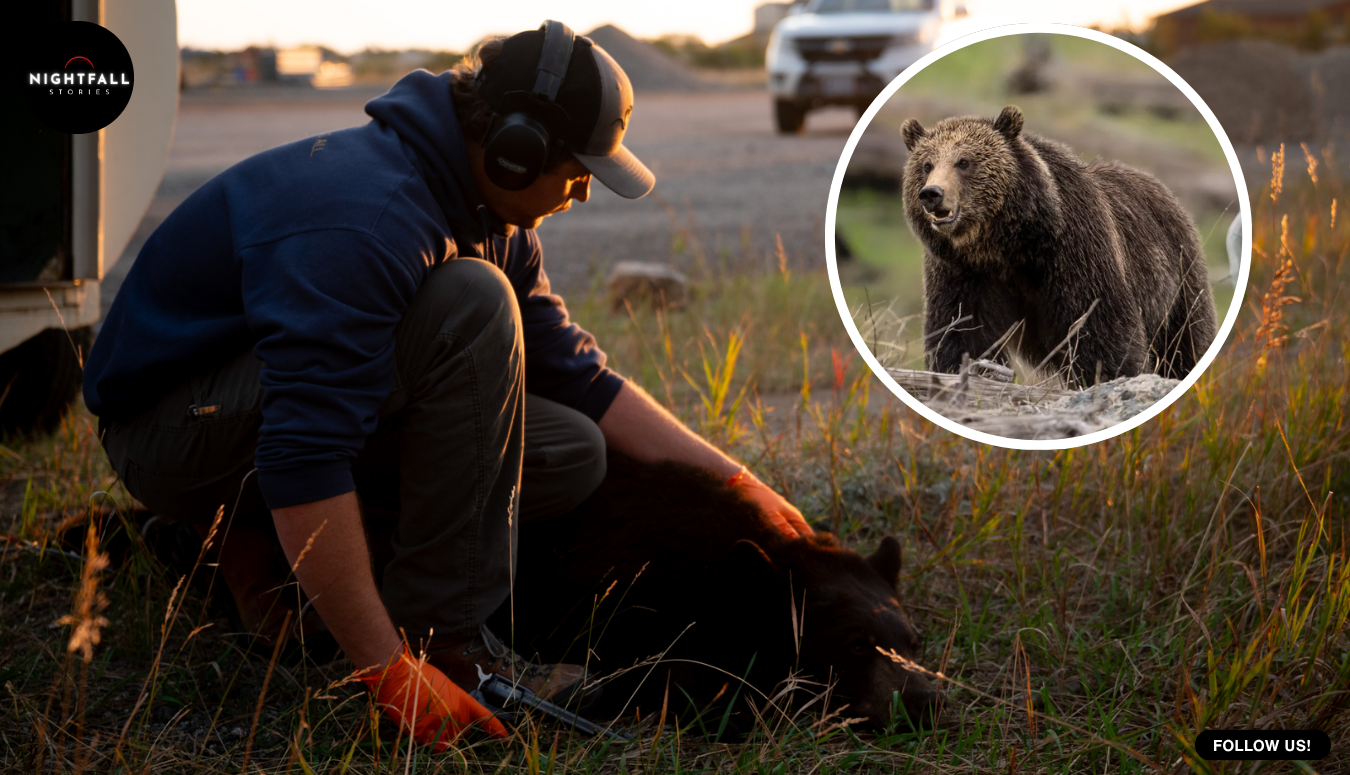
Thomi put on hearing protection, knelt down beside the sedated animal, and positioned the barrel below its ear. This was the seventh bear killed inside Red Lodge that year.
Another wasted bear, McHugh said. This town sure likes to waste their bears.
After the shot the lot went quiet except for traffic on the road. The sun was coming up. Thomi lowered the gun, and then he reached down and stroked the dead bear’s fur.
He had just killed it, as part of his job, and then he touched it. That is all. It is not a redemption and it does not undo anything. It is what a person does.
The bears are dead and there is no appeal. The question the season leaves open is not a philosophical one. Somebody in that town is still putting food out, the warden has pictures of the bait sites and not of the person, and the men who spent their summer killing bears they did not want to kill are the ones who will be out there before dawn next autumn if the berries fail again. The bears were never the problem. The problem has a name and an address and nobody is saying it.