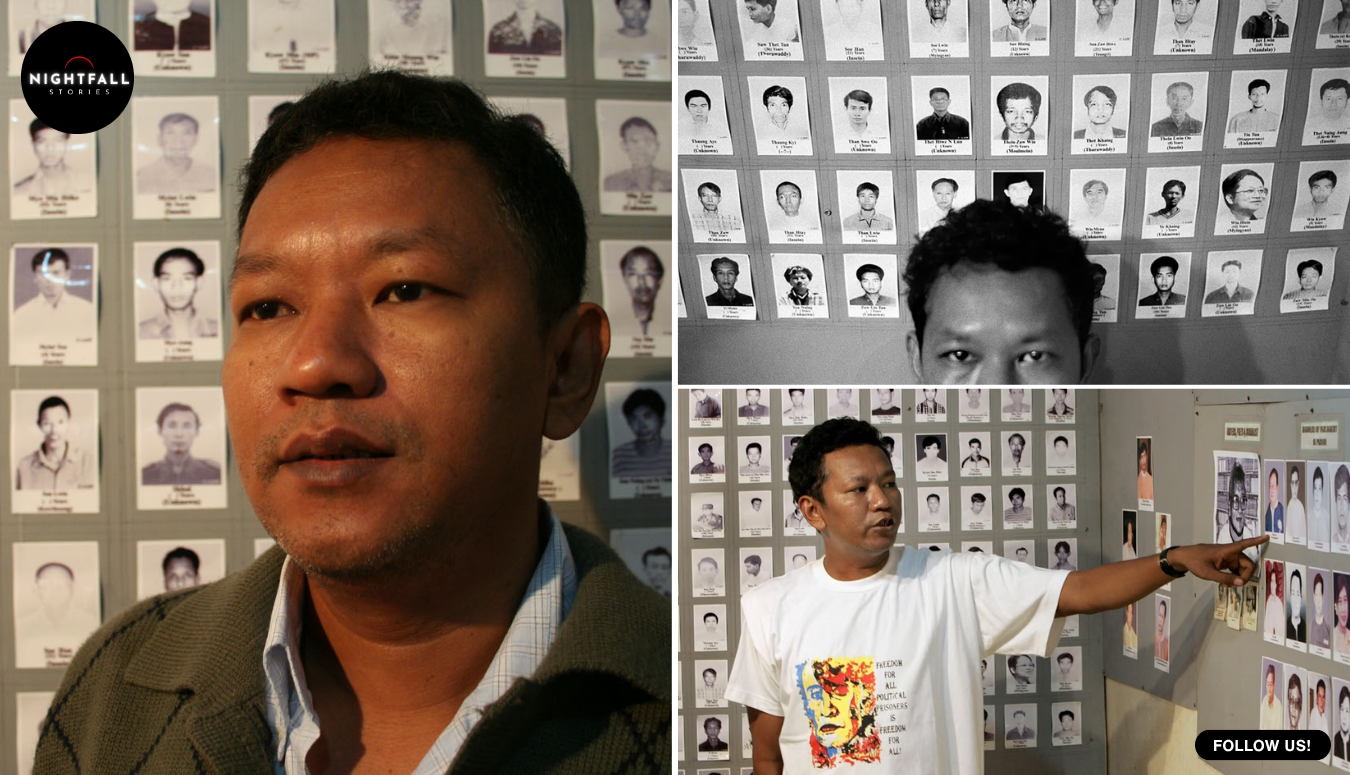
The offer was simple, and it was the kind of offer that works. Bo Kyi had already served one stretch in a Myanmar prison for taking part in the pro-democracy uprising of 1988, when he was a student at Rangoon Arts and Sciences University. He was out. Military officials came to him with a proposition: work for us, tell us who the activists are, and your life gets easier. He said no. By one account of the exchange he answered their offer with conditions of his own, that they release all political prisoners and open a dialogue with Aung San Suu Kyi, which was not a counter-offer so much as a way of declining without pretending to be polite about it. He was arrested again.
That is the whole story in one paragraph, and everything Bo Kyi has done in the thirty-odd years since follows from it. He had a door in front of him and the price of walking through it was other people’s freedom, and he shut it and went back to a cell. Nobody filmed it. There was no crowd. It is the kind of decision that leaves no record at all unless the person who made it survives long enough to be asked about it, and even then it sounds small when described, because the alternative version of his life, the one where he said yes, would have looked from the outside like an ordinary life.
Earlier this autumn he was named a Ramon Magsaysay Award laureate, the recognition often described as Asia’s Nobel Prize. The award body’s citation talks about extraordinary moral courage, personal sacrifice, and an unwavering belief that democracy and human dignity are always worth defending. Which is accurate and also tells you nothing about what he has actually been doing for the last twenty-six years, because the honest answer to that is clerical. He has been keeping a list.
Go back to the prison first, because there is one detail from those years that explains the rest of him better than any account of his treatment would. Bo Kyi taught himself English inside the cell. He did it by writing on the concrete floor with a piece of broken brick, which is what was available, and by taking lessons from a professor held in the next cell along. The professor would speak a sentence or two in English when the guard was out of earshot, and Bo Kyi would take it and work on it. He hid whatever study material he had accumulated every time a warden came past.
Think about what that requires. Not courage exactly. Patience of an almost inhuman order, and a particular kind of faith: that there would one day be a reason to have English, in a cell where the evidence pointed the other way. A man scratching letters into a floor with a brick fragment, learning a language one whispered sentence at a time, is not resisting in any way that inconveniences his jailers. He is making a bet on a future he has no reason to expect. The language is why he can now sit in front of foreign journalists, diplomats and award committees and give them numbers in their own vocabulary. The brick did that.
Accounts of the imprisonment itself differ in their detail, which is normal for Myanmar in that period and worth stating plainly rather than smoothing over. The award body’s own biography has him first arrested after the 1988 demonstrations, imprisoned twice, accumulating seven years in detention, released once in 1993 and again in 1998. An earlier profile by an international rights organisation dates an arrest to 1990 and gives a single sentence of seven years and three months. The totals are close enough that the shape is not in dispute. He went in as a student in his early twenties and came out, finally, in his late twenties, having spent most of the decade inside. He has never offered the physical particulars as his story, and they are not the point here either.
What he did on getting out the second time was leave. He crossed to Mae Sot, the Thai town on the Myanmar border that has absorbed exiles, refugees, clinics and opposition organisations for decades, and in March 2000 he and other former political prisoners founded the Assistance Association for Political Prisoners. Its founding principle has been quoted ever since: as long as political prisoners exist inside Burma, Burma will not be free. The organisation still gives its base as Mae Sot and Rangoon.
One thing about that founding is worth pausing on, because it is not incidental. AAPP was set up by former political prisoners, not by lawyers or academics or sympathetic outsiders. The people who built the register had all been on it. That is why the organisation knows what questions to ask a man who has just come out, and which answers are likely to be wrong, and how long to wait before asking anything at all. It is also why the work has a built-in expiry problem that nobody talks about, because the founding generation came out of the prisons of the 1990s and the people filling the cells now were not born when the brick was scratching the floor.
Mae Sot matters too. It is a border town, and border towns are where this kind of organisation can exist at all: close enough that information still arrives, far enough that the people handling it are not immediately reachable. An outfit documenting Myanmar’s prisons cannot be inside Myanmar. The entire structure of the work is a consequence of that single geographic fact, and so is the exile of everyone doing it.
Now, the list. This is the part that deserves the length, because it is the part that gets skipped.
The work of AAPP is to know, by name, who is being held for political reasons inside Myanmar, and to keep knowing it as the number changes. That sentence hides an enormous amount of labour. A political prisoner is not an entry in a public register. Arrests are frequently unacknowledged. Families are not told where someone has been taken, or whether they have been charged, or with what. Sentences are handed down in closed hearings. People are moved between facilities without notice. Someone released may be rearrested within weeks, which means the list is never finished, only current.
So the record has to be built from the outside in, which is slow and relies almost entirely on trust. Former prisoners are interviewed when they come out. Families come forward, or they do not. Lawyers, local networks and other organisations pass on what they have. Every name that arrives has to be checked, because an unverified report that goes into a public tally and turns out to be wrong damages the credibility of the whole record, and the credibility of the record is the only asset the organisation has. So AAPP does something unusual and quietly brave for an advocacy group: it publishes its uncertainty. Its running figures separate the detainees it has verified from the detainees it has not yet been able to verify. The second number is large. Keeping it visible rather than folding it into the headline total is a decision that makes the organisation look less impressive and the data much more useful.
By AAPP’s own tallies, published and updated continuously, something over thirty-two thousand people have been arrested for political reasons since the military coup of February 2021. Close to fifteen thousand are recorded as verified in detention, with another seven or eight thousand reported but not yet verified, which is where the roughly twenty-two thousand figure that circulates in reporting comes from. Over nine thousand people have been released. AAPP also maintains a count of those killed by the military since the coup, which stands in the thousands. All of these are the organisation’s own estimates, compiled in the way described above, and they should be read as such rather than as official statistics, because no official statistics exist.
The coup of 2021 changed the scale of the job rather than its nature. Before it, the counting was a matter of hundreds and then thousands; an international profile of Bo Kyi from the late 2000s put the number of political prisoners then held at around nineteen hundred. Then in a matter of months the arrests ran into five figures and the organisation had to move from periodic reporting to a daily briefing, because a monthly figure is useless when the number moves that fast. An outfit built by a handful of ex-prisoners in a border town absorbed that, and is still absorbing it.
Bo Kyi has also given a plainer measure of the limits of the work. By his account there are around forty-nine prisons and detention centres in the country. AAPP is able to reach into about thirty-three of them, and through those it supports somewhere in the region of five thousand prisoners and family members. Sixteen facilities, then, that it cannot get near. He does not present the gap as a failure. He presents it as the size of the job.
That reach is not only paperwork. The organisation’s work includes getting money and medical help to people inside and to the families left outside, monitoring conditions as far as it can, and running rehabilitation and assistance programmes for activists after release, which matters more than it sounds, because a person who has lost years and a career and sometimes a family comes out into a country that has no place for them. Since the coup AAPP has produced a daily briefing and a monthly data dashboard, which is the public face of the counting.
The cost of keeping a list like this is not abstract. Everyone who feeds information into it takes a risk by doing so, and so the methods have to stay out of view, which means the organisation can never fully show its work, which means it is permanently open to the accusation that it is making the numbers up. It has to be scrupulous precisely because it cannot be transparent. The people who do this work also cannot go home. Bo Kyi has been in exile since the late 1990s and operates from Thailand, and there is no public indication that he has been able to return to Myanmar in all that time. The country he keeps the register of is one he knows now mostly through other people’s testimony.
And the register is used. Governments, United Nations bodies, courts assembling evidence, bar associations, foreign ministries drafting sanctions, journalists and advocacy campaigns all need to be able to say how many and who, and when they do, the figure very often comes from this organisation. One of the stranger facts about international human rights machinery is how much of it rests on small outfits of exiles with a database. When a minister somewhere cites a number of political prisoners in Myanmar, a chain of custody runs backwards from that podium through a briefing paper, through a monthly dashboard, to an interview conducted with somebody who just got out, and before that to a family member who decided to risk telling someone.
Which is what makes the Magsaysay a slightly odd fit, and also the right one. The award has gone to three people this year, including a Singaporean diplomat and a Bangladeshi social entrepreneur, both of whom have built things you can point at. Bo Kyi’s body of work is a spreadsheet that nobody wants to exist. The citation reaches for the language of moral courage, which is fair for the man who refused the informer’s job in the 1990s, but the twenty-six years since have called for something much less dramatic and much harder to sustain, which is the willingness to do the same careful, unrewarding, unfinishable task every month while the thing you are counting gets worse.
Because it has got worse. That is the uncomfortable arithmetic sitting underneath the prize. The organisation was founded by men who had been political prisoners in the 1990s, at a point when the number inside was in the low thousands. A quarter of a century later, after a brief democratic opening and then the coup that closed it, the number is several times that. Bo Kyi has spent his adult life on this and the list is longer now than when he started.
It would be easy to turn that into despair, and he does not. Nothing in the record suggests he treats Myanmar’s situation as hopeless or as fated, and the work itself is an argument against both readings, because you do not maintain a careful register of the imprisoned unless you believe somebody will one day need it. A list is a bet on accountability. It assumes a future in which names matter: release negotiations, legal proceedings, a transition, a family finally told where someone is. If the future never arrives, the list was still the right thing to have kept. If it does arrive, the list is the only reason anyone will know who to look for.
The award ceremony falls later in the year, and a man who cannot go home will collect a prize in a country that is not his for keeping the count of a country that is. There is no neat ending available here, and inventing one would be a disservice.
So here is the real one. In the 1990s Bo Kyi was offered a way out of a cell in exchange for names, and he refused to give them, and went back inside. Everything since has been the same decision pointed the other way. For twenty-six years he has been collecting names, as carefully and as verifiably as it can be done from outside a border, so that the people inside are not simply absent. He would not give up a single name to the people who were holding him. He has given tens of thousands of them to the rest of the world, which is the only form of protection available to someone in his position, and he will be adding to the list next month.