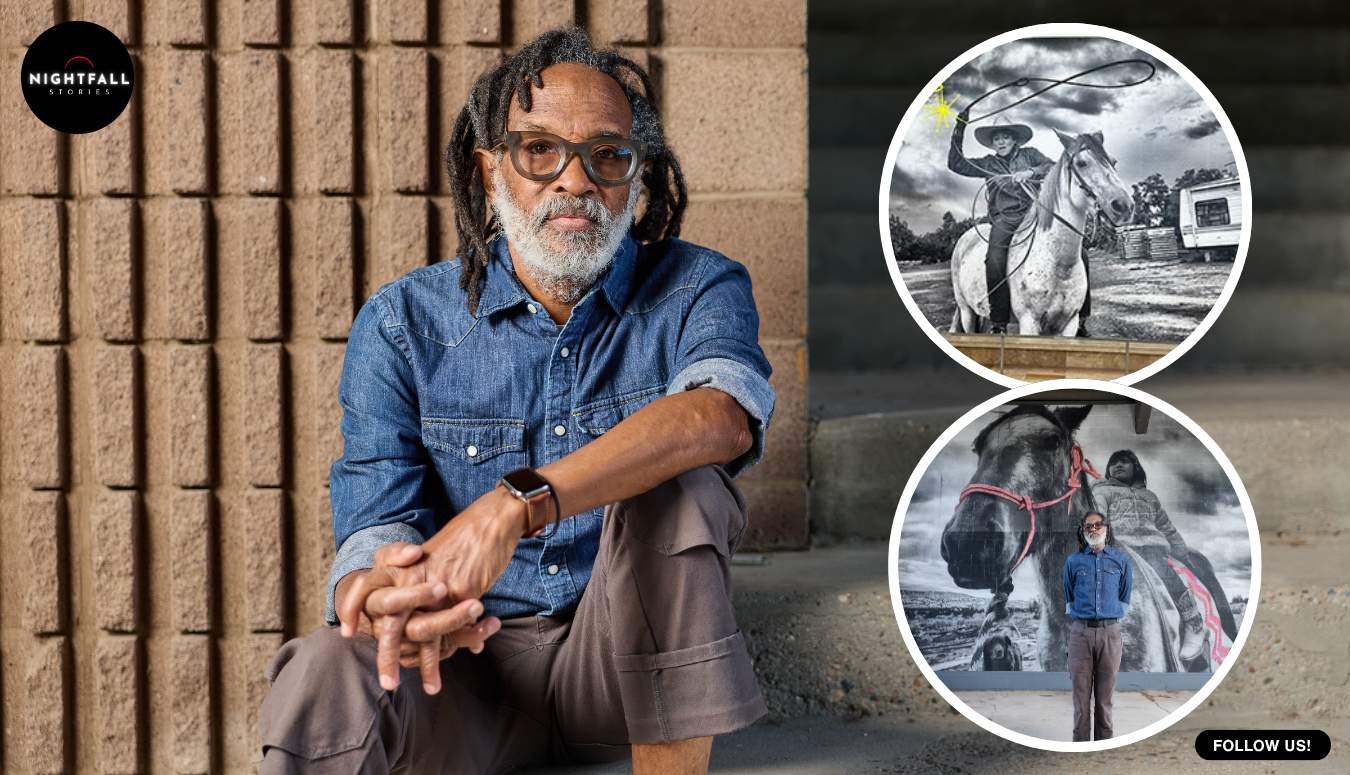
In 1987 a young physician named Chip Thomas took a posting at the Inscription House Health Center, a small Indian Health Service clinic on the Navajo Nation in northern Arizona, and he was still working there 36 years later. The clinic sits in the stretch of country between Monument Valley and the Grand Canyon. He arrived with a four-year obligation to the National Health Service Corps, which is the programme that sends new doctors to places that cannot otherwise recruit them, and which most doctors complete and then leave. He finished his in 1991 and stayed another 32 years.
Somewhere in the middle of that, he began pasting photographs onto the sides of water tanks.
Not small photographs. Enormous black and white prints, pasted up at the scale of a building, on roadside structures along the highways of the western Navajo Nation: water tanks, the plywood sides of roadside stalls, sheds, abandoned buildings. A forearm tattooed with the words Native Pride, running 30 feet across a wall in Flagstaff. An image of a Navajo Code Talker on a roadside stand, which turned the stand into somewhere people stopped. Faces, mostly. The faces of people who live in the country the highway runs through, put up at a size that makes them impossible to drive past without seeing.
He has done this since 2009, and in 2012 he gave the wider effort a name, the Painted Desert Project, and began bringing other artists in. He signs the work as jetsonorama. He retired from medicine in 2023. Last week, at 69, he was named a MacArthur Fellow.
The fellowship is the reason you are reading about him, and it is close to the least interesting thing about him, so let us get it out of the way. Twenty people were named, the award carries 800,000 dollars paid over five years, and there are no conditions on how it is spent. The foundation’s citation describes him as a public artist turning neglected spaces into public works grounded in community history. That is accurate and it is also a sentence that could describe several hundred people. What it does not capture is the thing that makes this unusual, which is that for most of the years the work was being made, the man making it was also the doctor.
Those two facts are not adjacent. They are the same fact.
It is worth sitting with the 36 years for a moment, because the number is the part most likely to be skimmed past, and it is the part that is genuinely hard to do. The Indian Health Service is the federal agency responsible for health care for tribal nations in the United States, and it has struggled to keep doctors for as long as anyone has been measuring. A review by the Government Accountability Office published in 2018 found that across the agency’s eight geographic areas the overall vacancy rate for providers, a category covering physicians, nurses, nurse practitioners, physician assistants, dentists and pharmacists, stood at 25 percent, and ranged as high as 31 percent in some areas. One position in four, unfilled. The reasons the review identified were not mysterious: the facilities are rural, often very rural, there is frequently not enough housing for the staff you are trying to hire, and the agency cannot match what the same doctor would be paid in a city.
The practical consequence of a vacancy rate like that is not an abstraction, and anyone who has lived somewhere underserved knows what it is. It is a different face every time. The doctor who knows your family history is replaced by one who has to read it off a screen, and then that one leaves too, and the people who most need continuity of care get the least of it. Against that, one physician in one small clinic for 36 years is not a nice biographical detail. It is the entire difference between being treated and being known.
Consider how he got the photographs. He has described the mechanism himself, more than once, and it is not a photographer’s method. At the end of a clinic visit he would ask people whether he could come and see them at home, and then go, and help. Herd sheep. Haul wood. Whatever work was happening around the place that day. Over years, that turned into friendships that existed outside the examination room, and the photographs came out of the friendships rather than the other way around. His own account of it is that by spending time with people in their homes and family camps he came to know them as friends and not just as patients. Before he raised a camera he asked whether they were comfortable with him bringing it.
This matters more than it might sound, because the obvious version of this story is a bad one. A doctor with a camera in a small community holds a quantity of power that would make most ethics committees go quiet. He is the person people come to when they are frightened. They cannot easily say no to him. If the photographs had been taken on that footing, nothing about the scale or the beauty of the finished work would redeem them, and the honest thing to do with the story would be to not tell it.
What is on the record cuts the other way, and it cuts that way consistently across sources that do not depend on each other. His own account is that the relationships preceded the pictures and that consent was asked for explicitly. A master’s thesis on the murals, written at the University of New Mexico in 2020 by Mandolen Sanchez, describes the images as being placed on and around the reservation specifically so that they are shared with the people who originally allowed him to photograph them. And people who have been depicted have spoken about it on the record and in their own voice. Cyndy Begaye, whose father appeared in one of the pieces, has said that the first time she saw it she was moved to tears. A colleague from the clinic has described the murals as reflecting back everyday life by someone who understands it.
That last point is the one Thomas himself puts at the centre of why the work moved outdoors at all. He had begun getting gallery shows around the country, and realised that the people in his photographs were the only people who never saw them whole. The pictures were travelling to cities to be looked at by strangers. So he stopped doing that as the primary thing and started putting the work where the people in it live, on the grounds, as he has put it, that what he wanted was to reflect back to the community the beauty it had shared with him. He has also described the whole enterprise as an extension of his medical practice, aimed at restoring balance, which is a doctor’s way of describing an art project and tells you which of the two careers he thought was the main one.
Now the part that does not resolve cleanly, because it should not be smoothed over.
The permission of the people in the photographs is documented. The permission for the walls was not always. Thomas has said so himself. He adopted the name jetsonorama in part because he did not always have the consent of the owner of the wall he was working on, and he has talked about the appeal of working that way in terms of it being democratic: if people do not like something, it is gone. Work has been removed. He has treated that as the deal.
Those are two different questions and they deserve to stay separate. One is about people, and about whether a community’s faces were used without agreement, and the answer there is that they were not, by every account available including the accounts of the people depicted. The other is about property, and about plywood and corrugated iron and water tanks, and the answer there is that the arrangements were sometimes informal and he has never claimed otherwise. Treating the second as if it contaminated the first would be sloppy. Pretending the second did not happen would be worse.
There has been friction of another kind too. A piece he made about protecting the Grand Canyon from uranium mining drew two people from the community who came and told him to his face that they objected, at a time of high unemployment, to an outsider campaigning against the kind of development that might bring work. That is a real argument and it is not a trivial one. Uranium mining on and around the Navajo Nation is one of the most charged subjects there is, with a long and bitter history of contamination and unpaid consequences, and also a history of being one of the few industries that ever paid local wages. Thomas kept making work about it. In 2024 he installed a photographic project explicitly about uranium mining and its effects, under the title panaceas, promises and problems. Reasonable people in the same community disagree about whether he should have.
Which brings us to the fact the piece cannot be written without, and which he has never hidden. He is not Navajo. He grew up in Raleigh, North Carolina, born in 1957, took a degree at Wake Forest in 1979 and a medical degree at Meharry Medical College in 1983, and he is Black. He describes himself on his own website, writing about the period when the mural work began, as a black doctor in his fifties working on the Navajo Nation. He has a son who is half Navajo. He has lived there since 1987, which by now is the majority of his life.
He is also entirely direct about what that does and does not buy him. Asked about it, his position has been that being a non-Navajo person, he will always be viewed as a non-Navajo person. There is no claim of adoption in that, no suggestion that long service converts into belonging. It is a statement about a permanent condition, offered without complaint.
What he has built in response is procedural rather than rhetorical, which is the most interesting thing about the Painted Desert Project as a structure. When he brings outside artists in, and more than 20 have come, among them Roa, Hyuro, Pixel Pancho and Alexis Diaz, they do not arrive with a design. They meet with elders first, to learn what imagery would not be appropriate and what subjects are not theirs to handle, and only then make something out of what they have actually encountered. The project’s own framing of why it works this way names the thing it is trying to avoid by its proper name: the charge of cultural imperialism that gets levelled, often correctly, at large street art festivals that descend on a place, extract its visual interest and leave.
Whether that is sufficient is a judgement, and it is the reader’s to make rather than this article’s. The case for it is that the photographs were consented to by people who have said publicly that they are glad of them, that the work was deliberately moved out of galleries and onto roads so those same people could see it, that the visiting artists are briefed by the community rather than by the curator, and that the man doing it had already spent decades being the person who showed up when someone was sick. The case against it is that none of that changes who holds the camera, who decides which face goes up 30 feet high, and whose name is on the fellowship.
Both of those can be true. They probably are.
The scholarly reading of the murals, in that New Mexico thesis, puts the work in a specific historical argument that is worth knowing about. Nineteenth and twentieth century photography of Native American people was used, extensively and deliberately, to present them as a vanishing race, a people in the act of disappearing, which was convenient for everyone doing the disappearing. Enormous photographs of living people, pasted at the edges of the roads they actually drive on, doing the work they actually do, argue the opposite. The thesis makes a further point that is almost too neat: in that exchange it is not the people who are ephemeral. It is the murals.
Because they are. This is paper and wheat paste on metal and plywood in high desert country, and the climate there is not gentle. The sun takes the contrast out. Wind gets under an edge and lifts it. Rain pulls a corner loose and then the next storm takes a whole panel. The structures themselves are working structures, which means they get repainted, re-signed, demolished, or simply used, and a water tank does not exist to be a gallery wall. Every piece is temporary and he has always known it. The thesis puts it as the murals altering with the surrounding landscape, which is a polite way of saying they come apart.
There is no conservation programme. There is no plaque. The pieces that are gone are gone, and the record of most of them is a photograph of a photograph.
So he puts up more.
That is the actual shape of 39 years in one place, and it is why the fellowship is the wrong ending. A man arrived to do one job for four years, among people who were not his, and did that job for 36. In the middle of it he found a second job nobody had asked him to do, which was to make the people he was treating visible to the strangers driving through their country at 65 miles an hour. He asked them first. He put the results where they could see them rather than where collectors could. He did not always ask the wall. He got argued with and kept going. The work does not last, and it was never going to, and the response to that has never been to find more durable materials.
It has been to get the bucket out, mix more paste, and go back out to the road.