Forty were asked for. Thirty nine were approved. One was declined, on the ground that it could not be clearly established as Naga at all.
That single refusal is the most interesting thing in a story that is otherwise being reported as a museum handing something back. Repatriation announcements almost always arrive as a clean number and a photograph of people shaking hands, and the number is always the number that was requested. Here the number came back one short, and the reason it came back one short is what makes the other thirty nine credible. A process that can say no about one set of remains is a process whose yes about thirty nine means something. If every claim were simply granted, the grant would be an administrative courtesy. Because one was not, the thirty nine are a finding.
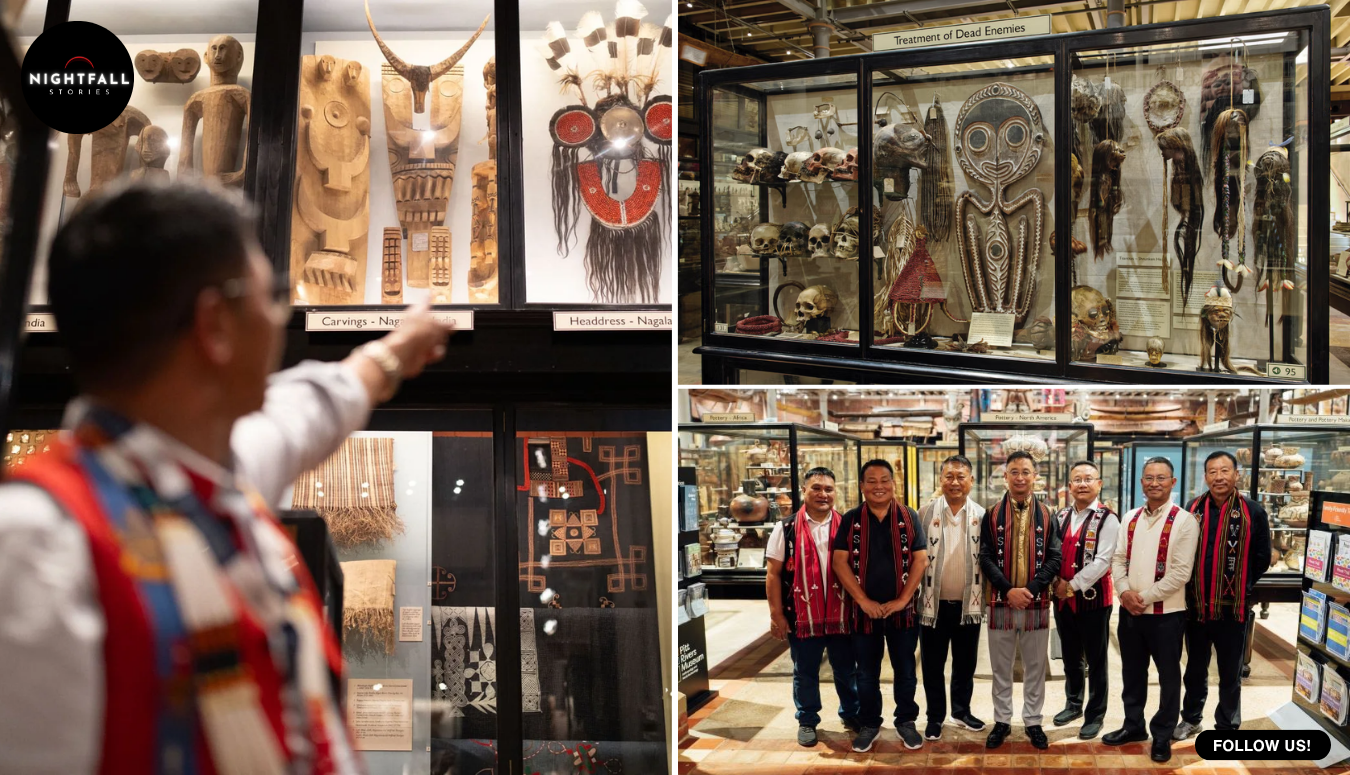
The ancestors in question were taken from what is now Nagaland, in the far northeast of India, and sent to the Pitt Rivers Museum in Oxford between roughly 1910 and 1940 by two British colonial administrators and anthropologists, John Henry Hutton and James Philip Mills. Both men collected on a scale that is hard to picture now. Their material made the Pitt Rivers the holder of the largest Naga collection in the world, which is a sentence that can be read two ways and is usually only read one.
The remains stayed in Oxford for a century. In 2020 the museum took all human remains in its care off public display, and that is the point at which this becomes an unusual story rather than a familiar one, because the next move came from the institution rather than from the community. The Naga anthropologist Dolly Kikon, now at the University of California, Santa Cruz, made contact with the museum’s director, and the museum reconnected with Naga partners rather than waiting to be asked. That is not how most of these cases begin. It deserves to be stated straight, without turning the museum into the hero of a story whose actual work happened eight thousand kilometres away.
Because the work did happen there, and it took about six years, and it is the part that nobody reports properly.
The Forum for Naga Reconciliation, a long established body that had spent years on peace and reconciliation work inside Naga society, began reaching out to the Naga tribe Hohos. A Hoho is an apex tribal body, the organisation that speaks for a tribe, and there are many of them, because the Naga are not one people in the way outside coverage tends to imply. They are many distinct communities with their own languages, their own customary law and their own named institutions. The Tangkhul Naga Long, the Phom People’s Council, the Angami Public Organisation, the Sumi Hoho and others each represent a different community with its own view of what ought to happen. Any decision that was going to hold had to be a decision all of them had reached, and that is exactly why it could not be done quickly.
In 2021 the forum formed a dedicated team called Recover, Restore and Decolonise, built around the academics Dolly Kikon and Arkotong Longkumer, who teaches at the University of Edinburgh, together with coordinators on the ground. Rev Dr Ellen Konyak Jamir took on the coordination of the whole effort, and she is the person at the centre of this story in the sense that matters: she is the one who had to hold a consultation across dozens of communities together for years without it fragmenting.
What a consultation like that actually involves is unglamorous and slow. It means getting into a village, sitting with people who have no particular reason to trust a delegation from anywhere, and explaining a situation that is genuinely hard to explain: that a person from your community, taken before most living people were born, is in a storeroom in England, and that a decision now has to be made about them by people who never knew them. Then it means listening to what the village says, which will not be the same as what the last village said, and carrying that back. Then doing it again. Across many communities, in many languages, over years, with the forum’s own standing as a reconciliation body the only thing holding the whole conversation together.
Much of the early work happened online, during the pandemic, in conversations between the forum, the museum and Naga elders. Then it moved into the villages. The team ran participatory research with communities across the Naga homeland, working through tribal Hohos, church bodies, student organisations, elders and intergenerational sessions. The forum also started holding an annual public gathering in Dimapur, the September Dialogue on Naga repatriation, decolonisation and healing, the first of which in 2021 was described as the first Naga public lecture on repatriation. It was not a legal campaign with a public relations arm. It was a long argument conducted mostly among Naga people about Naga ancestors.
And the question being argued was not the one you would expect. The obvious question, do you want them back, turns out to be the easy half. The hard half is what should happen to them when they arrive, and that question has no neutral answer in a society with many communities, several generations of differing belief, and a strong church presence alongside older customary practice. Ancestors taken generations ago from villages whose boundaries, names and populations have since changed cannot simply be handed back to an address. Some of them cannot be traced to a village at all.
What the communities decided, collectively, is the detail that tells you how seriously the consultation was taken. They chose not to send individual ancestors back to individual villages. They chose a single shared burial site, with a Naga monument of healing and peace, intended to stand for all generations and to express the oneness of the Naga people. In a place defined by the distinctness of its communities, dozens of separate bodies agreed to one grave. That is a far bigger concession, and a far more interesting one, than any museum decision in this story.
Rev Dr Ellen Konyak Jamir has been explicit that the treatment of the remains should follow what the communities themselves believe should be done, without being forced into a theological frame. Thejao Vihienuo, president of the Angami Public Organisation, has said the resting place has been identified and that the Nagaland state government is being consulted on finalising it. It is not finalised yet.
There was also a moment of real pressure in the middle of all this. According to the museum’s own account, an auction house attempted last year to sell a Naga ancestral remain. The museum and its Naga partners moved to stop the sale, Nagaland’s chief minister, Neiphiu Rio, objected publicly, and the question of selling human remains reached a debate in the British House of Lords, led by Lord Boateng and Baroness Black. Nothing concentrates a repatriation process like the discovery that the alternative to institutional custody is not necessarily a shelf. It can be a lot.
In June last year, a Naga delegation travelled to Oxford, the first formal delegation in the museum’s history. They were hosted for a week. On the second day they were given access to the ancestral remains, the first Naga people to see them since they were taken off display, in a ceremony that opened with an indigenous chant called Our Ancestor led by the forum elder Dr Visier Sanyu, and an invocation by Nepuni Piku. Later in the week, in a lecture theatre at the Oxford University Museum of Natural History, the tribe Hoho leaders presented the Naga Oxford Declaration on Repatriation. Twenty leaders and scholars were there. The declaration was a unanimous, intertribal statement, and the forum’s own account of it is blunt about how rare that is: nothing like it had been produced by the Naga peoples together before. Speakers at the public session included Kikon, Longkumer, Konyak Jamir, Dr Vihuto Asumi of the Sumi Hoho, Dr Akum Longchari of the forum, and the museum’s director, Professor Laura Van Broekhoven.
Then came the paperwork, and the paperwork is where the refusal lives. Earlier this year the forum, by then representing thirty nine Naga organisations, filed a formal claim for forty ancestral human remains. Keep those two numbers apart, because they are the same number and they are not the same thing: thirty nine organisations lodged a claim about forty ancestors.
The University of Oxford’s governing Council considered it in July and agreed to return thirty nine. The fortieth was not included, in the Council’s wording, because it does not have a clear provenance as Naga. The director confirmed the decision in writing to the forum, and in early September the forum announced it at a press conference in Dimapur, timed to coincide with that year’s September Dialogue. Van Broekhoven has described what happened over the preceding years as a Naga wide movement of healing and unification, which is a notably self effacing description from the institution that was being asked to give something up.
So consider the fortieth. Nobody has said which community it was thought to have come from, and nobody can, because the whole point is that the record does not establish it. It has been held in a collection that was assembled by two colonial officials across three decades, labelled by them according to their own categories, and catalogued by a museum working from those labels. Somewhere in that chain the information needed to say where this person came from either was never written down or was written down wrongly. The claim rested on the collection’s own documentation, and for this one the documentation would not carry it.
It is worth being precise about what provenance means in a museum context, because it is doing all the work here. It does not mean a scientific test. There is no procedure that reads an origin off a person. Provenance is a documentary chain: who collected this, where did they say they got it, when, from whom, and does anything else in the record support it. For remains sent out of Nagaland a century ago, that chain is only ever as good as the note the collector made at the time, and the collectors were working across a huge area with many communities whose distinctions they were not always interested in recording accurately. Where the note is thin, there is nothing behind it to fall back on.
The honest reading of that is uncomfortable in both directions. It means the Naga claim was assessed rather than waved through, which is what gives the approval its weight, and it also means a person who may well be Naga stays in a cabinet in England because the people who took them did not keep adequate notes. There is no process available that fixes that. Nobody involved is pretending there is. And it raises the question that sits under every repatriation claim anywhere, which is who gets to decide whose ancestor is whose, and on whose evidence. In this case the evidence was the collectors’ own, which is to say the evidence belonged to one side of the transaction.
The scale of what is not being claimed is worth sitting with too. The Pitt Rivers holds something in the order of six thousand Naga objects. The forum has deliberately not pursued them. Its position is that the priority is the ancestors, and that the object collection should remain available for Naga researchers and students to work with, which is a choice rather than an oversight, and a choice that cuts against the way these campaigns are usually imagined from outside. The museum’s listing of Naga human remains runs to two hundred and nineteen items in total, but the great majority of those, one hundred and seventy eight, are objects that contain or may contain human hair, and they are a separate question that has not been settled. The ancestral human remains themselves numbered just over forty, which is why a claim for forty was a claim for very nearly all of them.
Other European institutions are understood to hold further Naga ancestral remains. The forum has pointed towards pursuing those rather than taking them on itself, which is a realistic position for a volunteer led body that has just spent six years on one museum.
And the return has not happened yet. The handover will be a ceremony at the museum before the ancestors travel to Dimapur, accompanied by a delegation, and the date is still being agreed between the two sides. One report has put it in a specific month; the museum’s own account is more careful, noting that moving ancestral remains between countries requires approval under the international convention that governs trade in protected species, because of the materials involved, plus a specialist shipping agent and roughly two months of arrangement. Everyone involved expects it to be done before the end of the year. Nobody has produced a date you could hold them to.
Which leaves this story in the right place, which is unfinished. The grave is identified but not finalised, and a state government has to sign off on it. The hair objects are unresolved. The handover has no date. And in Oxford there is one more ancestor who was asked for and not returned, because a hundred years ago two men who were very careful about shipping remains across the world were not careful enough about writing down where they came from. Thirty nine people are going home to a single resting place chosen by dozens of communities that agreed, for once, on something. The fortieth stays, unnamed and unclaimable, which is precisely the proof that the other thirty nine were properly decided.