Lismore is a long thin island in Argyll, off the west coast of Scotland, with a population you could fit into a village hall. For as long as anyone has written anything down about it, it has claimed a monastery. Lios Mòr, the great enclosure, founded in the sixth century by a saint whose name survives on the island as Mo Luóc. The claim is in the place names. It is in the medieval records. It is in what people on the island tell each other.
What it was not in, until very recently, was the ground. For all of that history, the archaeological evidence for an early medieval monastery on Lismore amounted to a handful of carved cross fragments and essentially nothing else. No excavated cemetery. No buildings. No enclosure. A documented sixth century foundation with, in physical terms, almost nothing to show.
A paper published in the journal Antiquity has now closed that gap, and it is the reason this story exists at the start of October rather than years ago. The digging is not new. The seasons ran from 2018 through to 2021, and the big one, the season that produced the building and the metalworking, was 2019. What is new is the interpretation: eight authors setting out what the trenches actually mean, in print, with page numbers and a radiocarbon table.
Their title is “A major monastic centre? Rethinking Lismore’s place in the ecclesiastical landscapes of early medieval Britain.” Note the question mark. It is in the title the authors chose, and it is doing real work, which is a detail worth holding onto all the way through.
It is worth being careful about what the written record for the island actually is, because this is where stories about early saints usually go wrong. The sixth century foundation attributed to Mo Luóc is not reported by a contemporary witness taking notes. It comes through later material, and the saints’ lives of this period are devotional literature with a purpose, written to establish the standing of a church and its founder, often generations or centuries after the events they describe. They can preserve genuine memory. They can also tidy it, borrow from each other, and backdate an institution to a more impressive origin. Historians use them, carefully, as evidence of what a community believed about itself.
Lismore sits in what was the kingdom of Dál Riata, the Gaelic-speaking world that spanned the sea between western Scotland and the north of Ireland, and the authors place their site inside that kingdom’s early Christian networks. That is the frame to hold. These were not isolated holy men on remote rocks. They were nodes in a system of churches, patrons, trade and travel that treated the sea as a road rather than a barrier, which is exactly why gold turning up on a small island should not be dismissed as impossible.
Start with the man who got it off the ground, because this is not a story about a research grant finding a site. It is a story about a community deciding to test something it had always said about itself.
Robert Hay, known on the island as Bob, is listed in the paper as an independent researcher based in Edinburgh. He is a retired agricultural and environmental scientist with a long interest in land use history. He is also, by his own account on the island heritage centre’s website, somebody who came to Lismore first as a day visitor in the early 1990s, bought a steading there, and from 2001 lived on the island full time. He has written books about the place, including a history of how the island lost most of its people in the nineteenth century. He has been one of the curators of the island museum.
In the coverage of the paper he is described as a former island resident who organised the funding and the volunteers. That specific phrasing comes from one secondary account, and it sits slightly oddly against a bio that describes him as a resident rather than a former one, so the honest version is this: he lived on Lismore for many years, the paper now gives his address as Edinburgh, and the island’s own heritage centre lists him as the archaeology project’s contact and archivist. Whether he has since moved off the island, the published record does not say outright. What it does say, repeatedly, is that he is the person people went through.
The fundraising he fronted is documented and it is not a glamorous list. The island’s historical society, Comann Eachdraidh Lios Mòr, a registered Scottish charity, put out appeals that spelled out exactly what was short and why. Money came from the Lismore Gaelic Heritage Centre out of a bequest, from the Society of Antiquaries of Scotland, from the historical society itself, from a family foundation in the United States, from a clan society also in the United States, from the Hunter Trust, from the Leverhulme Trust for the writing up, and from individual donors giving small amounts into a crowdfunding page. At one point the published appeal was asking for roughly the equivalent of twelve thousand US dollars to finish analysing what had already come out of the ground, having raised about a tenth of it.
That is the actual texture of community archaeology. Somebody writes the appeals. Somebody chases the clan societies. Somebody keeps the finds moving between the island and a national museum lab. And then professionals do the technical work, in this case Clare Ellis of Argyll Archaeology in Campbeltown, who led the excavations and is the paper’s first author, with Gordon Noble of the University of Aberdeen as corresponding author and the source of the comparative argument that gives the paper its reach.
The work began where you would begin, which is by looking before cutting. Geophysical survey, both resistivity and gradiometry, went across the ground around the island’s parish church. What the survey picked up were possible enclosing features, which matters a great deal in this kind of archaeology. An early medieval monastery is defined less by its church than by its boundary, the vallum, the line that separated consecrated ground from everything else. Find the vallum and you have the shape and scale of the institution.
Here the result was suggestive rather than decisive, and the paper says so. Linear features appeared, some potentially associated with a boundary, but the authors note that there is little as yet to corroborate the particular enclosure line a previous researcher had proposed. They also offer a practical reason why a vallum here might be hard to find at all: the limestone bedrock sits very close to the surface, so a boundary on this site may always have been a stone wall or a turf bank without the deep ditch that geophysics finds easily.
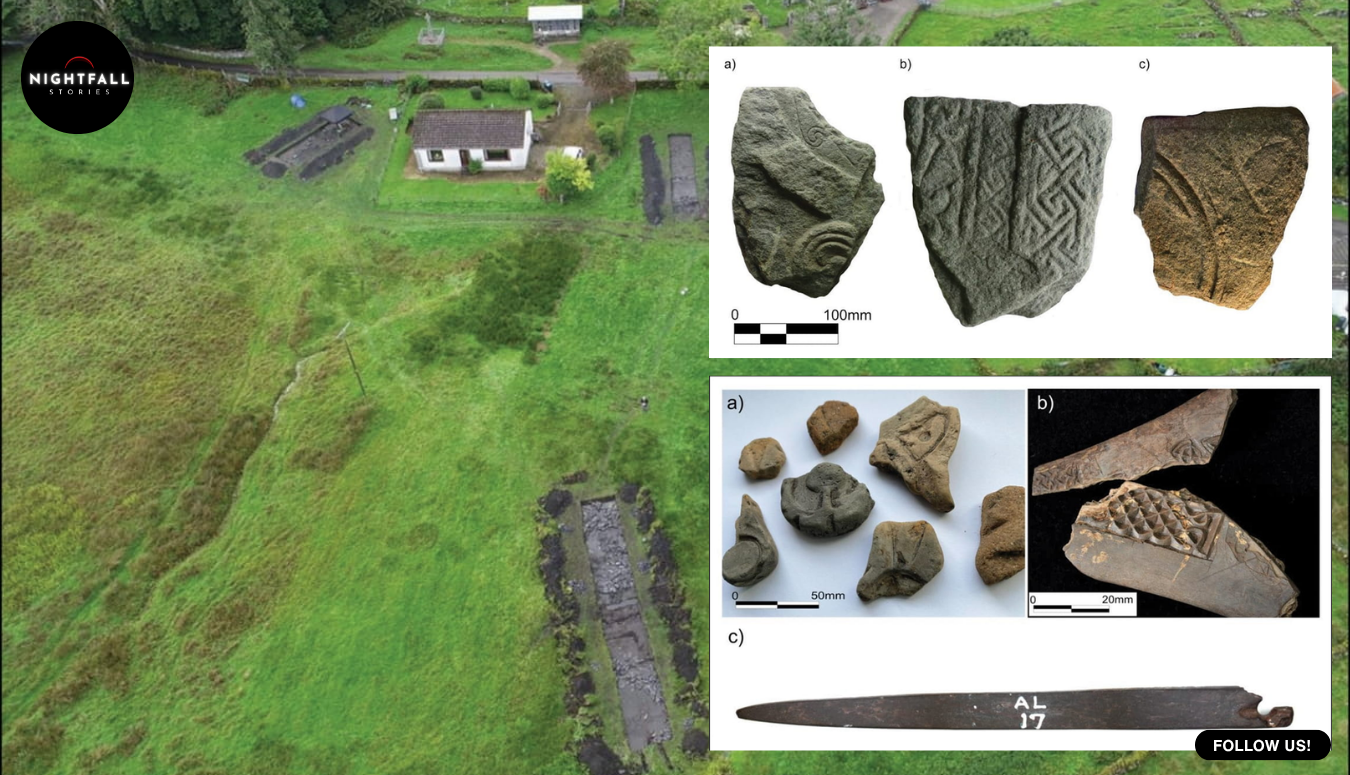
Then the trenches. The first of the important ones, opened in 2018, cut into the ground beside the church and found an early medieval cemetery: graves laid out east to west, inside a limestone cemetery wall, with a fragment of carved cross slab among them. Radiocarbon dates from the burials run, in calibrated terms, from about the middle of the seventh century to around the middle of the eleventh. That alone changes the island’s story. It puts organised Christian burial on this spot four hundred years before the medieval cathedral that later stood there.
Two further trenches, opened in 2021, extended the cemetery around a feature the island calls the Sanctuary Stone and produced more burials, stone lined and capped graves, and two more decorated cross slab fragments that had never been recorded before. The paper handles the human remains with the restraint the subject deserves and there is no need to go further into them here.
The trench that reframed everything was opened in 2019 and it was not a cemetery at all. It contained an oval building roughly eight metres across, with a drystone wall, limestone paving inside it, and a charcoal layer suggesting the place had burned at some point. The building dates to somewhere in the eighth to tenth centuries. And immediately next to it was a working area.
More than a thousand fragments of non ferrous metalworking debris came out of that area. Crucibles, by the dozen, of a handled type that the authors match to the sites that define the period in Scotland: Dunadd, the Brough of Birsay, Portmahomack. Analysis at the National Museums Scotland laboratories found that the crucibles had been used for melting copper alloys, silver and gold. There were broken clay moulds for penannular brooches, the big ring brooches with open ends that are the signature high status jewellery of early medieval Britain and Ireland. There were eight worked bone and antler objects, two of them motif pieces, small slabs carved with fine chip carved interlace, which are the practice sheets and pattern references of a working craftsman. The craftworking dates run from the seventh to the ninth centuries.
This is the point at which the story stops being about a church and becomes about an industry. Nobody melts gold on a small Hebridean island to make something for themselves. Penannular brooch moulds mean someone on Lismore was producing the elite metalwork of the period rather than buying it in, and that means patrons, raw material arriving from a long way off, a trained specialist living there, and somebody important enough to commission the output.
There is one more object in the story and the dossier version of it needs correcting, because it is the detail most likely to be told wrong. A touchstone, a small dark stone used for assaying gold by streaking metal across it and reading the mark, is part of this picture. It was not dug up by this project. It is an early medieval touchstone found on Lismore in the nineteenth century, long held in the National Museums Scotland collections, which the project’s work has now re identified and put into its proper context. That is still significant, and arguably more interesting than a fresh find: an object that sat in a museum drawer for well over a century now makes sense because somebody finally excavated the workshop it belongs with. But the trenches did not produce it, and saying they did would be wrong.
So what does all of this add up to, and here is where the question mark earns its place.
The authors’ argument is that the combination of extensive early medieval cemetery deposits, high status craftworking and early structural remains indicates that Lios Mòr was a major ecclesiastical centre. They read the material culture and the burial practice from the seventh to tenth centuries as reflecting a thriving monastic community with regional and possibly supra regional influence, with a level of wealth and artistic sophistication that parallels other major Insular monastic sites, and they name Iona and Portmahomack as the comparisons.
That comparison belongs to them and should be attributed to them, because it is a large claim. Iona is the most famous monastery in early medieval Scotland. Portmahomack is the Pictish monastic site whose excavation rewrote what archaeologists thought that kind of place looked like. Putting a previously evidence free site on Lismore alongside those two is an argument, not a measurement.
And the logic running through it is inference from assemblage. The excavation did not find a document saying Lios Mòr was important. It found moulds, crucibles, motif pieces and graves, and the authors reason from what that material implies about status, patronage and connection. That is entirely legitimate archaeological argument and it is how almost everything we know about this period was arrived at. It is also, inescapably, an interpretation that other specialists can now test, extend or push back on. Which is precisely why the authors put a question mark after “A major monastic centre” rather than a full stop, and why anybody reporting this should keep it there.
They are also clear that the work is unfinished. The stated next steps are to locate the monastery’s actual boundaries, which the geophysics has not pinned down, to look at further areas of the cemetery, and to study the wider church estate, in order to understand how these early Christian centres across Britain and Ireland were connected to each other.
What has changed, though, is not small, and it is worth being precise about what it is. Before this project, the sixth century monastery on Lismore was something the island knew and could not show. A tradition, a set of names, some carved stone. After it, there is an excavated early medieval cemetery with radiocarbon dates, a dated building, a metalworking area with over a thousand fragments of debris, moulds for high status jewellery, evidence of gold and silver being melted on the island, and a published interpretation in a major journal arguing that this was one of the significant religious and craft centres of its world.
The island was right about itself. That is the ending, and it holds without being inflated. A retired scientist who had made the place his home spent years getting the money and the people together to find out whether the thing everyone said was true. Professional archaeologists came and cut the trenches. The ground answered. And the answer was large enough that the people who wrote it up chose, carefully and deliberately, to phrase the biggest part of it as a question, because that is what the evidence actually supports and because an island that waited fourteen hundred years for proof deserves not to be told more than is known.